Tuesday, January 28, 2014
Monday, January 27, 2014
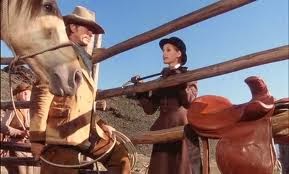
Hombre (1967)
Based on Elmore Leonard’s 1961 novel of the same name (reviewed here recently), this film offers an interesting example of
adaptation. The basic plot is unchanged, but the screenwriters have introduced
and substituted different characters. The result is a rather different story.
Plot. Leonard’s
novel revisits the central situation in John Ford’s Stagecoach (1939).
An assortment of stagecoach passengers gets into trouble while crossing a
stretch of perilous desert terrain. Instead of a wanted man (John Wayne) who
joins them, the pivotal character is a white man raised by Indians (Paul
Newman). Instead of undergoing attacks by hostiles, the coach is held up by a gang
of thieves.
![]() |
| Leonard's novel |
Characters. Newman’s
character, John Russell, besides being twice the age of the 21-year-old created
by Leonard, seems very close to the man we find in the novel. He is
single-mindedly focused on survival—his own. What the others do, whether they
stick with him or not, is their own business. Expressing nothing but cold, calm
determination, he seems never roused to an emotion.
Saturday, January 25, 2014
Glossay of frontier fiction: I, J
(ignus fatuus – jerk-line)
Below is a list of mostly forgotten terms, people, and the occasional song, drawn from a reading of frontier fiction, 1880-1915. Each week
a new list, progressing through the alphabet, “from A to Izzard.”
ignus fatuus =
will-o’-the-wisp; a phosphorescent light
that appears in marsh lands. “At the time he was following that ignis fatuus,
Holy Grail, pillar of cloud and pillar of fire, which was to him his Duty.” A.
B. Ward, The Sage Brush Parson.
I’m a Chinaman =
derogatory reference to Chinese,
expressing surprise and disbelief. “‘I’m a Chinaman,’ says Billy, ‘if it ain’t
a kid!” Alfred Henry Lewis, Wolfville.
I’m a Mexican =
derogatory reference to Mexicans,
expressing surprise and disbelief. “I’m a Mexican if this yere Sal don’t come
wanderin’ in, a-cryin’ an’ a-mournin’ powerful.” Alfred Henry Lewis, Wolfville.
![]() |
| Man with imperial |
imperial = small
part of a beard growing below the lower lip. “The snapping black eyes, with the
straight brows almost meeting over the nose, suggested Goethe’s Mephistopheles,
and Flemister shaved to fit the part, with curling mustaches and a
dagger-pointed imperial.” Francis Lynde, The Taming of Red Butte Western.
in bond = a term applied to the status of merchandise admitted
provisionally to a country without payment of duty, to be kept in a bonded
warehouse or for shipment to another point where duties will be imposed. “She
gave final and minute orders to tailors and dressmakers, instructed them to
send the trousseaux in bond directly to Great Falls, Montana.” Gertrude
Atherton, Perch of the Devil.
in high feather =
in good spirits. “The tireless little
animal followed him along the fence rails for perhaps a hundred yards, seeing
him off the premises and advising him not to return, then went back in high
feather to his task.” Charles G. D. Roberts, The Backwoodsmen.
“In the Baggage Coach Ahead” = a sentimental song
popular at the turn of the last century, written in 1896 by African American
composer Gussie L. Davis (1863-1899). “For nine months I have heard nothing but
‘The Baggage Coach Ahead’ and ‘She is My Baby’s Mother.’” Willa Cather, The
Troll Garden.
in the sulks =
unhappy. “But he was divided between his
impulse to send the trio on a double-quick about their business and the doubt
as to what effect it would have on the tribe if they were sent back to it in
the sulks.” Marah Ellis Ryan, Told in the Hills.
Thursday, January 23, 2014
John Reese, They Don’t Shoot Cowards (1973)
In a John Reese western, nothing is likely to be what it seems. Despite a wide, well-traveled trail across the genre’s terrain, you can
expect Reese to take you someplace you haven’t been before. Try guessing what
this novel is about from the title, the cover art, and the cover copy (“Cahoon had a killer’s reputation and a yellow streak down his back”), and you’ll be maybe 10%
right.
Characters. The
premise of the novel is actually not so unusual. A man has acquired a reputation as a
gunman, but has nothing of the required constitution or skill. Honker Cahoon’s
is the story of an ordinary drifter cowhand trying to keep from attracting
trouble. The problem is his frighteningly scarred face and a peculiar
disorder—like a form of Tourrettes. When terrified, he
explodes in angry outbursts so threatening that even the meanest men are
intimidated.
And Reese gives his condition a further twist. Cahoon
loses his hearing during these episodes and has no idea what he is saying. He
lives in fear that someday he will meet a real gunman who decides to draw on
him.
![]() |
| 1974 edition |
He is befriended early in the novel by a 14-year-old
runaway, claiming to be 18, whose name, Johnny Smith, sounds so fictional
Cahoon calls him Beansie. Against his better judgment, Cahoon cannot resist
entertaining the impressionable boy with tall tales of imagined confrontations
with notorious gunmen. The two get a job in a bustling mining camp in the
California Sierras, supplying slaughtered beef for Bill Shenker, the owner of a
highly profitable tent saloon.
Trouble brews as the camp’s merchants hire a gunman, Dewey
Score, to provide protection from a criminal element, and they grant him the
authority to collect his own pay. Soon he is raising the price of his
services and demanding a share of Shenker’s substantial profits. Thanks to young Beansie, who never misses a chance to brag about Cahoon’s assumed prowess
with a gun, the two men are destined to confront each other.
Labels:
book review,
california,
john reese,
western fiction,
western writers
Tuesday, January 21, 2014
Chino (1973)
Despite the raggedy and apparently pirated copy of this film currently showing on amazon, this movie shines through as a quiet gem. An
Italian-French-Spanish production, shot in Spain, it is not your usual
spaghetti western. Based on Lee Hoffman’s The Valdez Horses (reviewed here recently), it is faithful to the heartfelt spirit of that novel.
Characters. Cast
as the title character, Chino Valdez, Charles Bronson delivers a persuasive and
nuanced performance as a reclusive breeder and trainer of horses. His rough
appearance, which can turn a scowl or a grimace into a chilling expression,
suits the character of a gruff man who prefers the solitude of a lonely cabin
on the open range.
When the youngster Jamie Wagner (played by 16-year-old
Vincent Van Patten) shows up looking for work, Bronson at first seems to resent
the intrusion. Eventually, a bond builds between them, and the boy becomes a
trusted companion.
![]() |
| Charles Bronson, Jill Ireland |
Romance. The
half-sister of a business partner (Bronson’s real-life wife, Jill Ireland) is
next to intrude. As she asks him to choose and train a horse for her, he
ridicules her for intending to ride sidesaddle. Unaccustomed to western riding,
she strikes him as a poor horsewoman, and he has a good laugh.
The tables turn when she finds him taking a bath and,
refusing to look away, observes suggestively that he has not only the personality of a
horse but the appearance of one. Before long he is courting her, and as they happen
to witness Bronson’s stallion mounting a mare, they yield to nature’s urging as
well. Very Euro.
Monday, January 20, 2014
Julia Robb, Del Norte
This dark western novella from Texas writer Julia Robb begins appropriately with the gravestone of a murdered man. The stone leans against an
interior wall of a saloon, the Del Norte of the story’s title, owned and operated by a Mexican woman, Magdalena Chapas. We’re in a dusty
garrison town in West Texas. The year is 1870.
Characters. Robb
gives us an ensemble of characters, several men and women who have fetched up
on this isolated outpost. The battlefield carnage of the Civil War is recent
history for two of the men, who share a memory of deprivation and disgrace in a
POW camp in far-off Elmira, New York. Thomas, a decorated Union officer, bears
wounds to both body and spirit. Wade is a doctor, a consumptive, and unable to practice his profession because of injuries to his hands.
Labels:
book review,
texas,
western fiction,
western writers,
women writers
Sunday, January 19, 2014
One sentence journal, Jan 12 – 18
![]() |
| The Birds |
Time marches on . . .
1/12, Sunday. Thanks to Lynda, who had the grit to spend an eternity on the phone to a technical support center somewhere on the globe, the new Roku is now set up, and switching it on is like arriving at the ticket counter of a multiplex and discovering that a thousand movies are playing.
1/13, Monday. So it
turns out again that I’m a poor diagnoser of my own ailments, since a doctor at
Urgent Care says what I have is not carpal tunnel, but something more like
tennis elbow.
1/14, Tuesday. Pigeons
flock to a house on the corner where a retired gentleman lives with a Basset
Hound and throws out snacks for the birds, who hang out all day like they’re
waiting to audition for a remake of a Hitchcock movie.
1/15, Wednesday. After
waiting a week and a half and then spending another hour in the waiting room to
see a specialist who takes all of two minutes to send me to another specialist,
who can’t see me for another 2 weeks or more, I’m thinking, I’m going to get a
lot of reading done before this is over.
1/16, Thursday. Good
grief, I wake up in the middle of the night realizing that I have been dreaming
of composing one-sentence journal entries, and I’m wondering, is this such a
good idea?
1/17, Friday. A bump
under my chair in the middle of an episode of “Justified” on the TV, the dog
giving me a startled look, and I check usgs.gov later to discover a 3.0 seismic
disturbance over in Yucca Valley.
1/18, Saturday. Koan
for the week: Don’t search for the truth, simply stop having opinions,
and I’m thinking if that were generally put into practice, 95% of what’s on the
Internet would disappear.
Image credit: Ron
Scheer
Coming up: Julia
Robb, Del Norte
Subscribe to:
Posts (Atom)