Showing posts sorted by relevance for query andre de toth. Sort by date Show all posts

Tuesday, June 14, 2011

Springfield Rifle (1952)

Best not to read a plot summary of this film before watching it, and allow yourself to be surprised by its unexpected turns. This is an unusual western with some but not many of the typical conventions. The setting is Colorado during the Civil War, and Gary Cooper plays a high-ranking Union cavalry officer in charge of delivering horses to the Union forces.

Southern sympathizers, however, lie in wait no matter what route the cavalry takes, and after a firefight they make off with every herd to sell to the Confederacy. Someone is leaking key information to the thieves, and the film is about finding out who and how.

After surrendering a herd of horses to the thieves without firing a shot, Cooper is court-martialed and given a dishonorable discharge for cowardice and dereliction of duty. We then follow him as he becomes involved with the gang stealing the horses.

The plot turns on a bit of wartime history, as it concerns the introduction of the breech-loaded Springfield rifle to the battlefield. (Hence, the title.) These replaced the musket-loaded weapons used during the early years of the war and substantially increased the firepower of the troops equipped with them.

Hungarian-émigré Andre de Toth directed this engaging and unconventional western. Born into a military family who disapproved of his career choices, he seems likely to have had some personal interest in this story. A subplot of the film concerns the impact of Cooper’s discharge on his wife and son.

Recruiting poster, c1863
Filmed in color, Springfield Rifle makes ample use of the outdoor settings, many shot in snow-covered mountain terrain. Always visually interesting, the frame is filled with things to see, whether close-ups of faces or the herds of running horses in long shot, gracefully moving across an undulating landscape. Instead of a straightforward punch-up, a fistfight in the snow involves spectacular rolling falls down the drifted slopes.

Cooper is at his best as a complex character whose motivations are not easy to assess. There’s quite a large cast of characters, including brief appearances by Martin Milner and Fess Parker, who would become more familiar in TV roles. Lon Chaney, Jr., gets plenty of screen time as a mug-faced leader of the gang of horse thieves.

Coming as it does during the years of the Hollywood blacklists and the Korean War, it’s a curious depiction of the U.S. military. Compared to John Ford’s worshipful portrayals of the cavalry, this film is darker and less reassuring. Springfield Rifle is currently available at amazon and streamable at netflix.

Image credit: Wikimedia Commons

Coming up: Harper's Book of Facts (1895)

Tuesday, May 22, 2012

Man in the Saddle (1951)

Randolph Scott is a rancher in this western, with a nasty neighbor (Alexander Knox) who doesn’t like to share. Knox is the biggest rancher in the valley, and he wants the whole valley. That includes Joan Leslie, who tires of waiting for Scott to pop the question and marries Knox instead in the first reel.

From that point on, Kenneth Gamet’s script either runs out of ideas or goes after too many of them. There’s a second woman (Ellen Drew), with a small ranch nearby and a lot of gumption. She is sweet on Scott, but he’s still hankering for the married Leslie. It’s hard to understand why. She’s heartless as they come having married for money, and skip the connubial bliss, as the groom learns on his wedding night.

Plot. Knox and his foreman (Richard Rober) try to force Scott off his ranch, and they get pretty rough. They stampede his cattle and kill first one and then another of two cowboys. When Scott retaliates by shooting up a line camp full of Knox’s men, he and his house get shot up in return.

Ellen Drew, 1939
Leslie, meanwhile, has second thoughts about marriage to Knox and wants Scott to run off with her. But when he takes a round in one leg, he is rescued by Drew, who takes him to a mountain cabin to recuperate. Things are pretty friendly between them, and there’s the suggestion that something’s going on when the lights go out at night.

Enter loose cannon John Russell, who’s been making moves on Drew from the beginning and won’t get the hint that she’s not interested. He follows Scott and Drew to the mountain cabin with the professed intent to finish them both off. There’s a spectacular fistfight that first brings down the roof of the cabin and ends up with both men (then Drew) hurtling down a muddy mountain slope. Russell not only gets a drubbing from Scott but, when he returns to the ranch, is shot dead by Knox, his boss.

Cutting to the chase here, the final settling of scores happens in the hotel and the streets of town during a fierce, tumbleweed-blowing gale. Knox is shot when he steps into the line of fire between his foreman and Scott. The foreman attempts to outdraw Scott but fails. Scott and Drew then ride off together in a buckboard.

Tennessee Ernie Ford, 1957
Added value. The film was shot in Technicolor in the always handsome Alabama Hills of central California, with the snow-clad Sierras as a backdrop. The mountain cabin is located on wooded slopes above the snowline, where spring thaws swell the streams.

Tennessee Ernie Ford with his rich baritone voice appears by a roundup campfire to sing the theme song, “Man in the Saddle.” It was his first film appearance, and with a cowboy hat and a shaved upper lip, he passes easily as a ranch hand.

The presence of wonderful character actor Clem Bevans is a pleasure in the early scenes before he disappears from the plot. Bevans, thin as a rail and sporting a thick mustache, had a career of playing codgers. John Russell, of course, with his chiseled features, went on to star as TV's Lawman (1958-1962). The film also marks an early appearance of Cameron Mitchell, who would later turn in performances on 97 episodes of TV’s High Chaparral (1967-71).

Clem Bevans (right), The Kansan (1943)
Mexican actor Alfonso Bedoya plays Scott’s cook, and while taking a ribbing for his awful coffee, his character is more than an ethnic stereotype. He gets to play in some action scenes, and a running gag about his unsuccessful attempts to acquire a proper hat plays right to the last scene, where he snaps up the dead villain’s Stetson. Not sure how funny that is, but for what it’s worth, Bedoya gets the last laugh.

As for the action, there’s that spectacular fistfight between Scott and Russell. During the cattle stampede, Scott races to jump onto a runaway chuck wagon, which then ignites and bursts into flames behind him. A shootout in a saloon takes place in the dark, and we have to wait until the lights come back on to see who was a casualty.

Wrapping up. The film was based on a 1938 novel by Ernest Haycox, and anyone who has read it can say whether one bears any resemblance to the other. What’s missing for the audience is a clear understanding of Scott’s character beyond his desire to keep his ranch. His stiff upper lip says a lot but not enough.

His adversaries are cardboard characters, with the murderously irrational desire to possess what they can’t have. Leslie’s character is downright puzzling. What does she really want and does she even know? At the end, she seems intent on carrying out the wishes of her dying husband, but where did that come from?

There’s a slap-happy humor in some scenes and outright farce in others that might fit in a B-western but seem somewhat out of place in this film, where the drama seems meant to be taken seriously. The costuming and domestic interiors take advantage of the Technicolor and are so tastefully designed, you know you’re not far from Hollywood and Vine.

In a directing career that lasted from 1939-1987, Andre de Toth brought a number of memorable westerns to the screen, including Springfield Rifle (1952) and Day of the Outlaw (1959) both reviewed here earlier. Man in the Saddle is currently available at netflix and amazon.

For more of Tuesday’s Overlooked Movies, head on over to Todd Mason’s Sweet Freedom.

Photo credits: Wikimedia Commons

Coming up: Ridgwell Cullum, The Story of the Foss River Ranch (1903)

Tuesday, March 13, 2012

Day of the Outlaw (1959)

This gem of western noir stars Robert Ryan in another of his hard-bitten and slightly psychotic roles. Shot in black and white, the story is set in a small mountain town knee-deep in Wyoming winter snow. The location photography gives the film a gritty realism. So does the adult material. This is not a western for kids.

Plot. The first 20 minutes introduce us to the town’s residents, and tensions are running high. Cattleman Ryan is enraged by the encroachment of ranchers fencing off the open range. He says he intimidated and killed Indians and outlaws 20 years ago to defend himself. He’s ready to do it again.

His chief adversary is a determined settler, Crane, whose wife (Tina Louise) has some history with Ryan. To avoid a confrontation, she tries to fan a little spark of sympathy in Ryan and maybe a bit of the old romance, but he’ll have none of it. “You don’t have much mercy,” she says. “You won’t find much mercy anywhere in Wyoming,” he replies.

Just as a shootout is about to settle matters, a gang of surly outlaws arrives led by former Army captain Burl Ives. They have come into possession of a fortune in stolen gold, and the cavalry is in hot pursuit. Ives has taken a slug in his chest and needs a doctor. Under his orders the town’s residents are taken hostage, the local veterinarian removes the slug, and the weather worsens.

Tensions are now over the top. Only Ives is able to restrain the most libidinous and murderous of the men in his gang, and we learn that his time is running out. From what the vet tells Ryan, Ives is apparently dying from internal bleeding, while morphine keeps him miraculously ambulatory.
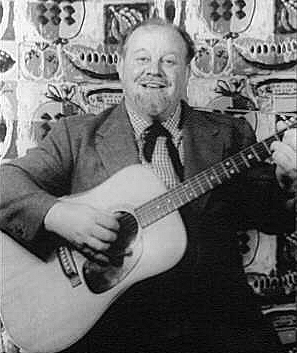
Burl Ives in his other career as a folksinger
After the gang persuades Ives that a dance with the handful of women in the camp would make the men less irritable, Ryan makes a move to get the whole slimy bunch out of town. And slimy they are, except for the clean-cut David Nelson (son of Ozzie and Harriet), who has somehow got mixed up with this bunch. Tender shoots of young love even begin to spring up between him and the storekeeper’s daughter.

Ryan reminds Ives that the cavalry will be there as soon as the weather improves. To avoid a “Mormon massacre,” he says he can lead the whole gang over a mountain pass that will take them to Cheyenne. And off they go, the horses knee deep and then belly deep in snow.

When one horse is injured and has to be shot, Nelson is ordered to give up his mount to the rider who is now afoot and to walk back to town. Then Ives dies, as predicted. And thus begins a slow process of attrition in which the remaining gang members begin to fight over the gold and do each other in.

Themes. This grim western set in the snow and wintry weather recalls the crime film On Dangerous Ground (1952), shot in the snowy mountains of Colorado and also starring Robert Ryan. The film’s leering villains are not just outlaws but certified sociopaths. As they manhandle the women in the dance scenes, you can feel your skin crawl.

Meanwhile, the film backs away from what a modern western would happily relish, the opportunity for blood and gore. The scene in which the vet removes the slug from Ives’ chest even cries out for it. Ives and the doctor both break into a sweat, but that’s about the extent of the trauma. It’s a surprise to see Ives walking around afterward hardly worse for wear.

David Nelson (left) with the rest of the family, 1960
A fistfight between Ryan and three of the gang members cuts back and forth between close shots and shots from the distance, where we see the fighters and a scattered collection of observers. The effect is oddly abstract. Instead of the usual scene in which an excited crowd gathers around to cheer, the onlookers watch without moving and without a word. It’s a strange effect.

The weather deserves a mention. Often the clouds descend and the snow flies, which suits the desperate mood of the film. A brief moment of farce intrudes as a man falls asleep with his boots against a stove, and they begin to smolder. Instead of garnering a laugh, however, the point seems to be that no one else in the room either notices or cares.

As matters worsen, Ryan has some sort of change of heart and gambles with his life as he lures Ives and the gang out of town with the false promise that he knows a way through the mountains. It is an act of mercy, which he’s said there’s little of in Wyoming. The apparently selfless act seems meant in a way to redeem him, but Ryan’s not that easily redeemable.

And it does not lead to a conventional ending, where he is reconciled with his former sweetheart Tina Louise. Instead, what we get in the final scene is Nelson asking him for a job. And after a moment’s thought Ryan says, “OK, you won’t need this,” and takes away the young man’s gun. There’s a similar resolution at the end of Shane (1952), when Chris (Ben Johnson) a former adversary, asks Starrett (Van Heflin) for a job as a hand.

Mount Bachelor, Oregon
Production notes. The film was actually shot in the mountains of central of Oregon, near what was then known as Bachelor Butte. At the time, the area was in the beginning stages of what was to become a major ski resort and renamed Mount Bachelor.

The film was directed by Hungarian-born director Andre de Toth, who’s also remembered for the Gary Cooper western, Springfield Rifle (1952). The film was adapted from a novel by Lee E. Wells by screenwriter Philip Yordan, whose credits include The Man From Laramie (1955) and The Bravados (1958).

Noir fans need to give this one a viewing. It’s up there among the best. Day of the Outlaw is currently available at netflix and amazon. Tuesday’s Overlooked Films is the much-appreciated effort of Todd Mason over at Sweet Freedom.

Picture credits: Wikimedia Commons

Coming up: Old West glossary, no. 27