Showing posts with label rex beach. Show all posts

Thursday, July 17, 2014

Rex Beach, The Spoilers (1906)

As a writer of popular fiction, Rex Beach hit the ground running with this, his first published novel, set in the gold rush days of Nome, Alaska. Its story was based on actual events and portrays attempts by crooked lawyers, politicians, and a judge to jump claims of legitimate miners already extracting fortunes from the gold fields.

Plot. The central character is Roy Glenister, a young and ambitious man, who has been prospecting for three years with his partner, an older man named Dextry. Their mine, the Midas, is one of the richest in the area. Returning by steamer from Seattle, where they have spent the winter, they learn that their claim is being challenged in court, and until the suit is settled, the Midas is being put in receivership, to be operated by a lawyer, Alec McNamara.

His intention is to make off with all the gold while the dispute remains stalled in legal proceedings. The judge, Stillman, provides the authority to carry out the plan, denying all requests to expedite judgment and refusing any appeals. A U.S. marshal arrives to enforce the law, such as it is, and the judge has troops from a nearby army post for support should they be needed.

Once the miners realize that they are the victims of a plot to steal their claims, they organize as vigilantes to take them back by force, threatening Stillman and McNamara with bodily harm. Glenister, who prefers to avoid violence is caught in the middle. He has fallen in love with Stillman’s niece, Helen Chester, and wants to stay in her good graces.
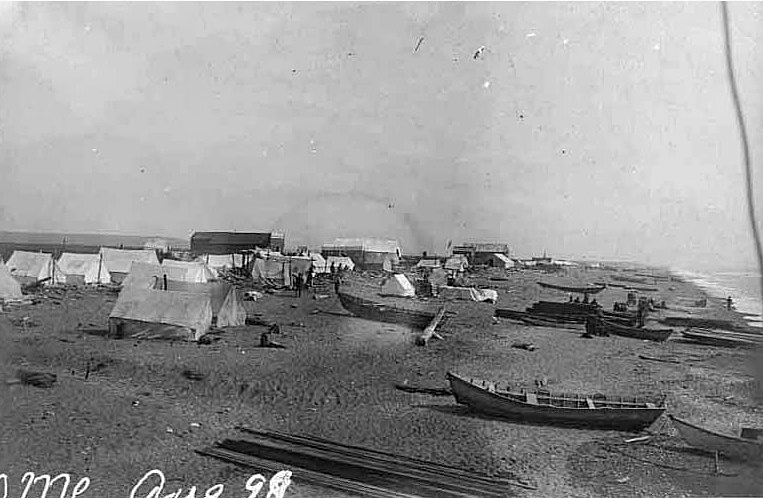
Nome beach, 1898
Romance. A standard theme in fiction of the period, the life-transforming attraction of a man to a young, pretty woman, drives much of the novel’s plot. Out here beyond the fringe of civilization, Helen Chester stands for law and order. Glenister tells her it’s “God’s free country” and the only law that’s needed is courage and a Colt’s. But he offends her when he tells her he subscribes to the Darwinian principle of survival of the fittest. “What I want, I take,” he says and steals a kiss.

Realizing that this kind of behavior is not going to win her heart, he complies with court orders without a fight, believing it will show him in a better light. But she is not persuaded. There is a “reckless energy” about him that lacks self-restraint. She is more taken by the likes of McNamara, whom she trusts as a representative of the law and the colleague of her uncle.

Friday, August 30, 2013

Rex Beach, Pardners (1906)


I reviewed this book three years ago while looking for cowboy stories and neglected its several stories set in gold rush Alaska. As I put together a chapter on Rex Beach for a book on frontier fiction, I’m correcting that oversight. Here is some of what I have added.

The subject of two prospectors working together as partners is at the heart of Rex Beach’s Alaska stories in this collection. One pair, Big George Brace and Charlie Captain are featured in three of them. Involved in daring adventures, usually saving the lives of others, they eventually must confront a life-threatening risk that may permanently separate them.

“Where Northern Lights Come Down o’ Nights.” In this story, Big George and Captain are up against a rogue priest, Father Orloff, a Russian who has a wide influence among the indigenous Eskimo tribes. Receiving a cold and threatening reception as the two partners arrive in one of their settlements, they claim sanctuary in the church. There they wait through a storm and make plans to escape before Father Orloff shows up with the certain intention of killing one or both of them.

“The Scourge.” This, the most disturbing of the Alaska stories, has death by scurvy as its subject. George and Captain come upon an encampment of 125 newly arrived prospectors who have dug in for the winter. Instead of putting up log cabins for shelter, they are living in dugouts, where Captain tells them that without air, light, exercise, and the right diet, they are certain to fall ill.

"The Scourge"
Unwilling to take anyone’s advice, they stay put, coming to dislike the industrious duo, who venture out daily to work in the snow and cold. Without preventatives like potatoes, limejuice, and citric acid, they begin to develop scurvy and start dying in numbers.

Short on rations themselves, George and Captain are also at risk and nervously watch for symptoms of the disease. When George falls ill, Captain and another man, Klusky, start off on a days-long journey for fresh grub.

“Pardners.” The title story, however, concerns a big, rough bruiser, Bill Joyce, who tells of taking a young tenderfoot under his wing. They have mixed fortunes as prospectors, but the real drama involves the young man’s wife back home.

When she doesn’t answer his letters, he gets so heartsick the two men return to the States. In Seattle, they find her singing in a variety show. She considers the marriage over because of some unflattering photos she has seen of her husband in the newspaper. In doing a photo feature on life up north, a sensation-seeking journalist has made him out to be a carouser and womanizer.

"The Thaw at Slisco's"
“The Thaw at Slisco’s.” Billy Joyce narrates this story as well. Several prospectors gather during a fierce winter storm in Slisco’s roadhouse, where they are joined by Annie Black, a hard and bitter woman considered with some contempt as a claim jumper.

When a nearly frozen Eskimo stumbles in out of the storm, they learn that two Swedes are still out in the snow about to perish. Annie marshals a rescue, shaming the reluctant men into leaving the comfort and safety of the roadhouse. The two Swedes are brought back alive. When a pretty young woman arrives in search of her mother, the mother turns out to be Annie.

Character. There’s a recurring theme in many of the stories that defines character as the willingness to make sacrifices for the sake of others in distress. That sacrifice usually involves a risk to one’s own life. It matters not whether a person in need is an adversary. You put past differences behind you and go to his aid.

Monday, September 20, 2010

Rex Beach, part 2

Last week I started talking about the short story collection Pardners (1906) by Rex Beach. It’s a mix of stories, some set in the West and some in Alaska, where Beach prospected for gold. I’m sticking with the western stories, since that’s been the focus here so far.

Rex Beach, wearing a Stetson
I actually don’t know whether Beach knew from experience the West he’s writing about. He spent his early and later years in Florida. We can wonder how much he was influenced by reading stories set in the West. Maybe I’ll find out more as I go along.

“The Shyness of Shorty.” This has to be a one-of-kind story. I’ll come back and change this if I ever find another one like it. The central character is a cowboy dwarf. No comic figure by a long shot, he has compensated for his height by being one tough son-of-a-gun.

Show any sign of amusement in his presence, and you’re looking down the barrel of one or both six-guns. He’s also physically strong and a fierce fighter, with the deepest voice of any man in the room. He is so rounded as a character and so not stereotypical, you have to believe Beach knew someone like him.

The story takes place at a roadside inn, where the innkeeper is friendly with a local gang of brigands. A new sheriff has sworn to bring the gang to justice, and as it happens all of the aforementioned characters converge the same night at the inn – including the sheriff’s new bride.

The bride, nonplussed by Shorty’s size, treats him with the kind regard she seems to have for every living thing. He is utterly disarmed by her and nearly unable to speak above a wheeze. Here at last is his Achilles heel.

Thursday, September 16, 2010

Rex Beach

Rex Beach (1877–1949) has been an enjoyable discovery. I’ve started with a collection of his short stories, Pardners, published in 1906. Four of them had already appeared in McClure’s and one in Everybody’s Magazine.

1906 edition
Beach was college-educated and an adventurer. He was preparing for a law career in Chicago when he raced off to the Klondike for five years. He never struck it rich as a prospector, but he turned the experience into a best-selling novel The Spoilers, which became a play and then a film. In his time, he was a big deal.

“Pardners.” The title story in this collection takes place in the Alaska gold fields and Seattle. The narrator is a big, rough bruiser, Bill Joyce, who tells of taking a young tenderfoot under his wing. They have mixed fortunes as prospectors, but the real drama involves the young man’s wife back home.

When she won’t answer his letters, he gets so heartsick the two men return to the States. In Seattle, they find her singing in a variety show. She considers the marriage over because of some unflattering photos she’s seen of her husband in the newspaper. In doing a photo feature on life up north, some yellow journalist has made him out to be a carouser and womanizer. Eventually, Bill does his part to reunite man and wife in wedded bliss.

Illustration for the story "Pardners"
The plot may or may not hold your interest, but the character of Bill Joyce as he tells the story is priceless. Like the Old Cattleman of Alfred Henry Lewis’ Wolfville stories, he is an unfailingly entertaining and colorful yarn spinner.

“Pardners” was made into an Edwin S. Porter film in 1910. It was the first of many of Rex Beach’s stories and novels to be adapted to the screen. The Spoilers appeared first in 1914 and was remade four more times, once with Gary Cooper (1930) and once with John Wayne (1942). Altogether, Beach has 52 writing credits at imdb.com.

“The Mule Driver and the Garrulous Mute.” This is one of four stories in the collection that qualify as westerns. The storyteller again is Bill Joyce. This time he recalls a time prospecting with a different partner, called Kink, in Arizona. The plot is quickly set in motion when Kink happens to shoot and kill an Indian.

Long past the time when this became a criminal offense, Kink evades arrest by making a run for the Mexican border. When soldiers from a nearby fort show up looking for him, Bill covers for his partner by pretending to be mute and mentally deficient.