Showing posts with label western fiction. Show all posts

Thursday, February 12, 2015

Guy Vanderhaeghe, A Good Man

I wanted to like this novel more than I did. For its length (464 pages), it promises somewhat more than it delivers. I had the same reaction to the author’s The Last Crossing (reviewed here a while ago). There are a lot of ideas and food for thought in this novel about character, friendship, responsibility, Native Americans, the frontier, and U.S.-Canadian relations. But in the end it’s hard to say what it all adds up to. You can puzzle if you like over the title. Who among the novel’s male characters is the “good man”? Is there one at all?

Set in the late 1870s, partly in the Cypress Hills of Saskatchewan where Fort Walsh was headquarters for the North-West Mounted Police; but mostly in the frontier settlement of Fort Benton, Montana, on the upper Missouri River, the action takes place in the aftermath of Custer’s defeat at the Little Bighorn and settlers of the sparsely populated prairie live in terror of the Sioux and other tribes who seem to be organizing under the leadership of Sitting Bull to rid the West of whites altogether.

Thursday, January 29, 2015

Elmer Kelton, Texas Showdown


This book is actually two short novels by Elmer Kelton, first published in the 1960s and reissued under one title by Forge in 2007. Pecos Crossing, originally titled Horsehead Crossing (1963), appeared under Kelton’s own name, while Shotgun, originally titled Shotgun Settlement (1969), was published under a house pseudonym, Alex Hawk.

First off, Elmer Kelton is one of my top-10 favorite western writers. He wrote with a strong sense of history and an informed awareness of the West Texas terrain, its flora and fauna, and its weather. I find it easy to believe in his characters. They are not just convenient types but possess an emotional depth that makes them three-dimensional.

Wednesday, January 14, 2015

Robert J. Randisi, ed., Livin’ on Jacks and Queens

This is an entertaining anthology of 14 stories about gamblers and gambling in the Old West. Editor Randisi has assembled a notable gathering of western writers, providing an array of storytelling styles and imaginative treatments of the subject. The names of several contributors will be quickly recognized: Johnny Boggs, John D. Nesbitt, Matthew P. Mayo, Nik Morton, and Chuck Tyrell.

To these he has added a story of his own, plus the yarns of two women writers who may be new to some readers: Christine Matthews and Lori Van Pelt.

My favorites of the bunch include Ms. Matthews’ “Odds on a Lawman,” which tells of a succession of sheriffs who each assumes a tenure of service to a frontier town, before dying or disappearing for various reasons, on which the townsmen place bets until the turn of events claims one of them the winner. It’s an amusing and well-written tale that brings its Dickensian cast of characters to entertaining life, while we wait to see the fate that befalls each of the town’s series of sheriffs.

For a colorful portrayal of the daily life and business of a riverboat gambler, Nik Morton brings that world vividly to life in his story, “Hazard.” In “Acey-Deucey,” John D. Nesbitt’s central character is hired by a woman to retrieve an emerald pendant once given to her by a paramour. Finally locating the current owner of the gem, he has to win a game of cards before he can take possession of it.

Robert Randisi
Randisi’s story, “Horseshoes and Pistols” is so quirky, I kept thinking that it qualified as Twilight Zone material. In it, two men are forced to bet their lives on a game of horseshoes. Matthew Mayo’s “Pay the Ferryman” veers off in another direction, as a man on the run escapes into what might well be called “the heart of darkness.”

My favorite story in the collection was penned by a favorite storyteller, Chuck Tyrell. His “Great Missouri River Steamship Race” evokes a period of river travel from the point of view of a youngster working as a fireman aboard a steamship with a regular route between St. Louis and Fort Benton. Tyrell brings his gifts for characterization, dialogue, and suspense to this story with its echoes of Huckleberry Finn.

Livin’ on Jacks and Queens is currently available in ebook format at amazon and Barnes&Noble.


Shamelsss plug: For an in-depth survey of early writers of frontier fiction, read How the West Was Written (to obtain acopy, click here).

Image credits: fantasticfiction.co.uk

Coming up: Illustrators of frontier fiction, Frank E. Schoonover

Wednesday, January 7, 2015

Richard Prosch, Devil’s Run

If there’s such a thing as comic violence in the western, Richard Prosch is a gentle master of it. There is shooting and fighting enough in his Devil’s Run—and work for the undertaker—but it’s a story told with a wry and barely suppressed grin.

The central character is Prosch’s “Peregrine,” John Coburn, a gun for hire who’s taken the job of escorting a man improbably named Tie-Down Sam Gustaffson, from Missouri to Nebraska, where he is to appear as a witness in a murder trial.

Family ties, however, produce an obstacle as the two men stop overnight at a river town called Bindlestick, and for a while it looks like they won’t make it out alive. They are joined in their attempt to escape by Margo Blaze, proprietress of the town’s hotel and whose bed was warmed the previous night by our man Coburn.

Thursday, January 1, 2015

Francis Lynde, Empire Builders (1907)

There are train spotters and railroad enthusiasts, but so far as I know, no one today writes fiction for this particular market. Anyway, not since Agatha Christie’s Murder on the Orient Express (1933). Travel by railway was still novel enough at the turn of the last century, however, to keep writers like Francis Lynde (1856–1930) selling books with plots about railroading.

This one is typical of his others and concerns a young superintendent of a line running from Denver into the Rocky Mountains. Stuart Ford is an ambitious fellow, who hatches a plan to extend the line to eventually connect Chicago and the West Coast. His chief competitor is the Transcontinental with its eye on hauling freight to and from the same regions of the West, profiting from the mining and crop-raising industries. In other words, there is a lot of money to be made for the railroad that can first lay its tracks there.

Friday, December 26, 2014

Edward A. Grainger, Further Adventures of Cash Laramie and Gideon Miles

As part of his education of a pulp writer, David Cranmer has been reinventing the traditional western over the past several years with his introduction of two deputy U.S. marshals, Cash Laramie and Gideon Miles. The two peace officers work out of 1880s Cheyenne, Wyoming, bringing in malefactors, felons, and fugitives from justice, of which as we know, there were plenty in the Old West.

Both men are admirable in their own ways not to say distinctive in their manner and personal style, as is often the case in pulp fiction. Cash Laramie has acquired a reputation as the Outlaw Marshal, stepping at times outside the precise requirements of his job description to bring undesirables to heel. Historians will recognize in him the thin gray line that separated the lawful and unlawful activities of frontier lawmen whose skill with side arms also qualified them as gunfighters.

Thursday, December 4, 2014

Giles A. Lutz, The Honyocker (1961)


Giles A. Lutz (1910-1982) was a prolific writer, with over 60 western novels published under his own name and a half dozen pseudonyms. During the 1940s and 1950s, he published more than 200 stories in the pulps, mostly westerns, but also sports fiction. In 1962, he received the Spur Award for this novel, The Honyocker, from Western Writers of America.

Plot. “Honyocker” was an insulting term bestowed by cattlemen and cowboys on homesteaders in the far West, who attempted to make a living from subsistence farming on what had at one time been open range. Turning the prairie sod, they were destroying not only free grass for the ranchers. Unknown to them, they were also permanently disturbing a fragile ecology too arid for cultivation of dryland crops that would support a family of settlers.

Thursday, November 20, 2014

Robert J. Conley, Quitting Time (1989)

This short novel is a curious cross between a standard western and an Agatha Christie murder mystery. The central character, Oliver Colfax, is something of a range detective, with a license to kill, should he be so inclined. But he’s grown weary of the work that has been his livelihood and is looking to retire from being a gunman for hire. It is, as he says, “quitting time.”

Considering a job for a Colorado cattleman who believes he is the victim of rustlers, Colfax travels to a small frontier town, drawn in part by the opportunity to see a touring theater company perform Shakespeare’s bloody tragedy, Titus Andronicus. Agreeing with the cattleman to find out who, if anybody, is rustling his stock, Colfax gets to work and determines before long that a gang of cowboys at a nearby camp are the only likely suspects.

Wednesday, November 5, 2014

Jenny Shank, The Ringer

Review and interview

Frontier fiction did not end with Louis L’Amour. Its themes and issues continue among today’s writers who place their stories west of the 100th meridian. Jenny Shank’s The Ringer is a fine example of how the frontier, despite Frederick Jackson Turner, has never really closed.

Set in modern-day Denver, this novel takes up two topics that date back to the origins of frontier fiction: the use of deadly force in law enforcement and the conflict between whites and the region’s ethnic populations, especially Spanish-speaking inhabitants who have long lived in the lands of the Southwest, taken in conquest by the U.S. government from Mexico.

Thursday, October 23, 2014

Andy Adams, Campfire Tales

William H. Hudson collected these 51 stories told by cowboys around the evening campfires in four books by Andy Adams (1859-1935): The Log of a Cowboy (1903), A Texas Matchmaker (1904), The Outlet (1905), and Cattle Brands (1906). 

By the rules of trail drive storytelling, they are factual, as actually happened, and without exaggeration. Storytellers were not allowed to be boastful or to be interrupted.

The collection makes for an entertaining read, as subject matter ranges over all sorts of topics, and stories are told with a certain cowboy attitude that brings them to colorful life.

Andy Adams, 1904
Among a few of my own favorites: 1) an account of a marathon of “bear sign” (i.e., doughnut) making, 2) Bat Masterson supervising a fractious crowd gathered for a public speaking event, 3) a case brought before Judge Roy Bean, 4) an explanation for why the Chisholm Trail forks as told to a gullible new man, and 5) a dispute between a disagreeable trail boss and his riders over the count of a herd.

First published in 1956 by the University of Texas Press, Andy Adams’ Campfire Tales was reissued in 1976 by the University of Nebraska Press, with an expanded and informative introduction. The book is currently available at amazon, Barnes&Noble, and AbeBooks. For more of Friday’s Forgotten Books, click on over to Patti Abbott’s blog.

Further reading/viewing:
BITS review, Andy Adams, The Outlet, Part 1, Part 2

Image credits: Adams’ photo, The Critic, 1904

Coming up: TBD


Thursday, October 16, 2014

Judy Alter and A. T. Row, eds., Unbridled Spirits

This anthology is not quite the book I expected. Subtitled Short Fiction about Women in the Old West, it leads the reader to expect stories written by women, and a wide selection of them. But besides those writers most easily named (Mary Hallock Foote, Willa Cather, Mari Sandoz, Mary Austin, and Dorothy Johnson), there are almost no women whose fiction would surely qualify them for inclusion here.

To name just a few from the early decades of frontier fiction: Molly Davis, Florence Finch Kelly, Mary Etta Stickney, Frances McElrath, Elizabeth Higgins, Marie Manning, B. M. Bower, Eleanor Gates, Caroline Lockhart, and Kate Boyles.

Instead, the editors find room for one of their own stories (Alter’s “Fool Girl”) and beef up the rest of the book with stories by male writers, which happen to include female characters. These are actually okay, especially Elmer Kelton’s “The Last Indian Fight in Kerr County,” Owen Wister’s “Hank’s Woman,” and Elmore Leonard’s “The Tonto Woman,” but they hardly help showcase the generally under-appreciated work of the many women who have taken pen in hand to tell their own stories of the Old West.

Thursday, October 9, 2014

Willa Cather, The Song of the Lark (1915)


Willa Cather, c1912
Willa Cather was a fine writer, with a special take on what it was like to grow up in a small town on the plains among descendants of immigrant homesteaders. The Song of the Lark tells of a young woman, Thea Kronborg, with a talent for music, who as the daughter of a minister finds friendship and approval not among her peers but among older men: a railway brakeman, the town doctor, and a piano teacher. They coach her through childhood and into adulthood, encouraging her to develop her musical abilities.

Plot. Cather follows her heroine to Chicago to study with a pianist, who discovers that she has an even greater talent for singing. Eventually, she goes to Germany to train as an operatic singer, and by novel’s end, she has been cast in roles that have her drawing enthusiastic audiences at the Met in New York.

Saturday, September 20, 2014

Willard Wyman, Blue Heaven

Can’t say how many times I have anticipated the opening of a review with the words, “This is really an unusual book.” For all the predictable conventions of storytelling, I am still often surprised by the unexpected turns a writer’s story takes. I don’t mean turns of plot, because we expect that in a novel. They are, in fact, a convention of the form. A novel would not be a novel without them.

What I mean is the presence or absence of conventions so out of the ordinary and unusual, you feel like your GPS has purposely taken you someplace you never intended to go, and could not find on your own if you tried. This happened to me with this novel.

Blue Heaven is a prequel, preceding in time Wyman’s earlier High Country (reviewed here a while ago). It introduces in its later chapters a character who is at the center of High Country, and is the link between them. Blue Heaven takes place during the 1910s to 1940s. High Country unfolds in the years that followed.

While Blue Heaven is set in the Swan range north of Missoula in Montana, High Country follows its characters southward to California’s High Sierras. Both novels are about wilderness packers and the mystique of being in the mountains, especially at high elevations, over passes, and along watersheds in hard to access back country.

Thursday, September 4, 2014

Elmer Kelton, Other Men’s Horses

More and more, I think of genre writing as a game of cards. A writer gets dealt a few from the deck to make of them what he or she can, given some ingenuity, luck, the rules of the game, and the help of a wild card or two. 

This is especially true of the western, which has long relied on a familiar formula, with its roots in the dime novel. A writer departs from that formula at some risk of losing an audience. You admire someone who manages to get away with it, and Elmer Kelton has been one of them.

Plot. Other Men’s Horses has several elements of a typical western plot: a Texas Ranger, horse thieves, a cavalry officer, a sheriff, a lynch mob, and a long pursuit over sparsely settled frontier. At the center of the story is Texas Ranger Andy Pickard, out to bring in a man for trial who has killed another man over the theft of a horse.

Pickard's life is unexpectedly saved by Bannister, the wanted man, who sees that he gets to a doctor when Pickard is himself shot. Given his duty to arrest Bannister, Pickard follows the man’s wife, Geneva, as she drives a buggy for many days across a stretch of 1880s Texas to meet up with her husband. Along the way, Pickard’s route crosses that of a Buffalo soldier, Joshua Hamlin, who is a deserter and on the run after avenging the death of one of his own men by whites.

Friday, August 29, 2014

James Lee Burke, Heartwood

Totally deconstruct F. Scott Fitzgerald’s The Great Gatsby; swap around the characters; add drugs and some Native American magical realism; make the narrator a former Texas Ranger; set the story in the hill country west of San Antonio, and you will have something close to this crime novel from the fertile mind of James Lee Burke.

It even ends with a dead body in a swimming pool and a melancholy closing image much like Fitzgerald’s—not “boats against the current,” but a boy and girl in a customized car speeding into the night, unaware of any rough road that lies ahead:

Esmeralda twisted sideways in the oxblood leather seat and grinned at him, pumping her arms to the beat from the stereo speakers, she and Ronnie disappearing down the highway, into the American mythos of gangbangers and youthful lovers and cars that pulsed with music, between hills that had been green and covered with sunlight only an hour ago.

The Tom and Daisy Buchanan of Burke’s story are Earl and Peggy Jean Dietrich, who live in comfortable wealth outside a West Texas town called Deaf Smith, where the novel’s narrator, Billy Bob Holland, works as a lawyer, typically defending clients in the clutches of brutal law enforcement and a dubious legal system. As Burke’s Nick Carraway, he is the one nursing a long smoldering love for an unattainable boyhood sweetheart, Peggy Jean, who left her blue-collar upbringing to marry into money.

Thursday, August 28, 2014

Richard Wheeler, Flint’s Honor

This is the third in Richard Wheeler’s series about frontier newspaper editor, Sam Flint. We catch him this time arriving in a silver mining settlement in Colorado. He’s been drawn there by a cruel editorial in the town newspaper, The Silver City Democrat, which smugly reported the suicide of a prostitute as a victory for the town’s morally righteous and a blow at the corruptive influence of vice.

Flint discovers that real estate is at a premium in town, and he has to settle for rental space in the very apartment where the prostitute took her life, harassed by the sheriff and his thug deputies, and unable to pay the heavy taxes levied by the town on those deemed undesirable.

Plot. Setting up shop as a rival newspaper, The Sentinel, Flint learns that his competitor, Digby Westminster, has the town sewed up, with a monopoly on the news and the advertising revenue. He manages a virtual cartel of local merchants, permitting them to avoid competitive pricing of their goods and services. Local law enforcement is also all too friendly with Westminster, and judge and prosecutor use their influence to keep Flint uninformed of any shady mishandling of public trust.

Thursday, August 21, 2014

Stephen Crane, The Western Writings of Stephen Crane (1979)

It’s been too long since I read The Red Badge of Courage—if I can say that I really read it the first time. (Literature gets wasted on the young.) I remember the irony of the novel’s premise, but I have no memory of Stephen Crane’s mastery of style, tone, and narrative flow. 

This collection of his western writings, compiled in 1979 for the New American Library, awakened in me both an appreciation for him as a writer and a deep sorrow that his creative life was cut so short, by consumption, at the age of only 28.

The handful of stories (nine, depending on how you count them) are wonderfully told, bright with wry wit and a sensibility that finds dark humor in the lives of ordinary people wading without knowing it into big trouble.

Themes. “The Blue Hotel” is the finest example of that, as four men gather by a stove to play cards in the parlor of a hotel during a fierce Nebraska blizzard. One of them, a Swede, behaves strangely. New to what he believes is the Wild West, he fully expects to be killed by one of the card players.

Emboldened by his fear he accuses the hotel owner’s son of cheating. After beating the boy soundly in a wind and snow swept fistfight outdoors, the Swede leaves the hotel and finds death waiting for him instead at the hands of a gambler at a nearby saloon.

Tuesday, August 5, 2014

Benjamin Dancer, Patriarch Run

I wasn’t sure what to make of this novel when I was approached by its author to read for a possible review. It sounded to me like YA fiction, though that turned out to be only one element of its active blending and bending of genres: coming-of-age story, cautionary tale, international espionage thriller, and kill-or-be-killed western set in modern-day Colorado.

In an afterword, Dancer says the novel is about fathers. We are given a clue of that already in the title, and though the pivotal character is an 18-year-old boy, it would not be misleading to claim patriarchy and fatherhood as themes underlying the narrative.

Father. So let’s start with the father in the novel. He is in many ways a man of heroic stature that any boy might even romanticize about: skilled with weapons, an operative in the service of national security, his missions cloaked in secrecy. The problem is that he is an absentee father, having mysteriously disappeared, except to materialize on the news from surveillance footage as a suspected terrorist bomber.

Friday, August 1, 2014

Bret Harte, Frontier Stories (1887)

Born in Albany, New York, Bret Harte (1836–1902) was not a Californian most of his life as I have long thought. He arrived there in 1853, just after the gold rush, and left again in 1871. While there, he began a writing career, publishing his best-known short stories, “The Luck of Roaring Camp” (1868) and “The Outcasts of Poker Flat” (1869). In later years, he took overseas assignments in the foreign service, and at the end of his life, he was living in England.

Frontier Stories is a collection of seven short stories and novellas, all set in the 1850s –60s, in or not far from San Francisco and the gold fields. The storytelling style owes much to literary predecessors like Robert Louis Stevenson and Walter Scott, who specialized in historical romance with an element of mystery. For me, two stories held the most interest, both of them novella-length.

“A Ship of ’49.” In this story, a French ship called the Pontiac was run aground on the muddy shore of the Bay during the excitement that flooded the settlement of San Francisco with new arrivals during the gold rush. Warehouses and commercial buildings have sprung up around it. Broken up into apartments, it is now used as rental space for tenants with various degrees of success in often dubious enterprises.

Thursday, July 17, 2014

Rex Beach, The Spoilers (1906)

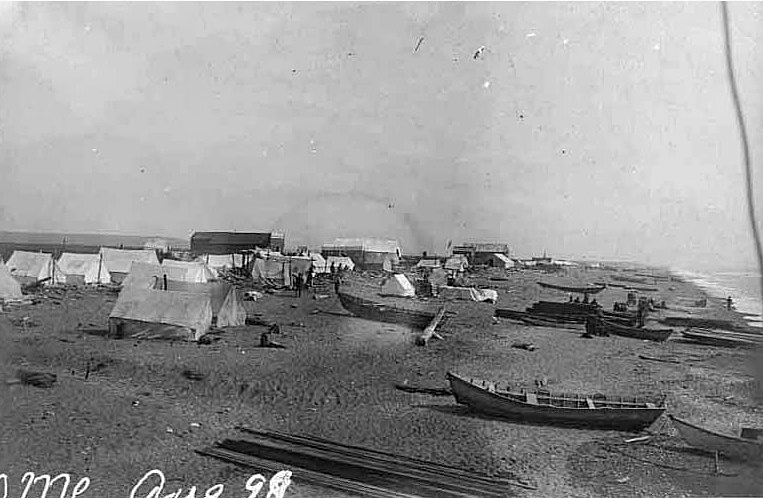
As a writer of popular fiction, Rex Beach hit the ground running with this, his first published novel, set in the gold rush days of Nome, Alaska. Its story was based on actual events and portrays attempts by crooked lawyers, politicians, and a judge to jump claims of legitimate miners already extracting fortunes from the gold fields.

Plot. The central character is Roy Glenister, a young and ambitious man, who has been prospecting for three years with his partner, an older man named Dextry. Their mine, the Midas, is one of the richest in the area. Returning by steamer from Seattle, where they have spent the winter, they learn that their claim is being challenged in court, and until the suit is settled, the Midas is being put in receivership, to be operated by a lawyer, Alec McNamara.

His intention is to make off with all the gold while the dispute remains stalled in legal proceedings. The judge, Stillman, provides the authority to carry out the plan, denying all requests to expedite judgment and refusing any appeals. A U.S. marshal arrives to enforce the law, such as it is, and the judge has troops from a nearby army post for support should they be needed.

Once the miners realize that they are the victims of a plot to steal their claims, they organize as vigilantes to take them back by force, threatening Stillman and McNamara with bodily harm. Glenister, who prefers to avoid violence is caught in the middle. He has fallen in love with Stillman’s niece, Helen Chester, and wants to stay in her good graces.

Nome beach, 1898
Romance. A standard theme in fiction of the period, the life-transforming attraction of a man to a young, pretty woman, drives much of the novel’s plot. Out here beyond the fringe of civilization, Helen Chester stands for law and order. Glenister tells her it’s “God’s free country” and the only law that’s needed is courage and a Colt’s. But he offends her when he tells her he subscribes to the Darwinian principle of survival of the fittest. “What I want, I take,” he says and steals a kiss.

Realizing that this kind of behavior is not going to win her heart, he complies with court orders without a fight, believing it will show him in a better light. But she is not persuaded. There is a “reckless energy” about him that lacks self-restraint. She is more taken by the likes of McNamara, whom she trusts as a representative of the law and the colleague of her uncle.