Showing posts with label kansas. Show all posts

Monday, May 19, 2014

The Gunfight at Dodge City (1959)

History remembers Bat Masterson as a buffalo hunter, U S. marshal, and Army scout, gambler, gunfighter, frontier lawman, and in later years as a newspaper columnist for the New York Morning Telegraph. The movies and TV remember him somewhat differently, though this western with Joel McCrea as Bat actually works in some factual details from his years in the Old West. Still, the difference between the two Bats is well represented by photos of both. You just have to look at their hats (see below).

The Gunfight at Dodge City parallels Bat’s time in the infamous cow town of the same name, during the years 1877 – 1879. There he joined a brother, Ed Masterson, who was town marshal.

Plot. The movie takes those few details and spins a story that casts Bat as a reluctant champion of justice against a corrupt sheriff (Don Haggerty) and his gang of deputized thugs, who run Dodge City and kill anyone who interferes with them. 

Joel McCrea as Bat Masterson
McCrea partners with the widow (Nancy Gates) of an uncooperative saloon owner the gang has removed from among the living. Reopening the saloon, he hires on the town doctor (John McIntire) as a card dealer, happy to have some diversion from patching up cowboys with accidental gunshot wounds from the weekly Saturday night hurrah in the streets.

Running as a reform candidate against Haggerty for county sheriff, Ed Masterson (Harry Lauter) is shot dead by an unknown assailant, and McCrea is persuaded to take his place on the ticket. Elected by a grateful citizenry, he gets unruly cowboys in line by cracking heads with his gun barrel and threatening to shoot anyone who still wants to run riot. His method brings to mind the brand of law enforcement usually associated with Wyatt Earp.

Bat Masterson as himself, 1879
As the story unfolds, complications multiply, none of them having to do with historical facts, though they would suffice. Bat was not all that careful about the company he kept or how he used public office.

Romance. With a nod to legend, if not history, the film begins with a flashback to a shooting in which Bat kills an Army sergeant who draws on him in a dispute over a girl. And the screenwriters quickly establish him as good with a gun and a ladies man. Besides the attractive widow and business partner in Dodge City, Bat enjoys the company of a preacher’s daughter (Julie Adams). Betrothed to Bat’s brother, Ed, before he is killed, she is understandably taken aback by Bat’s attentions. She admits to being afraid of him.

Long story short, Gates finally makes known what’s long been obvious to us—Bat has stolen her heart. Unable to keep him from his final gun duel with Haggerty, she hears him deliver the usual reason why a western hero does not run from a gunfight. Not running, McCrea tells her, is the difference between a rabbit and a man. By this time they have locked lips and, when it’s the other man who dies, McCrea is surrounded again by grateful citizens, and he gets his new sweetheart, too.

Joel McCrea, Nancy Gates
Wrapping up. The film was shot in Cinemascope and Technicolor, and was handsomely produced using Melody Ranch as a stand-in for Dodge City. Working in a variety of genres including film noir and sci-fi, director Joseph M. Newman is also remembered for another Joel McCrea western, Fort Massacre (1958), as well as The Outcasts of Poker Flat, Pony Soldier, and Red Skies of Montana, all of them in 1952.

John McIntire is particularly enjoyable in the film as the town doctor and friend of Bat. In 1959 he had already appeared as a continuing character in TV’s cop drama, Naked City. In a screen career that included roles in many westerns, he continued on TV for long runs of Wagon Train (1959 – 1965) and The Virginian (1967 – 1970). 

The screenwriters were Martin Goldsmith (Fort Massacre) and Dan Ullman, whose numerous writing credits for film and TV included many westerns, such as Good Day For a Hanging (1959), reviewed here a while ago.

The Gunfight at Dodge City is currently available online at youtube, and on DVD at amazon and Barnes&Noble. For more Overlooked movies and TV, click over to Todd Mason’s blog, Sweet Freedom.

Further reading:

Image credits:
Photo of Bat Masterson, Wikimedia Commons
Joel McRae as Bat Masterson, mgm.com

Coming up: Carol Buchanan, Gold Under Ice


Monday, December 16, 2013

Alfred Wallon, Showdown in Abilene


Review and interview

Originally published in 1981—in German—Showdown in Abilene was the first novella in Alfred Wallon’s Rio Concho series. Published now for the first time in English by Piccadilly Publishing, it’s in many ways a love letter to the American West.

Plot. With an abbreviated story that could well fit neatly into a one-hour TV western episode, Wallon introduces readers to a trail boss, Jay Durango, and his crew of cowboys. They have just arrived in Abilene, Kansas, after a summer-long cattle drive from Texas.

Encouraged to have a good time in town by the marshal, Bear River Tom Smith, but to stay out of trouble, the cowboys make an attempt to comply. But under the influence of too much alcohol, they cause a disturbance at the Opera House. Before long, they’re cooling off in jail.

More serious trouble is in store for Jay Durango. A pair of villains abduct him and hope to leave him dead in a shadowy corner of the red light district. Arson figures in to further plans for a bank robbery while a section of town burns. Bullets finally fly proving once again that crime rarely pays.

Railway, Abilene, Kansas, c1867
Pleasures of the text. There are many things to enjoy about the story and the storytelling. In Wallon’s hands a reader senses the pleasure of spinning a yarn from the familiar elements of the material. His characters are not only full of life. They are sketched in with hints of backstory that make you curious about them.

Durango, for instance, has what seem to be troubled memories of soldiering for the Confederacy. Returning to Texas, he’s in hopes of a new beginning. Billy Calhoun, the young son of the rancher he works for, was for two years abducted by Quanah Parker’s Comanches. He rankles at Durango’s attempts to supervise him. There’s even brief reference to a black cowboy, Bob Rennington.

Friday, February 1, 2013

Effie Graham, The Passin’-On Party (1912)


This short comic novel about African Americans in Kansas is one of a kind. Steeped in familiar racial stereotypes, it is also a sly portrayal of social pretensions on all sides of presumed color lines. Finally, it bestows a quiet dignity on its subjects. In her foreword, Graham calls her book “a story of a people, one time slaves and bondsmen, now free-tongued freeholders in a western land.”

At the center of the story is a “colored” couple, Aunt June and Uncle Jerry Ferguson. As a way of showing both their poverty and their industriousness, their house is described as a “hand-made” hodge-podge of used and discarded materials. Even the house number, 004&, comes from the side of an old railroad car.

Plot. Aunt June, her health in decline, is suffering from an attack of rheumatism. Believing her life to be about to wrap up, she expresses the wish for a “passin’-on” party, that is, a reception, like white folks have. At such a function, guests are greeted by the host and “passed on” to the next person in the receiving line and then on to the refreshments.

Topeka, Kansas, c1891
Three young white folks of the town, Dorothy, Nina, and Grace, decide to arrange such an affair, to lift the old woman’s spirits. A fourth, Ralph, shows up from the newspaper to take an announcement for the society pages. Aunt June specifies that on the date of the event, black folks are welcome early and late in the day and white folks in between. Blacks, she reasons, will be on their way to or coming home from work. Given a more convenient time of day for themselves, the whites won’t have to mix with the blacks.

Aunt June and Uncle Jerry
Blacks and whites. And thus we meet a cross section of the town’s population—segregated by color. Though mostly an affable gathering of folks, bits of prejudice and systemic bias have their way of leaking through into the conversation.

The black women talk about doing laundry, ironing in white people’s basements, scrubbing spittoons, and performing other menial tasks. Their talk is salted with gossip. An employee of the grocery store is encouraged to sing a song—but not a hymn. He holds forth with “Silver Threads Among the Gold.” Another guest, a policeman, sets a plate nearby for a collection, salting it with a few silver coins.

The town mayor is the first white person to call. The mother of a crippled boy comes at the insistence of her son, who gets a hello from June whenever he passes by the house. June remembers her as being willing once to sit by her on the bus, while the other white women remained standing.

The evening gathering
At the end of the day come the “true sons and daughters of Africa.” Field workers, they are “the happiest toilers under the sun,” says the narrator, who directs this comment to any who would “blame or ridicule” them as lowly laborers. Among the evening’s guests are three generations of black folk. Oldest are the work-hardened former slaves and after them the embittered survivors of Reconstruction. The youngest are “the product of the white man’s kindly meant, but somewhat misfit, educational policy.”

A well-spoken student, Solomon, is scolded by a preacher, Brother Marcus, for putting more faith in book learning than old-time religion. When Solomon speaks harshly of white people, June reminds him that her passin’-on party was organized by whites. Well, Solomon reminds her, times have changed. She won’t debate that, but warns his generation not to get “sassy an’ wicked in yo’ hearts.”

Friday, January 25, 2013

Dell H. Munger, The Wind Before the Dawn (1912)


This is a domestic western set on the plains of Kansas. Its heroine, Elizabeth “Lizzie” Farnshaw grows up in a fractious homesteading family where her domineering father makes life miserable for his wife and daughter. The long, 564-page novel covers 15 years of Elizabeth’s early life as she grows into womanhood.

Plot. Elizabeth’s fortunes seem to improve when she finds herself being courted by a newcomer in the neighborhood, a young farmer, John Hunter. John has a gentleman’s polish, a smattering of university education, and a comfortable inheritance. His proposal of marriage offers a welcome escape from her father’s domination.

Alas, John Hunter is not what he seems. As her husband, he does not bully her with the brute ignorance of her father, but he is oppressive in his own way. He builds a handsome house on his farm and invites his mother to live with them. Both have strict beliefs about a woman’s domestic duties, and their effect is to keep Elizabeth a virtual slave and a prisoner in her own home. Matters worsen still when Elizabeth gives birth to a child.

Elizabeth and John Hunter
John, it turns out, lacks caution in his investments and, against Elizabeth’s wishes, gets them deeply in debt. They are saved by an infusion of cash from a man who has come to Kansas looking for a business partner. Hugh Noland has a bad heart, which limits his prospects for the future, but farming with Hunter promises to be good for his health and a productive use of his remaining years.

The arrangement works well until Noland suffers an accident with a runaway team of horses. The doctor orders bed rest for him and encourages Elizabeth to give him plenty of tender loving care. But the two have already become too close. Both are torn between their affection for each other and her commitment to her marriage vows. Seeing the burden he has placed upon her, he hastens his demise by overdosing on his heart medicine.

Leaving all his assets to Elizabeth in his will, he gives her the leverage to finally stick up for herself with her husband. Infuriated that she wants to be his “boss,” he leaves her. The farm thrives under her direction, but she does not give up a belief that husbands and wives can live together as equals. In time, her husband asks her to take him back, and the closing pages suggest they might be able to make a go of it.

Elizabeth at the post office
Character. Elizabeth is drawn throughout the novel as an exemplar of character. “Quick to serve, sensitive, honest, dependable,” she has a strong sense of duty. The values of character espoused by the novel are both feminist and moralistic. Munger puts them in conflict with each other and shows how they might be resolved. A husband merely needs to give up the instinctive desire to dominate his wife.

Munger gives several examples of such men. The appearance of Noland offers the finest one. He shares Elizabeth’s love of books and freely regards her as a trusted friend. As she grows exhausted from overwork and motherhood, he has a concern for her that her husband lacks. The concern is shared by the doctor, who has seen from his practice how husbands wear out their wives by committing them to a life of drudgery and dependence.

Mrs. Farnshaw and Elizabeth
Women. While Munger sympathizes with the lot of farm wives, she does not exactly portray them as likeable or admirable. Quick to indulge in their jealousies, they are cruel and unforgiving gossips. For them, the most grievous social offense is to take on airs and act superior. When John refuses to let Elizabeth visit her neighbors, the local women assume she is being “stuck up” and viciously condemn her.

Elizabeth’s mother shows how a lifetime of subservience to men has made of her a bitter and demanding woman. She is jealous of Elizabeth’s friendship with Susan Hornby, a neighbor of kindred and warmly generous spirits. She is cruel and cutting to her daughter, siding with her husband as he physically abuses her.

Monday, January 7, 2013

John Williams, Butcher’s Crossing (1960)


Some would call this an anti-western. It reflects the dark underside of the 1950s and overturns some of the mythology of the West. It’s central character is a young man who flees the deadening effects of civilization as it’s practiced in 1870s Boston and heads out West to find adventure on the frontier.

William Andrews is 23 years old and wants above all to experience the wildness of the West, to immerse himself in its freedom. In that freedom, he expects to find goodness, hope, and vigor. He is a living example of Emerson’s belief in self-reliance and the wholesomeness of unspoiled nature.

Plot. Arriving in a settlement called Butcher’s Crossing, in central Kansas, he bankrolls a bison hunter who claims to know of a hidden herd in the mountains of Colorado. Bison hides are selling for $4.00, given market demand and the growing scarcity of the animal. Not only will the hunt be an adventure, it will turn a profit of thousands of dollars for them.

The trip to Colorado and back, with three experienced hunters, turns into an unexpected odyssey of many months. The party is headed by Miller, who is expert with a buffalo gun. He hires an experienced skinner, Schneider, and persuades the older Charley Hogue to go with them as driver of their oxen-drawn wagon. Andrews is to help with the skinning.

Bison hide yard, Dodge City, Kansas, 1878
It takes weeks to travel across western Kansas and eastern Colorado. Taking a shortcut across the arid prairie, they run out of water and nearly die of thirst. All the time, until Miller finds them, there is doubt that his herd of bison even exists.

But they do exist, in the thousands, surviving summer by summer in a mountain valley. Finding them, Miller gets right to work, and before long the hides pile up far beyond the number they can take back in one trip to Butcher’s Crossing. Over Schneider’s objection, Miller stays on, intending to wipe out the entire herd.

But he waits too long, and they get snowed in. The final third of the novel is an account of their fierce struggle to survive the winter. With the hides, Miller constructs a shelter and “sleeping bags” for them to keep from freezing to death. They live on game and a carefully rationed supply of coffee.

When enough snow has melted from the mountain pass leading out of the valley, they pile the wagon high with hides and head back to Kansas. That journey is marked by an accident that reverses their fortunes once again. Yet more bad news awaits their arrival at Butcher’s Crossing.

Dead bison in snow, 1872
History vs. myth. The killing off of the bison herds is an accepted fact of western history, but seldom if ever has it been the subject of a novel. Williams describes grimly but matter-of-factly the systematic conversion of thousands of living animals to skinned carcasses. Somehow, none of the men regards what they are doing as the extermination of a species.

Meanwhile, the relentless killing and skinning has an effect on them more deadening than the worst to be had in tired old civilized Boston. Andrews is first physically repulsed as he butchers one of the animals. He desperately washes the blood from himself and his clothes in an ice-cold mountain stream. Then he gradually succumbs to the machine-like process of slaughter.

He half realizes that instead of the thrilling excitement of living wild and free, he is being numbed by death and bloodshed. The irony is that the myth itself does not die for him. By novel’s end, he heads off again westward, with no destination in mind, but only a belief that he will eventually find what he is looking for.

Wednesday, December 12, 2012

Mary Doria Russell, Doc


One of the most curious friendships in the Old West is the one between Wyatt Earp and Doc Holliday. Each of them was so different from the other, Doc a well-educated and cultured Southern gentleman and Wyatt a hardheaded, unpolished Yankee of apparently no more than average intelligence.

Russell takes us back a few years from that fateful day in 1881 in the streets of Tombstone to the Kansas town where the two men became acquainted. In the pages of her novel, we’re in Dodge City, and the year is 1878. Wyatt has a temporary job as a keeper of the peace, and Doc has followed the money from Texas, using his skill at cards to make a living as a gambler.

The others we know from history are here, too. Wyatt’s brothers Morgan and James, and their women, including Kate Harony, the prostitute who is both bane and comfort for the ailing Doc. The town fathers are here as well, Bob Wright, George Hoover, and others. Entertainer Eddie Foy provides bawdy comedy and song at the Comique (pronounced “Commy-Q”).

Doc Holliday
Plot. Readers looking for Old West action will not find much of it in this story of people living day-to-day lives in a frontier railroad town. The excitement to be found tends to be of the unwelcome kind, as rowdy, young cattle drovers fill the saloons in the summer months. The job of keeping the peace falls to the likes of the Earp brothers and another legend in the making, Bat Masterson.

Doc’s poor health is treated with a graphic attention likely to surprise readers who think of TB as a quietly wasting disease, as we typically see it portrayed in film. Doc’s cough and bloody handkerchiefs are a motif throughout the novel, and a crisis point is reached near the end as his condition sharply worsens until he’s almost near death.

His recovery—one of several—is observed with a Christmas party at which he sits down at a newly tuned piano and plays the entire Emperor Concerto. It is a spellbinding performance that holds the assembled guests in a state of awe. Then with the coming of the new year, the Earps and Doc decide to pull up stakes and head for Tombstone. Prospects, they believe, are better there. We know what they don’t, that it’s an appointment with destiny.

Dodge City police officers
If there’s a plot thread at all, it concerns the mysterious death of a young, black faro dealer found in the smoldering remains of a livery barn burned to the ground. Doc suspects foul play and eventually unravels the mystery.

History. Russell gives credit to several sources as the historical basis of the novel, notably Karen Holliday Tanner’s biography, Doc Holliday: A Family Portrait. She takes imaginative liberties in filling in the details and clarifies in the opening pages of the book the few characters who are fiction and those that are not.

What gives the novel its particular point of view is her belief that the deepest friendship among these men was the one between Doc and Morgan, Wyatt’s younger brother. And Morgan is surely the most endearing, good humored, and likeably intelligent of the Earps. Wyatt, by comparison, is stolid, rigid in his Methodist beliefs, and no smarter than he needs to be.

Tuesday, September 4, 2012

Santa Fe Trail, 1940

You can sense the lingering images of Gone With the Wind (1939) on movie screens when this film was released in 1940. With its Southern sympathies, it has much of the same view of Civil War era history. Though shot in black and white, the scale of many scenes, the size of the cast, and especially the appearance of Olivia De Havilland in a full antebellum dress, also bring that earlier film to mind.

Plot. Its opening scenes set in 1854, the film introduces us to its central characters, J.E.B. Stuart (Errol Flynn) and George Armstrong Custer (Ronald Reagan). De Havilland is with a contingent from Kansas at their West Point graduation ceremonies. In a secondary role is Van Heflin, expelled from the academy for distributing anti-slavery literature in the cadets’ quarters. A monumental presence in the film is Raymond Massey’s stormy and apparently mad abolitionist, John Brown.

The characters all converge in Bleeding Kansas as pro- and anti-slavery forces take up arms against each other. Heflin, we learn, has become a strategic military advisor to Massey. But before engaging Massey’s army of volunteers, best friends Flynn and Reagan amicably woo de Havilland. Her father is a Kansas merchant with a vision of building a railroad from Fort Leavenworth to Santa Fe.

(Left to center) Raymond Massey, Van Heflin, Errol Flynn
Flynn, wearing a handsome black hat, is taken captive by Massey and escapes both hanging and a burning barn before being rescued by the cavalry, with Reagan in command. Defeated, Massey and his followers are driven from Kansas, only to turn up again at Harper’s Ferry.

Disenchanted with Massey, Heflin goes to Washington to reveal the man’s plans to incite a slave rebellion. Flynn and Reagan lead the charge that lays siege at Harper’s Ferry and take Massey captive. He is eventually hanged. Meanwhile, tracks for the new railroad are being laid along the Santa Fe Trail and de Havilland has decided it is Flynn she wants for a husband. The disappointed Reagan is quickly introduced to a fetching blonde who turns out to be the daughter of Jefferson Davis.

Ronald Reagan, Olivia de Havilland, Errol Flynn
History vs. bunk. The portrayal of J.E.B. “Jeb” Stuart comes fairly close to actual history. Stuart, who was later to be a Confederate general, did graduate from West Point in 1854, in time to receive a commission that put him in Kansas during John Brown’s tenure there.

As an officer in the military, Stuart was called upon to support the pro-slavery government of the Territory and to help quell the growing violence and bloodshed. In a whirlwind courtship, he also met and married Flora Cooke, the daughter of a lieutenant colonel.

The specifics of John Brown’s activities in Kansas are probably manufactured. But his portrayal as a fiery, Scripture-quoting domestic terrorist squares with the estimation of some, though not all, historians. His capture and attempted hanging of Stuart is an invention by the screenwriter.

Ronald Reagan’s George Custer is more of a fabrication. Custer was still at West Point during John Brown’s crusade and graduated with the rest of his class, a year early, when the Civil War broke out in 1861. Reagan’s big grin gives Custer more the manner of a good-time fraternity bloke, although from what we know of the man’s career as a cadet, that’s probably not too far off the mark.

Tuesday, July 3, 2012

When the Daltons Rode (1940)

History is complicated, and movies like to make sense of it by fitting it to stories already familiar to the audience. Thus the complicated history of the Dalton Gang was retold as a Depression-era fable about good men turning to crime because corrupt moneymen have driven them off their land.

Plot. Bob Dalton (Broderick Crawford) is sheriff in a Kansas town when a land and development company sends in surveyors to determine that the deed to his family’s farm is invalid. An altercation leads to the accidental death of one of the surveyors, and one of Crawford’s three brothers, Ben (Stewart Erwin), is arrested for murder.

During the trial, Crawford frees his brother at gunpoint, shouting, “Why should we obey the law that’s been twisted to fit the needs of thieves and liars?” Along with two of their brothers (Brian Donlevy, Frank Albertson) plus a friend (Andy Devine), they ride off and into hiding. Holed up in a barn, they learn that the newspapers are blaming them for a crime spree of bank and stagecoach robberies.

Cast, When the Daltons Rode
So they decide to live up to their reputation, hoping to put together a defense fund for a trial in another county. They already have a friendly lawyer (Randolph Scott) willing to plead their case.

Brother Ben is captured and nearly lynched before his mother (Mary Gordon) attempts to intervene and Scott spirits him away to the safety of the jailhouse. Crawford and his brothers engineer a jailbreak, but Ben, still pleading his innocence, is shot dead before they can get out of town.

The three remaining brothers and Devine are in business now in a series of holdups ranging over several states. They have to shoot their way out of a town in Oklahoma where armed citizens trap the brothers in a diner. They jump a train that they discover is full of lawmen and make off with loot from the express car. They make a getaway by jumping from the moving train on horses being transported in an open car, Crawford taking a long dive into a lake.

Crawford throws a punch in the courtroom as Scott looks on
Meanwhile, the misuse of the law for private gain goes on. Scott has learned that a local businessman and speculator (George Bancroft) is the chief culprit in the scheme to throw farmers off their land and resell it to the railroad at a tidy profit. Bancroft is smugly self-confident as Scott threatens to take him to court. Lacking evidence, the man says, it will take years for a grand jury to indict.

All ends badly, of course, as the gang decides to rob the bank in the Daltons’ hometown. In a nod to the Production Code, Crawford’s ma finds him first and pleads with him to change his ways. “You can’t make your own laws,” she tells him.

Discovering that the Daltons are back in town, Bancroft warns the sheriff, and their attempt to rob the bank is thwarted in a hail of gunfire. The gang lies dead or dying in the streets as Bancroft draws a bead on Scott from an upstairs window. With his last ounce of life, Crawford spies Bancroft and puts a last bullet through him.

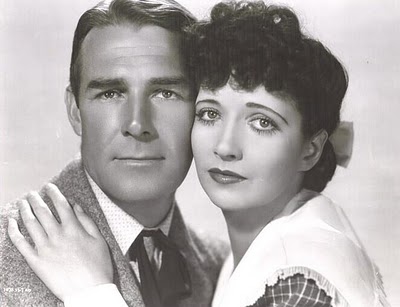
Randolph Scott, Kay Francis
Romance. There needs to be a happy couple at the end of a western, no matter how unfortunate for those who must learn that crime doesn’t pay. All along there’s been a subplot involving friendly, honest Scott and a woman (Kay Francis) who has been Crawford’s fiancĂ©e since the story’s start.

Scott has fallen for her, and the feeling grows mutual. But both attempt to remain loyal to Crawford—she because she’s promised to him and Scott because Crawford is an old friend. Finally, their love wins out, and Crawford doesn’t learn the truth until the fateful day of the failed bank robbery. When he kills Bancroft, he dies honorably, having saved the life of the man who has taken away the woman he's loved.

In the final scene, Scott and Francis are newlyweds and all smiles.

Thursday, May 17, 2012

Willis George Emerson, Buell Hampton (1902)

My somewhat used copy of the original novel
Every novel is a lesson in how to tell a story. This one has several stories to tell, and if the word “mashup” were available to reviewers in 1902, they surely would have used it to describe this one—instead of “amateur ,” “mediocre,” and “slush.”

It’s a young-man-goes-West story, a farmers vs. cattlemen story, a man vs. the elements story, a love story, a mystery, a story of long-lost family members, an amnesia victim story, a cattle-rustling story, another love story, and a story about social and political reform. The list is longer, but you get the idea. Set on the Kansas frontier in the 1880s, all of these stories revolve around a single character, Hugh Stanton. He’s a young Princeton graduate, who heads West with his inheritance to go into the banking business and make his fortune.

Hutchinson, Kansas, 1880
Plot. The novel is packed with characters and incidents. A faithful synopsis would be nearly as long as the book. Stanton himself is chiefly an observer, who doesn’t make an entrance until chapter four. Up to that point, the plot concerns the schemes of two Anglophile women to marry off the daughter of one of them to a titled Englishman. He’s shopping for an American heiress to rescue the family estate from a truckload of debt.

Meanwhile, Ethel, the girl in question, has fallen in love with a red-blooded American, Jack Redfield, a handsome young doctor in Chicago. The two women keep the young lovers apart by intercepting letters between them. And the Englishman, Avondale, is entertained on an extended stay in America, with a visit to the ranch of Ethel’s father, Horton, a millionaire cattleman. Avondale is all sleazy aristocracy, with the moral fiber of a soft-cooked egg. We don’t like him.

Buell Hampton, after whom the novel is named, is the local newspaper editor and an avowed Populist, who attributes every social ill to the unequal distribution of wealth. While cattle keep disappearing in large numbers from cattleman Horton’s herds, Hampton’s editorials call for greater effort to stop the rustlers. Though he even attempts to capture them himself, the rustlers go uncaptured.

Hampton’s beautiful young daughter Marie takes a fancy to Stanton, but Stanton is romance-proof and misses all her overtures. Determined to rescue Ethel from the clutches of Avondale, he proposes marriage to her instead. Alas, she’s still carrying a torch for Redfield.

Farmland, Kansas, 1887

A fall from a bucking horse sends Horton back 25 years to the Civil War battle where he sustained a head injury that wiped out his memory. Lo and behold, it turns out he is Stanton’s father, long thought dead. Often yearning for the father he never had, Stanton is delighted by this development. It also makes Ethel his half-sister, so it’s a good thing she declined his offer of marriage.

Hampton isn’t who he claims to be either. In the final chapters, the cattle thieving is finally tied to him. Something of a frontier Robin Hood, he has been actively redistributing wealth. But apparently mad as a hatter, he claims to be a Rosicrucian who has lived for hundreds of years in the support of mankind’s evolution toward altruism.

Though disposed of by vigilantes for cattle theft, he achieves a kind of resurrection not often seen outside the Bible. In his last appearance, he blesses the union of Stanton and Marie, who are now certifiably in love, and disappears into the night.