Showing posts with label book review. Show all posts

Thursday, February 26, 2015

Luke Allan, Blue Peter: “Half-Breed” (1921)

Métis fur trader, 1870
Blue Pete, a Métis cattle rustler who leaves a gang of horse and cattle thieves to work as an informant for the North-West Mounted Police, first appeared in 1921 in a short story in Western Story Magazine by Canadian-born writer William Lacey Amy (later to be known as Luke Allan). That same year, the character appeared in Blue Peter: “Half-Breed,” the first of a long series of Blue Pete novels, published in both London and New York, the last of which saw print in 1954.

Blue Peter is a love/crime fiction story set on the Canadian frontier, where the North-West Mounted Police are stationed at Medicine Hat  to maintain law and order. Their main problem is a gang of horse and cattle thieves fearlessly operating along the international border with the U.S. and using the Cypress Hills, a rough patch of wooded terrain in southern Saskatchewan , to hide out (cf. Jackson Hole, Wyoming).

Plot. As the story begins, Blue Peter parts company with the gang in an exchange of gunfire, meets up with a young
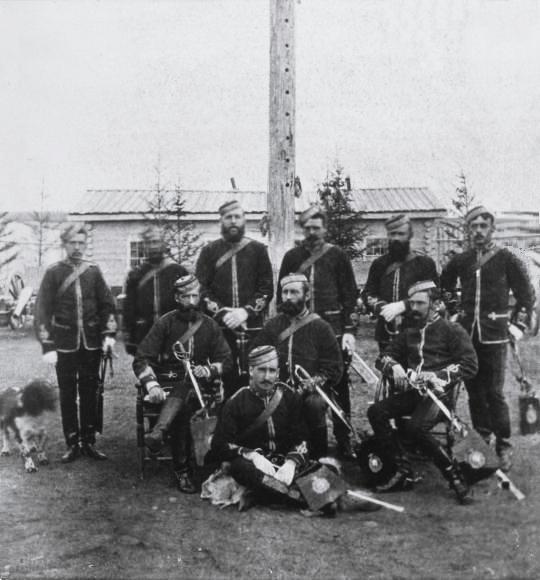
North-West Mounted Police Fort Walsh, 1878
Mountie, Constable Mahon, and is persuaded to work as an informant, sharing what he knows of the Hills and how they are used by the thieves to hide stolen stock; infiltrating the cowboys who work for ranchers on the open prairie, he reports any questionable behavior to the chief inspector at NWMP headquarters.
As it turns out, one family, the Stantons, are actively in cahoots with the gang. Caught in the act, two brothers, Jim and Joe Stanton, kill each other rather than allow themselves to be taken by the Mounties. Their sister, Mira, has been an accomplice in their thieving activities. She is an all-western girl, skilled as a rider and roper, pretty and independent-minded, embarrassed only by her lack of education and refinement.

Mahon, who has a girlfriend of his own, befriends Mira and helps her with the book-learning she desires. Meanwhile, grief-stricken at the loss of her brothers, Mira warms to him but holds him culpable for their deaths. In a fit of melodrama, she shoots and kills three of her four wolfhounds.

Romance. Blue Peter then comes to her rescue, offering her his cave in the Hills for shelter and his own companionship for solace. Standing trial for cattle theft, Mira is found guilty and sentenced to six months in prison. As she is being transported there by train and under guard, Blue Peter comes again to her rescue, and they are pursued on horseback by Mounties across the prairie. After the two are run aground, Mira surrenders herself to save Blue Peter, now a wanted man, from arrest.

Back at the cave, he waits mournfully through the winter for her release from prison. At last, with the coming of spring they are reunited.

Adventure. The latter part of the story is devoted to the capture of the gang, as exchanges of gunfire result in Mahon’s (now Sgt. Mahon) being wounded and the arrest and/or death of the rustlers. Blue Peter is also a casualty, shot as he saves Mahon’s life. At the end of the novel, there is reason to believe that Blue Peter’s wounds are mortal and once his body is found, Mira vows to bury him there in the Hills he loved.

For his part, Mahon has a granite monument carved as a memorial to the “half-breed” who was his friend. So the novel has this melancholy and sentimental ending. But like a modern-day TV series with a season finale lacking finality, Blue Peter and Mira live on to reappear for another adventure in a sequel, the Return of Blue Pete published in 1922.

The accuracy in the portrayal of Blue Pete is debatable especially in comparison with Frederic Remington’s mixed-blood title character in Sundown Leflare (1899), who speaks in broken, French-inflected English, and possesses no particular moral character. Physically strong and a creature well adapted to the natural world, Blue Pete has no faults. He is decent to the core, loyal, tenderhearted and willing to take a risk to help a friend. Outside of James Fenimore Cooper we do not find his likes in American frontier fiction.

Blue Peter: “Half-Breed,” is currently available online at Internet Archive and in ebook format at Barnes&Noble.For more of Friday's Forgotten Books click on over to Patti Abbott's blog

Further reading/viewing:

Blowing my own horn: For an in-depth, two-volume survey of early writers of frontier fiction, read How the West Was Written (to obtain a copy, click here). 

Image credits:
Wikimedia Commons

Coming up: new short stories


Wednesday, February 18, 2015

Nik Morton, Spanish Eye

I know Nik Morton more as a writer of westerns. His Bullets For a Ballot was reviewed here a while ago. Spanish Eye is something else.

Nik is one of those Brits who left the dark, rainy North for the sunny south coast of Spain, which is where this collection of 22 stories, featuring private investigator Leon Cazador, takes place.

Like Henning Mankell and other writers of euro crime fiction, Morton shares what he’s come to know about crime and the criminal element in Spain, though never painting it as dark as writers of the Scandi-noir school. Against a background of social conditions in modern-day Spain, it’s petty crime mostly, systemic graft, and fraud that find their way to Cazador’s attention. Meanwhile, the menace of organized crime and mafia elements lurks in the shadows.

Thursday, February 12, 2015

Guy Vanderhaeghe, A Good Man

I wanted to like this novel more than I did. For its length (464 pages), it promises somewhat more than it delivers. I had the same reaction to the author’s The Last Crossing (reviewed here a while ago). There are a lot of ideas and food for thought in this novel about character, friendship, responsibility, Native Americans, the frontier, and U.S.-Canadian relations. But in the end it’s hard to say what it all adds up to. You can puzzle if you like over the title. Who among the novel’s male characters is the “good man”? Is there one at all?

Set in the late 1870s, partly in the Cypress Hills of Saskatchewan where Fort Walsh was headquarters for the North-West Mounted Police; but mostly in the frontier settlement of Fort Benton, Montana, on the upper Missouri River, the action takes place in the aftermath of Custer’s defeat at the Little Bighorn and settlers of the sparsely populated prairie live in terror of the Sioux and other tribes who seem to be organizing under the leadership of Sitting Bull to rid the West of whites altogether.

Thursday, January 29, 2015

Elmer Kelton, Texas Showdown


This book is actually two short novels by Elmer Kelton, first published in the 1960s and reissued under one title by Forge in 2007. Pecos Crossing, originally titled Horsehead Crossing (1963), appeared under Kelton’s own name, while Shotgun, originally titled Shotgun Settlement (1969), was published under a house pseudonym, Alex Hawk.

First off, Elmer Kelton is one of my top-10 favorite western writers. He wrote with a strong sense of history and an informed awareness of the West Texas terrain, its flora and fauna, and its weather. I find it easy to believe in his characters. They are not just convenient types but possess an emotional depth that makes them three-dimensional.

Friday, January 23, 2015

Geoff Dyer, But Beautiful: A Book About Jazz

I guess you’d call this creative nonfiction. A former colleague recommended this book to me after reading some of my thoughts on the life-affirming and health-inducing aspects of listening to jazz as I deal with a visitation of brain cancer. The great irony is that the joyous practice of improvisation in smoky clubs of the bebop era was so virulently self-destructive for its musicians.

In Dyer’s evocative and impressionistic character sketches of several of its iconic figures (Lester Young, Bud Powell, Chet Baker, Art Pepper, Ben Webster, Thelonious Monk, Charles Mingus) we witness mostly downward trajectories, as drugs, prison, racism, alcoholism, mental illness, and violence take their toll. Whether or not you think of them as survivors, you come to understand that the music they invented and played was an act of defiance and subversion in the face of demons both internal and external.

Wednesday, January 14, 2015

Robert J. Randisi, ed., Livin’ on Jacks and Queens

This is an entertaining anthology of 14 stories about gamblers and gambling in the Old West. Editor Randisi has assembled a notable gathering of western writers, providing an array of storytelling styles and imaginative treatments of the subject. The names of several contributors will be quickly recognized: Johnny Boggs, John D. Nesbitt, Matthew P. Mayo, Nik Morton, and Chuck Tyrell.

To these he has added a story of his own, plus the yarns of two women writers who may be new to some readers: Christine Matthews and Lori Van Pelt.

My favorites of the bunch include Ms. Matthews’ “Odds on a Lawman,” which tells of a succession of sheriffs who each assumes a tenure of service to a frontier town, before dying or disappearing for various reasons, on which the townsmen place bets until the turn of events claims one of them the winner. It’s an amusing and well-written tale that brings its Dickensian cast of characters to entertaining life, while we wait to see the fate that befalls each of the town’s series of sheriffs.

For a colorful portrayal of the daily life and business of a riverboat gambler, Nik Morton brings that world vividly to life in his story, “Hazard.” In “Acey-Deucey,” John D. Nesbitt’s central character is hired by a woman to retrieve an emerald pendant once given to her by a paramour. Finally locating the current owner of the gem, he has to win a game of cards before he can take possession of it.

Robert Randisi
Randisi’s story, “Horseshoes and Pistols” is so quirky, I kept thinking that it qualified as Twilight Zone material. In it, two men are forced to bet their lives on a game of horseshoes. Matthew Mayo’s “Pay the Ferryman” veers off in another direction, as a man on the run escapes into what might well be called “the heart of darkness.”

My favorite story in the collection was penned by a favorite storyteller, Chuck Tyrell. His “Great Missouri River Steamship Race” evokes a period of river travel from the point of view of a youngster working as a fireman aboard a steamship with a regular route between St. Louis and Fort Benton. Tyrell brings his gifts for characterization, dialogue, and suspense to this story with its echoes of Huckleberry Finn.

Livin’ on Jacks and Queens is currently available in ebook format at amazon and Barnes&Noble.


Shamelsss plug: For an in-depth survey of early writers of frontier fiction, read How the West Was Written (to obtain acopy, click here).

Image credits: fantasticfiction.co.uk

Coming up: Illustrators of frontier fiction, Frank E. Schoonover

Thursday, January 8, 2015

Naguib Mahfouz, Karnak Café (1974)

Bit of a change today at BITS, from West to Middle East. This short novel by Nobel-winning Egyptian author Naguib Mahfouz is a sadly melancholy story of the crushing of youthful hope. Set in the 1960s around the time of the 1967 war with Israel, it describes how a generation of young Egyptians, the children of the revolution of 1954, were betrayed and lied to by their government, while being subjected to interrogation and imprisonment by secret police.

Their story is told by an older man (and stand-in for the author), who befriends a gathering of them who are regulars at a Cairo café, Al-Karnak. There they talk of politics and express their idealistic aspirations, both for themselves and their country. Abruptly disappearing for periods of time, they return shaken and demoralized. While in police custody, kept in windowless cells, they have endured harsh treatment and false accusations.

Eventually it’s revealed that they have been coerced into becoming informants, which corrodes their trust in each other and eventually leads to the death of one of them. Two, a loving couple at the story’s start, are driven apart by their guilt and shame.

Karnak Café is a troubling vision of life in a modern police state, and it sheds light for Westerners on the recent struggles in Egypt for freedom and justice. Novella-length, it takes a stand somewhat distant from political events, while clearly throwing its sympathies to the young people who speak on its pages. It is currently available in paper and ebook format at amazon, Barnes&Noble, and AbeBooks. For more of Friday's Forgotten Books, click on over to Patti Abbott's blog.

Coming up: Robert Randisi, ed., Livin’ on Jacks and Queens

Wednesday, January 7, 2015

Richard Prosch, Devil’s Run

If there’s such a thing as comic violence in the western, Richard Prosch is a gentle master of it. There is shooting and fighting enough in his Devil’s Run—and work for the undertaker—but it’s a story told with a wry and barely suppressed grin.

The central character is Prosch’s “Peregrine,” John Coburn, a gun for hire who’s taken the job of escorting a man improbably named Tie-Down Sam Gustaffson, from Missouri to Nebraska, where he is to appear as a witness in a murder trial.

Family ties, however, produce an obstacle as the two men stop overnight at a river town called Bindlestick, and for a while it looks like they won’t make it out alive. They are joined in their attempt to escape by Margo Blaze, proprietress of the town’s hotel and whose bed was warmed the previous night by our man Coburn.

Thursday, January 1, 2015

Francis Lynde, Empire Builders (1907)

There are train spotters and railroad enthusiasts, but so far as I know, no one today writes fiction for this particular market. Anyway, not since Agatha Christie’s Murder on the Orient Express (1933). Travel by railway was still novel enough at the turn of the last century, however, to keep writers like Francis Lynde (1856–1930) selling books with plots about railroading.

This one is typical of his others and concerns a young superintendent of a line running from Denver into the Rocky Mountains. Stuart Ford is an ambitious fellow, who hatches a plan to extend the line to eventually connect Chicago and the West Coast. His chief competitor is the Transcontinental with its eye on hauling freight to and from the same regions of the West, profiting from the mining and crop-raising industries. In other words, there is a lot of money to be made for the railroad that can first lay its tracks there.

Friday, December 26, 2014

Edward A. Grainger, Further Adventures of Cash Laramie and Gideon Miles

As part of his education of a pulp writer, David Cranmer has been reinventing the traditional western over the past several years with his introduction of two deputy U.S. marshals, Cash Laramie and Gideon Miles. The two peace officers work out of 1880s Cheyenne, Wyoming, bringing in malefactors, felons, and fugitives from justice, of which as we know, there were plenty in the Old West.

Both men are admirable in their own ways not to say distinctive in their manner and personal style, as is often the case in pulp fiction. Cash Laramie has acquired a reputation as the Outlaw Marshal, stepping at times outside the precise requirements of his job description to bring undesirables to heel. Historians will recognize in him the thin gray line that separated the lawful and unlawful activities of frontier lawmen whose skill with side arms also qualified them as gunfighters.

Thursday, November 20, 2014

Robert J. Conley, Quitting Time (1989)

This short novel is a curious cross between a standard western and an Agatha Christie murder mystery. The central character, Oliver Colfax, is something of a range detective, with a license to kill, should he be so inclined. But he’s grown weary of the work that has been his livelihood and is looking to retire from being a gunman for hire. It is, as he says, “quitting time.”

Considering a job for a Colorado cattleman who believes he is the victim of rustlers, Colfax travels to a small frontier town, drawn in part by the opportunity to see a touring theater company perform Shakespeare’s bloody tragedy, Titus Andronicus. Agreeing with the cattleman to find out who, if anybody, is rustling his stock, Colfax gets to work and determines before long that a gang of cowboys at a nearby camp are the only likely suspects.

Saturday, November 8, 2014

Kim Zupan, The Ploughmen

One reader has compared this novel to No Country For Old Men because of a murderous central character, John Cload, who brings to mind yet another dark work of fiction The Silence of the Lambs. Cload is more than a little like Hannibal Lecter, as he befriends a deputy sheriff who keeps him company from outside his jail cell through long, sleepless nights and escorts him to and from the county courthouse where he is under trial.

The deputy, Valentine Millimaki, has been encouraged by the sheriff to learn what he can about Cload that might help in the trial. But besides a single killing, for which there was a witness, the deputy remains unaware that Cload has bodies buried all over the rough Montana country along the northern shores of the upper Missouri River.

Not more than marginally interested in Cload anyway, Millimaki has troubles of his own. Cload correctly senses that they are woman troubles. As a schoolboy, Millimaki once discovered the body of his mother, who had hanged herself in a barn on the family farm. Now, his young wife has left him, weary and depressed by life in a backwater Montana town.

Wednesday, November 5, 2014

Jenny Shank, The Ringer

Review and interview

Frontier fiction did not end with Louis L’Amour. Its themes and issues continue among today’s writers who place their stories west of the 100th meridian. Jenny Shank’s The Ringer is a fine example of how the frontier, despite Frederick Jackson Turner, has never really closed.

Set in modern-day Denver, this novel takes up two topics that date back to the origins of frontier fiction: the use of deadly force in law enforcement and the conflict between whites and the region’s ethnic populations, especially Spanish-speaking inhabitants who have long lived in the lands of the Southwest, taken in conquest by the U.S. government from Mexico.

Thursday, October 30, 2014

The Spinners’ Book of Fiction (1907)

Living in San Francisco at the time of the 1906 earthquake, Ina Coolbrith (1841–1928) lost her home and a priceless personal library in the fire that consumed the city. With her interest in the arts and her connections in both San Francisco and New York, she had helped found the Overland Monthly with Bret Harte and encouraged the careers of Jack London and Isadora Duncan among many others.

Following the quake and fire, Coolbrith's friends, including California writer Gertrude Atherton, helped out with financial support. A collection of stories, The Spinners’ Book of Fiction was published with all proceeds to go to Coolbrith. Sixteen Bay Area writers contributed to the anthology, as well as several illustrators and artists. 

Here are a few samples:

Thursday, October 23, 2014

Andy Adams, Campfire Tales

William H. Hudson collected these 51 stories told by cowboys around the evening campfires in four books by Andy Adams (1859-1935): The Log of a Cowboy (1903), A Texas Matchmaker (1904), The Outlet (1905), and Cattle Brands (1906). 

By the rules of trail drive storytelling, they are factual, as actually happened, and without exaggeration. Storytellers were not allowed to be boastful or to be interrupted.

The collection makes for an entertaining read, as subject matter ranges over all sorts of topics, and stories are told with a certain cowboy attitude that brings them to colorful life.

Andy Adams, 1904
Among a few of my own favorites: 1) an account of a marathon of “bear sign” (i.e., doughnut) making, 2) Bat Masterson supervising a fractious crowd gathered for a public speaking event, 3) a case brought before Judge Roy Bean, 4) an explanation for why the Chisholm Trail forks as told to a gullible new man, and 5) a dispute between a disagreeable trail boss and his riders over the count of a herd.

First published in 1956 by the University of Texas Press, Andy Adams’ Campfire Tales was reissued in 1976 by the University of Nebraska Press, with an expanded and informative introduction. The book is currently available at amazon, Barnes&Noble, and AbeBooks. For more of Friday’s Forgotten Books, click on over to Patti Abbott’s blog.

Further reading/viewing:
BITS review, Andy Adams, The Outlet, Part 1, Part 2

Image credits: Adams’ photo, The Critic, 1904

Coming up: TBD


Thursday, October 16, 2014

Judy Alter and A. T. Row, eds., Unbridled Spirits

This anthology is not quite the book I expected. Subtitled Short Fiction about Women in the Old West, it leads the reader to expect stories written by women, and a wide selection of them. But besides those writers most easily named (Mary Hallock Foote, Willa Cather, Mari Sandoz, Mary Austin, and Dorothy Johnson), there are almost no women whose fiction would surely qualify them for inclusion here.

To name just a few from the early decades of frontier fiction: Molly Davis, Florence Finch Kelly, Mary Etta Stickney, Frances McElrath, Elizabeth Higgins, Marie Manning, B. M. Bower, Eleanor Gates, Caroline Lockhart, and Kate Boyles.

Instead, the editors find room for one of their own stories (Alter’s “Fool Girl”) and beef up the rest of the book with stories by male writers, which happen to include female characters. These are actually okay, especially Elmer Kelton’s “The Last Indian Fight in Kerr County,” Owen Wister’s “Hank’s Woman,” and Elmore Leonard’s “The Tonto Woman,” but they hardly help showcase the generally under-appreciated work of the many women who have taken pen in hand to tell their own stories of the Old West.