Showing posts with label oregon. Show all posts

Friday, March 22, 2013

Vingie E. Roe, The Heart of Night Wind: A Story of the Great North West (1913)


Sandry falls under Siletz' spell
This one is a heavy-duty romance set astride the standard elements of the logging novel. A man is loved by two women and despised by an unscrupulous rival, who is attempting to drive him out of business. Meanwhile, the man, a tenderfoot from the East, develops the true grit of a westerner.

Plot. Walter Sandry has come to the pinewoods of the Oregon coast to make money as owner-operator of a timber cutting company. Success needs to come quickly to (a) pay off potentially crippling debts and (b) please his invalid father.

Sandry’s business rival, a man named Hampden, blocks access to a large stand of his timber by fraudulently claiming a strip of land that the young Easterner believes is his own. Sandry fights to fill a large, important contract despite Hampden’s efforts to stop him, including the hiring away of most of his men and dynamiting a boom of logs as it’s being delivered.

Though he is nearly killed by the explosion, Sandry is able to make good on the contract with the help of his loyal foreman and the men of a local Indian tribe. Defeat, however, is seized from the jaws of victory when Hampden turns arsonist and begins burning down the woods. The novel’s climax involves a massive forest fire, which leaves Sandry singed and Hampden dead.
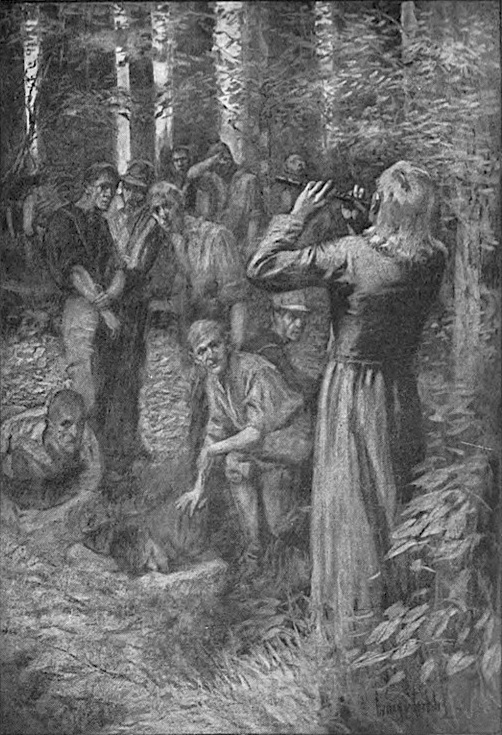
The Preacher's arrival stops a fight
Romance. The real heavy breathing in the novel involves the conflict between two women who compete for the heart and mind of Sandry. Young Siletz is a mysterious girl who works at the lumber camp for the cook. She is a child of the woods and embodies the spirit of the West, with her Indian name, meaning “Night Wind,” and her knowledge of Indian customs. In her are blended a spiritual purity made up of what she has learned from Nature and from a wandering preacher, a flute-playing and somewhat addled advocate of peace and love.

The other woman, Poppy Ordway, is a glamorous author from New York, who has come west with her typewriter to absorb local color for her current novel. She is a high-class vision straight from Fifth Avenue. Hovering on the brink of Fame—and sure of attaining it—she is surprised by her passionate desire to make a conquest of Sandry as well.

Sandry is suspended between his attraction to both women. One has his heart, but is only a simple girl of no particular breeding. The other, of good stock, comes with a pedigree. It’s a case of blue blood vs. a heart of gold. Meanwhile, he is unaware of the designs of either woman to bag him.

The choice is finally made for him in the forest fire that nearly sweeps them all to their doom. Siletz shows a willingness to die with Sandry in the flames, while Miss Ordway unceremoniously rides off on the only horse that will take her to safety. Saved by the arrival of rains that put out the fires, Sandry is finally assured of his love for Siletz, and they are set to live happily ever after.

Tuesday, December 6, 2011

Bend of the River (1952)

This James Stewart and Anthony Mann western makes an interesting comparison with Meek’s Cutoff, reviewed here last week. There are many of the same elements, including a wagon train, a hired scout, Indians, and the vast unsettled terrain of Oregon.

This Oregon is a good deal more picturesque, with forests, a distant snow-covered mountain peak, and a navigable river. Like Meek, Stewart plays a man with something of a past, though he rarely speaks of it. He’s run with border raiders in Missouri and Kansas during the Civil War, the scars on his neck evidence of an encounter with vigilantes.

It’s hard to believe likable James Stewart as a former bad man. While he is always an enjoyable screen presence, this is a role more for Clint Eastwood or Sam Elliott. Actually, it’s a role for Arthur Kennedy, who is also in the film as another former bad man. We first meet him, about to be elevated at the end of a rope, and Stewart saves him without asking any questions.

Plot. The two men team up and are joined later by a third man, a gambler played handsomely by Rock Hudson. The wagon train is harassed by Shoshone, who are dispatched one by one, 1950s style, by gun and knife. The travelers are received warmly by the folks in Portland, who give them a big send-off as they head upriver by steamboat to a valley where they intend to settle.

The warm welcome quickly disappears with the discovery of gold in the vicinity. Portland turns into sin city, and the settlers’ supplier reneges on a deal to ship them cattle and food for the winter. Stewart, Kennedy, and Hudson seize the goods and set out on a long trek, first by boat and then overland, blazing a trail over a mountain pass.

They are pursued first by the supplier and his henchmen, who come to an unhappy end in a fierce firefight. Then several hired hands mutiny, and with Kennedy taking charge, there’s a change of plans. He heads the wagons instead for a mining camp, where big money has been promised for delivery of the settlers’ food and cattle.

Left behind but undaunted, Stewart pursues them, and during a shootout in the midst of a river crossing, he struggles fiercely with Kennedy, finally overpowering him and sending his body down the river. Stewart’s past becomes known, and he’s recognized as a changed man. The supply train arrives at the settlement, where Stewart gets a big thank you for his efforts and the affection of Laura whose respect he has won.
 
Mount Hood, Sandy River, Oregon
Genre conventions. Indians in this film are menacing figures, plain and simple. There’s no debate about how to deal with them. It’s kill or be killed. Bad men are the same. Many bite the dust during the film, and their deaths are treated like ball players who have fouled out of the game. We see them fall dead, and for all we know they are left where they fall.

Filmed on location in Oregon, this color film makes the most of being outdoors. There are grand vistas, and steamboat lovers will enjoy the footage of river travel. Four-horse teams exert impressive effort as they pull wagons up to mountain snowlines, where beyond them distant valleys and ranges can be seen. The music track is correspondingly grand.

Though blacks are seldom seen in westerns, this one has the dubious presence of Stepin Fetchit, who does his usual slow-witted routine, as assistant to the ship’s captain. You can imagine a mid-century audience chuckling at his coon antics and you can cringe with embarrassment.

Women are present to add a grace note of femininity. Julia Adams, in fact, is grace under pressure. Wounded by an Indian arrow to the throat, she hardly pales under the primitive conditions of frontier health care. The traditional alcoholic doctor removes the arrow and prescribes a month of bed rest, during which she gets to liking city life and takes a job as a cashier in a gambling den. Instead of taking a shine to the likes of Stewart, she shows additional bad judgment by getting chummy with Kennedy.

Tuesday, November 29, 2011

Meek’s Cutoff

Imagine a western without a single western cliché. This one comes close. If it used documentary camera techniques, you’d call it a docudrama. But in fact a large part of the film’s effect is the artistry of the cinematography and editing, plus a haunting music track.

The plot of the film is based on an actual journey of emigrants by wagon train across Oregon in 1845. In the film, three families are traveling over high desert terrain, led by a Buffalo Bill-style scout called Meek (Bruce Greenwood), who may or may not know where he’s taking them.

The group dynamics begin to shift as some of them lose confidence in the blowhard Meek. One of the wives (Michelle Williams) has yielded, like the other wives, to the will of their husbands, who do all the deciding. But she doesn’t pretend to like or respect Meek. Eventually they lock horns.

Running low on water, with no sign of an anticipated mountain range ahead, they encounter a lone Indian in beads and buckskin leggings. After he is captured, Williams and Meek disagree over whether to kill him or keep him alive. Meek considers him dangerous, but she and others hope that he can lead them to water.

The difficulty is that neither understands a word of the other’s language. The Indian leads them onward, but it is never clear that he is taking them where they want to go. Meanwhile, one of the families relies on the good will and protection of the God they pray to. The wife of one man loses heart and panics, wanting only to go home. Another man falls ill.

Oregon high desert
With the loss of one wagon, they quickly regroup, generosity and helping each other coming as readily as the expected mercy of God. But their blithe acceptance of adversity and uncertainty is not assurance of eventual deliverance from the growing dilemma of their situation. They are lost in a harsh, uncharted land.

The film sloughs off all the Hollywood and textbook myths about transcontinental emigrants and leaves you with the more likely reality of the actual experience. Long takes and slow tracking shots mirror the slow, tedious process of covering hundreds of miles on foot. Shown sometimes as tiny figures moving across a serenely empty landscape, they appear plainly vulnerable to unspeakable dangers.

The startling effect of the film is the way it cuts you off from all the comfortable expectations of the Hollywood western. The most comforting of those is the element of story itself. Real life, someone has said, has lots of beginnings, some middles, and rarely the endings we are used to from fiction.

While there are plenty of story elements (character, setting, conflict), they keep dissolving into a formlessness that is more like life. You realize that if they ever reach their destination, there will be no ending and no happily ever after. Life will continue on as it has for them, rife with uncertainties and lack of resolution.

Without the usual conventions, Meek’s Cutoff puts the audience into terra incognita, just like the characters in its story. Watching it, you literally have no clue what if anything is going to happen next. It’s a strange, uncomfortable, but illuminating feeling. If the western is in fact entering a renaissance, Meek’s Cutoff is a doorway out of the dusty storehouse of overused western clichés into something new and excitingly different.

Further reading: An account of the 1845 emigrant train led by Meek

Photo credit: Wikimedia Commons

Coming up: Caroline Lockhart, Me—Smith (1911)