Showing posts with label western literature association. Show all posts

Wednesday, October 5, 2011

Overland Journeys in Early Western Fiction

On Thursday, at 8:00 a.m., I'll be presenting this paper at the Western Literature Association conference in Missoula, Montana. Thought you might like a preview.

In the brief time I have this morning, I’m going to try connecting a few dots in a way that’s related to the theme of this conference, “Bodies, Rest, Motion: Stasis and Mobility in the North American West.” I want to talk in particular about overland journeys by people traveling alone across sections of the frontier, and how that idea shows up in the fiction of a couple early western writers. 
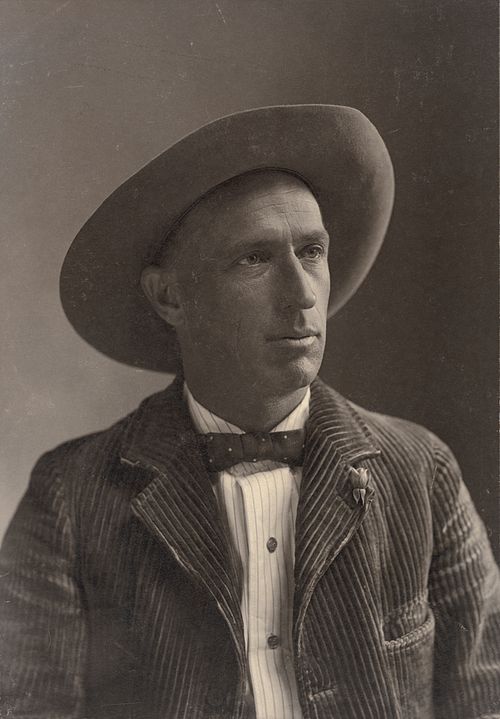
Charles Lummis
Charles Lummis. First I’ll mention two real-life journeyers, who traveled alone across the North American landscape in the late 19th century. One of them was Charles Lummis, who as something of a publicity stunt went on foot from Cincinnati to Los Angeles in 1884, a distance of 3500 miles, which took him 143 days. He wrote it all up for the newspapers as he went, and his book about that trip A Tramp Across the Continent was published in 1892.

He stayed on in Los Angeles and became a prominent and controversial citizen. His large collection of Indian artifacts became the basis of the Southwest Museum of the American Indian, which is now part of the Autry Museum of Western Heritage.

Roger Pocock. Another long-distance traveler was a Brit by the name of Roger Pocock, who was something of an adventurer. In 1899, he rode on horseback from Fort McLeod in Alberta to Mexico City, a distance of 3600 miles. In no particular hurry, he took 200 days to make the trip across Montana, through Indian territory and along the Outlaw Trail into the Southwest and on into Mexico. He claimed to have met Butch Cassidy, but then so did a lot of people.

Pocock was a novelist who returned to England and went on to found the Legion of the Frontiersman of the Commonwealth, a kind of amateur intelligence-gathering organization in the years leading up to World War I. 

Old Stage-Coach of the Plains, Remington
Others. The West had for decades been traversed by scientific expeditions, cattle drovers, U.S. cavalry, homesteaders, railroad builders, gold and silver prospectors, freighters, traders, and outlaws—not to mention the original inhabitants, typically moved about under duress.

Most had somewhere to go and something to get done, and few of them traveled alone. Like Lummis and Pocock, there were also those who crossed it as an adventure, a high-risk personal journey that was a test of endurance.

Western writers. As the history of the West morphed into mythology, this mythology was preserved and elaborated by the growing ranks of writers about the West. In their fiction the western landscape emerged as a sometimes forbidding terrain on which a mythic drama was played out over and over.

Typically that drama was about an individual, almost always a man, who was given or took upon himself a difficult task. Often that task involved a lonely, perilous cross-country journey, either on foot or on horseback. Today I’d like to touch on a few instances of that as time permits.

All of us know Owen Wister, who did much to help invent the genre of the western novel. He was by no means the only writer of stories set in the West at the time. In 1883, Mary Hallock Foote had a novel about silver miners in Colorado called The Led-Horse Claim. Her letters and papers, by the way, were eventually the source material for Wallace Stegner’s Angle of Repose almost a century later.

Charles King
In 1890, Charles King, an officer in the U.S. Army, had a novel set in Texas called Dunraven Ranch about the uneasy relations between a cavalry outpost and a nearby cattle ranch. Starting in 1897, Alfred Henry Lewis published the first of three comic novels set in an Arizona town called Wolfville, a thinly disguised fictional stand-in for Tombstone.

In 1899, Mollie Davis had a range-war novel set in Texas called The Wire-Cutters. That same year, Canadian author Ralph Connor produced the first of several novels, called The Sky Pilot, about an itinerant preacher on the range. Also in 1899, Frederic Remington, the painter, had a novel set in Montana, named after its half-breed protagonist, Sundown Leflare.

In 1901, a year before The Virginian, Stewart Edward White’s mining camp novel The Westerners was set like Deadwood in Dakota Territory. There another half-breed character runs a dancehall, corrupts the morals of a young woman, and plots against a prospector he dislikes. Then in the same year, we get Henry Wallace Phillips’ collection of short stories named after their main character, Red Saunders

And here we can see a shift taking place. Red is a big, healthy, physically strong, good-humored cowboy, with plenty of gumption and nerve. Living and working in Dakota Territory, he may be found attempting to escape a band of bloodthirsty Indians or joining his friends to help a love-sick cowboy elope with the rancher’s daughter. He’s a cousin of Owen Wister’s Lin McLean, a Wyoming cowboy who’d already appeared in a collection of stories in 1897. 

TR and John Muir at Glacier Point
The strenuous life. Teddy Roosevelt’s arrival in the White House seems to have ushered in a new twist on this material. An advocate of the strenuous life, he regarded the West as terrain for development of character. Out here, far from civilization, men like himself could prove their mettle.

And so we begin seeing more instances in western fiction of men who make a display of their manhood with long, lonely, sometimes perilous overland journeys. I’m going to talk about just two of the dozens of early western writers whose imagined West was captured between the covers of novels. One is Zane Grey. The other is Eugene Manlove Rhodes.

Zane Grey. Grey’s first novel was The Heritage of the Desert (1910). It tells the story of a man, Jack Hare, who recovers from an undisclosed sickness of both body and soul in the clean desert air of southern Utah. He is first of all saved from death by the patriarch of a Mormon family. But the real boost to his physical and spiritual health is the love he comes to feel for a half-breed Indian maiden, Mescal, who lives and works at the family compound. She is, alas, destined to be the second wife of the rancher’s villainous son.

Zane Grey at Penn, c1895
The test of Hare’s character comes in a long, protracted journey across the desert sands in search of Mescal, who has run off on her wedding night. He nearly perishes in his search for her, and when he finally finds her, they make a slow return to the ranch, along a route that takes them through the Grand Canyon. There in this magnificent setting, their love is cemented, if not consummated. More important, Hare has shaken off his former self and taken command of his life. By the end of the novel, he has defeated his enemies and won Mescal for himself.

Grey in this early novel is not yet the top-ten bestseller writer he would become a few years later, with The Lone Star Ranger (1915) and The U. P. Trail (1917). This novel is heavily melodramatic and suffers from having only one point-of-view character from beginning to end. It’s also an Easterner’s mythologizing of a West that Grey knew from very little first hand experience.

Eugene Manlove Rhodes. By contrast, Rhodes had grown up in New Mexico, had cowboyed, prospected, and held a number of frontier occupations. He apparently had known some shady characters as well. He was a Westerner who always wrote of the West, he said, with a regard for accuracy that kept him true to his subject.

Eugene Manlove Rhodes
Unlike Grey, who was apparently an indifferent student at the University of Pennsylvania, where he had a baseball scholarship, Rhodes was largely self-taught, too poor to attend college except for one year, which he financed himself. He is remembered as a voracious reader, who often read books while riding a horse.

His love of language and literature shows through in his stories, which are often cleverly told, while displaying a deep feeling for the integrity of his characters. His novel Bransford of Rainbow Range (1913) involves a long horseback ride along the Tularosa Valley all the way across the Rio Grande to Mexico. The protagonist, Jeff Bransford, is being pursued by the law for a crime he didn’t commit.

Rhodes does a reprise of this ride in Paso Por Aqui (1926). Again, the character is on the dodge from the law, and the description of riding, riding, riding is told at a pace that replicates the experience of covering long, sparsely populated distances. And each time, his rider is put to the test, proving the quality of his intelligence, his manhood, and his integrity.

As someone who grew up on a remote farm in Nebraska during the 1940s and 1950s, I recognize Rhodes’ account of time spent alone and in the open. While my traveling was on a tractor, back and forth across quarter-mile long fields of corn and hay, I know the inner experience he describes. To be there with your own thoughts hour after hour under a big sky of sun and clouds. In the chill air of early morning and the dry, hot wind and dust of mid-day. No radio, no iPhone. I know why cowboys sang, and why they talked to their horses. 

Cornfield near Mitchell, Nebraska, 1910
Wrapping up. What I’m driving at here has something to do with how both these writers use a similar plot device for very different ends. Grey in this early novel saw the West as the setting for myth, romance, and melodrama. The overland journey is a quest, and surviving the rigors of travel, his character lays claim to his manhood.

Rhodes sees the West in all its dusty, gritty reality. It’s a life in a harsh climate that is not softened by myth and romance but by humor and irony. Adversity is to be expected. It comes to a man unbidden. Only one already in full possession of his manhood accepts its challenges.

And manhood for Rhodes is measured by cleverness and frontier resourcefulness, not a fast draw or a fistfight. Jeff Bransford escapes the men who are on his trail by brazenly outwitting them. In Grey’s novel, the hero’s adversaries are villains, and he doesn’t get the best of them until they’ve been shot dead.

And this difference marks the way to the traditional and more popular western that flourished with Zane Grey. While Rhodes’ portrayal of westerners and the West has had its followers, the mainstream of Western fiction evolved in the style of Grey’s first novel. As a result, the long overland journey of the western novel itself has taken place in the romanticized West of melodrama, gunplay, and bloodshed.

Photo credits: Wikimedia Commons
Photo portrait of Eugene Manlove Rhodes, Journal of the Southwest, 1967

Coming up: John Neihardt, The Lonesome Trail (1907)

Thursday, October 28, 2010

Western Literature Association

The Western Literature Association has been meeting over in Prescott, Arizona. Some among this group of scholars have been happily reinventing the whole idea of American literature. The WLA blog reports a panel discussing the pioneering work of Annette Kolodny who wrote an influential article in 1992, “Letting Go our Grand Obsessions.”

She challenged back then a bunch of “grand” notions about what folks mean by “American literature.” One of them is the idea of “the frontier.” And since that’s a word that gets kicked around a lot in talk about westerns, I wanted to devote a few words to it here.

A new frontier. Kolodny argued that the frontier is not just the unsettled areas at the advancing edge of “civilization.” It exists in a geographical area, yes, but it’s not that area itself. It’s the place where different cultures come into contact and begin to merge. Think of Tex-Mex and you have an example.

Another example even closer to BITS is the absorption of vaquero culture and practices into what became the American cattle industry. Just think of all the Spanish words absorbed by cowboys into the English language: rodeo, lariat, ranch, buckaroo. A Texan version of this culture then traveled northward as far as Canada with the cowboys who adopted it.

We are used to thinking of this as a “dominant” culture and its language taking what it needs from a lesser one. Kolodny would see it as only another example of how cultures blend at the boundaries – a process that continues today in the multi-lingual Southwest and California. And with every new wave of immigrants to the New World, there are still those boundaries of contact. The frontier, she says, never closed.

She also reminds readers that Native American cultures had been bumping up against each other for centuries before the arrival of Europeans. There was a vast network of trade routes along which cultures and their products and technologies spread. Indians were accustomed to encounters with “foreigners,” whether friendly or hostile.

And one other thing to remember: the Native American populations were reduced more by “foreign” microbes than foreigners themselves. Europeans brought a kind of Black Plague with them that wiped out as much as two-thirds of those who were here first. This resulted in the impression among early explorers that the western frontier was virtually “empty.” It hadn’t been.

American literature, Kolodny says, has been whatever’s recognized as literary at the English-speaking urban centers. As a result – big surprise – any literature that came from points of contact with other cultures has been regarded as regional or “marginal,” and therefore of lesser importance. Maybe not even literature at all.

Connecting the dots. It’s early for me to be doing this, but I start connecting some of these ideas with the western fiction I’ve been reading. Some things pop out right away.

Life on the margins, Kolodny points out, is first about encounters with “foreign” landscapes and geography. This subject is often celebrated in western fiction, where stories involve individuals in a vast wilderness terrain or at the mercy of the elements. Thus, the little settlement that’s the only sign of human life from horizon to horizon came to represent “the frontier” in the American imagination.

More complex is the debate often going on in this fiction between Eastern and Western values. Or to use Kolodny’s terminology, think of it as a dialogue between the center and the margins.

Whether writers were Easterners or Westerners, the book-buying public was in the East. And it was the Eastern-based editors who were selecting what got into print. We can assume what they picked was their idea of what would sell.

So what we get in western fiction is what would fit Eastern notions of the frontier. And that includes the racial biases and the appearance of Native Americans, African Americans, Asians, “half-breeds,” and Mexicans as little more than cardboard stereotypes. There are exceptions, but they are not many.

The notion of a “half breed,” in fact, seems to have been the most repellant of all for readers, since that’s the way this individual is cast in novels. The French-Indian central character in Stewart Edward White’s The Westerners is supposed to make your skin crawl. White even explains the genetics that account for his amorality. It’s a short step from that to a similar view of any cross-cultural output. (Scholars, by the way, like to use the term “hybridizing” when cultures meet and mix.)

So the western novel is constrained by the assumptions of the East, and they come together in a myth about racial, cultural, and technological dominance over inferior peoples. Some readers and moviegoers still prefer that myth. It would be interesting to measure how much the early western helped create it. Meanwhile, scholars of American Literature are shaking things up in a way that may eventually create some new myths.

Further reading:
Annette Kolodny. “Letting Go our Grand Obsessions: Notes Toward a New Literary History of the American Frontiers,” American Literature 64.1 (1992), 1-18.

Image credits:
1) Book cover from Yellow Star: A Story of East and West (1911) by Elaine G. Eastman. Eastman was a teacher among the Lakota Sioux and wife of Native American physician Charles Eastman. Illustrators, Angel de Cora and William Henry "Lone Star" Dietz. Source: wikimedia.org.
2) Sioux tipis, Karl Bodmer, 1833; wikimedia.org
3) I Know'd It Was Ripe, Thomas Hovenden, c1885, Brooklyn Museum; wikimedia.org.

Coming up: A Year of Books