Showing posts with label zane grey. Show all posts

Tuesday, May 14, 2013

Gunfighters (1947)


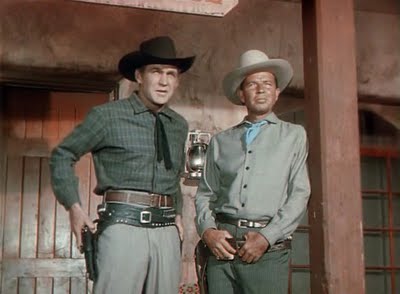
This is one of those westerns that might have been dreamed up by a 14-year-old. The plot is a far-fetched configuration of just about every convention of the genre. Based, as the credits tell us, on a novel by Zane Grey called Twin Sombreros (1940), it has that writer’s general disregard for history, reality, and geography.

That said, the film has the saving grace of a starring role for Randolph Scott, some excellent color cinematography, a few breathtaking stunts, and well-edited action scenes. If you ignore the worn conventions, the contrived plot, and the perfunctory romance, there’s enough to enjoy.

Plot. Scott is a gunfighter who is giving up his guns. Arriving at a ranch, where he hopes to take an honest job as a cowpuncher, he is moments too late to prevent the shooting death of an old friend. The two killers are already riding off in a cloud of dust.

Big-time rancher Mr. Banner (Griff Barnett) sees to it that Scott is arrested for the killing, and the posse nearly hangs him before he is rescued by another, friendlier rancher (Charley Grapewin). Taken to the sheriff in town, Scott clears himself and leaves again a free man.

Barbara Britton, Randolph Scott, Dorothy Hart
Determined to find the killers, he returns to the Banner ranch, where it turns out there are two sisters (Barbara Britton, Dorothy Hart) who take an interest in him, though one of them is only pretending. She’s covering for her true love, the ranch foreman (Bruce Cabot), who is the villain of the story.

Back at Grapewin’s ranch, Scott meets an aspiring young gunfighter (John Miles). He gives the boy some tips on fast drawing while warning him away from gun fighting as a profession.

Cabot and a deputy sheriff (Grant Withers) keep taunting Scott to put on his guns. Meanwhile, Cabot hires a shady character (Forrest Tucker) to do some dirty work. Tucker ambushes Grapewin, Withers provokes Scott into a long fistfight in the street, and Miles is chased by a posse and shot dead.

Borrowing a pair of sidearms to settle an old score with the deputy, Scott finds Withers at the sheriff’s office and gets a confession from him at gunpoint. The deputy admits that Banner was behind the killing of Scott’s friend in the opening scenes.

Forrest Tucker, Bruce Cabot
When it becomes clear to Hart that her father has been guilty of a long series of misdeeds, she begs Scott to go easy on him. He’s had to be tough to build his empire, she says. But Scott begs to differ. The old man has to be stopped. She angrily tells him, “You’re just a killer, you’ll always be a killer.”

Well, yes and no. When he arrives at the ranch, first Tucker and then Cabot draw on him, and the two men bite the dust. Hart, fed up with it all, has packed her saddlebags. Seeing her father draw on Scott, she picks up a revolver and levels a mortal shot at the old man.

The villains’ days now over, Scott decides to give an honest life another go, gets rid of his guns again, and rides off across the desert. Hart jumps on a horse and chases after him. They ride off together as the music swells.

Death. Scott is his handsome self, congenial and smiling, happy to banter with the two women in the story. He’s good for a kiss or two. But you never buy him as a gunfighter. He’s too clean cut and untouched by the string of deaths he’s been responsible for.

Forrest Tucker’s bushwhacker comes a good deal closer to the kind of cold-blooded and remorseless personality you would expect of a killer. Sullen and irritable most of the time, he relishes the moments as he draws a bead on Grapewin. He waits to pull the trigger, almost letting the man get away. Then he smiles like a kid with a new pony as he squeezes off a shot and sees his victim struck down.

For that matter, death itself is hardly worth anybody’s fuss. As in a video game, it occasions no one’s grief. Bodies are never buried. At the demise of her sweetheart, one of the sisters (Britton) slumps and turns away from the camera, as if to say, “There go all my plans.”

Thursday, January 24, 2013

Zane Grey, The Drift Fence (1933)


freeread.com.au
Zane Grey’s writing career was in full stride when this novel was first published in 1929 as a serial in the pages of The American Magazine. That year saw two other serials, in The Country Gentleman and Ladies Home Journal, plus short fiction in Collier’s and McCall’s.

Not much has changed since he found his basic western formula in his first novel, Heritage of the Desert (1910), reviewed here a while ago. A tenderfoot arrives in the Southwest, learns the ways of the West, wins the heart of a western girl, does battle with a nasty villain and his gang, and wins the approval of his superiors.

Plot. It is 1889 in open rangeland of Arizona, where cattlemen are being preyed upon by rustlers. Jim Traft, a young Missourian arrives at the invitation of his uncle, who wants to build a 100-mile fence to keep his cattle from drifting into the wrong hands. To put up the fence, Jim is made foreman of his uncle’s toughest group of cowboys, the Diamond outfit.

His cowboys don’t take kindly to being bossed by a tenderfoot, and they haze him mercilessly. To show his grit, he challenges them one by one to a fistfight and, as he beats them, gradually wins their grudging respect. They are finally just devil-may-care cowboys, not mean-spirited. The most likable of the lot is Curly Prentiss, who is among the first to befriend Jim.

The one mean one of the lot is Hackamore Jocelyn. He schemes to join up with the rustlers, who are led by a young gunman, Arch Dunn, also known as Slinger Dunn. Jocelyn instigates a plot to kidnap Traft and hold him for ransom from his rich uncle, then kill him, cut the fence, and run off a bunch of cattle.

Donkey rider, c1933
A young girl provides the story’s complications. Slinger Dunn has a sweet 16-year-old sister named Molly, who has won the heart of Jim Traft. He meets her at a fair and, before the day is over, gets a kiss from her and professes his undying love. From the start, they are star-crossed lovers.

Her brother, who has killed men before, attempts to put Jim out of the picture, and it’s something of a contest to see which of the two villains will be first to do the job. Molly defends her lover, throwing herself twice between Jim and a gun being drawn on him.

In the end, Jim wins her hand, and it is Jocelyn who dies, shot through the heart by Slinger Dunn. Molly’s brother is a good bad man after all, and in the closing chapter, Jim is offering him a job, to partner on a ranch he’s getting from his grateful uncle, and to go after yet another band of rustlers.

Character. Jim Traft is a man in the making. Decent and honorable but untested, he gladly assumes the responsibilities given to him, though the going is far from easy. In his favor is that he has both brains and brawn. He never loses a fistfight in the novel, even when one opponent attempts to “rooster” him, i.e. to kick him in the face with his spurs.

Hospital, Gleeson, Arizona, 1925
Never mind that this is hard to believe. Any one of a tough bunch of cowboys should have been able to beat a tenderfoot to a pulp. Forget that a tenderfoot would not have been given a foreman’s job over them in the first place.

In a reflective moment near the end, we find Jim wishing he could be more like the tough Slinger Dunn, a leader of men who survives several bullet wounds in a shootout with two gang members. Softening Dunn’s cold resolve, Jim also aspires to be like Curly Prentiss, a loyal friend with a playful sense of humor.

Romance.  Grey’s heroes fall hopelessly and head-over-heels in love. It almost undoes them they suffer so forlornly for the girls of their dreams. As in his first novel, Heritage of the Desert, the girl has to be rescued from the clutches of a darkly evil man. In this case, it is Hackamore Jocelyn, who has plans to leave the country with her, by force if necessary.

In part, it is also social class that comes between them. Nephew of a well-to-do cattleman, Jim seems far above Molly’s lowly station as the daughter of a poor settler. But Jim sees in her a natural simplicity, virtuousness and courage. Despite her “primitive” upbringing, she has the “instincts” of a lady. Later we discover that she is actually the granddaughter of Southern stock from Virginia. Her qualities are in the blood.

Friday, December 28, 2012

Zane Grey, Nevada (1928)


I’ve had a first edition copy of this book for about 15 years. It was given to me by a friend at work when I was just getting into western history—but not yet westerns. Watching the 1944 movie Nevada based on it (and reviewed here), I got curious about the original story. So it was time to read the book.

How the movie compares to the novel can be summed up in two words. It doesn’t. Besides the names of a handful of Grey’s characters, there’s not the remotest resemblance between the stories. Still, movie posters of the time advertised the film as “Zane Grey’s Nevada.” So much for truth in advertising.

Plot. In its 365 pages, the novel tells a complex story involving a gunman named Jim Lacy who is known to some characters as “Nevada” and to others as “Texas Jack.” As Jim Lacy, he has a reputation that puts fear into the hearts of even the bravest men. As “Nevada,” he is remembered by a California family as an honorable man who won their love and respect before disappearing in the novel’s opening chapter.

Windmill, Arizona, c1920
As “Texas Jack,” he’s a hard-working cowboy for an Arizona rancher, who goes after a gang of cattle thieves called the Pine Tree outfit. In a plot device often used later in B-westerns, he infiltrates the gang to learn the identity of its members. One by one, he then kills them.

Maybe two-thirds of the novel is devoted to the family from California, Ben Ide and his sister Hettie. Both have fallen deeply in love with the man they know as Nevada, and they leave California to take up ranching in Arizona, where each hopes to find him again. Alas, no one knows of a “Nevada” there.

By chance, Hettie learns that Nevada and the notorious Jim Lacy are one and the same. Stunned by this discovery, she decides to keep it from her idealistic brother. His early enthusiasm for Arizona is waning as he finds that he’s been cheated by the man who has sold him a ranch, and thieves are making off with his cattle.

When the paths of the two men finally cross, it is after Ben has become determined to see the man “Jim Lacy” hanged as a cattle thief. Having killed the last gang member, Lacy is being held under arrest when Ben first lays eyes on him. Overjoyed to be reunited with his long-lost friend, Ben learns that Lacy has been working undercover for two local ranchers. Any charges against him are handily dismissed.

Meanwhile, Hettie Ide has been shaken to her boots by this sudden turn of events. She feels unworthy of the courageous man whose true identity she’s doubted. For his part, having always worshiped Hettie, he feels unworthy of her. They finally get past their false assumptions about each other and agree to marry and live happily ever after.

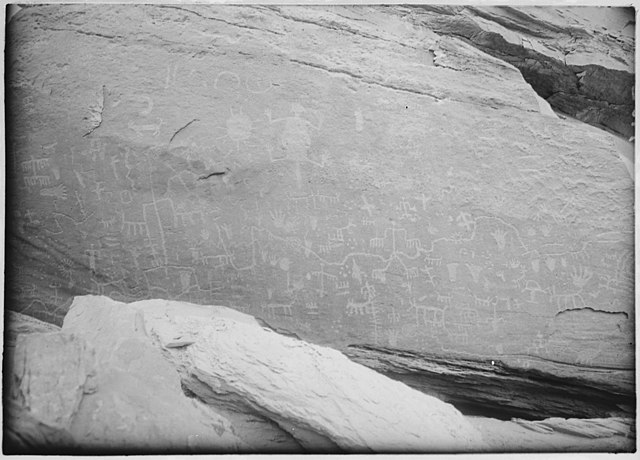
Pictographs, Arizona, 1903
Character. The strongest parts of Grey’s story have to do with the man of three faces, Jim Lacy. A decent and honorable man but given to violence, he is something of a wounded hero. As we learn in the opening chapter, he has killed others in the service of those he respects. But it also isolates him as a fugitive from those who would repay violence with violence.

More than once, Grey characterizes Jim Lacy as a “lone wolf.” Hiding out for a while in a remote canyon, he is swept up by feelings of loneliness and self-pity. There is a melancholy, despairing side of him. He knows shame for his part once in a stagecoach robbery. Yet while he lives at considerable risk, he knows no fear, for he “was not in love with life.”

Before he disappears from the narrative for much of the novel, he is established as a man who never loses his cool. He doesn’t drink, because alcohol affects his judgment and his skill with a gun. He avoids trouble and calmly declines to be lured into a gun duel by a man he scorns. He’s also unmoved by the come-on from a flirtatious saloon girl. But when she is beaten up by her boyfriend, he kills the man.

Cabin, Arizona, 1920s
Themes. The novel is a celebration of Arizona. Whole chunks of it would make rapturous prose poems for Arizona Highways. Zane Grey’s reputed love of the outdoors is in evidence on page after page.

For a western novel, there’s an unusual amount of it devoted to the subject of love and a resulting flood of romantic emotions. Besides Ben’s and Hettie’s frequent professions of love for the absent Nevada, we get Nevada’s lonely yearning for Hettie. There’s also a subplot devoted to the burst of first love that consumes a young cowboy Marvie and his sweetheart Rose.

Monday, December 26, 2011

Progress report

Owen Wister
Have you ever started out on a project that just kept growing? A year and a half ago I got the idea I’d like to read the novels of the writers who helped invent the western. There was Owen Wister and Zane Grey, and a gap of about a decade between them. I figured there was maybe a dozen writers at the time trying their hand at cowboy westerns. It would not be a big job.

Acquiring a few reference books, like Tuska and Piekarski’s Encyclopedia of Frontier and Western Fiction and Geoff Sadler’s Twentieth-Century Western Writers, I found there were a good deal more than a dozen. The notion of a “cowboy western” also enlarged until I was considering any fiction set in the West. Western writers of the time were also telling exciting stories about mining, railroading, and engineering projects. Cowboys sometimes figured in them; sometimes not. So the notion of a “cowboy western” got fuzzy and then kind of leaked away.

The period I was looking in expanded, too. There were more western writers than I expected to find who were publishing before Wister. If you think about it, there were “westerns” to be read from almost the beginning of American fiction. From the days of the first white settlements, there was always a “West” out there beyond civilization. I arbitrarily chose to draw the line at 1880.

At the other end of the period, I came to see WWI as an important watershed and chose to stop with 1915. That was also the first year after The Virginian that a western novel reached the annual top-ten best seller list at Publisher’s Weekly. It was Zane Grey’s The Lone Star Ranger. (His The U.P. Trail would go to no. 1 in 1918.)

What made the project doable at all was the purchase of a nook and the availability at Barnes & Noble of nearly every book I was looking for at .99 or free. So far, I have read the first novels or story collections of 48 writers, starting with Mary Hallock Foote’s The Led-Horse Claim (1883) and ending with George W. Ogden’s The Long Fight (1915). Meanwhile, my TBR pile of early westerns has kept growing.

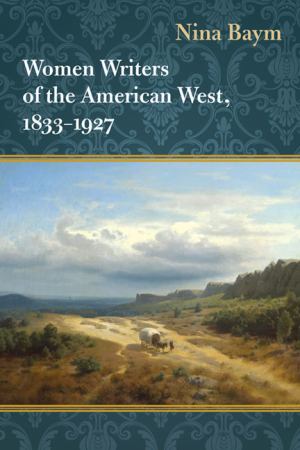
The light was at the end of the tunnel a week ago until I got my hands on a copy of Nina Baym’s Women Writers of the American West, 1833-1927. It’s an old story, and we know how male writers took over the genre of western writing. Women, it turns out, were also publishing volumes of fiction about the West. I’d found a few of them before now: B. M. Bower, Mary Austin, Kate Boyles, and Carol Lockhart. Now I’ve got a bunch more. Which is a lot of reading, but definitely cool. I like the idea of a more balanced picture.

So I am now miles away from the book I’ve been putting together about these writers. There’ll be about 75 of them when I’m finished. Maybe a year from now, you’ll hear me shout on the western wind, “I’m done!” In the meantime, I’m enjoying this project even more now than before, and I continue to believe I’ll be pleased with the end result and that readers and writers of westerns will find it fun and informative reading.

I’d be interested in hearing stories by anybody else who's had similar experiences.

Photo credits: Wikimedia Commons

Coming up: Tom Mix, Sky High (1922)

Wednesday, October 5, 2011

Overland Journeys in Early Western Fiction

On Thursday, at 8:00 a.m., I'll be presenting this paper at the Western Literature Association conference in Missoula, Montana. Thought you might like a preview.

In the brief time I have this morning, I’m going to try connecting a few dots in a way that’s related to the theme of this conference, “Bodies, Rest, Motion: Stasis and Mobility in the North American West.” I want to talk in particular about overland journeys by people traveling alone across sections of the frontier, and how that idea shows up in the fiction of a couple early western writers. 
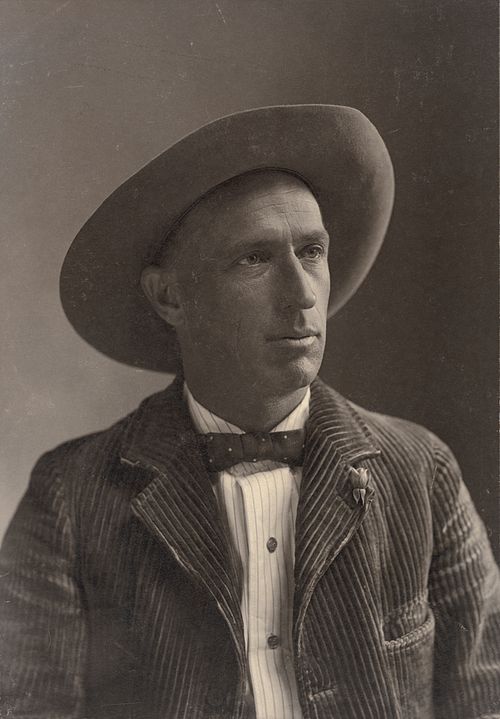
Charles Lummis
Charles Lummis. First I’ll mention two real-life journeyers, who traveled alone across the North American landscape in the late 19th century. One of them was Charles Lummis, who as something of a publicity stunt went on foot from Cincinnati to Los Angeles in 1884, a distance of 3500 miles, which took him 143 days. He wrote it all up for the newspapers as he went, and his book about that trip A Tramp Across the Continent was published in 1892.

He stayed on in Los Angeles and became a prominent and controversial citizen. His large collection of Indian artifacts became the basis of the Southwest Museum of the American Indian, which is now part of the Autry Museum of Western Heritage.

Roger Pocock. Another long-distance traveler was a Brit by the name of Roger Pocock, who was something of an adventurer. In 1899, he rode on horseback from Fort McLeod in Alberta to Mexico City, a distance of 3600 miles. In no particular hurry, he took 200 days to make the trip across Montana, through Indian territory and along the Outlaw Trail into the Southwest and on into Mexico. He claimed to have met Butch Cassidy, but then so did a lot of people.

Pocock was a novelist who returned to England and went on to found the Legion of the Frontiersman of the Commonwealth, a kind of amateur intelligence-gathering organization in the years leading up to World War I. 

Old Stage-Coach of the Plains, Remington
Others. The West had for decades been traversed by scientific expeditions, cattle drovers, U.S. cavalry, homesteaders, railroad builders, gold and silver prospectors, freighters, traders, and outlaws—not to mention the original inhabitants, typically moved about under duress.

Most had somewhere to go and something to get done, and few of them traveled alone. Like Lummis and Pocock, there were also those who crossed it as an adventure, a high-risk personal journey that was a test of endurance.

Western writers. As the history of the West morphed into mythology, this mythology was preserved and elaborated by the growing ranks of writers about the West. In their fiction the western landscape emerged as a sometimes forbidding terrain on which a mythic drama was played out over and over.

Typically that drama was about an individual, almost always a man, who was given or took upon himself a difficult task. Often that task involved a lonely, perilous cross-country journey, either on foot or on horseback. Today I’d like to touch on a few instances of that as time permits.

All of us know Owen Wister, who did much to help invent the genre of the western novel. He was by no means the only writer of stories set in the West at the time. In 1883, Mary Hallock Foote had a novel about silver miners in Colorado called The Led-Horse Claim. Her letters and papers, by the way, were eventually the source material for Wallace Stegner’s Angle of Repose almost a century later.

Charles King
In 1890, Charles King, an officer in the U.S. Army, had a novel set in Texas called Dunraven Ranch about the uneasy relations between a cavalry outpost and a nearby cattle ranch. Starting in 1897, Alfred Henry Lewis published the first of three comic novels set in an Arizona town called Wolfville, a thinly disguised fictional stand-in for Tombstone.

In 1899, Mollie Davis had a range-war novel set in Texas called The Wire-Cutters. That same year, Canadian author Ralph Connor produced the first of several novels, called The Sky Pilot, about an itinerant preacher on the range. Also in 1899, Frederic Remington, the painter, had a novel set in Montana, named after its half-breed protagonist, Sundown Leflare.

In 1901, a year before The Virginian, Stewart Edward White’s mining camp novel The Westerners was set like Deadwood in Dakota Territory. There another half-breed character runs a dancehall, corrupts the morals of a young woman, and plots against a prospector he dislikes. Then in the same year, we get Henry Wallace Phillips’ collection of short stories named after their main character, Red Saunders

And here we can see a shift taking place. Red is a big, healthy, physically strong, good-humored cowboy, with plenty of gumption and nerve. Living and working in Dakota Territory, he may be found attempting to escape a band of bloodthirsty Indians or joining his friends to help a love-sick cowboy elope with the rancher’s daughter. He’s a cousin of Owen Wister’s Lin McLean, a Wyoming cowboy who’d already appeared in a collection of stories in 1897. 

TR and John Muir at Glacier Point
The strenuous life. Teddy Roosevelt’s arrival in the White House seems to have ushered in a new twist on this material. An advocate of the strenuous life, he regarded the West as terrain for development of character. Out here, far from civilization, men like himself could prove their mettle.

And so we begin seeing more instances in western fiction of men who make a display of their manhood with long, lonely, sometimes perilous overland journeys. I’m going to talk about just two of the dozens of early western writers whose imagined West was captured between the covers of novels. One is Zane Grey. The other is Eugene Manlove Rhodes.

Zane Grey. Grey’s first novel was The Heritage of the Desert (1910). It tells the story of a man, Jack Hare, who recovers from an undisclosed sickness of both body and soul in the clean desert air of southern Utah. He is first of all saved from death by the patriarch of a Mormon family. But the real boost to his physical and spiritual health is the love he comes to feel for a half-breed Indian maiden, Mescal, who lives and works at the family compound. She is, alas, destined to be the second wife of the rancher’s villainous son.

Zane Grey at Penn, c1895
The test of Hare’s character comes in a long, protracted journey across the desert sands in search of Mescal, who has run off on her wedding night. He nearly perishes in his search for her, and when he finally finds her, they make a slow return to the ranch, along a route that takes them through the Grand Canyon. There in this magnificent setting, their love is cemented, if not consummated. More important, Hare has shaken off his former self and taken command of his life. By the end of the novel, he has defeated his enemies and won Mescal for himself.

Grey in this early novel is not yet the top-ten bestseller writer he would become a few years later, with The Lone Star Ranger (1915) and The U. P. Trail (1917). This novel is heavily melodramatic and suffers from having only one point-of-view character from beginning to end. It’s also an Easterner’s mythologizing of a West that Grey knew from very little first hand experience.

Eugene Manlove Rhodes. By contrast, Rhodes had grown up in New Mexico, had cowboyed, prospected, and held a number of frontier occupations. He apparently had known some shady characters as well. He was a Westerner who always wrote of the West, he said, with a regard for accuracy that kept him true to his subject.

Eugene Manlove Rhodes
Unlike Grey, who was apparently an indifferent student at the University of Pennsylvania, where he had a baseball scholarship, Rhodes was largely self-taught, too poor to attend college except for one year, which he financed himself. He is remembered as a voracious reader, who often read books while riding a horse.

His love of language and literature shows through in his stories, which are often cleverly told, while displaying a deep feeling for the integrity of his characters. His novel Bransford of Rainbow Range (1913) involves a long horseback ride along the Tularosa Valley all the way across the Rio Grande to Mexico. The protagonist, Jeff Bransford, is being pursued by the law for a crime he didn’t commit.

Rhodes does a reprise of this ride in Paso Por Aqui (1926). Again, the character is on the dodge from the law, and the description of riding, riding, riding is told at a pace that replicates the experience of covering long, sparsely populated distances. And each time, his rider is put to the test, proving the quality of his intelligence, his manhood, and his integrity.

As someone who grew up on a remote farm in Nebraska during the 1940s and 1950s, I recognize Rhodes’ account of time spent alone and in the open. While my traveling was on a tractor, back and forth across quarter-mile long fields of corn and hay, I know the inner experience he describes. To be there with your own thoughts hour after hour under a big sky of sun and clouds. In the chill air of early morning and the dry, hot wind and dust of mid-day. No radio, no iPhone. I know why cowboys sang, and why they talked to their horses. 

Cornfield near Mitchell, Nebraska, 1910
Wrapping up. What I’m driving at here has something to do with how both these writers use a similar plot device for very different ends. Grey in this early novel saw the West as the setting for myth, romance, and melodrama. The overland journey is a quest, and surviving the rigors of travel, his character lays claim to his manhood.

Rhodes sees the West in all its dusty, gritty reality. It’s a life in a harsh climate that is not softened by myth and romance but by humor and irony. Adversity is to be expected. It comes to a man unbidden. Only one already in full possession of his manhood accepts its challenges.

And manhood for Rhodes is measured by cleverness and frontier resourcefulness, not a fast draw or a fistfight. Jeff Bransford escapes the men who are on his trail by brazenly outwitting them. In Grey’s novel, the hero’s adversaries are villains, and he doesn’t get the best of them until they’ve been shot dead.

And this difference marks the way to the traditional and more popular western that flourished with Zane Grey. While Rhodes’ portrayal of westerners and the West has had its followers, the mainstream of Western fiction evolved in the style of Grey’s first novel. As a result, the long overland journey of the western novel itself has taken place in the romanticized West of melodrama, gunplay, and bloodshed.

Photo credits: Wikimedia Commons
Photo portrait of Eugene Manlove Rhodes, Journal of the Southwest, 1967

Coming up: John Neihardt, The Lonesome Trail (1907)

Wednesday, March 9, 2011

How to write like Zane Grey (cont.)

Thanks to readers who offered thoughts on Zane Grey’s popularity after my last post. If Grey had been one of the first western writers writing for a western-starved public, I’d be ready to agree with Walker Martin. Being first would have given him a head start on all the competition.

But with the success of Riders of the Purple Sage in 1912, he was really coming from the back of the pack. There were 20-30 other western novelists by that time. Some of them had already published several novels with established publishing houses.


Melodrama. Elisabeth observed that Grey’s novels are heavy on the drama, if not melodrama. I’d definitely agree with this. Of all the early writers I’ve read from this period, the melodrama is the defining feature of his storytelling.

And his kind of melodrama seems particularly heavy-handed. To be fair, it is youthful and maybe idealistic, but in the way that young people can be way over-serious. He writes from what seems to me an adolescent view of the world – big emotions and big scenes, but no irony.

Monday, March 7, 2011

How to write like Zane Grey

The success and popularity of Zane Grey continues to puzzle me. Reading the opening chapter of his novel The Drift Fence (1933), I stopped after the opening chapter to consider why I had little desire to read farther. So I have to wonder why the man's writing had the opposite effect on his legions of fans.

Surely contemporary western writers of the 1920s and 30s must have wondered the same thing as they tried to emulate him. Studying this book, they could well have derived the following rules for writing a compelling first chapter:

1. Introduce lots of characters and a couple place names in the first paragraph. This will get the story started off with a bang and give the impression that there's lots going on.

2. Write in short, choppy sentences. Some readers can process only one detail at a time.

3. Make your main character a sixteen-year-old. That way you don’t risk telling the story through someone smarter than your reader.

4. Provide all the exposition through dialogue. This is another advantage of a young point of view character. Everything has to be explained to them, so it’s easy for the reader follow.

5. Have characters speak in a drawl. This adds amusing local color.

6. Introduce a hopelessly stupid character. This will show the superior intelligence of the central character even though they know little themselves.

7. Keep it generic. Don’t confuse a reader with details and specifics that might challenge their vague ideas of geography and history.

8. Keep it simple. Your characters should all be recognizable types. Readers don’t want to be reminded that humans are infinitely complex.

9. Mix in some multi-syllable words. Using words that your characters would not use themselves shows off your vocabulary. Words like: insidious, imminence, wherefore, affirmative, nonchalant, and so on.

10. Feel free to over-dramatize. Don’t say, “When he was done talking, no one spoke.” That's too matter of fact. Say, “His ominous reasoning had a silencing effect upon his hearers.”

I could go on.

The irony is that in spite of all this, Grey became a hugely successful and wealthy writer. His novels were best sellers, with sales of 100,000 copies and more. Many were made into movies. Today he is one of the few remembered by the general public as a writer of westerns.

You might expect that his contemporaries wrote no better. Reading early western fiction, the great surprise to me is that so little of it seems dated. The writing is typically fresh, sharp, interesting, well crafted.

Apparently, even today, these aspects of craft somehow don't matter much to the average reader. For me, you can’t have a well-told story without them. Anyone out there attempting to do both, whether they find a big audience or not, has my complete admiration.

Photo credit: Wikimedia Commons

Coming up: Sam Brown, The Big Lonely

Monday, December 13, 2010

Eugene Manlove Rhodes, stories

Today I’m taking a quick look back at Eugene Manlove Rhodes. I have a copy of a story collection, The Rhodes Reader, assembled by W. H. Hutchinson in 1957. This is truly a “forgotten book” available only from used book sellers, even though reprinted a couple of times since then.

Hutchinson begins the book with an essay on western fiction at a time when as a genre it was still going strong, both in print and on screen. The heyday of pulp fiction was past, but he predicts that the western is here to stay. He only laments that it hasn’t been taken seriously as a narrative genre since Zane Grey first drew scorn from the literary establishment.

In his essay, he argues that Grey fixed the genre in a formula of three elements: “virgins, villains, and varmints.” Each is defined by a limited selection of stereotypes. He attributes this in part to a simple fact. Western writers, including Grey, were chiefly “outsiders” from east of the 100th meridian, writing about a West they knew only selectively and from partial experience.

Grey vs. Rhodes. Grey, as we’ve seen, was writing about a mythic West. He favors action and melodrama set against a panoramic backdrop of mountain, desert, and canyons. Romance is elevated to grand passion. Villains are evil and must die. It is escapism pure and simple.

After reading writers of western fiction who were his contemporaries, you soon notice his utter lack of wit and humor. If there is irony in his writing, it can be heavy-handed. He was no master of the light touch.

The son of a dentist, Grey grew up in Pennsylvania and Ohio. He went to the University of Pennsylvania on a baseball scholarship and was apparently a middling student. It’s worth noting that he knew the West as a place for adventuring. He wrote for Field and Stream, which featured his articles on hunting mountain lions and deep-sea fishing.

Sacramento Mountains, New Mexico
Rhodes, Hutchinson reminds us, grew up in Nebraska and Kansas before resettling with his family in New Mexico. He worked there as a cowboy, miner, freight hauler, and in at least a dozen other jobs from an early age. The characters in his stories were men he actually knew. It is said that he wouldn’t write a word that would ring false to any of them.

There are virgins, villains and varmints in his fiction, but he presents them with a feeling for the human comedy. To know all is to forgive all. The virgins are clever and surprisingly daring in their refusal to be sidelined because of their gender – or their need of rescue. Violence between adversaries is avoided if possible. Life is hard enough without willfully making it worse.

Rhodes was mostly self-educated and a voracious reader from an early age. His fiction is full of literary allusions and a playful love of language. There is wit and humor and a brand of irony that make light of adversity and the harsh conditions of western life. It is a “western” sensibility.

So today I’m briefly looking at a few of his first stories, all of them published before 1910.

Thursday, November 25, 2010

3-minute western

Happy Thanksgiving for everyone celebrating the holiday. For something different, I've put together a video I'm calling a "3-Minute Western" (suitable for timing your soft-cooked eggs). Thanks to Patti Abbott, who gave me the idea for something like this in the first place.

Hit play, and you can hear my midwestern twang as I read the first two pages of Zane Grey's novel, The Heritage of the Desert, which I reviewed here recently. It's a thrilling beginning, as a man at the point of death hears two men debating the pros and cons of saving his life.


3-minute western: Zane Grey, "The Heritage of the Desert" from Ron Scheer on Vimeo.

Enjoy your holiday! Hope you're with family and friends and folks you care about.

Coming up: Dan O'Brien and Nebraska writers

Monday, November 22, 2010

Zane Grey, Heritage of the Desert (1910)

I put off reading Zane Grey (1872-1939) until after I’d read about a dozen other western writers from this period. Just to see if I could tell why he became so suddenly and hugely popular. Which is pretty much what happened.

Grey was in his late 30s, schooled as a dentist, and an unknown writer of magazine articles about fishing and baseball. Though he’d been an indifferent student in college, he aspired to follow in the footsteps of Owen Wister, whose novel The Virginian (1902) was a best seller.

But his efforts at novel writing had earned him nothing but disappointment. Not only that. One editor is supposed to have told him he had no talent for writing fiction at all. On his last dime, married, and the father of a little Grey, he threw everything he had into a last ditch effort.

It was a story of adventure on the deserts of northern Arizona, where he'd been the guest of a buffalo rancher in 1907. The defendant in a paternity suit while he was still in college, he also seems to have drawn on a degree of reckless infatuation with women. Once in print, the result was a ripping yarn that flew off the shelves. He had stormed the publishing establishment – both Harper’s and Street & Smith on the same day – and the public had declared him a winner. It was all fame and fortune from then on.

The plot. The novel begins in the desert of southern Utah. It is the 1870s. The central character is a young man, Jack Hare. He shows up suddenly on page one, discovered at the point of death by a Mormon rancher, who has taken to heart the parable of the Good Samaritan.

The rancher, August Naab, is the patriarch of a large family, with two wives and several sons and daughters. His ranch is an oasis in a canyon near the Colorado River, just over the line into northern Arizona.

Hare is a consumptive and needs nursing back to health. Naab puts him to work with an adopted daughter, Mescal, who tends his herd of sheep. Mescal is a half-breed, her father a Spaniard and her mother a Navajo. Out in the open air, Hare not only recovers his health; he falls for Mescal in a big way.

The first 100 pages of this novel are actually kind of tedious. Nothing happens that you can’t see coming a mile away. Then it takes off like fireworks and doesn’t let up until the end. Mescal, we learn, has been promised to Naab’s oldest son Snap, who is no prize. He’s a drinker, a killer, a wife-beater, and has friends among a band of rustlers who work for another rancher, Holderness.

Holderness is the main villain of the novel, moving in on other ranchers’ ranges, stealing their cattle, taking away their water, killing a man now and then as needed. Naab, a god-fearing man, refuses to fight him. He also has high hopes for his wayward son, Snap. Neither of these objectives works out.

Mormon and wives, photo by C. Weitfle (1836-1921)
While the family celebrates the wedding of Mescal and Snap, the bride-to-be disappears into the night. Snap snaps and the new leaf he’s turned to win everyone’s good will goes right to hell. He takes off and joins up with Holderness against his father.

Meanwhile, Hare is in agony over the absence of his true love, and he travels across trackless wastes in search of Mescal. With the help of her dog, Wolf, he eventually finds her. And they return to the ranch, after a perilous crossing of the Colorado River.

There are more escapes and chases, and a final shoot-out occurs in the Mormon settlement of White Sage, where Hare kills Holderness, and the remnants of the band of cowboy rustlers are either shot or hanged. Finally, the much-delayed consummation of the love between Hare and Mescal takes place with an idyllic wedding. After enough bloodshed, the strongest have survived, and peace and love return to the desert.