For starters, this book is not about Allan Pinkerton,
founder of the famous detective agency. As we discover in the subtitle, it’s
about
The Amazing Life and Times of James McParland (1843-1919), who headed up Pinkerton’s western
division, based in Denver. McParland, in his early career had been instrumental
in infiltrating the Molly Maguires, the secret militant arm of a union of Irish
coal miners in Pennsylvania.
His success in dismantling this organization was
controversial, and remains so today, where sympathies gather in favor of
exploited labor against ruthless and unchecked capital. At the time, the 1870s,
it gained him a reputation that impressed even the fictional master of detection,
Sherlock Holmes. Later years would find him in the hire of mine owners,
breaking sometimes-violent strikes with hard-knuckle tactics of his own at
locations throughout the West.
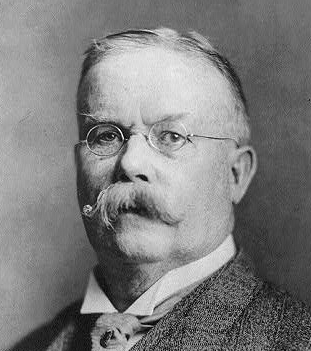 |
| James McParland, 1907 |
McParland, by Riffenburgh’s account, makes an elusive
subject for a biography. He boasted of accomplishments that seem not to have
been his own, and he seems to have masterfully covered his tracks for anyone
attempting to reconstruct his professional and personal life. A man of
subterfuge in the pursuit of troublemakers and outlaws, he left little trace of
himself in the way of reliably documented records. The result is an account of
him that is to a great extent guesswork.
Readers with an interest in law enforcement in the
historical West will find the latter half of this book informative. Here we
find McParland joined by his most trusted operative, Charlie Siringo. Fearless
as was his boss, Siringo was also adept at winning the confidence of labor
organizers and thieves, to find his way inside targeted organizations and gather
intelligence to be used against them in court—or less admirably, to be leaked
to vigilantes.
We learn of the crime-ridden frontier of the 1890s, marked
by waves of train and bank robberies. Riffenburgh devotes chapters to the
outlaws who drifted in and out of Butch Cassidy’s gang as they repeatedly
eluded capture, even gloried in their ability to rob and steal with impunity
over a vast area of the West. We also meet Cassidy’s compatriot, Harry
Longabaugh, better known as the Sundance Kid.
 |
| Charles Siringo |
Caveats. The book’s
subject and its title promise more than they deliver. Riffenburgh has done
yeoman’s work in piecing together a factual record of McParland’s career, but a
reader may be disappointed in the results of his efforts. They seldom add up to
what should be a vivid portrait of the man. Dashiell Hammett seems to have had
him in mind as the prototype of his fictional agency director, “the Old Man,”
known to operatives as “Pontius Pilate, because he smiled pleasantly as he sent
us out to be crucified.”
That characterization comes miles closer to capturing the
man in words than Riffenburgh’s final admission that McParland “was, is, and
forever will remain an enigma.” These two quotes side by side are the best
argument for historical fiction over history. (Curious and curiouser, to find
the source of that Hammett quote, you have to go to a website online to find
the book’s footnotes.)
If you want a ripping suspenseful account of high-risk
detective work, Riffenburgh’s book (despite its four pages of acknowledgments
and the 5-star reviews at amazon) seems hardly to find much depth or
excitement in its subject. Despite its title, it will be not “amazing” for
readers looking for both history and a page-turner.
Wrapping up. A
historian with a PhD in history from the University of Cambridge, Riffenburgh
is described on the book’s dust jacket as the author of books on polar
exploration, including Shackleton’s in the Antarctic. Pinkerton’s Great
Detective is currently available in ebook, audio, and hardcover at
amazon and
Barnes&Noble.
Image credits: Wikimedia
Commons
Coming up: Alan Ladd, The Proud Rebel (1958)


