 |
| New haircut |
Saturday, February 28, 2015
Fathers and sons


Thursday, February 26, 2015
Luke Allan, Blue Peter: “Half-Breed” (1921)
 |
| Métis fur trader, 1870 |
Blue Pete, a Métis cattle rustler who leaves a gang of horse and cattle
thieves to work as an informant for the North-West Mounted Police, first
appeared in 1921 in a short story in Western
Story Magazine by Canadian-born writer William Lacey Amy (later to be known
as Luke Allan). That same year, the character appeared in Blue Peter: “Half-Breed,” the first of a long series of Blue Pete
novels, published in both London and New York, the last of which saw print in 1954.
Blue Peter is a love/crime
fiction story set on the Canadian frontier, where the North-West Mounted Police
are stationed at Medicine Hat to
maintain law and order. Their main problem is a gang of horse and cattle
thieves fearlessly operating along the international border with the U.S. and using
the Cypress Hills, a rough patch of wooded terrain in southern Saskatchewan , to hide out (cf. Jackson Hole, Wyoming).
Plot. As the story
begins, Blue Peter parts company with the gang in an exchange of gunfire, meets up with a young
Mountie, Constable Mahon, and is persuaded to work as an
informant, sharing what he knows of the Hills and how they are used by the thieves
to hide stolen stock; infiltrating the cowboys who work for ranchers on the
open prairie, he reports any questionable behavior to the chief inspector at
NWMP headquarters.
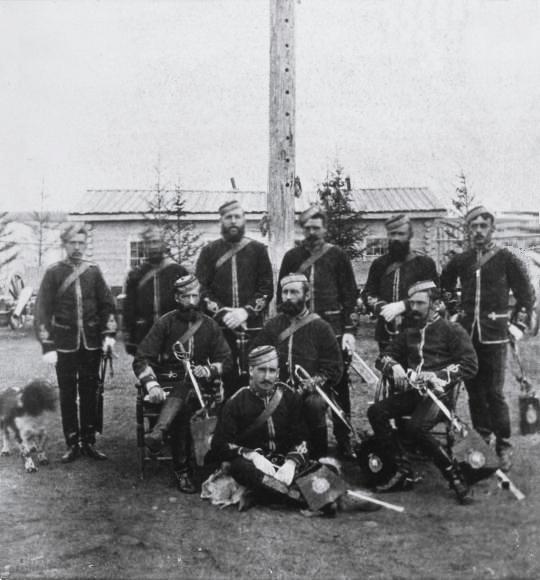 |
| North-West Mounted Police Fort Walsh, 1878 |
As it turns out, one family, the Stantons, are actively in cahoots with the gang. Caught in the act, two brothers, Jim and Joe Stanton, kill each other
rather than allow themselves to be taken by the Mounties. Their sister, Mira,
has been an accomplice in their thieving activities. She is an all-western
girl, skilled as a rider and roper, pretty and independent-minded, embarrassed
only by her lack of education and refinement.
Mahon, who has a girlfriend of his own, befriends Mira and helps her with
the book-learning she desires. Meanwhile, grief-stricken at the loss of her
brothers, Mira warms to him but holds him culpable for their deaths. In a fit
of melodrama, she shoots and kills three of her four wolfhounds.
Romance. Blue Peter
then comes to her rescue, offering her his cave in the Hills for shelter and
his own companionship for solace. Standing trial for cattle theft, Mira is
found guilty and sentenced to six months in prison. As she is being transported
there by train and under guard, Blue Peter comes again to her rescue, and they
are pursued on horseback by Mounties across the prairie. After the two are run
aground, Mira surrenders herself to save Blue Peter, now a wanted man, from
arrest.
Back at the cave, he waits mournfully through the winter for her
release from prison. At last,
with the coming of spring they are reunited.
Adventure. The latter
part of the story is devoted to the capture of the gang, as exchanges of
gunfire result in Mahon’s (now Sgt. Mahon) being wounded and the arrest and/or
death of the rustlers. Blue Peter is also a casualty, shot as he saves Mahon’s
life. At the end of the novel, there is reason to believe that Blue Peter’s wounds
are mortal and once his body is found, Mira vows to bury him there in the Hills
he loved.
For his part, Mahon has a granite monument carved as a memorial to the
“half-breed” who was his friend. So the novel has this melancholy and sentimental
ending. But like a modern-day TV series with a season finale lacking finality, Blue Peter and Mira live on to reappear
for another adventure in a sequel, the Return
of Blue Pete published in 1922.
The accuracy in the portrayal of Blue Pete is debatable especially in
comparison with Frederic Remington’s mixed-blood title character in Sundown Leflare (1899), who speaks in
broken, French-inflected English, and possesses no particular moral character. Physically
strong and a creature well adapted to the natural world, Blue Pete has no
faults. He is decent to the core, loyal, tenderhearted and willing to take a
risk to help a friend. Outside of James Fenimore Cooper we do not find his
likes in American frontier fiction.
Blue Peter:
“Half-Breed,” is currently available online at Internet Archive and in
ebook format at Barnes&Noble.For more of Friday's Forgotten Books click on over to Patti Abbott's blog
Further
reading/viewing:
Blowing my own horn: For an in-depth, two-volume survey of early writers of frontier fiction, read How the West Was Written (to obtain a copy, click here).
Image credits:
Wikimedia Commons
Coming up: new short
stories
Sunday, February 22, 2015
Meds again
 I feel like Hunter Thompson
in the opening pages of Fear and Loathing
in Las Vegas –waiting for the drugs to kick in. I look at the pill bottles
collecting on the dining room table and wonder at the mix of pharmaceuticals
circling in my bloodstream. Thursday of this week I was at the UCLA Medical
Center getting another infusion of Avastin and an adjustment to my intake of
drugs and supplements – this time, more steroids and more antidepressants. All
to deal with an undertow of counter-productive moods, lethargy, and general
grumpiness.
I feel like Hunter Thompson
in the opening pages of Fear and Loathing
in Las Vegas –waiting for the drugs to kick in. I look at the pill bottles
collecting on the dining room table and wonder at the mix of pharmaceuticals
circling in my bloodstream. Thursday of this week I was at the UCLA Medical
Center getting another infusion of Avastin and an adjustment to my intake of
drugs and supplements – this time, more steroids and more antidepressants. All
to deal with an undertow of counter-productive moods, lethargy, and general
grumpiness.
Lately, I’ve also been made aware of a lot of anger that comes out
as I struggle with losses of strength, coordination, and equilibrium, (I am
covered in scratches and Band-Aids from the last spill I took while out on a
morning stroll in the desert a few days ago. Because I bruise easily now I also
bear a striking display of purple blotches from wrist to elbow.)
Wednesday, February 18, 2015
Nik Morton, Spanish Eye

I know Nik Morton more as a
writer of westerns. His Bullets For a
Ballot was reviewed here a while ago. Spanish
Eye is something else.
Nik is one of those Brits who left the dark, rainy North for the sunny
south coast of Spain, which is where this collection of 22 stories, featuring
private investigator Leon Cazador, takes place.
Like Henning Mankell and other writers of euro crime fiction, Morton
shares what he’s come to know about crime and the criminal element in Spain, though
never painting it as dark as writers of the Scandi-noir school. Against a
background of social conditions in modern-day Spain, it’s petty crime mostly,
systemic graft, and fraud that find their way to Cazador’s attention. Meanwhile,
the menace of organized crime and mafia elements lurks in the shadows.
Sunday, February 15, 2015
Knickers and twists
 |
| DMV |
Today’s post may be short. We
have guests coming to celebrate a friend’s becoming recently a U.S. citizen.
Fortunately, my wife has the energy required of entertaining. I have been in a
fog all week; at one point I was standing in a parking lot staring blankly
ahead with not a thought anywhere between my ears, which, ironically, is the
nearest I get to meditation in the crowded thoroughfare of neural activity that
is my usual level of awareness. I assume it is the meds I’m getting as a
participant in the drug trial at UCLA.
Thursday, February 12, 2015
Guy Vanderhaeghe, A Good Man

I wanted to like this novel more
than I did. For its length (464 pages), it promises somewhat more than it
delivers. I had the same reaction to the author’s The Last Crossing (reviewed here a while ago). There are a lot of
ideas and food for thought in this novel about character, friendship, responsibility,
Native Americans, the frontier, and U.S.-Canadian relations. But in the end
it’s hard to say what it all adds up to. You can puzzle if you like over the
title. Who among the novel’s male characters is the “good man”? Is there one at
all?
Set in the late 1870s, partly in the Cypress Hills of Saskatchewan where
Fort Walsh was headquarters for the North-West Mounted Police; but mostly in
the frontier settlement of Fort Benton, Montana, on the upper Missouri River, the
action takes place in the aftermath of Custer’s defeat at the Little Bighorn
and settlers of the sparsely populated prairie live in terror of the Sioux and
other tribes who seem to be organizing under the leadership of Sitting Bull to rid
the West of whites altogether.
Wednesday, February 11, 2015
Richard Wheeler’s blog
 |
| Richard S. Wheeler |
I have been meaning to mention that Richard Wheeler has begun blogging
again after a long hiatus. His most recent news is that the Western Writers of America is honoring him with induction to the WWA Hall of Fame at their next
meeting in Texas. After several Spur Awards, he
was already chosen in 2001 for that organization's Lifetime Achievement Award, named for Owen Wister.
A man who has characterized himself at his previous blog as a
“curmudgeon,” Wheeler can be counted on for sometimes prickly opinions on a wide
range of subjects: the current state of the traditional western; the proliferatrion of creative
writing programs; and author input to book cover design. Informative is his story of his own long-running Barnaby Skye series. His book reviews are generous in their
praise for thoughtful writing. He can also be revealing in disclosures of his personal
life, his health and state of mind, looking both back and forward at a long and productive writing career.
Subscribe to:
Posts (Atom)