Showing posts with label tom mix. Show all posts

Tuesday, September 30, 2014

Tom Mix, The Miracle Rider (1935)


One of the earliest on-screen appearances of Tom Mix (1880-1940) was as himself in the 1910 western documentary Ranch Life in the Great Southwest. Filming on location in Oklahoma, a director for Selig Pictures had found him working as a local deputy sheriff and hired him to handle stock.

Asking for a part in the picture, Mix got a scene as a bronc rider in a rodeo sequence. At the age of 30, he’d been married three times and had taken various jobs with a series of Wild West shows. Later the same year, he was starring in a two-reeler, The Range Riders, shot in Missouri.

By 1920, when he surpassed William S. Hart in popularity, Mix had accumulated acting credits in something like 235 films, all of them silent, most of them shorts. Of these he’d directed over 100. Like William S. Hart he’d begun featuring his horse, Tony, in the credits.

Tuesday, December 27, 2011

Tom Mix, Sky High (1922)

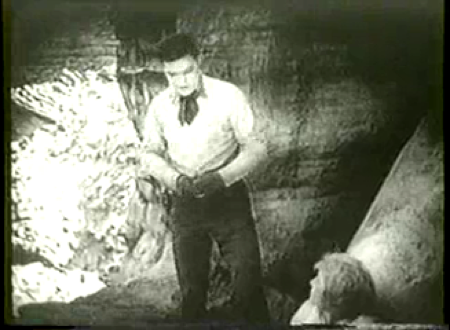
What a thrill this must have been for moviegoers in the early 1920s. Mix and director Lynn Reynolds go out for high adventure in the most spectacular canyon of all, Grand Canyon. Not only is there plenty of action up and down the canyon walls and in the water, but an airplane is worked into the story, with breathtaking aerial footage.

Plot. The situation in the story is unfortunately still topical 90 years later. Tom is a Deputy Inspector of Immigration, watching the US-Mexico border for illegal entry. This time around, it’s Chinese sneaking in, and we see him detaining a car full of passengers who turn out to be Chinese men dressed in women’s clothing. He ties a rope to the car and takes them into custody. All in a day’s work.

Next we learn that a couple of crooks have brought in 200 “chop suey eating Chinamen” along with a fortune in smuggled jewels and laces (yes, laces). Where they cross the border is not clear, but for unknown reasons they’re holed up in a camp at the bottom of Grand Canyon.

Tom gets an assignment to infiltrate the operation and learn who the kingpins are. There’s not much of a mystery to be solved. Tom finds out what he needs to know in short order and there’s only the matter of authorities to be notified and arrests to be made.
  
Tom Mix and Eva Novak
Also smuggled into the story is a romantic interest for Tom. A young woman, Estelle (Eva Novak), recently graduated from a “fashionable seminary” in Chicago, arrives at the Grand Canyon to summer with her guardian. Little does she know that her guardian is one of the alien smugglers. Affronted by the fresh advances of a male companion, she ventures into the Canyon alone and gets lost.

On an unofficial walkabout from the camp, Tom chances to meet her just as she falls from a ledge into enough water to get her soaked to the skin. He carries her, unconscious, to a ledge in the canyon wall where he provides her with blankets, a change of clothes, and some food to keep soul and body together. They picnic on crackers and sardines before turning in for the night.

Tom’s absence from the camp is noted, and he and Estelle are discovered by two of the villains. Tom is captured, fighting about 15 men until he's tied up and told that he can look forward to being drowned in the Colorado River. But he escapes, cutting his ropes with the sharp edge of a sardine can.

Mix in flight
The rest of the film is a series of chases on foot and horseback, fistfights, and not a few daring stunts. Tom (or his stunt man) scales up and rappels down canyon walls like Spiderman. The most spectacular stunt involves climbing down a rope and hanging suspended from under a biplane, finally dropping with a splash into the river.

Tom. As in Just Tony (reviewed here last week), Tom lights up the screen with his presence. Unlike the lugubrious William S. Hart, Tom is eager, athletic, and quick with a smile. Not much in the way of a ladies man, he can get playful when a woman is around. He hangs a blanket for Estelle to step behind while she changes clothes, and though his back is turned you know he’s aware of her draping over it the garments she’s taking off.

Eva Novak, 1924
Far more respectful and well mannered than the young cad who tries to steal a kiss from her, Tom waits until the last minute of the film to reveal his feelings. When her guardian asks Tom to look after her while he does time in federal prison, Tom says he’d happily look after her for the rest of her life! Then he joins her at the edge of a cliff and politely kisses her before the fade to black.

Just 50 minutes long, Sky High was one of the six to nine Tom Mix feature-length films produced every year during the 1920s until the introduction of sound. It is currently available and streamable at amazon. Tuesday’s Overlooked Movies is the much appreciated enterprise of Todd Mason over at Sweet Freedom.

Photo credit: Wikimedia Commons

Coming up: Ted Kooser, Lights on a Ground of Darkness

Tuesday, December 20, 2011

Tom Mix, Just Tony (1922)

Appearing in over 300 movies during his career in Hollywood, Tom Mix made this film in honor of his horse Tony. In its 58 minutes, the film tells of a wild mustang also named Tony who has lived with his band of horses in the Nevada deserts. There he is observed by a cowboy from Utah, Jim Perris (Tom Mix), who hopes one day to be Tony’s owner and "pal."

Captured by a man who mistreats him, Tony is saved from further harm by Jim, who has come to town for a rodeo. His giving the horse-abuser a thorough pounding in the dusty corral is appreciated by an observer, the pretty Marianne, recently returned from an Eastern college.

Marianne’s father owns a horse ranch, whose stock is being driven off by his shady foreman. Jim helps Marianne buy four new mares by preventing Tony from losing a race at the rodeo, and Tony eventually escapes back to the desert. As the foreman and his cowboys go after the wild horses with guns, Tony retaliates by stealing away the four new mares.

Marianne hires Jim to capture Tony, promising the horse to him if he’s successful. The foreman tries to interfere, but Jim is able to catch Tony in a trap. He ropes and rides him, bucking bronco style, until Tony finally throws him, knocking the cowboy unconscious. Remembering how Jim had saved him once before, Tony takes an interest in the man's welfare and follows him back to his cabin.

In an exciting finish, as Marianne and Jim are dodging bullets while being pursued by the ranch hands, Tony comes to the couple's rescue. Together they ride on his back to safety at the ranch. There Jim settles an old matter with her father and instead of returning to the desert to roam free, Tony decides to stay with Jim.

Tom Mix, 1919
Just Tony was adapted from the novel Alcatraz by Max Brand, which had appeared as a five-part serial the same year in Country Gentleman. The film was shot at Lone Pine in the Sierras of central California.

Pitched to a young audience, the movie is wonderfully unembarrassed in its sentiments. Talking to Marianne, Jim professes his love for Tony and his hope that Tony will some day love him. Rescued from abuse, Tony receives from Jim’s gentle hand the “first caress” he has ever known.

Tony is indeed a wonder horse, chewing through ropes, opening gates, and taking down fences. If we can believe the inter titles, he even has human thoughts. Concerned for Jim’s welfare when he’s waylaid by three bad men, he sees Marianne arriving and thinks, “A woman. More trouble.” 

Mix is a warm, athletic presence before the camera. In his gigantic hat, wide leather chaps, and handsome shirts, he comes close at times to disappearing inside his outfit. Apparently doing at least some of his own stunts, he leaps over fences, rolls down a steep sandy bank, and rides the sunfishing Tony until he is thrown off.

The photography is often scenic, with snow-capped mountains in the background as horses and riders race across sagebrush flats, deserts, and wide rivers. Scenes from a rodeo include a parade, rough stock events, and a thrilling horse race.

Director and scenarist Lynn Reynolds is credited with 81 films during a Hollywood career cut short in 1927, when he took his own life during a party being held in his honor. Included in his credits are numerous westerns, including film adaptations of Henry H. Knibbs’ Overland Red (1920), Zane Grey’s Riders of the Purple Sage (1925),  and B. M. Bower’s Chip of the Flying U (1926).

Just Tony is currently available and streamable at amazon. Tuesday’s Overlooked Movies is the much appreciated enterprise of Todd Mason over at Sweet Freedom.

Sources: 
imdb.com
maxbrandonline.com

Photo credit: Wikimedia Commons

Coming up: Kent Meyers, The Work of Wolves

Friday, September 17, 2010

First westerns: D. W. Griffith and Tom Mix

It's Friday again and time to continue our little survey of the first western movies. This time, two other major figures in Hollywood. One came from New York as a director with a long list of film credits. The other was a  jack of various trades living in Oklahoma. By 1920, the first had already made the one great film he'd be remembered for. The other was on his way to becoming one of the biggest cowboy stars of all time.

D. W. Griffith, c1925
D. W. Griffith. The directing career of D. W. Griffith (1875-1948) began with Thomas Edison’s company Biograph, where he made the one- and two-reelers that the New York-based filmmaking Trust permitted. Two early westerns, made in California, are his Fighting Blood and The Last Drop of Water, both released in 1911.

The first is set in Dakota Territory and concerns an Indian attack on a settler's cabin. The second tells of a wagon train, facing various perils, including another Indian attack and running out of water. In a melodramatic resolution of this latter problem, one man dies and is left behind.

Directed by D. W. Griffith, 1914
His final film before leaving Biograph was a two-reeler western, The Battle of Elderbush Gulch (1914). This film featured yet another Indian attack and rescue by the cavalry. It starred Mae Marsh and Lillian Gish.

After that, given the freedom to make the monumental feature-length films he had in mind, D. W. had bigger fish to fry. But before the end of the decade, after the success of Birth of a Nation (1915) and the failure of Intolerance (1916), it was all over.

According to film historian Jon Tuska, what Griffith brought to the western were filming and editing techniques that would make the story more exciting for the audience. As one example, he advanced the art of crosscutting, taking us back and forth between two different threads of action – the embattled settlers and the cavalry racing to the rescue. These techniques he continued to perfect in his feature-length films.

You can see the entire Battle of Elderbush Gulch below. The film's scope is ambitious for a two-reeler, especially as the screen fills with large numbers of Indians and settlers in hand-to-hand combat, horses milling among them, and dust flying.


Tom Mix, 1919
Tom Mix. The first on-screen appearance of Tom Mix (1880-1940) was in the 1910 western Ranch Life in the Great Southwest. At the age of thirty, he’d been married three times, was an Army deserter, and held various jobs, including employment with the Miller Brothers’ 101 Ranch Wild West show.

Filming on location in Oklahoma, director Francis Boggs found him working as a local deputy sheriff and hired him to handle stock. Asking for a part in the picture, Mix got a scene as a bronc rider in a rodeo sequence. Later the same year, he was starring in a two-reeler, The Range Rider, shot in Missouri.

Released 1920
By 1920, when he surpassed William S. Hart in popularity, Mix had accumulated acting credits in something like 235 films, most of them shorts. Of these he’d directed over 100. Like William S. Hart he’d begun featuring his horse, Tony, in the credits.

But unlike the high seriousness of Hart, Mix had a high-spirited, show-business persona. Gone was the realism and sentimentality of Hart’s post-Victorian portrayals. Comparing the two cowboy stars, you see a major cultural shift happening in almost the blink of an eye.


Source: Jon Tuska, The Filming of the West, New York: Doubleday, 1976.

Picture credits:
All images from wikimedia.org


Coming up: More on Rex Beach