Showing posts with label alaska. Show all posts

Thursday, July 17, 2014

Rex Beach, The Spoilers (1906)

As a writer of popular fiction, Rex Beach hit the ground running with this, his first published novel, set in the gold rush days of Nome, Alaska. Its story was based on actual events and portrays attempts by crooked lawyers, politicians, and a judge to jump claims of legitimate miners already extracting fortunes from the gold fields.

Plot. The central character is Roy Glenister, a young and ambitious man, who has been prospecting for three years with his partner, an older man named Dextry. Their mine, the Midas, is one of the richest in the area. Returning by steamer from Seattle, where they have spent the winter, they learn that their claim is being challenged in court, and until the suit is settled, the Midas is being put in receivership, to be operated by a lawyer, Alec McNamara.

His intention is to make off with all the gold while the dispute remains stalled in legal proceedings. The judge, Stillman, provides the authority to carry out the plan, denying all requests to expedite judgment and refusing any appeals. A U.S. marshal arrives to enforce the law, such as it is, and the judge has troops from a nearby army post for support should they be needed.

Once the miners realize that they are the victims of a plot to steal their claims, they organize as vigilantes to take them back by force, threatening Stillman and McNamara with bodily harm. Glenister, who prefers to avoid violence is caught in the middle. He has fallen in love with Stillman’s niece, Helen Chester, and wants to stay in her good graces.
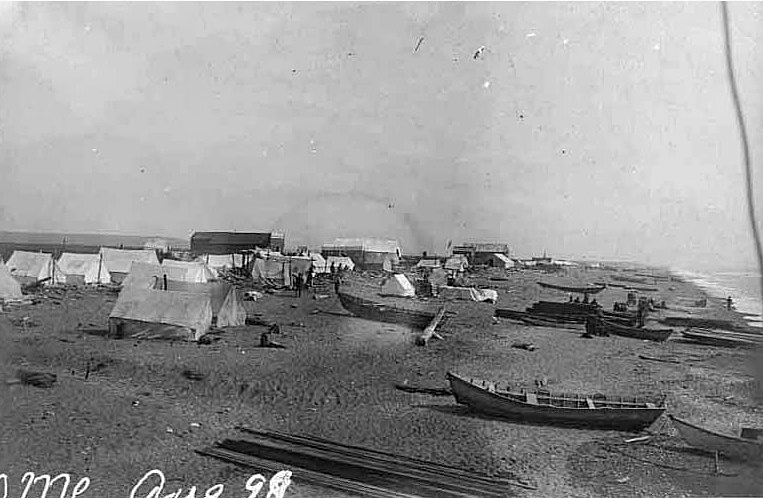
Nome beach, 1898
Romance. A standard theme in fiction of the period, the life-transforming attraction of a man to a young, pretty woman, drives much of the novel’s plot. Out here beyond the fringe of civilization, Helen Chester stands for law and order. Glenister tells her it’s “God’s free country” and the only law that’s needed is courage and a Colt’s. But he offends her when he tells her he subscribes to the Darwinian principle of survival of the fittest. “What I want, I take,” he says and steals a kiss.

Realizing that this kind of behavior is not going to win her heart, he complies with court orders without a fight, believing it will show him in a better light. But she is not persuaded. There is a “reckless energy” about him that lacks self-restraint. She is more taken by the likes of McNamara, whom she trusts as a representative of the law and the colleague of her uncle.

Friday, August 30, 2013

Rex Beach, Pardners (1906)


I reviewed this book three years ago while looking for cowboy stories and neglected its several stories set in gold rush Alaska. As I put together a chapter on Rex Beach for a book on frontier fiction, I’m correcting that oversight. Here is some of what I have added.

The subject of two prospectors working together as partners is at the heart of Rex Beach’s Alaska stories in this collection. One pair, Big George Brace and Charlie Captain are featured in three of them. Involved in daring adventures, usually saving the lives of others, they eventually must confront a life-threatening risk that may permanently separate them.

“Where Northern Lights Come Down o’ Nights.” In this story, Big George and Captain are up against a rogue priest, Father Orloff, a Russian who has a wide influence among the indigenous Eskimo tribes. Receiving a cold and threatening reception as the two partners arrive in one of their settlements, they claim sanctuary in the church. There they wait through a storm and make plans to escape before Father Orloff shows up with the certain intention of killing one or both of them.

“The Scourge.” This, the most disturbing of the Alaska stories, has death by scurvy as its subject. George and Captain come upon an encampment of 125 newly arrived prospectors who have dug in for the winter. Instead of putting up log cabins for shelter, they are living in dugouts, where Captain tells them that without air, light, exercise, and the right diet, they are certain to fall ill.

"The Scourge"
Unwilling to take anyone’s advice, they stay put, coming to dislike the industrious duo, who venture out daily to work in the snow and cold. Without preventatives like potatoes, limejuice, and citric acid, they begin to develop scurvy and start dying in numbers.

Short on rations themselves, George and Captain are also at risk and nervously watch for symptoms of the disease. When George falls ill, Captain and another man, Klusky, start off on a days-long journey for fresh grub.

“Pardners.” The title story, however, concerns a big, rough bruiser, Bill Joyce, who tells of taking a young tenderfoot under his wing. They have mixed fortunes as prospectors, but the real drama involves the young man’s wife back home.

When she doesn’t answer his letters, he gets so heartsick the two men return to the States. In Seattle, they find her singing in a variety show. She considers the marriage over because of some unflattering photos she has seen of her husband in the newspaper. In doing a photo feature on life up north, a sensation-seeking journalist has made him out to be a carouser and womanizer.

"The Thaw at Slisco's"
“The Thaw at Slisco’s.” Billy Joyce narrates this story as well. Several prospectors gather during a fierce winter storm in Slisco’s roadhouse, where they are joined by Annie Black, a hard and bitter woman considered with some contempt as a claim jumper.

When a nearly frozen Eskimo stumbles in out of the storm, they learn that two Swedes are still out in the snow about to perish. Annie marshals a rescue, shaming the reluctant men into leaving the comfort and safety of the roadhouse. The two Swedes are brought back alive. When a pretty young woman arrives in search of her mother, the mother turns out to be Annie.

Character. There’s a recurring theme in many of the stories that defines character as the willingness to make sacrifices for the sake of others in distress. That sacrifice usually involves a risk to one’s own life. It matters not whether a person in need is an adversary. You put past differences behind you and go to his aid.

Tuesday, May 21, 2013

The Spoilers (1942)


This 1940s gold-rush western is jaw dropping. For one thing, it has John Wayne in black face swapping “colored” jokes with African American actress Marietta Canty. What was probably meant to be cheeky and rib-tickling in 1942 looks just plain racially insensitive today.  For another, the movie has Randolph Scott as a slick crook. And it’s no fun watching him use his patently pleasant and winning persona to trick honest folks into trusting him.

Another thing. Veteran actor Harry Carey is more or less wasted in a small two-dimensional role. And while that makes three strikes, The Spoilers isn’t quite out. It has the saving grace of Marlene Dietrich as a sultry and spectacularly dressed saloon owner. Her scenes with both Wayne and Scott are steamy with flirtatious bantering and sexual innuendo.

Plot. Another point in the film’s favor is its plot. Based on a bestselling Rex Beach novel of the same name, published in 1906, The Spoilers tells a ripping story of claim jumping in the Alaska gold fields. John Wayne and Harry Carey are mine owning partners whose claim to their mine is being challenged in court.

Randolph Scott, John Wayne, Marlene Dietrich
A crooked judge (Samuel S. Hinds) promises to clear up the cooked-up dispute and puts the mine and all its assets into receivership. He’s in cahoots with the local gold commissioner (Scott), who takes a safe full of gold from the mine’s offices as soon as they can lay hands on it.

Wayne is first trusting that the case will be settled fairly, while Carey trusts no one, and the two men part company for a while. When it’s clear they are being had by a bunch of “spoilers,” they engineer a bank robbery and, after dynamiting the front door, make off with their safe.

But during the robbery, the town marshal is accidentally shot dead by another man, and Wayne is blamed for the killing and thrown in jail to face murder charges. Scott arranges with the jailer to allow Wayne to escape, intending to have him shot dead as he attempts to ride off. But Dietrich foils that plan and gets Wayne safely out of jail herself.

To take back their mine, Wayne and Carey drive a train locomotive through the barricades set up around the perimeter and shoot it out with the armed men on guard. That leaves only a matter to settle with Scott, and the two men have a knock-down-drag-out fistfight that demolishes most of the saloon. When it’s done, Scott lies battered in the street, and Wayne comes around in the arms of Dietrich, bloody but smiling.

John Wayne, Marlene Dietrich
Romance. At the film's start, Dietrich and Wayne have been an item of long standing, but there’s trouble between them as he arrives in town on a ship from Seattle. On board, he’s befriended the judge’s daughter (Margaret Lindsay), unaware that she knows of the plot against him. Dietrich suspects him of being untrue, and the scenes between the two are less than sanguine.

Wayne plays tough with her, hoping she’ll relent, but he’s disappointed her once too often. She tosses him out of her apartment, a comfortably furnished retreat upstairs from the saloon. One of her employees, a gambler by the name of Bronco (Richard Barthelmess) has romantic hopes for her himself, but she keeps putting him off.

Enter Scott, who sets his eye on her, too. She strings him along for reasons of her own. As an investor in Wayne and Carey’s mine, she has an interest in keeping the mine in their hands. While Wayne is in jail, she pays a call on Lindsay, the other woman. By this time, father and daughter know the jig is up and are packing their bags to get out of town.

Why are you running away, Dietrich wants to know. A woman sticks by the man she loves. And that’s exactly what Dietrich does, breaking Wayne out of jail. Having learned of Scott’s scheming, she pretends to grant him some privileges. Thinking Wayne is dead, he is quick to take advantage.

Friday, April 12, 2013

Robert Dunn, The Youngest World: A Novel of the Frontier (1914)


There are long novels, and then there are monumental novels. This one falls in the latter category. It is not one but as many as four separate adventure stories folded into a saga of a man’s journey to Alaska to make something of himself and to understand the meaning of existence. Few early westerns take on such an ambitious project, but Dunn is determined to give it a go.

Plot. His main character, Gabriel Thain, starts out as a confused and unhappy 25-year-old. On impulse, he books passage on a coastal freighter sailing from Seattle to Alaska. En route, he meets two people, Clara, who catches his fancy, and an explorer, Robert Snowden, who persuades him to climb a snowbound mountain peak with him. The climb is arduous and finally a killer. Thain survives, but Snowden, snow-blind, succumbs to mountain fever and freezes to death before reaching the top.

Back off the mountain, Thain joins a party of explorers from Idaho, led by a forthright man, John Hartline. They have found copper in the interior of the territory but are up against the greedy machinations of a big copper trust. A crew employed by the trust blocks their way and a gun battle ensues.

Mt. McKinley, Alaska, 1903
Thain treks by dogsled for months across the uncharted land, meeting all manner of colorful and intrepid frontiersmen. One of them, Dick Trueblood, saves his life when he falls through ice into a river. Thain then winters in a mining camp, Chickaman, a desperate place full of desperate people.

In an isolated valley, he discovers gold and stakes a claim. To his surprise, he also discovers Clara nearby. They travel by skow on an open channel in a frozen river, and they narrowly escape death in an ice jam.

Skip ahead a year or more. He and Clara are operating a trading post in an Inuit village along the coast. A pair of speculators arrives on the monthly mail boat. They have invested in Thain’s claim and want to see it. With Thain, they strike off into the approaching winter.

After many weeks, without locating the claim, they reach the end of their rations and their strength. The horses, unable to go farther, have been shot. The dogs pulling their sled have drowned in the river. Looking at certain starvation and death by exposure, they are rescued in the novel’s final pages by another prospector, Thain’s old friend, Trueblood.

Climbers on Mt. McKinley, 1903
Women and romance. There is plenty in the book about males and females getting together in the quest to live happily ever after. But this is not your usual romance. Always rationalizing, Thain is not content to just let libido lead the way. Love has to fit into some grand design of the Universe. Woman has to take her place alongside a bunch of other capitalized abstractions: Self, Nature, Love, Fate, Charity, and the Great Will of Existence.

In the wilderness, he gets conflicting advice from other men about women. Climbing the mountain, he comes to understand that for Snowden women are not a necessity. Conquering an unclimbed mountain is grander than being a husband and father. Later, Dick Trueblood tells Thain that attachment to women is the ruin of men because they make a man too soft, and you have to stay tough in the wilderness.

When Thain and Clara marry, he is troubled when after a year she has been unable to conceive a child. Their lack of offspring erodes the confidence he struggles to have in himself. He believes their union is incomplete until she has made him a father.

Dogsled
Character. Like other early western novels, this is a story about the building of character. When we meet Thain, his life has gone off the rails, chiefly because he has been willful and impulsive. During the rest of the novel, he keeps meeting men who demonstrate different ways of being strong and independent.

In the final chapters, facing death on the trail, he realizes that he has finally lost all of his self-doubt. He has a confidence born of “his own lonely being.” All comes together for him as he comprehends once and for all that he is “a wanderer, marching eternally upon the common trail of life.”