Showing posts with label book reivew. Show all posts

Thursday, February 20, 2014

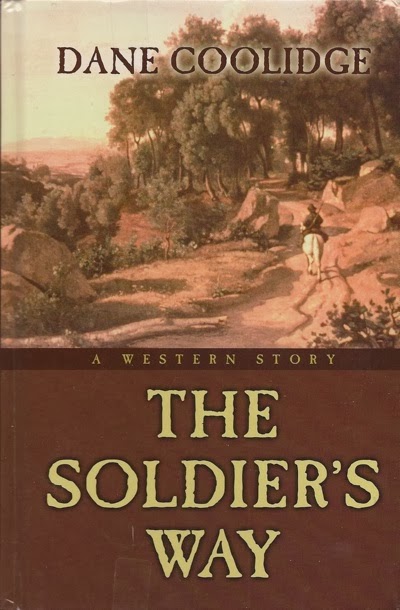
Dane Coolidge, The Soldier’s Way (1917)


This is a ripping yarn set among a band of American mercenaries and soldiers of fortune during the last years of the Mexican Revolution. It appeared first in 1917 as a four-part serial in The Popular Magazine. While prepared in a book-length version by Coolidge, it was not published as such until 2006 by Five Star.

Plot and character. The story is based on that of the so-called Gringo Battalion that fought in the army of revolutionary general Pancho Villa. Coolidge singles out two Americans from among them to illustrate the daring, the egoism, and adrenalin-fueled risk taking that drive the actions of such men.

One is the Irish-American Beanie Bogan, who with the rank of sergeant commands the respect of a small “legion” of American fighters, most of them deserters from the U.S. Army. The other is Bruce Whittle, a descendant of the Scots warrior hero, Robert the Bruce. While Bogan is all business, a skilled leader of fighting men and a veteran of combat, Whittle is a man seeking oblivion in death on the battlefield. The girl he passionately loves has married another man.

In spite of himself, Whittle has an instinct for survival that not only keeps him alive. His high-risk exploits earn him popular acclaim, while making him an outlaw at home. As a U.S. citizen he is deemed guilty of violating his homeland’s official policy of neutrality in the conflict.

Mexican rebel camp, c1911
Set on the international border along the Rio Grande, the story starts on the U.S. side in Del Norte, where Bogan recruits Whittle into the “foreign legion” fighting under Col. Gambolier, a French military consultant to revolutionary general Pepe Montaña. The underfed, poorly armed, and undisciplined army of revolutionaries is camped in the mountains above the garrison town of Fronteras, well defended by government troops. Military progress is at a stalemate.

In a strategy to isolate the town in advance of an attack, Bogan and Whittle accept a mission to dynamite a key bridge on the railway from the interior. Their job done, they find themselves betrayed by Montaña and Gambolier. This sets in motion a series of plot turns that has the Americans assembling their own assault on the town. The remaining chapters are an account of fierce street fighting, as they make their way by night and house by house to the central plaza to lay siege to the government strongholds.

Tuesday, September 17, 2013

Pamela Nowak, Changes


This historical western romance is equal parts history and romance. Set in Omaha in 1879, it tells of a trial that was a milestone in advancing Indian rights. The central character is a young woman, one-quarter Sioux, who falls quite in love with one of the attorneys in the trial.

Plot. Lise Dupree is a survivor of the 1863 Sioux Uprising in Minnesota, which ended in the mass execution of 38 Indians and the tribe’s forced removal to the western prairies. Passing as white, she works as a librarian at the Omaha Public Library, a job she would not be able to hold if her Sioux background were known.

When a small band of Ponca Indians from the Niobrara refuses to be relocated to Indian Territory, they are taken prisoner, chiefly through the effort of an Indian agent, Rufus Christy. Their situation is abetted by a scheming politician, Adam Foster, who has groomed a protégé, Zach Spencer, for election as state senator.

The Ponca are being held by the Army at Fort Omaha without charge. To delay and hopefully prevent further action against them, they sue for a writ of habeas corpus. Spencer as district attorney is called upon to make the case in court in defense of the government. Foster welcomes the trial because it will ignite the anti-Indian vote and give Spencer free publicity in the newspapers.

What gets ignited instead is Spencer’s sudden attraction to Lise as he first meets her while using the library’s law books. And the attraction is mutual. Young and handsome, with a boyish charm, he thrills her with his flirtations. His only fault, in her eyes, is that he’s building a case against the Ponca rather than in their support.

Chief Standing Bear
She is already quietly helping Tom Tibbles, the editor of the Omaha Herald, and Susette LeFlesche, whose father is chief of the Omaha. Both are marshaling a legal team and doing research for the Ponca. Sympathetic to their cause is General Crook, commanding officer at Fort Omaha.

Thus is set in motion a courtroom drama in which an argument based on treaty law is pitted against one on Constitutional law. While Indians are not citizens, what’s at issue is whether they are people covered by the 14th Amendment. This dimension of the story is illuminating, and a reader is reminded of the Kiowa chiefs trial related in Johnny Boggs’ Spark on the Prairie, reviewed here recently.

Nowak has done some research, and she has taken most of her characters from the pages of history, including General Crook, Tom Tibbles, Susette LeFlesche and her father, the plaintiff attorneys, the trial judge, and the Ponca chief himself, Standing Bear.

Romance. Sharing the storyline of competing legal and political interests is the romance that flourishes between Nowak’s two fictional characters, Lise Dupree and Zach Spencer. Theirs is an affair heated by intense attraction and frustrated by a variety of obstacles. They are repeatedly drawn together and forced apart again by misunderstandings, divided loyalties, and the meddling interference of Foster and Christy.

Nonreaders of western romances—and I’m thinking mostly of males—will be more than a little surprised by the explicitness of Nowak’s love scenes. The sexual tension builds from the couple’s first encounter. Almost nothing is left to the imagination as their meetings escalate from fevered kissing and groping to unbridled intercourse.

Wednesday, August 1, 2012

Jean Henry Mead, Escape

This novel might also have been called No Escape, for it tells the story of a young woman, Andy, taken hostage by some Hole in the Wall desperadoes on the run from the law. Her hair cut short and disguised in men’s clothes, she is mistaken for a boy by the gang. One of them discovers her identity, a boy named Billy, who is little older than she. He agrees to keep her secret and does his best to protect her.

Far from home, she is trapped among her captors and put to work as cook and domestic. Meanwhile, she develops an attachment to Billy. He’s a neophyte in the gang, with little criminal experience, and she wants to save him from the life of an outlaw. As the law is cracking down on rustlers and robbers with increasing ferocity, there seems little future in frontier crime anyway.

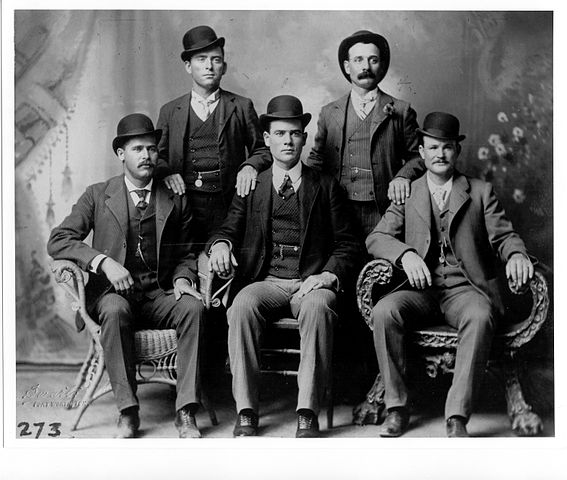
Characters. While Butch Cassidy figures only briefly in the story, Harry Longabaugh (the Sundance Kid) has a turn in a parallel plot involving a bank robbery in Belle Fourche, South Dakota. Longabaugh is not the congenial sort that Robert Redford made memorable in the movies. He’s a bit cranky and impatient. When the bank robbery is a fiasco, we find him to be little more than the above-average crook.

The Wild Bunch, Fort Worth, Texas c1900
Other characters of interest include Harve Logan, who attends Longabaugh on the ill-fated robbery attempt. The two get captured and jailed, then escape together, only to cross paths with two low-lifes with nefarious plans to join the Wild Bunch. We also get to know Tom O’Day, the man who bungles the robbery, chiefly because of a bad drinking problem.

Jim McCloud is another man bound for the Hole in the Wall when we first meet him. Freshly escaped from prison, he’s jumping trains, shedding his prison clothes and worried that his prison-shorn hair will give him away. Also memorable—for his stutter—is Jim’s friend, Dick Hale.

Plot. Much of the novel involves a winter trek across Wyoming by Billy and Andy as they deliver a change of horses for the Belle Fourche bank robbers. Having left the horses at an agreed place, the two then set off into bad weather on a return journey that takes many days and finally leaves them lost, on foot, and freezing from cold.

Along the way they encounter one difficulty after another. Meanwhile, Andy is torn by her growing affection for Billy and his resistance to her pleas for him to leave the gang. For him, the gang is his only family, and Butch is like a big brother to him. Failing to persuade Billy, Andy wants only to get back home, but obstacles continue to prevent that from happening.

Jean Henry Mead
Wrapping up. Mead has marshaled a good deal of history about members of the Hole in the Wall gang. The book closes with an account of the fate of many of them. I’d recommend readers to jump to that section first, because it provides an informative context for the story she has to tell.

Historical accounts, which focus on incidents and dates, don’t reflect the actual day-to-day experience of the men and women who lived outside the law. Of the Hole in the Wall gang and Butch Cassidy’s Wild Bunch, the novel captures the long months in hiding and the lack of diversions besides playing cards. Food was unvaried and bad. Illness and gunshot wounds had to be doctored with home remedies.

Traveling for days at a time across rough and hostile terrain in the worst of weather was a tedious, often life-threatening trial. Holed up in a cabin with the same handful of men week after week was no less wearying. Mead’s novel removes the romance and excitement from what we imagine as the outlaw life, and leaves us with what’s left, and it’s not exactly all thrills. I won’t think of the Wild Bunch again without recalling Mead’s portrayal of them.

Escape is currently available at amazon and Barnes&Noble and for the kindle.

Jean Henry Mead is a writer of historical fiction and mysteries, as well as an award-winning photojournalist and writer of children’s books. She is a frequent interviewer of western writers at her blog, Writers of the West. You can find out more about her at her website.

Image credits:
The Wild Bunch, Wikimedia Commons

Coming up: Lewis B. France, Pine Valley (1897)

Monday, March 19, 2012

John Sayles, A Moment in the Sun

This will be the briefest review of one of the longest books I’ve ever read. At 955 pages, Sayles’ novel set at the turn of the last century comes in just short of Larry McMurtry’s Lonesome Dove. The difference between the two is that there’s not a single long-winded passage in Sayles. And there’s more packed into it per square inch even than McMurtry’s multi-character, multi-plotted cattle drive novel.

Like Lonesome Dove, I read this one because it comes square in the middle of a historical period I’ve been interested in. Taking place between the years 1897 and 1902, it portrays a moment in American history when the frontier had closed and the country took its first steps toward empire with the Spanish-American War.

The novel is largely about that war, a small part devoted to the adventure in Cuba and a much greater part to the war in the Philippines. There we are treated to points of view from three sides, white troops of volunteers, black U.S. Army troops, and the “insurgents” fighting them. And all of it is set in the larger context of life back in the States.

I can tell you the names of the handful of soldiers whose lives we follow with considerable intimacy from start to finish. But I can’t keep a mental list long enough to recall the host of other characters whose lives weave in and out of the rest of the narrative. Still, they are drawn with such clarity, I came to feel utterly familiar with every one of them.

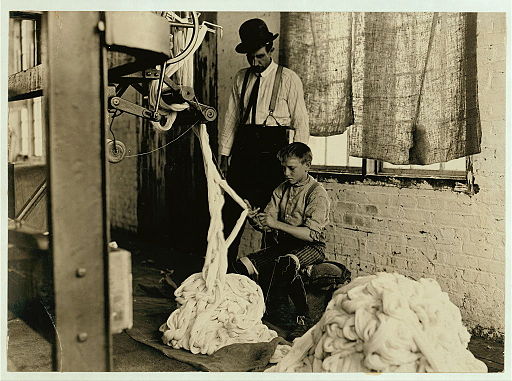
Boy working at spinning mill, Newton, North Carolina, 1908
To a great extent, the novel is about race relations. While two young black men take up arms to fight in the War, their families back home experience the convulsive upheavals that followed so-called Reconstruction in the South. We get the story of the “recapture” of Wilmington, North Carolina, as whites forcibly take an election away from the blacks and cause their flight to the North.

There’s much also about working people and the poor. We are witness to grinding, low-paid physical labor. One example being the work involved in the removal and disposing of dead horses from city streets. There’s work in the mines of Colorado and women working in sweat shops and scrubbing floors in mansions. And there’s child labor, as homeless boys hawk newspapers on curbs and street corners in Manhattan.

There’s also a glancing focus at the media itself as editors, correspondents, and cartoonists shape and sensationalize the news for public consumption. And one character is entranced by the possibilities of a new invention that takes moving pictures. One of its first uses is to film reenactments of battle scenes showing U.S. troops abroad.

Assassination of President McKinley, September 6, 1901
Historical figures walk the pages of the novel, among them the boomtown entrepreneur, Soapy Smith. We visit cigar factories in Tampa Bay, a military fort in Missoula, and the gold rush town of Skaguay, Alaska. One of the most absorbing chapters takes place entirely within a prison in upstate New York on the day President McKinley is shot at the Pan-American Exposition in Buffalo.

It’s the kind of book you can go on and on about, particularly when you know that you’ll probably never persuade another person to read it because of its length. And what’s ironic is that it’s so well suited to readers with short attention spans. Its 100-plus chapters are each like a tightly written short story. You can pick it up anywhere and read one without needing to know what came before it.

Set in another context, this novel covers the years leading up to the publication of Owen Wister’s The Virginian (1902). It’s curious and maybe telling that at a time of war abroad and political assassination at home, this romance of the Old West became a best seller.

A Moment in the Sun is currently available at amazon, AbeBooks, and for kindle and the nook. John Sayles also has a recent movie, Amigo (2010), about Americans troops in the Philippines, which is available at netflix.

Image credits: Wikimedia Commons

Coming up: Warner Baxter, In Old Arizona (1928)

Thursday, December 29, 2011

Ted Kooser, Lights on a Ground of Darkness

Given the brief shelf life of books today, a book published in 2005 probably qualifies as “forgotten.” Ted Kooser, despite his credentials, may well be unknown by many here in the blogs. Written by a Pulitzer Prize winner for poetry and former U.S. Poet Laureate, Lights on a Ground of Darkness is a short, tenderly written memoir of the writer’s family.

A book like this, full of family stories, always intrigues me, for I come from a similar ancestry (German Lutheran immigrants) but hardly a single story to commemorate it. There seemed to be a code of silence about the past among my forebears. Or maybe I wasn’t paying attention, which is just as likely.

Kooser’s memoir is structured mostly around his maternal grandfather, a farmer in Iowa, who operated a full-service gas station after his retirement in the Mississippi River town of Guttenberg. He was a man who lived into his 90s despite being a smoker and eating a diet that included sandwiches laced with lard. There’s also Kooser’s disabled uncle, Elvy, born with cerebral palsy and living at home.

Kooser has a poet’s eye for detail, and the stories and vignettes come to life with a vividness that’s sometimes startling. Moving back and forward in time, he anchors the flood of memories to a summer evening in 1949 at his grandfather’s house next to the gas station, when Kooser was ten years old. There family members gather for weekly pinochle.

Instructive for any writer is the way Kooser navigates the waters of emotion and sentiment. The dominance of hard-boiled and noir writing today makes distant company for a book that takes the greater risk of honoring everyday life and taking on themes like loss and the relentless erosion of time. The shadows and darkness in his writing are told of simply and not sensationalized.
  
Ted Kooser's hometown, Guttenberg, Iowa.
The title of the book originates in a quote from Scots poet Edwin Muir. “Our memories of a place, no matter how fond we were of it, are little more than a confusion of lights on a ground of darkness.” The bitter-sweetness of that observation about the way the past is remembered occurs over and again in this book. It is balanced against a motif of generations of irises, blooming anew each year.

The Dead about an evening gathering in James Joyce’s Dublin (and John Huston's wonderful film adaptation) has a similar ring of poignance. Beneath the everyday surface of lives being lived, there are loss and sadness that are sometimes crushing. Yet people persevere with home-grown humor and a quiet dignity.

It’s the tone that’s missing in Garrison Keillor’s Lake Woebegone, where the attitude is more like satire. And it’s what annoys me about that program. Keillor affects a warm regard for small-town midwestern life while making light of it—when he’s not making fun of it.

The achievement of Kooser is that he is able to honor the lives of very ordinary people. They are the ones left behind by the flight of their more gifted, moneyed, intelligent schoolmates to college and the City—the audiences who laugh knowingly at Prairie Home Companion. Not to mention the New Yorker readers who are amused by Roz Chast’s cartoons.

Kooser tells of their lives with an honesty that makes readers realize they are no different. Illness and age will find them, dreams will gather dust, and one day they will be no more. Only as memories of those who outlive them, for a while, and then not at all.

Lights on a Ground of Darkness is currently available at amazon (paper and kindle), AbeBooks, and alibris. Friday’s Forgotten Books is the bright idea of Patti Abbott over at pattinase. Thanks to my wife for putting this one under the tree for me this Christmas.

Photo credit: Wikimedia Commons

Coming up: Maria Ampara Ruiz de Burton, The Squatter and the Don (1885)