Showing posts with label nebraska. Show all posts

Thursday, October 9, 2014

Willa Cather, The Song of the Lark (1915)


Willa Cather, c1912
Willa Cather was a fine writer, with a special take on what it was like to grow up in a small town on the plains among descendants of immigrant homesteaders. The Song of the Lark tells of a young woman, Thea Kronborg, with a talent for music, who as the daughter of a minister finds friendship and approval not among her peers but among older men: a railway brakeman, the town doctor, and a piano teacher. They coach her through childhood and into adulthood, encouraging her to develop her musical abilities.

Plot. Cather follows her heroine to Chicago to study with a pianist, who discovers that she has an even greater talent for singing. Eventually, she goes to Germany to train as an operatic singer, and by novel’s end, she has been cast in roles that have her drawing enthusiastic audiences at the Met in New York.

Monday, May 19, 2014

Richard Prosch, One Against a Gun Horde

A complaint I have about the traditional western is that they are often humorless. They take place in a kill-or-be-killed world where every action taken and every word spoken are typically dead serious. You won’t find this to be true in the cowboy western at its beginnings. Owen Wister found room for humor in his fiction, both humor and comic irony, even while his stories could take up darker turns of plot, like hanging horse thieves, cruelty to animals, and gun duels at sundown.

There is comedy in other western writers of the time, too, notably the Wolfville stories of Alfred Henry Lewis, the fiction of Emerson Hough (Hearts Desire, 1905), Henry Wallace Phillips (Red Saunders, 1902) and B. M. Bower (Chip of the Flying U, 1906). Clarence Mulford, with his Hopalong Cassidy stories even finds fun in the shoot-em-up West, where gunfire and death are the norm on page after page.

Zane Grey did a lot to change all this. I cannot speak for all his many novels, but of the ones I’ve read and reviewed here they were of the dead serious variety, lacking anything that would coax a chuckle from the reader. Melodrama prevails instead. It’s hero versus villain until one of them must die.

Thursday, September 26, 2013

John Reese, The Wild One (1972)


What I most enjoy about a John Reese western is how he takes the conventions of the genre and makes them completely unpredictable. The conventions this time are right there on the cover from the title to the artwork to the tag line:

He was a boy in a man’s boots, packing a man’s gun, and sitting in a man’s saddle when he went riding into strange country…

All familiar and all true as far as they go. But try to guess what actually happens between the covers of this novel, and you’ll be mistaken.

Plot. Its plot is the basic bildungsroman (and there should be a simple word for that in English), a story about the moral and psychological growth of a novel’s main character. You see it over and over in westerns, a young man in his late teens forced by circumstances to take on the responsibilities of adulthood. It usually involves a crisis in which he leaves home and has to prove his mettle, usually with the use of a gun.

That character in this novel is Henry Ely, almost 18 years old, who is already flirting with trouble when we meet him in chapter one. Despite his mother’s warnings, he’s saddling up to meet with a neighbor’s wife for what he half expects will turn into the loss of his virginity. By the end of chapter two, he’s been hunted down by her husband and three sons, who beat him to within an inch of his life.

Thus begins an odyssey that takes him from Texas to a godforsaken settlement in New Mexico, where he gives himself another name, Jack Neely, and takes a job with a horse trader. There he inadvertently crosses a gun slinging outlaw, beats him in a fistfight, and eventually has to defend himself in a gun duel. Having developed nerves of steel by this point, he develops a reputation as a man-killer.

Nebraska Sandhills
Before long he is working as a foreman for a large cattle and sheep ranch in Wyoming, where he yearns to be his own man. That means running his own business. He has a dream of breeding mules using mustang mares. A partner has his eye on a ranch for sale in the Nebraska Sandhills, if they can somehow raise the money. And there’s this nice little bank waiting to be robbed.

And so on, through several more chapters, as the plot careens onward taking one unexpected turn after another. At the end, Jack (now Henry again) emerges from it all a grown man, having shown his grit by weathering several crises, including the loss of his virginity.

Characters. What makes all this work so well has a lot to do with how strongly characters drive the plot. Henry, as just one example, is so clearly a one-of-a-kind individual. A complicated guy, he doesn’t care whether or not you like him. He’s unsentimental and bonds with other people only as far as he can trust them. Which is not a lot.

Tuesday, September 17, 2013

Pamela Nowak, Changes


This historical western romance is equal parts history and romance. Set in Omaha in 1879, it tells of a trial that was a milestone in advancing Indian rights. The central character is a young woman, one-quarter Sioux, who falls quite in love with one of the attorneys in the trial.

Plot. Lise Dupree is a survivor of the 1863 Sioux Uprising in Minnesota, which ended in the mass execution of 38 Indians and the tribe’s forced removal to the western prairies. Passing as white, she works as a librarian at the Omaha Public Library, a job she would not be able to hold if her Sioux background were known.

When a small band of Ponca Indians from the Niobrara refuses to be relocated to Indian Territory, they are taken prisoner, chiefly through the effort of an Indian agent, Rufus Christy. Their situation is abetted by a scheming politician, Adam Foster, who has groomed a protégé, Zach Spencer, for election as state senator.

The Ponca are being held by the Army at Fort Omaha without charge. To delay and hopefully prevent further action against them, they sue for a writ of habeas corpus. Spencer as district attorney is called upon to make the case in court in defense of the government. Foster welcomes the trial because it will ignite the anti-Indian vote and give Spencer free publicity in the newspapers.

What gets ignited instead is Spencer’s sudden attraction to Lise as he first meets her while using the library’s law books. And the attraction is mutual. Young and handsome, with a boyish charm, he thrills her with his flirtations. His only fault, in her eyes, is that he’s building a case against the Ponca rather than in their support.

Chief Standing Bear
She is already quietly helping Tom Tibbles, the editor of the Omaha Herald, and Susette LeFlesche, whose father is chief of the Omaha. Both are marshaling a legal team and doing research for the Ponca. Sympathetic to their cause is General Crook, commanding officer at Fort Omaha.

Thus is set in motion a courtroom drama in which an argument based on treaty law is pitted against one on Constitutional law. While Indians are not citizens, what’s at issue is whether they are people covered by the 14th Amendment. This dimension of the story is illuminating, and a reader is reminded of the Kiowa chiefs trial related in Johnny Boggs’ Spark on the Prairie, reviewed here recently.

Nowak has done some research, and she has taken most of her characters from the pages of history, including General Crook, Tom Tibbles, Susette LeFlesche and her father, the plaintiff attorneys, the trial judge, and the Ponca chief himself, Standing Bear.

Romance. Sharing the storyline of competing legal and political interests is the romance that flourishes between Nowak’s two fictional characters, Lise Dupree and Zach Spencer. Theirs is an affair heated by intense attraction and frustrated by a variety of obstacles. They are repeatedly drawn together and forced apart again by misunderstandings, divided loyalties, and the meddling interference of Foster and Christy.

Nonreaders of western romances—and I’m thinking mostly of males—will be more than a little surprised by the explicitness of Nowak’s love scenes. The sexual tension builds from the couple’s first encounter. Almost nothing is left to the imagination as their meetings escalate from fevered kissing and groping to unbridled intercourse.

Friday, May 10, 2013

Willa Cather, The Troll Garden (1905)


Willa Cather (1873-1947) was a Virginian by birth, but lucky for the rest of us, she lived from the age of nine in little Red Cloud, Nebraska. And her life there on the Great Plains became the source of some of her best fiction:O Pioneers! (1913), The Song of the Lark (1915), and My Ántonia (1918).

The Troll Garden was a collection of stories written during her years living and working in Pittsburgh, after taking a degree in English from the University of Nebraska. Three of the stories are related to the West, two of them set in Kansas and Wyoming and the third about a woman from Nebraska on a trip to Boston. They portray the Plains as bruisingly harsh for men and women with certain creative and artistic sensibilities. Themes of repression, self-denial, escape, and entrapment run throughout.

Willa Cather Memorial Prairie, Nebraska
Character. Early westerns typically deal with the making of men who achieve or demonstrate their manhood through tests of their character. Cather’s stories echo that same concern. However, her men exhibit strength of character in gentler ways. No gunning down villains. Still, they are decent men—what the characters in other early westerns would call “white.”

They are armed only with a protective concern for the vulnerable and a contempt for the selfish, small minded, and thoughtless. Jim Laird in “The Sculptor’s Funeral” may be the finest example. He defends the memory of a dead man who acquired fame as an artist. Then he condemns his money-grubbing fellow townsmen for their ill will toward the man and their callous disregard of principle.

There is a sweeter poignancy in a man’s tender regard for a dying woman in “A Death in the Desert.” Everette Hilgare might resent his more famous brother and envy him for the privileges that go with fame, including the adoration he has won from the girl who was Everett’s first love. Still, he chooses generosity and patient kindness instead.

Laramie, Wyoming, 1908

East vs. West. Meanwhile, life on the prairie, far from the centers of culture, is portrayed as soul-crushing. And you wonder that Cather came around to celebrating the lives of the pioneers, as she eventually did. While the gravitational pull in other fiction is westward, almost all her characters in these stories are drifting eastward.

The plains are a troubling presence. They can be portrayed in the stories as calmly death-like, as in “The Sculptor’s Funeral”:

The lamps in the still village were shining from under the low, snow-burdened roofs; and beyond, on every side, the plains reached out into emptiness, peaceful and wide as the soft sky itself, and wrapped in a tangible, white silence.

Or they are stark with menace, as seen through the windows of a train in “A Death in the Desert”:

The grey and yellow desert was varied only by occasional ruins of deserted towns, and the little red boxes of station-houses, where the spindling trees and sickly vines in the blue-grass yards made little green reserves fenced off in that confusing wilderness of sand.

Poverty can exist anywhere, but rural poverty has a grimness all its own. In “The Wagner Matinee,” Cather gives this  description of subsistence living on a homestead:

I saw again the tall, naked house on the prairie, black and grim as a wooden fortress; the black pond where I had learned to swim, its margin pitted with sun-dried cattle tracks; the rain gullied clay banks about the naked house, the four dwarf ash seedlings where the dish-coths were always hung to dry before the kitchen door.

Monday, February 4, 2013

Richard Prosch, Holt County Law


Today, they call Richard Prosch’s part of Nebraska the Outback. A tourist board thought that up, but it’s apt. In 1881, it was as far off the beaten track as it is today—a two-hour drive from the nearest interstate. Wikipedia kindly informs us that the county’s population in 1880 was 3,287. After peaking in 1920, it had shrunk in the last census to 10,435, or 4.3 folks per square mile. A good place to go stretch your legs.

I’m guessing you’d find some of the same people there today that you’d find in Prosch’s new western novella, Holt County Law, and his short story, “Branham’s Due.” Whit Branham is deputy sheriff in Holt County, where wearing a badge has its hazards. Even before chapter one of the novella, his young sheriff has been shot dead while playing cards in the saloon.

Deputy Branham is the kind of man you want as a lawman. At least, I always enjoy finding his type of character in a western story. He is a dedicated officer of the law and a dependable public servant, who knows everybody and most of what’s going on in his jurisdiction. Enforcing the law requires as much psychology and diplomacy as skill with firearms.

Holt County, Nebraska
He’s even-tempered, intelligent, and a reliable judge of another man’s character, though while people may respect him, they aren’t necessarily friendly. So it can be a lonely job. He knows the few people in town he can truly trust. One of them is the hotelkeeper, Clara Byrnes.

The new sheriff in Holt County is an unknown quantity, having left town on unspecified business. So when a cowhand turns up dead on a nearby ranch, it falls to Branham to investigate. We know before he does that some truly nasty horse thieves are at work in the area, and his path soon crosses theirs. The rest of the novella is a chase across the prairie as he pursues them.

Prosch has a real gift as a storyteller, whether his Nebraska stories are set in frontier days or the present. (I recommend his collections of each, Devil’s Nest and Meadows Ford Blues.) He gets inside his characters, so you feel you really know them—and care about them. His West is also peopled with believable villains, elusive, calculating sociopaths who thrive in the wide-open spaces of the “outback.” 

The stories are also told with a bracing economy. Characters and situations are sketched in with sharp focus, and action unfolds at a brisk pace. You often stop just to admire the precision of the writing. “Branham’s Due” and Holt County Law are currently available for the kindle.
  
Richard Prosch
Interview

Richard Prosch has generously agreed to spend some time here today talking about writing and the writing of Holt County Law. So I’m turning the rest of this page over to him.

Richard, we last talked here in April 2012. How have the last nine months been for you as a writer?
Since April, I finished a third juvenile book with magician Mac King, a juvenile western of my own, a handful of short stories, and a novella. During the holidays, I wrote two more stories and have a good start on the direct sequel to Holt County Law

The biggest challenge was switching gears between juvenile and adult fiction. Also, some of HCL was written way back in 2011. I tried too hard to make those early scenes fit into the story when I came back to it last summer. In the end, most of it didn’t make the final cut.

How did the idea for Holt County Law suggest itself to you?
Holt County holds a special place for me. My most memorable high school football games were played in O’Neill (with St. Mary’s), and it’s the first place Gina and I stopped at after we left home as a married couple on our way to Wyoming. It’s home to some of Nebraska’s most exciting history and real life Old West outlaws. Holt County is also a kind of geographic way station where the rich soil of the east gives way to the sandhills in the west.

Was the published version similar to how you first conceived it or somewhat different?
A little different. There’s a great scene in the pilot episode of the TV series, NYPD Blue, where the main character, Andy Sipowicz, makes an obscene gesture to a female DA who he later falls in love with. Originally, I thought of Whit Branham that way, as a drunken ass who redeems himself and gets the girl. The more I wrote, the more it became clear that Whit wasn’t Sipowicz. No matter how much I wanted him to be a misogynistic jerk, he just wouldn’t cooperate.

Moses-Kincaid Bldg, O'Neill, built 1883
Talk a bit about editing and revising. After completing a first draft, did it go through any key changes?
Yes, like I was saying, it was basically written in two sittings with the juvenile books in the middle. I won’t ever do that again. Coming back to it, I tried to keep the same voice I’d used earlier, and it didn’t work. Not only did the 2011 characters and story lose momentum, but the early writing was ponderous, fat, and out of focus. So most of the early stuff got trimmed away.

Were you thinking of any previous western writers while writing this one?
Not consciously, but I discovered Gordon D. Shirreffs during the summer of 2012, so some of his hard-edged prose might come through a little. And Peter Brandvold gave me permission to use sound effects, which I kind of like.

Was there anything about the story that surprised you in the writing of it?
Two things. Once I made the decision for a story grounded in Nebraska history, I was surprised by the freedom I was able to find. I was actually pretty worried about the constraints real life would put on my characters and action, but they didn’t materialize. So that felt good: to find that wiggle room with pretend characters and situations, while still maintaining historic plausibility.

The second surprise, again, was how Whit Branham wouldn’t accept his assigned role. Other characters more or less fell in line: Althea with her ego and sense of right, Ezrie as the tough old sidekick. But Whit had more integrity than I originally gave him credit for.

Tuesday, September 18, 2012

Good Day for a Hanging, 1959

You don’t think westerns when you think of Fred MacMurray, but he was a versatile actor and equally at home in just about any kind of role. Here he plays a character found in other 1950s westerns, a lawman alone against a town that has lost faith in him.

Plot. It’s 1878 in a small Nebraska town. A bank holdup in the opening scenes leads to a chase in which the town marshal is killed and a young member of the gang (Robert Vaughan) is captured. In need of a new marshal, the town fathers persuade MacMurray to wear the badge and see that justice is done.

The rest of the film turns on the courtroom testimony of the one witness (MacMurray) who remembers clearly that it was Vaughan who shot the marshal. Though first outraged at the loss of a well-loved public servant, the town’s opinion shifts when a skillful defense lawyer with political ambitions appeals to their sympathies. The young lad, he reminds folks, had a deprived childhood and was obviously not a hardened criminal.

Fred MacMurray and Joan Blackman
There’s also the fact that MacMurray’s daughter (Joan Blackman) is sweet on Vaughan. She brings him food baskets and TLC despite her father’s disapproval. Townspeople begin to suspect that this development may color MacMurray’s judgment and his memory of the shootout. Even the widow (Maggie Hayes) MacMurray is to marry turns against him and calls off their wedding.

The trial jury reluctantly finds Vaughan guilty, and a gallows is constructed outside the jail. Meanwhile, the whole town signs a petition for clemency to be delivered to the state governor. Only Hayes’ young son sticks by MacMurray and praises him for his courage. The widow of the dead marshal also counsels him to stay true to himself and do what he believes is right, though it may alienate everyone.

Margaret Hayes
Script. The film was adapted by veteran screenwriter Daniel B. Ullman from a story by prolific western writer John Reese (1910-1981). Without finding the original story (title unknown), it’s hard to say who gets credit for the sharp plotting and the moral complexity. The dilemma in which MacMurray finds himself is cleverly constructed.

We are also left in doubt until the end about the degree of Vaughan’s guilt—if there's any at all. Exasperating, unless you’re watching on DVD and can replay the scene, is that being witnesses ourselves to the killing of the marshal, we’re not likely to recollect exactly how it all happened. I sure couldn’t.

Like High Noon, this is a western that takes place mostly indoors and in the streets of a small town. The opening scene finds a stagecoach being observed from a distance by several men on horseback, and you expect the usual holdup, but they ride off instead. It’s the first clue that the film is not going to be entirely conventional.

The personal drama is heightened at points by the obligatory gunfire, a chase, a fistfight, and the final shootout. We also get the usual scene in which a woman pleads with the main character to see reason and forego the heroics. The strength of the film, though, is the way it portrays MacMurray’s growing dilemma.

Friday, September 14, 2012

Edgar Beecher Bronson, Reminiscences of a Ranchman, 1908

1910 edition
Edgar Beecher Bronson (1856-1917) was one of those larger than life writers and adventurers of the 19th and early 20th century. Born in Pennsylvania, he began as a youthful newspaper reporter for The New York Tribune. At nineteen, he was already a model of nerve and persistence. Covering the 1875 Henry Ward Beecher adultery trial in Brooklyn, he crossed the ice-covered East River on foot with his report when there was no boat to ferry him over.

Bronson was a member of that “strenuous” generation praised by Theodore Roosevelt. He anticipated TR’s interest in the West by giving up his reporter’s job and going west to cowboy and then take up ranching. This book is his memoir of that frontier adventure.

The new outfit
Cowboy to rancher. Through a connection with field geologist Clarence King, he found his way to a horse ranch in Wyoming where he endured several months as a tenderfoot among seasoned punchers. His accounts of rising to the challenge show him remarkable for his tenacity, eventually winning the respect of the other men and his employer.

Before long, he is in Texas, buying up cattle to drive north, with the intention of ranching on the plains. Still in his early twenties, he is out of his depth dealing with dishonest traders and trying to boss trail hands who resent his lack of experience and his Yankee origins.

Holding his herd in Wyoming, he is one of the first cattlemen to venture north of the North Platte River. He winters there with several of his men in a dugout near Fort Laramie. The structure is 18-feet square, with rawhide mattresses in the bed frames, a fireplace, a mountain lion skin on the floor, and tomato can cases nailed to the walls for shelves.

"Shet y'r yawp."
He has problems in Wyoming with rustlers, who take 70 or more of his cattle to Deadwood. In that wild mining camp, over 200 miles away, meat on the hoof is worth a small fortune. Catching a night coach, he is able to track down his cows and, after some hard bargaining, buy them back from a shady and threatening butcher.

By 1877, he has settled in the Nebraska panhandle, just south of Fort Robinson, hundreds of miles from any duly constituted authority. He is on his own, with 8-10 ranch hands, to keep cattle and horses on his range and out of the hands of rustlers and the Sioux.

Chief Dull Knife
Indians. With the Sioux resisting efforts to move them off their traditional lands, and Custer's recent encounter with them at the Little Big Horn, there is also the risk of retaliation. Bronson has several moments in tight spots with them when he’s fully aware that he may be breathing his last.

His understanding of the dilemma faced by the Indians makes him largely sympathetic with them. He admires their courage and ingenuity and gives a long account of Dull Knife’s breakout from Indian Territory. The tribe’s amazing trek northward defied multiple efforts of the U.S. government to intercept them. Fighting valiantly to the last in bitter winter cold, starved and scarcely clothed, they win Bronson’s unreserved respect.

Two chapters are devoted to what Bronson believes are the last Sundance ceremonies by Sioux tribes gathering at the agency near Fort Robinson. There in the spring of 1880 or 1881, he and several other whites observe days of rituals and dancing by an assembly of 10,000 Ogallala Sioux and 2,000 Brules.

Mutiny
Moving on. In 1882, at the age of 26, Bronson saw the writing on the wall. The range was getting overstocked, and homesteaders were arriving in droves. He’d had five good years and knew that staying on he chanced being wiped out by a killing winter. Against the wishes of his loyal cowhands, who were ready to take up their guns and drive the nesters out, he sells the ranch and returns east.

His last summer on the prairie finds him in Ogallala, Nebraska, at the height of its rip-roaring bad old days. There, with one hotel, 20 saloons, dancehalls, and gambling joints, all in a single row facing the railroad tracks, the town is surrounded by the herds of 12 or more trail outfits. He estimates that there are 20-30,000 cattle fresh from Texas.

The fierce, triple-digit heat gives way to a sudden storm front, which sends the temperature down 40-50 degrees F. After torrents of rain, the river floods, driving residents in the hotel to the second floor, raising fears that the whole town will be swept away. A tornado is sighted in the flashes of lightning, but it misses the town.

Monday, September 10, 2012

John Henry Reese, Halter-Broke (1977)

Nebraska does not have a lot of homegrown writers, but you can certainly add western-writer John Reese (1910-1981) to the list. Born in Sweetwater, on the fringe of the Sandhills, he knew frontier old-timers who remembered the 1880s and 1890s. The oldest of six children, he described his father as a horse breaker and former cavalryman. His mother was the daughter of a blacksmith and woodworker.

Sweetwater is a wide spot in the road in north Buffalo County, in central Nebraska. It’s on Highway 2, next to the Burlington Railroad line, which today hauls coal from strip mines in Wyoming. Nearly as remote a place on earth as my own humbly rural origins some 50 miles to the east, it gives me a particular feeling of kinship with the man.

Reese was a prolific writer and a good one. He produced hundreds of stories that were published in pulps and slicks, including The Saturday Evening Post, plus numerous novels, mostly westerns. His widely praised and wonderfully named Jesus on Horseback trilogy dates from 1971, and he also produced the long-running Jefferson Hewitt series (1973-1980).

Farmstead, Buffalo County, Nebraska, 1903
Plot. Halter-Broke is a short novel that is cleverly constructed of different kinds of plot elements and an ensemble of characters. Rather than a central plot, it closely interweaves the threads of several stories, so that as a reader you’re always a little unsure how the pieces are going to come together. But come together they do in a way that’s both darkly comic and leavened with sentiment.

Reese’s familiarity with rural western attitudes and people, his knowledge of horses, and the sparks that flare up between the genders combine here in a perfectly believable way. Add to that the mechanics of well-digging, and you know we’re in the hands of a writer with his boots on the ground.

There’s also a playful kind of bait and switch with readers’ expectations as characters you don’t immediately warm to turn out to be OK after all. They don’t change or redeem themselves. By the end of the novel, you just get around to seeing things their way.

Bridge over Mud Creek, Sweetwater, Nebraska, built 1909
Character. The central character in this case is Alec Pitman, a well-to-do rancher, kind of a hardass and plain spoken, who has worked himself to the bone over the years. He’s unmarried, thirty-something, and has the worn look of a much older man. Oh, yes, he’s under the thumb of his domineering mother, who can’t abide the one woman he cares for, a young widow, Mrs. Butterworth, who owns a neighboring ranch.

Actually, “cares for” doesn’t quite describe his interest in her. He wants her ranch, too. And he isn’t so much sweet on her as he'd like to involve her in some good old-fashioned lovemaking. These feelings are further complicated by his rivalry with another rancher, a maybe shady guy who is courting her by digging a new well at her ranch.

That’s only one thread, and mixed together with it is Pitman’s foreman who’s a few bricks shy of a load, a runaway boy who has “walked down” a horse, two villains who have brutally murdered a local blacksmith and his wife, an old-timer living in fear of a younger partner with plans to take his ranch away from him, a doctor/coroner, and a played-out sheriff.

John Henry Reese
Wrapping up. If there isn’t a John Reese cult, there should be. The guy understands the western and puts a spin on it that’s full of surprises and poker-faced amusement. In the midst of the comic world he creates there is bloodshed and some nasty violence. The mix shows a wryly-entertaining intelligence at work. I intend to read more of his work and will review it here.

Reese’s novels are out of print and used copies can be found at amazon, Barnes&Noble, and AbeBooks. Several titles are available online at OpenLibrary.

Photo credits:
Author’s photo, goodreads.com
Sweetwater bridge, fhwa.dot.gov
Farm family, loc.gov

Coming up: Audie Murphy, 6 Black Horses (1962)

Friday, September 7, 2012

Wayne D. Dundee, Reckoning at Rainrock

Wayne Dundee writes westerns faster than I can read them. Reckoning at Rainrock was published earlier this year, not long after Manhunter’s Mountain, and already there’s another one out, Rio Matanza.

Reckoning is a Lone McGantry novel, a follow-up to last year’s Dismal River, both set in 1880s Nebraska. It tells a neatly crafted story with multiple characters who become involved in the fortunes of a woman convicted of the killing of her father.

Plot. Like a private eye novel—a form of fiction Dundee also practices—the story kicks off with a visit by an attractive female with a problem she wants the hero to solve. In this case, the female is a lawyer, Harriet Munro, and her problem is a missing client, Roxanne Purdom Bigbee. She’s not exactly missing, but held captive by what could be called human traffickers. She’s being kept across the line in Julesburg, Colorado, as a sex-worker in a bucket-of-blood saloon.

McGantry retrieves her, and because she’s a fugitive from justice, collects a reward for her capture. The lady lawyer has new evidence, and her plan is to get a retrial with a new judge. She expects the judge to reverse the guilty verdict and the sentence of death by hanging handed down at the previous trial.

Turns out there are too many people in town with too much to lose if that happens. Roxanne gets sprung from jail by an interested party, and the rest of the novel is a pursuit by posse—and others, including McGantry—into the Toadstool badlands of the Nebraska panhandle.

Toadstool Geological Park, Nebraska
Storytelling. For me, part of the enjoyment of westerns is seeing the way different western writers go about telling their stories. As a reader, you’re familiar with the western franchise, but the ways of marshaling its rich material are infinite. Stories set in some previous period of history are also interesting for what they say about the time when they were written. The past is made familiar and less remote by recasting it in terms of the present.

Dundee is free to disagree with me about this, but about a third of the way into this novel, I realized that it reminded me a lot of TV westerns like Gunsmoke and Bonanza. Like the continuing characters in those westerns, Dundee’s people talk a lot. The scene is often of two people in friendly conversation, and the plot moves forward as they discuss the past, present, and future.

And the talk is that smoothly even-tempered, lightly humorous manner of casual conversation that TV writers put into the mouths of their characters. It’s familiar to the ear, modern-sounding for the way it fills a social space. You don’t notice that modernisms creep in, as they do when Dundee’s characters talk. Somehow the word “coldcock” rings true, even though a slang dictionary says it was not in use in the 1880s.

The values in the novel are also modern ones. Julia Roberts can sympathetically play a prostitute in a movie today, and an audience is not puzzled or appalled as it would have been in the Victorian 1880s. Sting can sing of his own “Roxanne,” and in both cases what we get is romantic and palatable. So Dundee’s Roxanne glides easily into a modern reader’s imagination.

McGantry. Dundee’s central character Lone McGantry is something of a loner, comfortable with being alone and, like many western heroes, on his own from an early age. All the same, he is gallant and chivalrous, comfortable in the company of a respectable, educated woman.

Still, beneath his calm surface, you sense that he harbors a cauldron of cold rage. His rescue of Roxanne from the saloon is precise and methodical, and the deaths of those who stand in his way are sudden and brutal. Stopping at a relay station on a stagecoach line, he takes exception to a cowboy’s salacious remarks about Roxanne and gets into a fight. Rudely interrupted by a local rancher during a pleasant meal with lawyer Munro, he leaps instantly to her defense, ready to draw his gun, though they’re in a hotel dining room. 

He is a fierce protector of women’s honor. When he himself is sexually stirred by the sleeping Roxanne while camping with her on the trail, he berates himself for his urges. When she makes clear that she’d happily give him a roll in the hay, he backs off, shunning anything that might remotely suggest a romantic entanglement.

Thursday, April 19, 2012

Elizabeth Higgins, Out of the West (1902)

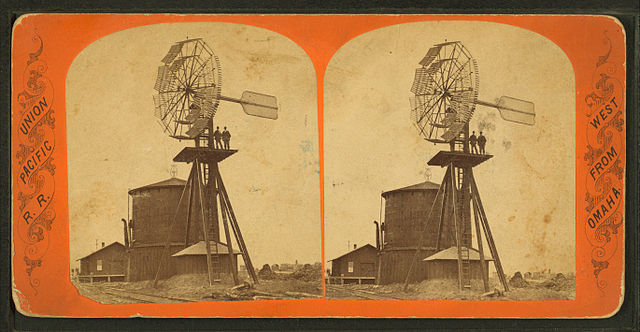
Windmill, Columbus, Nebraska, c1870
Here comes another anti-railroad novel. Set in Nebraska in a fictional small town, Columbia Junction, it describes the disastrous impact of rising freight rates on early settlers. The central character, Frank Fields, lives there in exile, sent West by his wealthy father to manage a couple of grain elevators acquired in a foreclosure.

Columbia Junction is a big comedown for Frank, a young lawyer, who is accustomed to the high life in New York. He’s bored out of his mind in Columbia Junction, and author Elizabeth Higgins does little to prove him wrong about the place. The shabby town lacks a single saving grace, and the surrounding farmland is described as flat and dreary. The town’s respectable folks are mostly shallow and small-minded, while “Polack Town,” on the wrong side of the creek, is a disreputable rural slum.

Platte County, Nebraska; Columbus, county seat.
Plot. In Frank’s first year there, the farmers have bumper crops, but they go unharvested and unshipped to market because railway freight rates have been jacked up too high. The next year there is a bad drought, and the farmers have no crop at all. Two years without an income drive many of them into poverty. People go hungry, and children starve. In a gut-grabber of a scene, a man is forced to shoot a favorite horse because he can no longer afford to feed it.

The novel takes on a political tone as a populist orator emerges from the mountains of Colorado, where striking workers have been fired upon and bayoneted by soldiers. The orator is a young woman, Edith Hull, known by one and all as a Joan of Arc. Grieved by the loss of both father and brother, she has rallied opposition to the railroads and Eastern capital, and a People’s Party begins to organize among her followers.

Frank is enchanted by her and falls in love. Eventually, they marry, and she moves into a sparsely furnished house with Frank, so small that the cooking stove is in the parlor. Running for state senator as a Populist, Frank is elected with a mandate to make a law regulating freight rates.

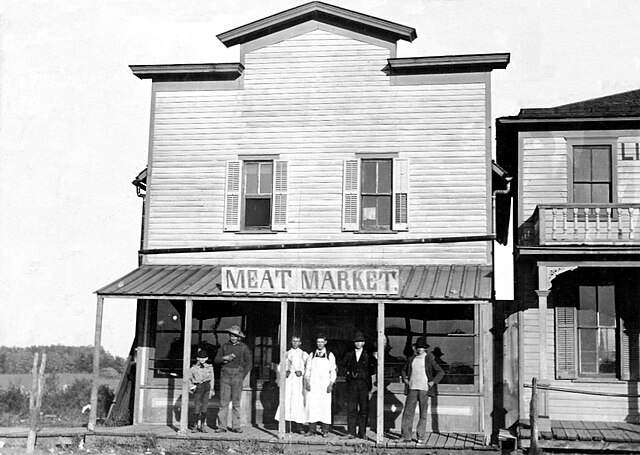
Butchers and other men in front of meat market, c1895
But he quickly learns how hard it is to defeat the railroad interests, which are well organized and have deep pockets for corrupting legislators. The real crisis comes when Frank is elected to a seat in Congress. Edith discovers that Frank has sold out to the railroad interests in exchange for a job with a law firm in New York, where he can live and work in comfort again, with all those urban amenities he’s missed.

It takes the dismay of his wife and the death of his young son to jolt Frank back on track again. He snatches his soul from the grasp of the railroad goons who lurk in the corridors of Congress and successfully gets passage for his rates bill. Returning home, he decides that Nebraska isn’t so bad after all.

Character. Frank is a gentleman and behaves accordingly. But through most of the novel he rarely exhibits character traits that seem grounded in anything deeper than the politeness that goes with being of a higher social class. When he spends all his savings to keep on the employees his father wants him to sack, he is mostly avoiding the unpleasantness of firing them.

Finally, it is love and sympathy for Edith Hull that draw him into politics. He’s not by nature a public servant, and he resists the role for a long time as something unsuited to a man of his social position. But he has a gift for public speaking, and the acclaim of an appreciative crowd feeds his ego. He ends up doing the right thing for the wrong reasons.

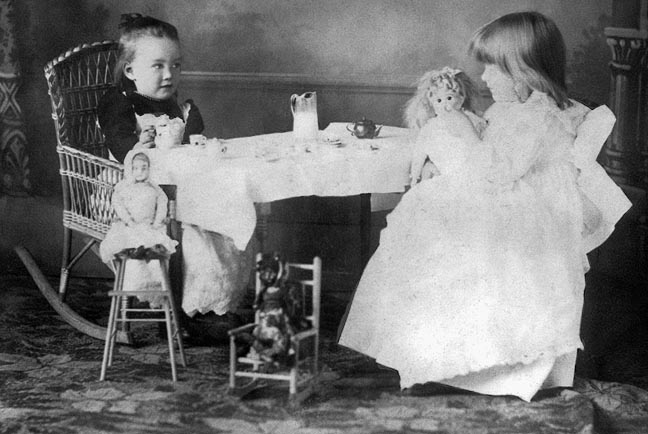
Tea Party, Nebraska, 1890s
Women. It’s Edith, finally, who shows real character in the novel. Though physically fragile, she has more backbone than anybody, including Frank. She has the courage to stand up against all odds for the rights of others. Rising to the occasion, she can more than hold her own in a debate with the slickest of scoffers. She’s even more impressive for refusing to be silenced because of her gender.

There are no other women in the novel who come near her in stature. Most suffer under the laborious burdens of housekeeping and child rearing, their lives portrayed as confined and dispiriting. Meanwhile, the females we meet in Washington are crass and materialistic. Devoted to the latest fashion and the pleasures of the flesh, they are either involved in political intrigues or willfully ignorant of anything but frivolous matters.


Wagon shop, Broken Bow, Nebraska, 1889
East vs. West. Higgins’ portrayal of the West as we find it in Nebraska is pretty grim. She satirizes the social life and the people of Columbia Junction (no doubt a fictional version of her actual hometown of Columbus). Frank tolerates them because he has no choice. The surrounding countryside redeems itself briefly with the flourish of colors that break over the landscape in autumn. For the rest of the year, the extremes of winter and summer weather make what passes for life intolerable.

But if the West is not much to her liking, she has little but scorn for the East, where people are downright contemptible. Their complacent sense of superiority to westerners is galling, especially as Higgins shows that their fine opinion of themselves is clearly groundless. In a side-by-side comparison, the West comes out looking better, if only because the benighted folks who live there earn some of our sympathy.

Columbus, Nebraska, today. Archer Daniels Midland corn processing plant

Wrapping up. Elizabeth Higgins (b. 1874) was the daughter of a Judge and grew up one of six children in the town of Columbus in eastern Nebraska. Her bio describes her as a journalist in Omaha and Chicago and a novelist. A handful of short stories appeared in magazines, such as The Red Book, during the years following this novel.

Out of the West is currently available at Internet Archive and for the nook. Friday’s Forgotten Books is the bright idea of Patti Abbott over at pattinase.

Sources:
Woman’s Who’s Who of America, 1914-15

Photo credits: Wikimedia Commons

Coming up: Troy D. Smith, Cherokee Winter

Thursday, October 27, 2011

Tom McNeal, Goodnight, Nebraska (1998)

In observance of turning 70 today, I'm reviewing a book from my home state, Nebraska, set in my favorite part of it, the treeless, rolling terrain of the Panhandle. The Goodnight of the title is a small town, surrounded by the uncompromising harsh beauty of the landscape, where the characters' lives depend much on the ability to withstand solitude and isolation.

Randall, the young protagonist, contracts into a self-protective stoniness as he fetches up here on his own like a shipwreck victim. Marcy, the girl who becomes his sweetheart, strives for a hard-won personal independence from her hard-working farmer parents. The teenage couple's late-night lovemaking and eventual marriage are an against-all-odds attempt to keep from being swallowed up by the indifference of the natural world and the conventional expectations of their small-town world.

 Given the explosiveness of young Randall's character, his insensitiviy, and his distrust of others, it's a welcome surprise when he grows to steady and responsible manhood. So is his loyalty to Marcy and his willingness to regard her as an equal in love and marriage. He even agrees to her leaving him for an adventure of her own in California. Her discovery of him asleep in his pickup, parked in the driveway at her apartment house, the smell of rural Nebraska still filling the cab, is a wonderful portrayal of the bond that holds them together.


Another long sequence in the novel describes a hunting party that grows progressively unnerving, as the more trigger-happy in the group get steadily drunker and more frustrated at the lack of game. There is an ominous threat of trouble as you follow them, page after page, and eventually learn of the dark deeds of the day.

Tom McNeal's Goodnight, Nebraska is currently available at amazon, AbeBooks, alibris, and Powell's Books, and for kindle and the nook. Friday's Forgotten Books is the bright idea of Patti Abbott over at pattinase. 

Coming up: Buster Keaton's Go West (1925)

Thursday, October 6, 2011

John Neihardt, Lonesome Trail (1907)

Illustration for "The Nemesis of the Deuces" 
Born in Illinois, John Neihardt (1881-1973) grew up in eastern Nebraska and as a young man lived in Bancroft, near the Omaha reservation. A poet, he developed a life-long interest in Native American cultures. Much of his writing concerns the settlement of the West and the displacement of the Indians.

Lonesome Trail
was his first collection of stories, many of which had appeared in the magazines. He lists seven of them in the opening pages of the book: Munsey’s, Tom Watson’s, Overland Monthly, Scrap Book, All-Story, Smart Set, and The American Magazine.

Style and tone. While a few of the stories are about whites on the frontier, most of them are about Indians. And most of those attempt to assume an Indian point of view and style of storytelling. They have a sober, weighty tone not unlike the accounts of figures in the Old Testament.

They’re told with a matter-of-fact style that accepts the norms and customs of another culture without question. While Native Americans surely had a sense of humor and a capacity for irony, these stories are more high-minded in their purpose. They seem meant to carry the weight of life lessons, not simply to entertain.

Missouri, Oto, Ponca Indians, Karl Bodmer (1809-1893)
His portrayal of the Omaha, Ponca, and other tribes he knew can apparently make some claim to authenticity. Susan La Flesche-Picotte, the first Native American doctor, provided a note with one of Neihardt’s stories in a 1907 issue of Munsey’s. There she commended Neihardt for showing Indians as “beautiful, noble, and dignified” and for his “insight into the mysticism and spiritual nature of the race.”

Neihardt was a poet, and you realize at times you are reading the words of a writer with a poet’s sensibility. This happens typically when he has occasion to describe the prairie or the weather. There’s not a lot of this, however. Neihardt has stories to tell, and he seems intent on moving on to what happens next, with a kind of stark simplicity.

"The Look in the Face," Munsey's July 1906
Theme. Nearly all the 20 stories in the collection have a single theme. From the first, “The Alien,” about a half-breed who tries to befriend a wolf, to the last, “The Nemesis of the Deuces,” about a guilt-ridden drifter, they are about loss and isolation. Usually there’s a murder.

In “Feather for Feather,” White Cloud claims wrongly that he’s earned a feather by taking a Sioux chief’s scalp-lock in battle. In fact, he stole the scalp-lock from Little Weasel, who kills White Cloud in a fit of rage. Expelled from the tribe for killing a tribesman, Little Weasel gains re-entry—and gets his feather—by starting a prairie fire that burns over the tribe’s camp.

In “The Scars,” a man tells of transporting a prisoner from Pierre to St. Louis, where he is to be hanged for murder. The killing we learn, was in self-defense, and the victim had once left his killer to die so that he could marry a woman they both loved. When the prisoner fails to seize an opportunity to make an escape, he explains to his escort that he is not a coward just because he is going to be hanged. 

Achieving manhood. A frequent theme in the stories is the transition from boyhood to manhood, usually achieved in a Dream of greatness that comes as part of a ritual of initiation. Greatly to be desired is a dream of being a great warrior, pitiless and strong, as one mother hopes for her son. A dream of a great holy man or medicine man is also welcome. It means a direct line to Wakunda, the Great Spirit.

Neihardt’s stories are typically about failure to have a dream that promises greatness. His young males or more often than not disabled, physically weak, or taken by other less manly interests. Failing to achieve manhood means being relegated to the ranks of the women, whose job is to carry water and wood. Or such males may leave the tribe altogether, to wander on their own.

"The Lonesome Trail" published Feb. 1906
In “The Singer of the Ache,” an Indian boy fails to have a fortuitous dream. Instead, he has a vision of a woman in the moon, which has the effect of filling him with melancholy. A disappointment to the tribe, he happens to see a white woman on a northbound steamboat. He follows it, but eventually returns, having never found her. He is expelled from the tribe as a fool. 

Red and white. Whites and Indians cross paths in only a few of the stories. In “A Political Coup at Little Omaha,” Neihardt segues into farce, as Republican and Democratic candidates for Congress attempt to win the Indian vote by fair means or foul, and in total ignorance of their constituents.

Only a handful of stories are just about whites. In a dark tale, “The Revolt of a Sheep,” a man awaits execution for the slow and painful killing of a priest who has fathered a child by the man’s wife. In “The Nemesis of Deuces,” a man mournfully tells of a friend who gave up his life in a prairie fire so that one of them could escape on their only horse. 

John Neihardt's study, Bancroft, Nebraska
Wrapping up. Neihardt’s Indian stories may seem a little beyond the margins of the western with its usual concerns. But a look at the geography and the climate of Neihardt’s stories, and you recognize them as familiar “western” territory. For that reason it makes sense to include them in the big picture of western fiction.

The Lonesome Trail is currently available online at google books and Internet Archive.


Image credits:
Illustration for "The Nemesis of the Deuces" by F. E. Schoonover
Illustration for "The Look in the Face" by E. M. Ashe
All-Story cover,  FictionMags Index
Wikimedia Commons

Coming up: The Westerner (1940)