Showing posts with label dane coolidge. Show all posts

Thursday, April 10, 2014

Dane Coolidge, Rimrock Jones (1917)


Rimrock Jones, prospector
Leave it to Dane Coolidge (1873 – 1940) to write a love story that is 90% about greed, high finance, the stock market, and mining law. Set in the deserts of southern Arizona, this novel pits its title character, a hard-drinking, gun-toting miner, against a railway tycoon in a struggle for ownership of a multi-million dollar copper mine. Between them is a deaf (we would say hearing-impaired today) freelance typist, with her own interest in both the mine and Rimrock Jones.

Plot. This is a novel that requires a reader to follow the money. Rimrock has sold 49% interest in his copper claim to W. H. Stoddard, the afore-mentioned tycoon. With cash received, he pays off everyone who has grubstaked him. One of these is the typist, Mary Fortune, who isn’t satisfied until she persuades him to give her a 1% share of the mine.

A little romantic attraction between them gets him thinking that he can count on her to pool her interest with his remaining 49%, and he’ll retain control. But true love does not run so smoothly. Possessing better sense than Rimrock, she objects to his high-handed ways as he protects his interest in the claim, especially as he kills a man who attempts to jump it.

Rimrock Jones, frontispiece
Meanwhile the nefarious scheming of Stoddard to win control of the mine would fill a book (which it does). He gets and keeps key employees in his pocket and drives a wedge between Rimrock and Mary Fortune. The wedge comes in the form of a wildcat skin-wearing adventuress from New York called Mrs. Hattersley.

She lures Rimrock away to the Big Apple, where he takes up residence at the Waldorf and lives the high life as profits from the mine begin rolling in. An inveterate high-stakes gambler, he throws himself into playing the stock market, hatching a scheme to drive Stoddard into financial ruin by manipulating copper shares. Meanwhile, without direct supervision of his trusted employees, he is unaware that they are doing Stoddard’s bidding back in Arizona.

Thursday, February 27, 2014

Dane Coolidge, The Texican (1911)


This early cowboy western is a rollicking political satire, the likes of which a reader would find difficult to duplicate in a western novel today. The Texican of the title is a freelance cattle rustler, Pecos Dalhart, who fetches up in Arizona, where he gets involved in a feud between two rival cattlemen, Ike Crittendon and John Upton.

Plot and character. Crittendon hires Pecos to alter the brands on any of Upton’s cattle he finds on the range. Meanwhile, the local sheriff, Boone Morgan, is alert to any signs of cattle theft, and when Crittendon falsely accuses Pecos of stealing a cow, he gets hauled in to the county jail, to await trial.

Pecos draws his pistol
Pecos, as Dane Coolidge describes him, was “born a Democrat and taught to love whiskey and hate Mexicans.” However, he has begun reading an anti-capitalist newspaper, The Voice of Reason, which has opened his eyes to the corrupt law enforcement system used by the rich to oppress the poor. Sheriff Morgan soon learns he has incarcerated an outspoken advocate of revolution.

Cracking heads, Pecos immediately overturns Morgan’s use of a prisoner-run kangaroo court for maintaining order in the jail. Joined by a friend and fellow revolutionary, Angevine “Babe” Thorne (jailed for drunk and disorderly), and winning the respect and protection of the Mexican prisoners, Pecos takes charge behind bars. He is soon getting preferred treatment from Hung Wo, provider of the jail’s meal service. 

Thursday, February 20, 2014

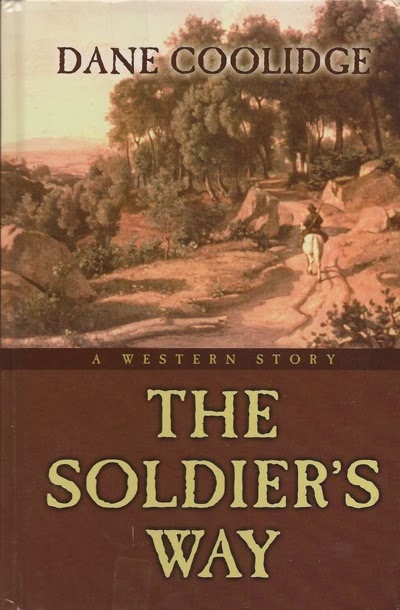
Dane Coolidge, The Soldier’s Way (1917)


This is a ripping yarn set among a band of American mercenaries and soldiers of fortune during the last years of the Mexican Revolution. It appeared first in 1917 as a four-part serial in The Popular Magazine. While prepared in a book-length version by Coolidge, it was not published as such until 2006 by Five Star.

Plot and character. The story is based on that of the so-called Gringo Battalion that fought in the army of revolutionary general Pancho Villa. Coolidge singles out two Americans from among them to illustrate the daring, the egoism, and adrenalin-fueled risk taking that drive the actions of such men.

One is the Irish-American Beanie Bogan, who with the rank of sergeant commands the respect of a small “legion” of American fighters, most of them deserters from the U.S. Army. The other is Bruce Whittle, a descendant of the Scots warrior hero, Robert the Bruce. While Bogan is all business, a skilled leader of fighting men and a veteran of combat, Whittle is a man seeking oblivion in death on the battlefield. The girl he passionately loves has married another man.

In spite of himself, Whittle has an instinct for survival that not only keeps him alive. His high-risk exploits earn him popular acclaim, while making him an outlaw at home. As a U.S. citizen he is deemed guilty of violating his homeland’s official policy of neutrality in the conflict.

Mexican rebel camp, c1911
Set on the international border along the Rio Grande, the story starts on the U.S. side in Del Norte, where Bogan recruits Whittle into the “foreign legion” fighting under Col. Gambolier, a French military consultant to revolutionary general Pepe Montaña. The underfed, poorly armed, and undisciplined army of revolutionaries is camped in the mountains above the garrison town of Fronteras, well defended by government troops. Military progress is at a stalemate.

In a strategy to isolate the town in advance of an attack, Bogan and Whittle accept a mission to dynamite a key bridge on the railway from the interior. Their job done, they find themselves betrayed by Montaña and Gambolier. This sets in motion a series of plot turns that has the Americans assembling their own assault on the town. The remaining chapters are an account of fierce street fighting, as they make their way by night and house by house to the central plaza to lay siege to the government strongholds.

Wednesday, June 27, 2012

Dane Coolidge: photographer


Western writer Dane Coolidge (1873-1940) was also a photographer. Rummaging through old magazines online I came across an article by him about working cowboys in Arizona, fully illustrated with his photographs. The article appeared in a 1904 issue of Sunset Magazine. His book Cowboys of Arizona was published in 1938. His first novel Hidden Water (1910) was reviewed here at BITS a while ago. Find it here.


I like the hip-slung posture of the cowpuncher in the background. I believe it is supposed to be characteristic of the Texas cowboy. You see Paul Newman affecting it in the posters for the movie Hud.


Coming up: Charles Duff Stuart, Casa Grande (1906)

Friday, November 19, 2010

Forgotten books: Bat Wing Bowles by Dane Coolidge

Just about all the books I review here on BITS are "forgotten books," but here's another one. This early novel by prolific western writer Dane Coolidge (1873-1940) was first published in 1913, a decade after its famous predecessor The Virginian (1902). There are many of the same elements in this story: an easterner who's a fish out of water in the West, a rivalry between a man of strong principle and one with none, a close friendship between two men, class differences, and a long-running and much frustrated courtship.

A big difference is that having grown up in rural California, Coolidge knew of the West and ranch life much better than Owen Wister. And he was more interested in representing the actual work of real cowboys - something entirely missing from Wister's novel. Based on his own field research, Coolidge's novels describe the business of working cattle, living conditions on a ranch, and the ins and outs of cowboy culture. He knows, for instance, the three books to be found in any bunkhouse.

Set on the Bat Wing ranch in southern Arizona, this story tells of a young Easterner, Bowles, who falls in love with the daughter of a rancher. Through luck and persistence he manages to prove himself as a cowboy and win her hand. Through him, we learn of the grueling work of rounding up and branding cattle. We experience the difficulty of being accepted into a fraternity of rough-riding men who labor tirelessly, amuse each other with long-winded tales, play practical jokes, get drunk in town, haze newcomers, and just as easily square off into heated disputes and fist fights.

One of the more strongly drawn characters is Gus, a stereotypically grumpy camp cook. Another is Brigham, a lapsed Mormon with grievances about his church that keep him from marrying. There is some humor in all this but little romanticizing. The subduing of an unbroken horse, for instance, is described in brutal detail.

This one is for readers interested in the old West as it was actually lived. Without gunfights, chases, outlaws, Indians, or a mounting body count, he maintains our interest, rings a range of emotions, and keeps things moving along. Available free at Barnes and Noble for the Nook.

Image credit: wikimedia.org

Coming up: Zane Grey, The Heritage of the Desert (1910)

Thursday, July 15, 2010

Book: Man From Wyoming

I picked up this novel by Dane Coolidge mainly because of Jon Tuska’s introduction, written in 2000. Tuska is co-author of The Encyclopedia of  Frontier and Western Fiction. There’s not much been written about Dane Coolidge, and I wanted to see what Tuska had to say.

I’d also read two of Coolidge’s early novels, Hidden Water (1910) and Bat Wing Bowles (1914), the one that got me interested in Coolidge in the first place. Man From Wyoming was first published in 1924 as The Scalp-Lock, and then revised and renamed for publication in 1935 in the pulp magazine Western Novel and Short Stories. I wanted to see if and how Coolidge had matured as a writer. (The edition I’m reading was published in 2001.)

Tuska says Coolidge is interesting for the way he kept pushing the genre he helped invent in new directions. And there’s a lot that’s unconventional about Man From Wyoming. For starters, the main character, Clayton Hawks, is by temperament not a man of action. He is almost too indecisive for a western hero.

Meanwhile, Coolidge has really stacked the cards against him. A man with a Boston background, he arrives in Wyoming to find out why his father’s ranch is losing money. Several hundred steers have disappeared, and rustlers are suspected. It turns out that the manager of the ranch, William Bones, is a crook, and all the cowboys are doing the rustling.

To make matters worse, Hawks’ fiancée, Penny, does him wrong by falling big time for the charms of the head rustler, Jim Keck. When Keck and his men are fired, Penny takes off with him.

Tuesday, July 6, 2010

Book: Hidden Water, part 2

A few more things to say about Dane Coolidge's first novel Hidden Water (1910).

The love story. Yes, like The Virginian, there is one. And it’s there, I suspect, for the same reason – to appeal to the tender-hearted in the audience. Wister gave us a schoolmarm from Vermont, you’ll remember. Coolidge gives us two women, Lucy and Kitty, from San Francisco, and he complicates their relationships with the two men, Hardy and Creede, in ways that would take paragraphs to sum up. Put simply, Kitty breaks both men’s hearts. Neither of them is able to see that she’s manipulative and self-centered.

Lucy is the patient, loyal friend, who young Hardy has to discover is his true sweetheart. Kind of a role switch from Wister, whose character Molly has to learn that the Virginian is her true sweetheart. Coolidge even borrows a scene from Wister when he has Lucy nursing our hero Hardy back to health after a trauma. For many modern readers, this thread of the story may be more cloying at times than the courtship of The Virginian and Molly.

The sentimentalizing of "true love" takes the narrative out of the real West of 1910. The women bring with them the mores and social customs of young middle-class city dwellers. Like Wister's Molly, they are fish out of water here. But unlike her, they do not yield to the realities of the frontier. While Molly comes to accept the hanging of horse thieves without benefit of trial, Coolidge's Lucy successfully prevents Hardy from using his gun against the sheep men.

Meanwhile, the book acknowledges that cowboys on the range go for months at a time without contact of any kind with women. When the visits of the two girls from the city get the cowboys on the roundup excited, Creede has to persuade them to stop singing bawdy songs. But Coolidge ventures no further into the landscape of the libido. That not a single prostitute is even remotely alluded to in this novel says how sexuality is being candy-coated for popular consumption. Like Wister, the language is correspondingly suitable for polite reading. Both cowboy heroes, the Virginian and Creede, stop before completing the phrase, “son of a ___.”

Politics. While The Virginian was dedicated to Teddy Roosevelt, a college friend of Owen Wister, Coolidge's novel is set squarely in the political climate of the TR administration. Coolidge notes early on that over-grazing of public lands can be prevented by declaring them federally protected forest reserves. Cattle and sheep grazing would be permitted then by license only.

Monday, July 5, 2010

Book: Hidden Water, part 1

Dane Coolidge’s first published novel, Hidden Water (1910), appears at an interesting point in literary history. It came right after the publication of The Virginian (1902), the first western novel to become a bestseller. And it came before the vast outpouring of western fiction that exploded into print and non-print media during the rest of the century.

Taking Owen Wister’s lead, Coolidge helped create this new genre. So did Zane Grey, whose first western novel, The Heritage of the Desert was also published in 1910, while Riders of the Purple Sage came two years later. Wister might have joined them, but he didn’t. After adapting his novel as a stage play – also well received – he seems to have lost interest in the West.

Coolidge and Grey represent two different impulses within the western genre – the wish to record the West as it really was and the irresistible romance of the Western myth. Coolidge leans toward historical accuracy, Grey toward myth. Given the greater appeal of myth, it’s not hard to understand why Zane Grey is remembered today and Dane Coolidge has been forgotten.

It’s worth mentioning western writer Andy Adams, also writing at this time. His Log of a Cowboy (1903) falls on Coolidge’s side of the equation. It’s a realistic portrayal of a cattle drive that some say was the inspiration for Larry McMurtry’s Lonesome Dove (1986). Adams knew the West as a working cowboy and wanted it remembered as it was, not as it was being romanticized in Wild West shows and dime novels. Alas, Adams has been mostly forgotten, too.

So, as he worked in the shadow of Owen Wister’s achievement, it’s interesting to see Coolidge creating his own kind of western novel. It certainly borrows from Wister, but it has another kind of story to tell.

Plot and main characters. The plot is what would come to be known as the “range war.” Here we have cattlemen vs. sheep men in what was then present-day Arizona. We are west of Tucson and not far from the Mexican border. It’s desolate, arid, sparsely populated.

Friday, July 2, 2010

Dane Coolidge, western writer

In 1910, exactly 100 years ago, Dane Coolidge (1873-1940) published Hidden Water the first of over 50 western novels. Over three decades he also published countless short stories, appearing in Street & Smith’s The Popular Magazine, Western Story Magazine, and many others. For readers and writers of western fiction, Coolidge is interesting today for several reasons.

For starters, he grew up in the West, among the orange groves of Riverside County in Southern California. He was educated at Stanford University. And as a young man he did two (I think) cool things. He dropped out of Harvard graduate school because he found New England too dreary, and he married one of his Stanford professors he’d obviously taken a shine to.

Working as a field naturalist and photographer for museums, he knew the Southwest from firsthand experience. He knew flora, fauna, climates, landscapes, and the people who lived and worked in far-flung parts of the deserts, mountains, and ranch country. With his wife, a sociologist, he studied and wrote about Indian tribes. He had a similar interest in prospectors and mining.

He especially knew cowboys, from having worked around them. In addition to his novels, he wrote three nonfiction books about them, one of which is still in print: Texas Cowboys. You can find the other two at used booksellers: Arizona Cowboys and California Cowboys. His ear for language and his observation of social behavior make his books about cowboys richly detailed time capsules of the period.

Read a novel like Hidden Water and you are witness to the way cowboys talked, thought, and behaved in those years right after the turn of the last century. If you’re curious at all and not just reading for the plot, you’ll find yourself looking up words and idioms that crop up in their speech: coon-can, white ribbon boy, hello girl, sandsoap, congress shoes, Keno!, Digger Injun.

Being comfortable in polite company is called being parlor-broke. A man taking a risky swim across a river may say, “Born to be hung and ye can’t get drowned.” You may be surprised to discover that buttinsky is already being used in 1910 for an interfering person. Making hair bridles in Yuma meant doing time in the Territorial Prison – the same prison Ben Wade is headed for in 3:10 to Yuma.