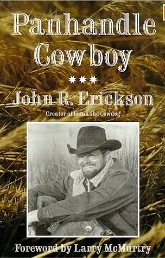
This is not exactly a cowboy memoir. The author is a newspaperman, not a cowboy, who spends a year on a large ranch in western Montana. All the same, his account of that year is the best book I've read on modern-day cattle ranching. McCumber is a complete novice and has to learn nearly everything there is to learn about it on the job. And the reader learns right along with him.
McCumber's employer, Bill Galt, is a hard-driving man, leaving no room for error and no time to rest. The men on his ranch routinely put in 12-hour days, working seven days a week. They work in all kinds of weather, including long winter months of snow, wind, and bitter cold.
The author's account of the year includes calving, branding, irrigation, fencing, haying, fire-fighting, trips to sale barns, moving cattle, and maintaining equipment of all kinds. Largely mechanized, working cattle in traditional ways ahorseback is a rarity.
Never mind the lone horseman on the cover. The most vivid images that have stayed with me since reading it are the racks of manure-filled straw to be carted out from the calving barn, the burning of trash in the ranch's dump, the disposal of dead animals, and the men's living quarters - prefab cabins with the bruising winter wind whistling in the dark outside.
Besides Galt, several of the men come to life on the page with particular vividness, especially Keith the foreman. A young cowboy, Jerry, who tries everyone's patience, is also memorable. This book is for anyone who has ever thought of leaving a tiresome job and working on a ranch.
What it shows is that cowboying is hard, back-breaking, dangerous, exhausting, unending work, requiring countless skills. And you understand the measure of pride that men who choose this kind of work take in what they do.
Friday, October 15, 2010
Thursday, October 14, 2010
Emerson Hough, again
Here's the last word about Emerson Hough before I move on to his fiction. Wrapping up my own notes on his book, The Story of the Cowboy (1897), I thought there might be interest in a subject he covers in one chapter - the range wars of the frontier - and two in particular, the Lincoln County War (c1880) and the Johnson County War (1892).
Lincoln County War. Having lived for a time in central New Mexico, Hough had heard plenty about the Lincoln County War. Little is really known for sure about that conflict, he admits. It took place in a time and place without modern news gathering as it existed in 1897. But he passes along what he’s heard and gives it his own spin. It was a time, he says, when the bravery of hardy and determined men confronted the savagery that lies at the heart of human nature
According to him, this “war” resulted in the deaths of 200-300 men. The villain at the center of it all was Billy the Kid, who gets painted by Hough as one mean desperado. Dead at the age of 23, he was credited with the killings of 23 men. He and his gang were said to have mercilessly shot seven Mexicans, “just to see them kick,” though it’s not clear whether Hough counts any of these among the 23.
This reign of terror developed into open warfare when Billy took on wealthy cattleman John Chisum, who defended himself and his property with a band of armed men of his own. Hostilities finally reached a flash point in the streets of Lincoln, where Billy eventually escaped from a burning house.
All of which is only somewhat accurate.
Hough makes no mention of the actual antagonists in the Lincoln County War. These were Lawrence Murphy and James Dolan on one side and John Tunstall and Alexander McSween on the other. We now know that Billy became directly involved in this conflict of interests when Tunstall, who had hired him, was murdered.
Hough provides his own version of events right up to Pat Garrett’s shooting of Billy. It is a scene told in detail that corresponds closely to the accounts of modern historians. It’s interesting that Billy’s final moments were known so well at the time, even while much of his story was the stuff of legend and hearsay.
There’s no mistaking where Hough’s sympathies lie. He portrays Billy as a scoundrel and a ruffian, who’d murdered his first man when he was only fourteen. Historical records show that he was actually sixteen at the time and he never killed more than nine men – maybe as few as four. He was also just 21 when he died.
Hough would surely have been appalled to know that Billy was to become a folk hero, still admired 130 years later. For him, the hero of the story is Pat Garrett, who as sheriff put an end to the young criminal. Pat Garrett, he reports, “is a respected ranchman, as pleasant a man as one would ask to meet” (p. 309).
![]() |
| The Round-Up, F.W. Schulz, 1907 |
Johnson County War. This range war had taken place more recently in Wyoming. Though only two lives were lost in the conflict between cattlemen and rustlers, it was covered extensively by the national press. Still, Hough chooses to put more confidence in the oral accounts given to him from individuals directly involved on both sides.
And both sides were in the wrong, he argues. The rustlers, with their own duly elected sheriff in Buffalo, were no better than a loosely organized form of organized crime. But the band of vigilantes with their death list of 125 names were more to be scorned, for their foolhardy and cowardly behavior.
For the most part wealthy men from the East, they knew nothing of the plains. The twenty cowpunchers from Texas they hired as mercenaries should have been in charge. Stupid mistakes would not have been made, and the vigilantes wouldn’t have ended up besieged in a ranch house and requiring rescue by the troops from a nearby Army post.
Worse yet, these men fled to the protection of the law, which they had so openly flouted. And with their money and influence were able to escape justice for the killing of the two “rustlers,” Nate Champion and Nick Ray. Hough even portrays these two men sympathetically. He reports the content of a letter found on Champion’s body, describing his last hours in the house where the vigilantes have held him under siege.
Hough points out that there were cowboys on both sides of this conflict, living by the code of the West. And only among those can be found men who acted honorably in this “unpleasant” matter – for such a man shows true courage: "Misguided and impulsive perhaps, he was always eager to be where the fighting was thickest, and there he conducted himself as a man according to the creed under which he had been reared” (p. 323).
Photo credit: Billy the Kid, wikimedia.org
Coming up: More cowboy memoirs and Emerson Hough's Heart's Delight (1905)
Labels:
billy the kid,
cowboys,
emerson hough,
new mexico,
pat garrett,
western writers,
wyoming
Wednesday, October 13, 2010
Emerson Hough, continued
I’m still reading Emerson Hough’s The Story of the Cowboy (1897), a book that is densely packed with information about the Old West. At first I thought much of the book was guesswork, since Hough spent so little time on the frontier, but in one way or another he seems to have done his homework. He might be wrong about some things, but much of what he writes has the ring of authenticity. It’s a great source book about the early West.
Another factor was that big ranchers were increasingly “outsiders” from the East or foreign countries. Often they were impersonal corporations and syndicates. Unlike the first cattlemen, they were faceless investors who never even came West. This made them unpopular with residents in general, and their efforts to enforce the new laws met with general lack of sympathy.
![]() |
| Looking for Rustlers, Illustration from the book by Charles Russell |
Rustlers. Hough devotes a chapter to cattle rustlers that put a new twist on the subject for me. The term “rustler” began, he says, with a positive rather than pejorative meaning. In the early days of the open range, cowpunchers were rewarded as much as five dollars a head for finding and branding mavericks for the home ranch. Such a man “rustled” for this extra income in the way that a city dweller might “hustle” to make a better living for himself.
Many cowboys also became cattle owners in their own right, and a cowboy might well choose instead to put his own brand on a maverick to claim it for his own herd. As these “little guys” proliferated, they eventually earned the disapproval of the big cattle barons.
In Wyoming, the big ranchers formed an association to put a stop to this development, and they quit paying their cowboys for branding mavericks. Worse, they made it illegal for them to own their own brand. What they didn’t count on was the widespread resistance these new rules would ignite.
For one thing, they went dead against the code that the West had lived by until then. This code granted a man the freedom to live and thrive as he pleased – so long as he did not take unfair advantage of another man. The new rules of the range were clearly unfair and therefore unjust.
![]() |
| The Cattle Thieves, by F.W. Schulz, 1907 |
Another factor was that big ranchers were increasingly “outsiders” from the East or foreign countries. Often they were impersonal corporations and syndicates. Unlike the first cattlemen, they were faceless investors who never even came West. This made them unpopular with residents in general, and their efforts to enforce the new laws met with general lack of sympathy.
So, many folks cooperated with rustlers. A homesteader might receive the gift of a quarter of beef on one day and be asked to corral a small herd of calves or horses on another – no questions asked. A butcher in town might be a ready customer for a slaughtered cow. The large railroad crews laying track across the plains in these years provided another ready market for meat. The less known on all these occasions, the better.
The result of the association’s efforts was to greatly increase rather than decrease the loss of their stock. Their own cowpunchers, even the foreman, could look the other way as cattle disappeared. There was such a broad gray area between right and wrong during this time that a cowboy could easily be torn in either direction.
Hough is quick to distinguish honest “rustlers” from the truly bad men who infiltrated their number and were even the rule in places like Montana. These were the lawless men who had lived by thievery in remote areas from the earliest days. Or they were the buffalo hunters who had worked their trade on the plains before the arrival of the cattle herds.
Hough sides with the cowboys who still tried to live by the old rules. They may have broken the law, but they weren’t criminals. Rustlers were not outlaws, he argues, but the last holdouts of the original code of the West.
Coming up: Emerson Hough, Heart's Desire (1905) and more cowboy memoirs
Tuesday, October 12, 2010
John Erickson, Panhandle Cowboy
This is an enjoyable cowboy memoir for any reader interested in the day-to-day, season-by-season work of modern-day cowboying and running a ranch. The author describes in this well-written book his four years (1974-78) of single-handedly managing a cow-calf operation on 5000 acres of sandy grassland in the Oklahoma Panhandle.
The writing is precise and informative, full of love for the life he has chosen, admiration for the hard-working men who are his friends and neighbors, and a deepening understanding of the ranch's four not-always-cooperative horses. There's also a good deal of humor in the book, much of it owing to the particularly unmanageable nature of the cattle on the ranch.
An episode of fruitlessly chasing two wild cows through a series of pasture fences qualifies as bona fide cowboy comedy. We also read how the author gets a reputation for picking the worst weather for fall roundups. The book ends on a soberer note, as Erickson is told that the ranch is being sold and that he's out of a job. While he's happy enough to clear the ranch of the hateful cattle that have tried his patience, there's a bittersweetness as he parts with the horses that we've come to know so well.
This is the first, and maybe best, of a series of books by the author about his ranching experiences. It was followed by Cowboy Country and LZ Cowboy. As in the others, the text of this book is illustrated with a number of nicely selected black and white photographs.
Larry McMurtry has some interesting words to say about cowboys by way of introduction (he's usually not so appreciative). For kids of all ages, Erickson is also the author of a series of genuinely funny children's books about Hank the Cow Dog.
Coming up: Emerson Hough's Heart's Desire (1905)
The writing is precise and informative, full of love for the life he has chosen, admiration for the hard-working men who are his friends and neighbors, and a deepening understanding of the ranch's four not-always-cooperative horses. There's also a good deal of humor in the book, much of it owing to the particularly unmanageable nature of the cattle on the ranch.
An episode of fruitlessly chasing two wild cows through a series of pasture fences qualifies as bona fide cowboy comedy. We also read how the author gets a reputation for picking the worst weather for fall roundups. The book ends on a soberer note, as Erickson is told that the ranch is being sold and that he's out of a job. While he's happy enough to clear the ranch of the hateful cattle that have tried his patience, there's a bittersweetness as he parts with the horses that we've come to know so well.
This is the first, and maybe best, of a series of books by the author about his ranching experiences. It was followed by Cowboy Country and LZ Cowboy. As in the others, the text of this book is illustrated with a number of nicely selected black and white photographs.
Larry McMurtry has some interesting words to say about cowboys by way of introduction (he's usually not so appreciative). For kids of all ages, Erickson is also the author of a series of genuinely funny children's books about Hank the Cow Dog.
Coming up: Emerson Hough's Heart's Desire (1905)
Monday, October 11, 2010
Emerson Hough, The Story of the Cowboy (1897)
Emerson Hough (1857-1923) was another Midwesterner who spent a while during his twenties in the Southwest. Arriving in 1883, he practiced law in White Oaks, New Mexico.
White Oaks was a boom town that sprang up in the 1880s after the discovery of gold. Just 40 miles west of Lincoln, New Mexico, it had been within easy roaming distance for Billy the Kid until his demise in 1881. Rapidly growing from a tent city to a respectable town, it would have been a reasonable location for a young lawyer from back East.
![]() |
| Roping a Maverick, Charles Russell |
Though Hough remembers White Oaks fondly, he didn’t stay long – less than two years. Returning to the Midwest, he wrote for newspapers and other publications in the years that followed. It was a long, discouraging wait, but by the age of 40, he’d finally been commissioned to write his first book, The Story of the Cowboy.
It drew the attention of Teddy Roosevelt, Hamlin Garland, and others who mattered. Then with a novel, The Girl at the Halfway House (1900), his career as a western writer finally took off.
What did Hough know about cowboys? Interesting question. Unlike other western writers, Hough was never a cowboy himself. He seems to have known them as hunting companions and may have gathered a lot of his “story” thus second-hand.
Hough was a life-long outdoorsman (in today’s sense of the word), and his chapter on “The Cowboy’s Amusements” is chiefly about hunting wildlife. Averse to going afoot, he says, cowboys loved any hunt that involved a chase on horseback.
In the days of the open range, the abundant game was typically roped to a standstill before being killed: coyotes, wolves, elk, buffalo, even grizzlies. Greyhounds were used to chase down deer and antelope. Mountain lions were treed and then shot.
![]() |
| Looking for Rustlers, Charles M. Russell |
Showing up as uninvited guests in bedrolls, a few varmints did their part to even the score. There were rattlesnakes, of course, but also the loathsome polecat, whose rabid bite was a sure killer. Centipedes were also dreaded. The poisonous tread of their many feet across bare skin was believed to induce insanity.
As for other amusements, Hough notes that cowboys enjoyed racing horses and betting everything on a local favorite to win. Competitive tarantula fighting was also a sport. But the real fun was to be had in town.
In the days of the Wild West cow town, cowboys were drawn there to indulge every vice available to them. He describes that early breed thus:
Each and all of powerful constitution, of superb physical health, and of all the daring and boldness inculcated by wild life amid wild surroundings, these men were ignorant of fear, ignorant of self-restraint, ignorant of life in any but the narrowest sense of the word (p. 233).
But those days, he argues, are long gone. The cowboy of 1897 is a “faithful laborer,” little different from working men anywhere.
Still, given a choice, Hough prefers the spirit of the Old West. He laments the increase of wealth and what he calls “artificiality” and "degeneration" in the urban East. Human nature is better suited, he argues, to the rugged individualism practiced among Westerners. He says,
Mankind has always loved the strong, because it is only the strong which is fit to be loved. So we go back continually, fascinated, and revel in the stories of strong times (p. 238).
It’s a telling remark. Hough advocates a doctrine that sounds a lot like survival of the fittest. It reveals assumptions about character that underlie the popularity of Western fiction in the following decades.
Friday, October 8, 2010
Charles Siringo, A Texas Cowboy
Charles Siringo (1855-1928) was all of 28 when he wrote this memoir (full title: A Texas Cowboy; or, Fifteen Years on the Hurricane Deck of a Spanish Pony). Born on the Gulf Coast of Texas, Siringo worked in one job after another across the Midwest and Southwest, ranging from St. Louis to New Mexico. Still a teenager, he settled on cowboying at the time of the great cattle drives and was apparently very good at it, though no luckier than most at making a living from it.
He worked for many years for the LX ranch in the Texas Panhandle, for a while rounding up cattle that had drifted away or were stolen. This occupation put him in New Mexico at the time of Billy the Kid, who was four years his junior. He never met Billy but knew men who did, and his imagination seems to have been fired by the stories they told about the pursuit and eventual shooting of this young outlaw.
Though by his own account Siringo never shot a man himself, he was a dead aim with a six-shooter. His memoir was written, as he admits in his preface, to make money "and lots of it." It's not great literature, beginning with his earliest childhood memories and recounting the events of his life with no particular sense of compelling storytelling. It's just one darn thing after another.
But a reader with some patience will be rewarded in the latter part of the book as his adventures begin adding up to something like a real narrative. Working for the LX as a range detective, he begins emerging as more of a coherent protagonist in his own story.
And it's not all about the work of cowboying, herding and rounding up cattle, and taking them to market. There are some close scrapes and some fearless derring-do. And there are also matters of the heart, as the young cowboy falls in love with a string of sweethearts he meets along the way, finally marrying one he meets in Kansas and ending his career as a cowboy.
As a range detective, Siringo shows up in other writings of the period and also as a fictional character in novels. A bit raggedy as narrative, his memoir is rewarding for what it reveals about the Wild West, cowboys, ranching in the days of the open ranges, and social history of the late 19th century. [The 1950 edition is worth having for the introduction by Texas folklorist J. Frank Dobie.]
Photo credit:
Charles Siringo, wikimedia.org
He worked for many years for the LX ranch in the Texas Panhandle, for a while rounding up cattle that had drifted away or were stolen. This occupation put him in New Mexico at the time of Billy the Kid, who was four years his junior. He never met Billy but knew men who did, and his imagination seems to have been fired by the stories they told about the pursuit and eventual shooting of this young outlaw.
![]() |
| Charles Siringo |
But a reader with some patience will be rewarded in the latter part of the book as his adventures begin adding up to something like a real narrative. Working for the LX as a range detective, he begins emerging as more of a coherent protagonist in his own story.
And it's not all about the work of cowboying, herding and rounding up cattle, and taking them to market. There are some close scrapes and some fearless derring-do. And there are also matters of the heart, as the young cowboy falls in love with a string of sweethearts he meets along the way, finally marrying one he meets in Kansas and ending his career as a cowboy.
As a range detective, Siringo shows up in other writings of the period and also as a fictional character in novels. A bit raggedy as narrative, his memoir is rewarding for what it reveals about the Wild West, cowboys, ranching in the days of the open ranges, and social history of the late 19th century. [The 1950 edition is worth having for the introduction by Texas folklorist J. Frank Dobie.]
Photo credit:
Charles Siringo, wikimedia.org
Thursday, October 7, 2010
Old West Glossary
Here’s another edition of Buddies in the Saddle’s ongoing Old West glossary, with terms found in the early westerns I’ve been reading. Authors this time include Andy Adams, Rex Beach, Stewart Edward White, and Charles Alden Seltzer.
![]() |
| Montana cowboys, c1910 [click to enlarge] |
For definitions, I’ve consulted a variety of online dictionaries, plus Ramon Adams’ Cowboy Dictionary and The Shorter Oxford English Dictionary. There’s one term at the end that threw me. If you know the meaning, be sure to leave a comment.
B&S = brandy and soda. “Let's go somewhere for a B & S, and find out about each other.” Stewart Edward White, Arizona Nights
biscuit shooter = camp cook. “Woman she dont need no tooter / Be she skule mam or biscuit shooter.” Charles Alden Seltzer, The Coming of the Law
buck nun = a hermit; a cloistered male. “I might as well go be a buck nun and be done with it.” Stewart Edward White, Arizona Nights
Bully! = an expression of approval used apparently widely among cowboys, and not just by Teddy Roosevelt. “Norton’s eyes gleamed with a savage delight. ‘Bully!’ he declared. ‘If you stay here you’ll get plenty of action’.” Charles Alden Seltzer, The Coming of the Law
chuck-a-luck = a gambling game played with dice. “And a man's so sick of himself by the time he gets this far that he’d play chuck-a-luck, let alone faro or monte.” Stewart Edward White, Arizona Nights
forty-rod = cheap, strong whiskey, said to be strong enough to kill at a distance of forty rods (11 miles), or to give the drinker strength to run full-speed at that distance, or to permit a drinker to walk no far than that distance. “An average twenty-wagon outfit, first and last, would bring him in somewheres about fifty dollars—and besides he had forty-rod at four bits a glass.” Stewart Edward White, Arizona Nights
![]() |
| Dobbins Mills, Black Hills, Dakota Territory |
heady = judicious, exercising good judgment or common sense. “He was a heady fellow, and in drinking had an oak-tan stomach.” Andy Adams, The Outlet
herd-rode = beaten in a fight; overcome. “Herd-rode him, the damned sneaks! Beat him up so’s his own mother wouldn’t know him!” Charles Alden Seltzer, The Coming of the Law
jug = to evade, dodge, avoid. “If those shorthorns attempt to offer any opposition, I’ll run a blazer on them, and if necessary I’ll jug the pair.” Andy Adams, The Outlet
Kentucky breakfast = a three-pound steak, a bottle of whisky, and a setter dog. “What’s the dog for? Why, to eat the steak, of course.” Stewart Edward White, Arizona Nights
Mohammed’s coffin = a European fable in which the coffin of the Prophet is suspended by magnetic force between heaven and earth. “One of the spider-legged horses had fallen, and the rider being projected horizontally forward, was suspended rigidly in mid air like Mohammed’s coffin, and with as much apparent prospect of coming to earth.” Stewart Edward White, The Westerners
Nick Carter = character in a dime novel entitled “The Old Detective’s Pupil; or, The Mysterious Crime of Madison Square” (1886), written by John R. Coryell. “I never heard what Struthers said, but it don’t take no Nick Carter to guess.” Rex Beach, Pardners
![]() |
| Bottler's Ranch, on Yellowstone, Montana, 1871 |
oak-tan = leather. “He was a heady fellow, and in drinking had an oak-tan stomach.” Andy Adams, The Outlet
pink tea = any frivolous social gathering, attended largely by women. “In them days there wasn’t a railroad in that section, ranches were scatterin’, and people weren’t givin’ pink teas to every stranger that rode up—especially when they were as hard-lookin’ as we were.” Rex Beach, Pardners
run a blazer = deceive, trick. “If those shorthorns attempt to offer any opposition, I’ll run a blazer on them.” Andy Adams, The Outlet
sleeper = a calf that has been ear-marked, but not branded. “Every owner has a certain brand, as you know, and then he crops and slits the ears in a certain way, too. In that manner he don't have to look at the brand, except to corroborate the ears; and, as the critter generally sticks his ears up inquirin’-like to anyone ridin’ up, it’s easy to know the brand without lookin’ at it, merely from the ear-marks. Once in a great while, when a man comes across an unbranded calf, and it ain’t handy to build a fire, he just ear-marks it and let’s the brandin’ go till later. But it isn’t done often, and our outfit had strict orders never to make sleepers.” Stewart Edward White, Arizona Nights
![]() |
| Cowboy, Montana, c1910 |
wet blanket branding = to manipulate a brand by applying “the hot iron through a piece of wet blanket” to give a new brand “the appearance of age.” Charles Alden Seltzer, The Coming of the Law
Here’s one I couldn’t find in any source:
handsome boy = ? “I had a kid outfit of h'ar bridle, lots of silver and such, and I used to ride over and be the handsome boy before such outfits as happened along.” Stewart Edward White, Arizona Nights
Does anybody happen to know this one?
Picture credits: All photos from wikimedia.org
Coming up: Emerson Hough, The Story of the Cowboy (1897)
Subscribe to:
Posts (Atom)