Showing posts with label steve mcqueen. Show all posts

Tuesday, October 21, 2014

Wanted: Dead or Alive, (1958-1961)

In 1958, Steve McQueen emerged after some minor TV work to star in three seasons (94 episodes) of the CBS TV series, Wanted: Dead or Alive. There he developed the screen presence we came to expect of him in one dramatic role after another, from The Magnificent Seven (1960) to Junior Bonner (1972) and a final western, Tom Horn (1980). 

Readers here may remember that, among western actors, Randolph Scott is a favorite of mine, but Steve McQueen is a close second. It may be that the two of them have some things in common—not the least of which is a particular brand of coolness in their style. Physically they are obviously different. Scott is tall and lean and carries himself with what you could even call elegance. McQueen is shorter, with a compact build. When he walks, he strides.

Tuesday, February 12, 2013

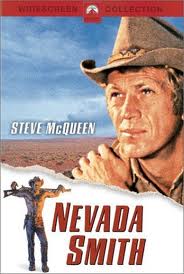
Nevada Smith (1966)


Steve McQueen starred in this rambling movie set mostly in the West. Its central character goes by different names until almost the end, when he calls himself “Nevada Smith.” The film was a prequel, based on a character in Harold Robbins’ 1961 potboiler, The Carpetbaggers. That novel had been made into a film in 1964, the character of Nevada Smith played by Alan Ladd  as a Tom Mix-style cowboy actor.

While it’s always a pleasure to watch McQueen on screen, this story was an odd fit for him. Already in his 30s, he is supposed to be a rank teenager in the opening scenes. More of a stretch is accepting him as a blond-haired “half-breed,” whose mother was a Kiowa Indian.

Plot. The story of the film has often been told in westerns. A man (or young woman, as in the case of True Grit) revenges the death of a family member. In this film, McQueen’s parents are tortured and killed by three outlaws (Arthur Kennedy, Karl Malden, Martin Landau). Then in 2+ hours of screen time, he tracks them down one by one to kill them.

First he has to learn how to use a gun and the many survival skills a man needs to stay alive in the West. A traveling gunsmith (Brian Keith) reluctantly but generously teaches him what he needs to know.

McQueen, parents' cabin burning
Believing himself ready to pursue his quest, he finally leaves Keith and begins looking for the three outlaws. He first finds Landau, who’s making a living as a gambler. After denying that he’s ever killed anyone, Landau tries to make an escape. In a knife fight, the two are wounded, Landau fatally, and McQueen is nursed back to health by the Kiowa.

Next he follows Kennedy into a state prison somewhere in the swamps of the Mississippi Delta. There he befriends the man and gets him to attempt an escape with the help of a prisoner from a nearby women’s prison camp (Suzanne Pleshette). Kennedy gets his due as McQueen shoots him dead with a revolver that he’s taken from a guard. Pleshette expires from snakebite.

Back in the West, arriving in the gold fields of California, McQueen gets a job with the last of the three villains, Karl Malden, who plans to hold up a shipment of bullion. In the middle of the robbery, as the other men ride off in every direction with the loot, McQueen turns his gun on Malden and leaves him to die, while Malden begs to be finished off.

Brian Keith
Structure. The film uses the structure of a revenge plot to tell the story of a boy’s loss of innocence and growth into manhood. Unable to read and inexperienced at playing cards, drinking alcohol, and sex, McQueen’s young man gets some exposure to all these aspects of adulthood.

The screenplay also introduces him to religion when he is saved by a mission priest from being maliciously roughed up by some of Malden’s gang. The good father tries to persuade him to give up a life of violence. However, seeing a crucifix on the wall, McQueen observes that forgiving and forgetting didn’t work out so well for the man on the cross. He’ll stick with “an eye for an eye.”

Realism. McQueen does well with all this and is convincing in a role that demands a lot of him, while not giving him much more than a two-dimensional character. His “half-breed” parentage is used to make the villains more hateful, as they sneer at him and his mother. But his character is untouched by any ethnic or racial heritage. True to movie conventions of the time, white ancestry obliterates all traces of red.

Saturday, March 12, 2011

Rodeo Week, Junior Bonner (1972)

It’s Rodeo Week starting Monday at BITS – reviews of five great books about rodeo. Today I’m giving y’all a heads up with a review of not a book, but one of the best movies ever made about rodeo.

I’m calling it best, maybe, because it starred two of my favorite actors, Steve McQueen and Robert Preston. True to the spirit of rodeo, it’s also a comedy. Surprisingly, it was directed by Sam Peckinpah, who was hardly known for his light touch.

Junior Bonner was one of those movies that fell "under the influence" of the early 1970s. It came in that aimless trough between Easy Rider (1969) and Jaws (1975), when Hollywood was willing to let filmmakers try about anything to hang onto a youthful audience. It was a period also more than a little challenged by the post-Vietnam years of national bafflement.

The movie grabs for this mood from the opening credits, with kinetic split-screen images showing in slow motion a disastrous ride on a bull. These are intercut with shots of McQueen driving a mud-spattered and beat up white Cadillac convertible, towing a horse trailer. Altogether it’s the picture of a man down on his luck.

Pendleton Roundup, 2004. Photo by Bobjgalingo.
Then we get a vision of an American West exhausted and resold as suburban housing developments of so-called rancheros (never mind that "ranchero" in Spanish means rancher). The marketing involves busloads of prospective buyers shepherded by young women in cowboy hats and hot pants.

McQueen's rodeo cowboy, Junior Bonner, returns to the home place outside Prescott, Arizona, to find heavy equipment operators fiercely tearing up the earth and anything that gets in their way. He stands there in his Lee jeans, western shirt and straw cowboy hat, surveying a land laid waste. Like the mood of the country at the time, the scene portrays a promising future that has seriously run aground somewhere.

But after this downbeat start, the movie becomes a kind of romantic comedy. We meet Bonner Senior (Robert Preston) rising from his hospital bed with a dream of prospecting in Australia. He’s also making a last attempt to win back his wife of many years, played nicely by Ida Lupino.

Calf roper, Pendleton Roundup, 2004. Photo by Bobjgalingo.
There is plenty of farce, including Preston and McQueen riding a horse through backyards and getting hung up on a clothesline, a comical barroom brawl, and a punch that sends a man through a front porch window. The rodeo itself is a rapid montage of graceless falls from rough stock played against turkey-in-the-straw music.

Meanwhile, Junior, as an aging, stove-up bull rider, is the calm at the center of this storm. Preston clowns, Lupino frowns, Joe Don Baker fumes, and Ben Johnson grins and cracks jokes. There’s even a girl with an eye on Junior. But he is untouched by it all.

McQueen does what he does best, reflecting a quiet cowboy reserve. Though the West is no more, Junior continues to represent a long line of western heroes holding true to the cowboy code of generosity, individualism, and toughing it out when the going gets rough. Before all is said and done, he gets the girl, but not for long, because true to form, he has to get on down the road.

Picture credits: Wikimedia Commons

Coming up: W. K. Stratton, Chasing the Rodeo

Wednesday, July 14, 2010

Rodeo movies

I’m probably missing some, but there have been darn few movies about rodeo. Taking them one at a time, I’ll share what I can about the ones I’ve seen.

J. W. Coop (1971)
This film was written and directed by Cliff Robertson, who also plays the title character, a rough stock rider just released from serving nine years in prison. Coop has not only missed a big chunk of what might have been a prize-winning career in rodeo. He missed the 1960s, too. Walking confidently from prison in a fresh pair of Lee jeans and a black Stetson, he finds himself in a different America than the one he left.

He’s not long on the road before a peace-and-love hippie girl befriends him, introducing him to soy nuts and talk about the environment. (He’s already been stopped by a patrolman for the gross polluting old Hudson he’s driving). Hitching rides with truckers, he gets an ear full of right-wing politics and devotion to big-ticket consumer products.

Worse yet, rodeo itself has changed. Riders now “specialize” in their events, and the high-flyers literally fly their private planes between rodeos, to take in two and three a day. It’s become a big-money business. Coop gives it a shot anyway, never daunted by the odds, and we follow him on the circuit all over the Southwest.

The film was shot at actual small and regional rodeos, winding up at the National Finals in Oklahoma City. (This was before the move to Las Vegas.) Robertson got real rodeo cowboys to play themselves in the film, including Larry Mahan, who was then a World All-Around Rodeo Champion. Also Myrtis Dightman who was a Champion Afro-American Bull Rider (see above).

The rapid, telephoto montages of cowboys riding and being thrown, with a spirited music track, make rodeo seem all non-stop excitement. In reality, there are often long waits between rides, which are themselves hard to see well from the grandstand. You find yourself restlessly drifting toward the beer tent.

The movie is very much a product of its time, with Vietnam-era social comment that we also get in Easy Rider (1969), Zabriskie Point (1970), and M.A.S.H. (1970). Robertson is enjoyable as the easy-going, indomitable, small-town Texas rodeo cowboy going for the brass ring – all the way until the last reel, where reality finally catches up with him.