Showing posts with label robert mitchum. Show all posts

Monday, March 24, 2014

The Wonderful Country (1959)


Based on Tom Lea’s 1952 border novel of the same name, this Robert Mitchum western tells a story of a man without a country, wonderful or otherwise. Fleeing to Mexico as a boy, after killing the man who murdered his father, he becomes a pistolero for a powerful Mexican family, the Castros.

Plot. Older now, he  crosses the border into Texas, where a broken leg keeps him from returning to Mexico with a shipment of contraband rifles. Recovering, he befriends a German immigrant, is offered a job with the Texas Rangers, and meets the newly arrived commanding officer (Gary Merrill) at a nearby Army post. He also meets Merrill’s discontented wife (Julie London).

When it looks like Mitchum is about to start a new life, gainfully employed and reclaiming his lost identity as an American citizen, he finds himself in deep trouble and fleeing once more across the border. There is no real sanctuary for him this time in Mexico. The shipment of rifles has been stolen, and he is held responsible. Also, a power play between two bothers of the Castro family leaves him caught perilously in the middle.

Tuesday, March 12, 2013

The Sundowners (1960)


Not quite a western, this story of an itinerant sheepman and his family in the great outdoors of Australia has stood up well. The enjoyment comes mostly from the performances and the novelty of watching something besides cows being driven across country. The work of sheep shearers and their camaraderie make another contrasting parallel to the usual run of cowboys.

Plot. Robert Mitchum and Deborah Kerr play a couple who have been together and working sheep long enough to raise a son (Michael Anderson, Jr.), who is now a teenager. As the film begins, they are joined by a fellow drover (Peter Ustinov), an Englishman with history as a seaman who is currently down on his luck.

Kerr and the boy yearn to settle down on a farm, but Mitchum is happy living out of a horse-drawn wagon and a tent. By temperament he’s a drifter and not the sort to save enough money for a down payment on any kind of property that would require him to stay in one place. He’d rather be drinking up his earnings in the local boozer and singing Irish songs. 

Kerr, Mitchum, and Ustinov
He is finally persuaded by Kerr to take a job with a company of shearers, and she hires on as the cook. It turns out he is quite good at separating sheep from their wool. His co-workers eventually talk him into going one on one with another shearer in a contest where they expect to win big on side bets. Instead, Mitchum is beaten by an old man who looks deceptively past his prime.

His luck turns in a two-up game at the hotel bar, and he wins not only a fistful of cash but a racehorse. With his wife’s savings, they are close to making a down payment on a farm she has fallen in love with. With their son as jockey, the horse starts winning some races, but there’s a final turn of fortune that puts them back on the road again.

In a couple of subplots, Ustinov takes up with a hotel owner (Glynis Johns), and Kerr befriends a sheep station owner’s lonely young wife (Dina Merrill). The two of them give shelter to a third woman, the very pregnant wife of one of the shearers. And a baby is born without benefit of a doctor.

Robert Mitchum
Four stars. The film gets one star for each of its leads. Mitchum is his usual self, comfortable in his role as a man among men, tough and determined but easy-going. He has a serviceable Aussie accent that works well enough for this American ear though he hardly sounds like Russell Crowe, and it probably rings pretty false to an Australian.

Deborah Kerr is the biggest surprise. She relaxes into a role that is so unlike the starched and repressed women I remember her playing. She and Mitchum are well matched in both their disputes and their lovemaking. Their moments on screen together are captured beautifully in this video:


Ustinov is a pure pleasure, and you realize what a presence he had on screen, for his ability to wring both the humor and poignance out of a simple line of dialogue. Glynis Johns is a whirlwind of comic energy as she bustles about as hotelkeeper, barkeep, and happy recipient of Ustinov’s attentions.

Peter Ustinov
I credit director Fred Zinnemann (High Noon, From Here to Eternity, A Man for All Seasons) for each of these low-keyed, natural performances as well as the way the cast clicks together. There’s a gentle touch in the film from beginning to end, and today it would be marketed as a family movie, with probably a PG rating. It maintains an upbeat tone, even as clouds sometimes gather, without diminishing the human drama.

In structure, the film is episodic, with complications that arise and are then soon resolved, like a brush fire during a sheep drive that threatens and separates them for a while. But after a moment of worry, Kerr rides off to look for Mitchum and eventually finds him, unscathed.

Tuesday, January 1, 2013

River of No Return (1954)


This is a western meant for CinemaScope. Shot in the Banff and Jasper National Parks of Alberta, Canada, it’s a breathtaking travelogue of river, woods, and snowy mountains. The majestic scenery often dwarfs its handful of characters. The film cries out to be seen on the Big Screen.

Viewers today are more likely to know this film because of one of its two stars, Marilyn Monroe. Although stronger actresses have appeared in westerns, she makes it one of the few whose female lead carries as much interest as the men cast opposite her. One could argue that River of No Return is a Marilyn Monroe picture and a western only incidentally.

Which is not to say that she overshadows her co-star Robert Mitchum. Only a decade after his first leading role in Nevada (1944), reviewed here a while ago, he is a solid presence on screen. He persuades with his physical authority and the measured range of his voice.

Plot. In the opening scene, Mitchum is reunited with his young son (Tommy Rettig). The boy has been sent to his father who is homesteading not far from a tent city in the gold fields of the Northwest. Monroe works there as a chanteuse in a saloon. Her boyfriend (Rory Calhoun) is a gambler who has just won a gold mine in a card game. No horses being available, he buys a raft that will take them downriver to the nearest town where he can file at a claims office.

Robert Mitchum, Marilyn Monroe
Travel by raft is rougher going than they expected, and they are rescued by Mitchum as they pass by his homestead. The river, Mitchum tells Calhoun, is a series of treacherous rapids. They’ll never make it. In a change of plans, Calhoun steals Mitchum’s rifle and horse and heads cross country, leaving Monroe behind with the promise that he’ll return in five days.

An Indian raid forces Mitchum, Monroe and the boy to take to the raft and head downriver themselves. The rest of the film is their long, hair-raising journey, the odds against them all the way. Besides more hostile Indians, they encounter only two other humans (Murvyn Vye, Douglas Spencer), the prospectors who lost their mine to Calhoun. They are after the gambler but make trouble for Mitchum when one of them pulls a knife on him.

There’s plenty of trouble as well between Mitchum and Monroe. She’s loyal to Calhoun and gets worried when Mitchum reminds her that as a horse thief her gambler boyfriend deserves to hang. She tries several ways to slow their progress downriver, including making nice to Mitchum, which he doesn’t buy and leads instead to a fierce wrestling match between the two of them.

Marilyn Monroe, Rory Calhoun
Finally arriving at their destination, they discover Calhoun busy playing cards and full of excuses for abandoning Monroe. Realizing the depth of his betrayal, she tries to prevent him from settling scores with Mitchum. The conflicts between the three of them are resolved in a couple of unexpected ways that I’ll leave for curious readers to discover for themselves.

Scale. The film’s director was the formidable Otto Preminger. The scale of the production shows his mark on the material. The opening scene, set after dark in the tent city, is a tour de force as the camera follows Mitchum riding through a maze of tents and people. The shot starts simple and then continues to unfold like a 12-ring circus as the camera tracks and tracks and tracks. We are slowly immersed in a scene as complex as a Hieronymus Bosch painting of hell.

Getting off his horse, Mitchum talks briefly to a priest, who is dismounting from a mule, then walks toward the camera to speak to the trading post owner, too busy to look up from his work. Behind them, a horse drawn wagon emerges from a lake and tips to one side, its women passengers slipping into the water, shrieking with laughter, and then being carried off by several men. It is storytelling on a grand scale.

One often reads of Monroe as a tentative actress, requiring many takes to complete a scene. A marvel of this film is the many scenes done as a master shot, played through from start to finish without edits. In them, she doesn’t miss a beat or take a false step. In a few she’s also playing a guitar as she sings, and her strumming of the guitar is tightly synchronous with the song track.

Tuesday, December 18, 2012

The Red Pony (1949)


This film about a California ranch family at the turn of the last century is not exactly a movie for the whole family. Its central theme of a 10-year-old boy learning about death and disappointment has moments that would disturb the 10-year-old in all of us. It is the work of John Steinbeck, who wrote the screenplay and the stories it is based on.

Less tragic than his Of Mice and Men, it still finds an under layer of darkness in the California sunshine. It introduces themes of family discord that would find full expression in his novel East of Eden, also set in California in the early years of the twentieth century.

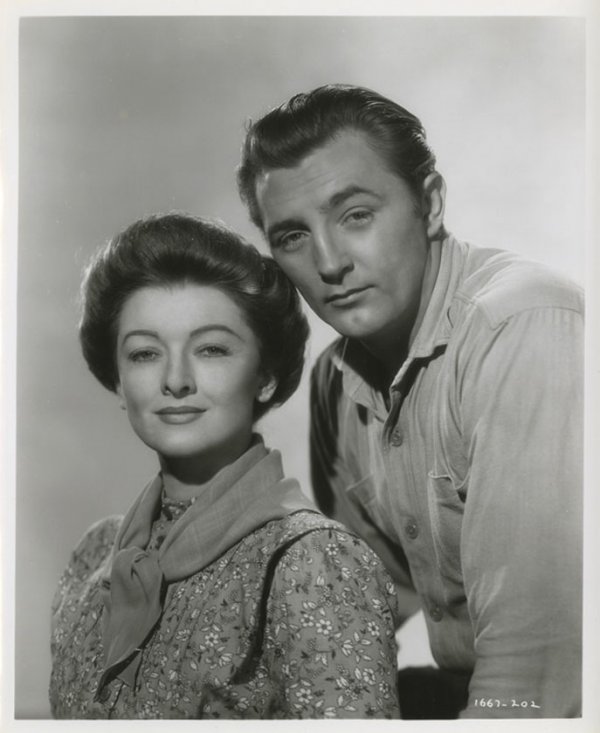
Plot. Little Tom Tiflin (Peter Miles) is given a pony, which he is training with the help of a ranch hand, Billy Buck (Robert Mitchum). The boy’s father (Shepperd Strudwick) is an unhappy man, never having adapted to life in the country after marrying his wife Alice (Myrna Loy). The emotional distance that has grown in the marriage intensifies when her father (Louis Calhern) arrives for an extended visit.

Peter Miles, Robert Mitchum
Calhern with his long white hair and beard could be a double for Buffalo Bill Cody. And he has a similar past, as a man who once led wagon trains of pioneers to the West. He loves to recount those exciting days, but his son-in-law has long ago grown tired of his stories and finally says so in an outburst that the old man overhears.

There’s also distance between father and young son. The boy is enamored of Mitchum, a coolly competent cowboy, who says he’s half horse, having been fed horse milk as a baby. In Greek mythology that would make him a centaur, a creature embodying untamed nature, as well as being a teacher. Billy Buck is both.

The problem with Billy is that he’s not altogether reliable as a teacher. He casually makes promises that he can’t keep. After he’s assured the boy that it won’t rain while he’s at school, the pony lets himself out of the barn in a terrible storm and takes a fever. Mitchum says the pony will recover, but despite his efforts it slowly worsens.

Myrna Loy, Robert Mitchum
While the boy takes to sleeping in the stall with the pony, it escapes again and is found dead, the buzzards already feeding on it. The boy is shattered by the discovery and in a horrific scene tries to strangle one of the birds as it struggles fiercely with bloody talons.

The lessons learned are hard ones. The boy discovers he cannot trust the word of grown-ups, even the man he admires. The grandfather learns that as a man who was once a leader of men, his day in the sun is over. The boy’s father takes a leave of absence with his brother in San Jose—a kind of homecoming. But he comes to realize that he is a “stranger” to others wherever he lives.

Finally, the life of Mitchum’s mare hangs in the balance, as he believes the colt in her is turned wrong. Sharpening the knife he’s used to doctor the pony, he is ready to kill the mare to save the colt. The emotionally wrought boy steals the knife, and while Mitchum leaves the barn to retrieve it from him, the mare safely gives birth to the colt. True to his word, Mitchum gives the colt to the boy. In the last scenes, we see the adults together, all smiles, as the boy rides his new pony across the fields of the ranch.

Myrna Loy, Shepperd Strudwick, Peter Miles
Comments. Long a B-movie factory, Republic Pictures was the surprising producer of this feature film with an all-star cast. Shot locally in Agoura, California, and in Technicolor, it has the look and feel of Steinbeck country in central California. The effect is partly due to the rain-soaked earth underfoot in many scenes.

Myrna Loy is everybody’s lovely mother, a composed woman of private emotions, who keeps house, cooks meals, and plays classical music on the piano. Robert Mitchum, a star of cowboy movies from the war years, plays a ranch hand with the actor’s usual cool confidence.

Steinbeck’s script has many fine moments, as when Calhern’s garrulous old man laments how the drive to adventure westward has died out of people. “It was a job for men,” he tells his grandson. “Now only little boys want to hear about it.” Later, he scolds Mitchum for being unaware of a rule against sitting on another man’s bed.

Tuesday, December 11, 2012

Nevada (1944)


This remake of a remake was Robert “Bob” Mitchum’s first film with a starring role. He plays the title character, “Nevada,” in a story about gold rush crooks trying to swindle folks out of their ranches and prospecting claims. They've discovered that the worthless “blue stuff” being dug up is really rich in silver. But Mitchum foils their plans.

Plot. Mitchum is riding with two sidekicks, Dusty (Guinn “Big Boy” Williams) and Chito Rafferty (Richard Martin). Winning $7,000 shooting dice at a saloon, Mitchum has to make a hasty exit as he declines to give the angry saloonkeeper a chance to win back the money. Chased out of town, the three friends split up.

When Mitchum rides up on a man who's been ambushed and left lying in the road, he is discovered standing over the body by a sheriff and posse who arrive on the scene. They assume Mitchum killed the man for the money he is carrying. They don’t believe it is gambling winnings, and they haul him off to jail.

A woman (Anne Jeffreys) who runs a gambling hall in town recognizes Mitchum as the man who rescued her and a wagonload of her dancing girls in reel one when she lost control of her team of horses. He seems hardly a killer to her, she says. But as the only banker in town, she happens to know that the dead man was carrying $7,000.

Robert "Bob" Mitchum as Nevada
Trail pals Williams and Martin bust Mitchum out of jail with a clever ruse, inciting a lynch mob to break into the jail. Once he’s out in the street and on a horse with a rope around his neck, the three of them race off out of town.

The villain of the story (Craig Reynolds) and his henchman (Harry Woods), as we’ve known all along, are the ones who killed the old man and took his money. Reynolds and Jeffreys are old friends, and he lets her in on the secret that he’s buying up local land before anyone discovers there are rich deposits of silver under it.

After a comparison of bank notes, Jeffreys learns that Mitchum was not carrying the stolen money. He's been telling the truth. There’s a lot of riding back and forth and a couple of fistfights as justice slowly takes its course. Reynolds shoots his partner, Woods, to keep him quiet, and Mitchum persuades a mining engineer to assay a sample of the ore believed to be worthless. Lo, it’s found to be rich with silver.

Woods, with his dying breaths, reveals to Jeffreys that he and Reynolds did the dirty work of killing and robbing the old man. There’s a final confrontation between Mitchum, Reynolds, and Jeffreys, in which Reynolds accidentally puts a bullet through Jeffreys. Mortally wounded, she is seated in a chair where she can look out the window with a pleasant view of the state of Nevada as she calmly dies.

DVD cover
B+ for a B-western. This short, 62-minute film is an above-average B-western. Mitchum is excellent, with that wonderfully cool presence he brought to so many roles in his career. He doesn’t know fear, Jeffreys says of his character early on, and it’s clear that he doesn’t. Mitchum’s movements are casual and unhurried, his stance relaxed. Note the way he wears his hat on the back of his head.

Always he has that unsmiling poker face, eyes not quite fully open, as if he is quietly taking the measure of whoever he’s talking to. If his face registers anything, it’s with a slight raising of the eyebrows, as if to say, “Is that so.”

His saddle partners are not just sidekicks, with roles played for laughs. They are friends rather than the usual foils of the cowboy hero, and they have key parts to play in the plot. The role of the whiskery buffoon, a stock character in B-westerns, is a barfly called Pancake, played by character actor Emmett Lynn.

Also, for added value, the film includes an instructive scene in which the mining engineer (Edmund Glover) actually fires a sample of ore to assay its ingredients and value. There is frequent mention of assayers in early western novels, but I don't recall ever seeing the job done on screen before.

Curiously, while Mitchum has a couple of dust-ups with the villains, including a fistfight that nearly rips off his shirt, he never fires a gun at them. One of the villains is mortally shot by the other, who also pulls the trigger that fells Jeffreys in the last scene. For all his misdeeds, he is taken away at the end by townfolk, presumably to get a fair trial before being hanged.

You might expect Mitchum and Jeffreys to end up in each other’s arms, but this western is short on romance. Another girl in the cast (Nancy Gates) has scenes with Mitchum, but she’s a peripheral character who doesn’t make the grade as a love interest.

Tuesday, November 27, 2012

El Dorado (1967)


This Howard Hawks western bears a strong resemblance to his previous western, Rio Bravo (1959). The elements are much the same, as if Hawks wanted to have another go at them. John Wayne appears again, this time as a hired gun. Particular about who hires him, he turns down a dirty job in the opening scenes offered by a land-greedy rancher (Ed Asner). Wayne ends up working instead with a sheriff (Robert Mitchum) to help a family keep their ranch out of Asner’s hands.

Plot. The family in question are the Macdonalds, with several grown sons and a feisty daughter (Michelle Carey). One of the boys takes a shot at Wayne and ends up dead. When Wayne brings his body to the ranch, Carey doesn’t believe his account of the incident and ambushes him. With a bullet now lodged near his spine, he is stricken at times by paralyzing pain that affects his shooting arm.

John Wayne
Drifting among the saguaros of the Southwest, he reluctantly picks up a trail buddy (James Caan), who has just killed his fourth man. Slow with a gun but quick with a knife, it seems he’s been avenging the death of an old friend, one man at a time. He adopts Wayne as a mentor.

When Wayne meets another gunman of his own professional caliber (Christopher George), he learns that the man has been hired by Asner to do the job he turned down. Wayne learns from George that while the sheriff, Mitchum, has a reputation as good with a gun, he is no longer a threat. He has been sidelined by two months of heavy drinking.

Wayne and Caan show up to give Mitchum a hand, and they wait for George and his gang. But Mitchum is in bad shape. He has hit bottom but doesn’t yet know it. The depth of his condition finally comes home to him when he is laughed at by the men in the saloon while buying another bottle of whiskey.

Robert Mitchum
As soon as the gang arrives there is trouble, and Wayne and Caan get to work getting rid of them, knocking off several in the first round. Mitchum gradually gets sober but, in an exchange of gunfire, gets shot in the leg. When Asner is taken prisoner, Wayne and the others are holed up in the jail and under siege.

All is resolved finally with a shootout at the saloon. Asner bites the dust along with George and other members of the gang we’ve come to know. Wayne takes some buckshot in his leg, and as Caan leaves to follow up on a rough meeting with Carey in the straw of a stable, Wayne and Mitchum hobble down main street, each of them on a crutch.

Tone. This is a loosely meandering film that sets up a good guys vs. bad guys conflict in the opening scenes and saves the final confrontation until almost two hours later. During that time there are several characters to get to know and some lengthy conversations.

James Caan, John Wayne
The tone of the film fluctuates between melancholy and lightly humorous, with a stretch or two of outright farce. When Macdonald says he doesn’t blame Wayne for his son’s death, Wayne turns to go, saying sadly to himself that it is not much consolation.

Meanwhile, there are several running jokes, one of them involving the riverboat gambler’s hat that Caan wears. As Mitchum slowly sobers up, he can’t remember who Caan is and keeps asking, “Who is he?” In another comic scene, Mitchum takes a much-needed bath, while everyone who visits brings him a bar of soap.

Mitchum’s alcoholism is also played for a while for laughs. When Wayne finds him passed out in a jail cell and dumps a bucket of water on him, Mitchum comes out with fists flying. Later, almost creeping away from the saloon with another bottle, he cradles it to his belly with both arms. In only a few minutes of screen time, we’ve gone from the Three Stooges to Lost Weekend.

Tuesday, November 13, 2012

Young Billy Young, 1969


Burt Kennedy wrote and directed this good-looking western, set among the saguaros of Arizona. And with Robert Mitchum and Angie Dickinson in the cast, it should have been a corker. But the best scenes in the film have to work hard to keep the whole film afloat.

Plot. Mitchum takes a job as sheriff in Lordsburg to introduce some law and order, where it may be needed but not wanted. Jack Kelly plays a local saloon owner (named John Behan, maybe a double of the sheriff over in Tombstone) who wants Mitchum out of town. Angie Dickinson entertains at the saloon and competes with the scenery in a black spangly one-piece and feather boa. We like her.

Talented but miscast Robert Walker, Jr., plays the title character, Billy Young, a handsome young drifter. He has just returned from Mexico where he and David Carradine were hired to kill some nasty federales. Mitchum offers Walker a job as deputy, but he declines, given the odds against a lawman’s staying alive in this lawless town.

Robert Mitchum
Carradine, it turns out, is the son of Frank Boone (John Anderson), an outlaw who once killed Mitchum’s son during a jailbreak in Dodge City. When Mitchum puts Carradine in jail, he hopes the move will flush Anderson out of the sagebrush, where he can settle an old score with the man.

Dickinson, meanwhile, is getting beaten up regularly by Behan. With the encouragement she gets from Mitchum’s tender attentions, she packs her bags. Conscience-stricken from years as a saloon dancer, she hopes to start a new life somewhere else.

There’s a shootout finally as Anderson and his gang arrive in town. Released from jail, Carradine shoots Behan, and Mitchum shoots Anderson, who gets run over by a stagecoach for good measure. In the final scene, Walker has agreed to wear a deputy’s star, Carradine is in jail again waiting the circuit judge, and Mitchum leaves town with a surprised Dickinson, who learns that she’s to become his wife.

Angie Dickinson
Pluses. There’s nothing really wrong with the plot of the film, but its story must struggle with several handicaps. Mitchum is not one of them, unless you have the temerity to fault his girth. His old cool manner is still there, rarely cracking a smile, but equally persuasive whether being stern or tenderly attentive, as he is in scenes with Dickinson.

Their scenes together, in fact, do much to buoy up the film. They show Kennedy’s particular strength as a writer, and you can point to other films written by him where the scenes between men and women come alive onscreen. The dialogue reveals their loneliness, their wish to be simply cared for, and their basic decency.

Minuses. Other scenes and sequences carry less conviction. The first fifteen minutes are given to Walker and Carradine’s boarding of a troop train in Mexico, their killing of a car full of officers, and their escape on horseback. The sequence could bristle with suspense and excitement, but it is ponderously slow and improbable. The playful, jazzy music track by Shelly Manne establishes the tone of the film as more comic than serious, which doesn’t help either. For a contemporary western that pulls this off far more successfully, turn to Butch Cassidy and the Sundance Kid (1969).

The focus of the film is also split between Walker and Mitchum. Walker is the title character and gets a lot of screen time, but it’s really Mitchum’s story that we care about. Casting Walker may well have been a play for a young audience (even using the word twice in the title), but the film doesn’t give his part of the story enough weight.

DVD cover
Wrapping up. The film was shot in Arizona, and the desert cinematography is handsome and definitely western worthy. The western town set looks realistic, though strangely vacant, as if there wasn’t money in the budget for extras.

Excellent character actor Paul Fix plays a crusty stagecoach driver, and Willis Bouchey is the town doctor. Other highlights include fistfights, a lengthy shootout, a stagecoach pursued by thieves being shot from their horses, and Angie Dickinson in a bubble bath. Of debatable merit is the ballad of Young Billy Young which is sung over the credits by Robert Mitchum.

The script was very loosely based on a Will Henry novel about Wyatt Earp called Who Rides With Wyatt (1955). There’s only passing interest in authenticity; Mitchum wears a thoroughly dusty black hat, but like most of the other men in the film, it has a modern-day potato-chip brim. Angie Dickinson’s stage outfit looks more Vegas showgirl than frontier saloon queen. It’s a western for fans who like their stories a little tongue in cheek.

Young Billy Young is currently available at netflix and at amazon and Barnes&Noble. For more of Tuesday’s Overlooked Movies and TV, click over to Todd Mason’s blog.


Coming up: Women writers of the West

Tuesday, October 16, 2012

The Lusty Men, 1952


There may be lusty men in the title of this rodeo western, but they’re no match for Susan Hayward, who more than weighs in for her own gender. She was a stormy presence in her roles on screen, both beautiful and independent. Here she coolly manages the attentions of two men, Robert Mitchum and Arthur Kennedy.

Hard to say how this script would have fared in other hands, but direction is by Nicholas Ray, who brings a psychological depth of character to his films. In company with his other notable films from the period—beginning with the noir romance They Live By Night (1949) and on through Rebel Without a Cause (1955)—this film has more in common with them than the typical western.

Plot. All the same, though set in the modern-day West, it starts out with western elements enough. Mitchum is a drifting rodeo cowboy, a past champion, who gets off the road after 18 years riding rough stock. Returning to his old home ranch, he finds it occupied by an old-timer ready to sell it for the right price to a young couple, Kennedy and Hayward.

Rodeo cowboys, Cottonwood Falls, Kansas, 1974
Kennedy gets Mitchum hired on at a nearby ranch, where he is foreman. Before long, Mitchum’s talk of rodeoing gets Kennedy eager to give it a try. With his winnings, he tells Hayward, they’ll be able to pay the asking price for the ranch a whole lot faster.

With coaching from Mitchum, Kennedy follows the circuit, and Hayward goes along for the ride. Soon the winnings begin to add up, and Kennedy is swept along by a rising wave of self-confidence. When he’s won enough to buy the ranch, he’s become addicted to the excitement and the glory. Ranch life no longer interests him.

Hayward’s patience with both men eventually runs out. When Mitchum puts the moves on her, she turns him down. It takes a fatal accident in the arena for Kennedy to see that giving his best years to the rodeo is not such a good idea after all.

Rodeo parade, Cottonwood Falls, Kansas, 1974
Noir. Shot in deep-focus black and white, with documentary-style footage of rodeo events, crowds, and parades, the film has a noir feel. Increasingly, scenes take place at night, and Ray lets the shadows reinforce the darkness that gathers around his characters.

Rodeo has its seamy side, and the film doesn’t sugarcoat that either. The “lusty” men who populate the background of the film are often seen drinking and gambling. Arthur Hunnicutt plays a washed-out rodeo cowboy full of rodeo stories and sporting the scars of a career that must have broken every bone in his body at least once. He gimps around, broke, relying on handouts from the men who remember his good old days.

Tuesday, August 2, 2011

Pursued (1947)

This noir western is a thorough mix of the two genres. James Wong Howe’s black and white cinematography makes much of contrast and shadows, while some scenes were shot on location near Gallup, New Mexico. We get images of riders racing along the foot of sheer bluffs in the same film with a bride pulling a gun on the groom on their wedding night.

Meanwhile, it’s an early starring role for Robert Mitchum, whose cool on-screen persona is already fully developed. Appearing along with him in major roles are Judith Anderson and Theresa Wright as mother and daughter. Wright, in fact, as the already established star (Shadow of a Doubt, The Best Years of Our Lives), gets top billing. Dean Jagger plays a villain so nasty he would hunt down and kill a ten-year-old boy. 

New Mexico
Plot. Mitchum’s character is the sole survivor of a shootout between two families, the cause of which is not revealed until the last reel. He is raised by a widow with two other children, a brother and sister who are also his age. Growing up, the two boys never get along, while the girl falls in love with Mitchum.

In true noir fashion, prospects for everyone never look too good, and eventually everything heads south. The dispute between Mitchum and Wright’s brother (John Rodney) escalates into bloodshed—the brother’s. And plans for Mitchum and Wright’s wedding come to a dead halt.

When Wright is courted by another man (Harry Carey, Jr.), Jagger engineers a gun duel between him and Mitchum. This exchange of gunfire ends similarly. Mitchum now has taken the lives of two men, who’ve both had some attachment to Wright.

Wednesday, July 14, 2010

Rodeo movies

I’m probably missing some, but there have been darn few movies about rodeo. Taking them one at a time, I’ll share what I can about the ones I’ve seen.

J. W. Coop (1971)
This film was written and directed by Cliff Robertson, who also plays the title character, a rough stock rider just released from serving nine years in prison. Coop has not only missed a big chunk of what might have been a prize-winning career in rodeo. He missed the 1960s, too. Walking confidently from prison in a fresh pair of Lee jeans and a black Stetson, he finds himself in a different America than the one he left.

He’s not long on the road before a peace-and-love hippie girl befriends him, introducing him to soy nuts and talk about the environment. (He’s already been stopped by a patrolman for the gross polluting old Hudson he’s driving). Hitching rides with truckers, he gets an ear full of right-wing politics and devotion to big-ticket consumer products.

Worse yet, rodeo itself has changed. Riders now “specialize” in their events, and the high-flyers literally fly their private planes between rodeos, to take in two and three a day. It’s become a big-money business. Coop gives it a shot anyway, never daunted by the odds, and we follow him on the circuit all over the Southwest.

The film was shot at actual small and regional rodeos, winding up at the National Finals in Oklahoma City. (This was before the move to Las Vegas.) Robertson got real rodeo cowboys to play themselves in the film, including Larry Mahan, who was then a World All-Around Rodeo Champion. Also Myrtis Dightman who was a Champion Afro-American Bull Rider (see above).

The rapid, telephoto montages of cowboys riding and being thrown, with a spirited music track, make rodeo seem all non-stop excitement. In reality, there are often long waits between rides, which are themselves hard to see well from the grandstand. You find yourself restlessly drifting toward the beer tent.

The movie is very much a product of its time, with Vietnam-era social comment that we also get in Easy Rider (1969), Zabriskie Point (1970), and M.A.S.H. (1970). Robertson is enjoyable as the easy-going, indomitable, small-town Texas rodeo cowboy going for the brass ring – all the way until the last reel, where reality finally catches up with him.