Friday, December 16, 2011

Photo-finish Friday: out and about


Here's another in the on-going series of wall murals. This pic was taken from a window of the Metrolink train from Riverside to Union Station in LA. It's one of a series at the Montebello station, placed at intervals along the side of the tracks. Somewhat faded, they may date back a few years.

This one represents the valley as it must have looked 75 or more years ago. There seem to be irrigated fields of maybe strawberries or some other vegetables. Beyond are low hills with oil derricks, and beyond that the mountain skyline. Looking over the fence, you can see what's become of all that today.

Photo-finish Friday is the bright idea of Leah Utas over at The Goat's Lunch Pail.

Coming up: Western writer inspiration, no. 16

Thursday, December 15, 2011

Honoré Willsie Morrow, The Heart of the Desert (1913)

Georgia O’Keefe didn’t find the Southwest until more than a decade later, but it’s hard not to think of her in this story of a woman who undergoes physical and spiritual rebirth in the deserts of New Mexico. Rhoda Tuttle begins this story of romantic adventure as a severely neurasthenic young woman from the East, convinced that she is about to die.

Visiting friends at a desert reclamation project, she is courted by two suitors. Both of them are refined, gentlemanly products of an Eastern education, who slip into white flannels as the occasion calls for them. One, John DeWitt, is a white man of good breeding. The other is an Apache Indian, who has adopted an Anglo name, Charley Cartwell.

Rhoda, when she is not too dispirited to object, dismisses the solicitous attentions of both men. DeWitt wants her to marry him, but she does not want to burden him with her sick self and, she believes, imminent death. Charley, whose Indian name is Kut-le, triggers mixed feelings in her. Handsome, well polished, and courteous enough, he makes her uneasy.

And well he should. He is an Indian inside his khakis, and a thousand years of white civilization separate the two of them. Though he is trained as an engineer and has plans for study abroad at the Sorbonne, he is little more to her than a dressed-up savage. When he says he loves her and proposes marriage, flags go down all over the field.
  
Rhoda and Kut-le
Plot. Rejected by Rhoda, Kut-le calmly and coldly cuts to the chase. He changes into his Indian garb, which leaves his broad shoulders and handsome body next to naked, and he kidnaps her. For the reader ready for a no-holds-barred romance, this has to be a thrilling development. For Rhoda it’s mortifying and horrifying.

Tied to her horse, she undergoes all manner of agonies as Kut-le spirits her off into the desert, traveling by night in the company of three other Indians. One of them, a squaw named Molly, ministers to the angry, humiliated, and terrified Rhoda.

Meanwhile, a search party follows in pursuit, comprised of DeWitt and three other men. An army of cowboys at a nearby ranch combs the desert for Kut-le and Rhoda. The declared intention of everyone is to shoot the Indian on sight or string him up. DeWitt, intent on revenge, wants that honor for himself and says he’s grateful to live where “lynch law” would exonerate him in the eyes of any jury.

Kut-le, nonetheless, eludes capture, and weeks pass as they live off the land. The strenuous cross-country travel first worsens Rhoda’s health and then makes her stronger. Resting at a pueblo, she discovers that she’s come to love the desert. Contemplating its shifting colors and moods, she senses something of a mystery much larger than civilization itself. Though she’s never had to do a lick of work in the past, she volunteers to pitch in with the camp chores and learns to eat roasted desert mice.

In time, she begins to experience a kind of “Stockholm effect.” She regains some of her old respect for Kut-le, who has never been more than firm and friendly with her—a complete gentleman in all things, if you don’t count abduction. She even comes to admit her love for him. But marriage would mean crossing the “race barrier,” and that she doesn’t have the chops for. True love, he argues, overcomes all obstacles. She isn’t convinced.

She’s rescued, recaptured again, and finally set free. But when the search party finds Kut-le, she defends him and, to the amazement of all, confesses her undying love for him. Discovering that Kut-le would rather die than live without her, she agrees to marry him. DeWitt realizes he can’t win and gives up his desire for revenge. The couple is married at a conveniently located desert mission, and they ride off into the sunset.

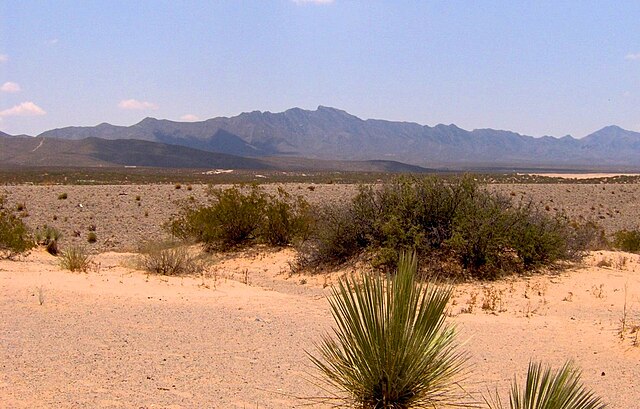
Mesilla Valley Desert, New Mexico (CC) Brian Stansberry
Race. Few if any early western novels tackle the subject of race and race relations so directly as this one. Frederic Remington’s John Ermine of the Yellowstone (1902) ventures into this territory but with unhappy results. His white man raised by Indians makes a similar play for the pretty daughter of an Army officer, but all the cards are stacked against them, even though there’s no racial divide to keep them apart.

Morrow has stacked them another way, making her male lead an Indian educated by whites. Gifted with superior intelligence, he exhibits mastery of both worlds, Indian and white. Rhoda, meanwhile, is beautiful and intelligent, capable of flourishing in the right conditions.

She has courage, strength of character, and the ability to think outside the box she’s been confined to by her “civilized” upbringing. Consider the strait-laced, rigidly constrained social world of Edith Wharton’s women by comparison. The result for Morrow is an interesting, though speculative, journey of what would later be called self-realization.

Her desert experience would have been lost on the shallow, empty-headed girl in Remington’s novel. His story is one of tragedy, its characters the victims of class and cultural differences. Morrow adds racial difference and writes a romance that is also a novel of ideas. Challenging the sexual fears that underlie racial prejudice, it surely must have been regarded by many readers as scandalous.

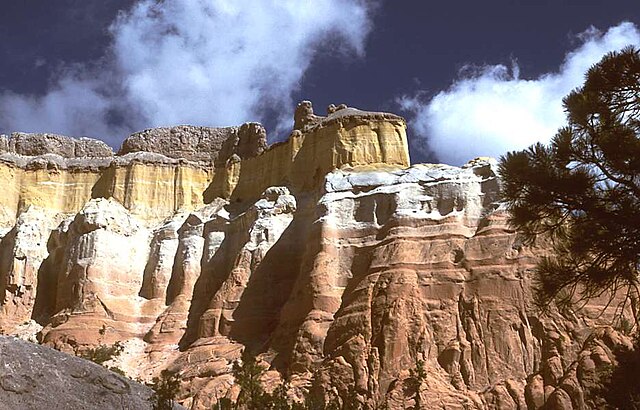
Sandstone cliffs, New Mexico
Wrapping up. Is it a western? While focusing on a love that hardly dared speak its name in 1913, its story is certainly set in the West, and its desert setting plays a major role in the action. Far from the ill effects of city living, it offers healing and rebirth for people enervated by civilization and its discontents.

Teddy Roosevelt, we know, was a big advocate of the strenuous life offered by the West, to toughen both body and spirit. Zane Grey’s first novel, with nearly the same name as Morrow’s, Heritage of the Desert (1910), maps out a similar course of therapy for its sickly protagonist. Both novels involve perilous treks across desert wastes, as do Peter B. Kyne’s The Three Godfathers (1913) and Harold Bell Wright’s The Winning of Barbara Worth (1911).

So Morrow’s story figures into the East vs. West theme to be found in most early western novels, with an emphasis on the West’s health benefits. It certainly goes a big step farther by throwing off social and cultural restraints entirely to find spiritual health in passionate interracial love.

Carlsbad Caverns National Park, New Mexico (CC) Daniel Mayer
Iowa-born, Morrow studied history at the University of Wisconsin and married twice, the second time to publisher William Morrow. Her books include a three-volume biography of Abraham Lincoln. The Heart of the Desert is currently available at google books, Internet Archive, kindle, and the nook. Friday’s Forgotten Books is the bright idea of Patti Abbott over at pattinase. 

Further reading: Short bio of Morrow as a “Famous Iowan”
Image credits: 
Illustration from first edition, W. Herbert Dunton
Wikimedia Commons

Coming up: Tom Mix, Just Tony (1922)

Wednesday, December 14, 2011

Heath Lowrance, Miles to Little Ridge

Cash Laramie and Gideon Miles belong to us all by now, which is how fast things happen in the new Old West. Already a franchise, and none to soon for Edward Grainger fans, this pair of U.S. Marshals portrays a timely style of frontier justice. And hats off to Heath Lowrance for contributing to their unfolding stories with such heartfelt energy.

Hard-boiled crime fiction has been well suited for a certain vision of moral ambiguity and an unreliable criminal justice system. The western, with its Code of the West, has been visiting that same lawless territory since before Owen Wister. The two genres, as they do here, can blend seamlessly.

Gideon Miles, as most of us know by now, is a black man with arguably a white man’s job. In the world of the whites-only western, colored folks if they appear at all were once referred to routinely with the n-word. While a polarized nation went to bloody war over their slavery, they all but disappeared from the mythology of the West.

Emancipated though they may have been in America, they were still regarded as an inferior race, along with Indians, Asians, and so-called “half-breeds.” A long-active racial hysteria intensified in the country after the Civil War, taking legal form in laws against so-called “miscegenation” and enforcing segregation.

There were regiments of black “buffalo soldiers” all of them with white officers. And there were homesteading settlements of freed slaves to be found on the plains of Kansas and Nebraska. Historical research has found that blacks had a visible presence in nearly all walks of life, including cowboying, all over the West. Reading most western fiction, back to the turn of the last century, you would not know it.

Bass Reeves
So here we have something of a compensation for that oversight in a historical anomaly that only fiction can provide—a black U.S. Marshal. True enough, his character is based on an actual historical anomaly, Bass Reeves, who provided federal law enforcement in Indian Territory, until it became the state of Oklahoma and he was put out of a job. But there was no Gideon Miles on the payroll for the feds in the Wyoming and Montana of 1885.

So Edward Grainger has had to invent one. Thus there are the particular pleasures to be had in a Gideon Miles story. Miles embodies the fierce independence celebrated in the western hero who stands up not only to criminals (“murderous skunks” as a Louis L’Amour character calls them). He must remain untouched by undisguised racial prejudice, and the color of his skin means he can trust no one—not even another law officer. Add to that another complication: as an armed lawman, he can fire only when fired upon.

Miles is a perfect hero for certain readers who have always been drawn to the western. There they can find the sense of isolation and vulnerability that comes with realizing the shortcomings of a flawed or inadequate criminal justice system. Gun law, as practiced in the Old West, has both a practical and romantic appeal for these readers.

At a time of political polarization evident in every sorry report of partisan wrangling from Washington, it’s not surprising that a Gideon Miles or Cash Laramie should emerge in the imagination of readers impatient with the nation’s unmet need for social justice. While Miles, despite all the odds, represents respect for the letter of the law, Cash is a kind of “rogue cop,” serving and protecting the marginalized with his own brand of justice.

Miles to Little Ridge articulates all this very nicely. Suspend your disbelief about black U.S. marshals on the frontier, and Heath Lowrance takes you on a journey that honors what you surely care about—eliminating hardened criminals and upholding the law, without making a single compromise.

Not only that, for any reader who ever feels alone, misunderstood, and unappreciated, Miles represents the saving importance of personal integrity. That may be a cold comfort, but it is a value that has been celebrated by the western since the beginning. To the extent that we can learn such a thing from fiction, it’s here to be learned and learned again.

Miles to Little Ridge is currently available for kindle.
Photo credit: Wikimedia Commons

Coming up: Honoré Willsie Morrow, The Heart of the Desert (1913)

Tuesday, December 13, 2011

High Plains Drifter (1973)

This Clint Eastwood classic was his second film as a director (following Play Misty For Me) and seems much influenced by the Euro westerns he made with Sergio Leone. Stripped of naturalistic trappings, it is set in a raw, isolated mining town called Lago on the shores of a lake.

Unlike the processed western mythology of 1950s Hollywood and the often bland family fare of network TV, this film revels in its MPAA-rated sex and violence. Stylized and amped up, the action is of a piece with Eastwood’s trademark squint, cheroot, flat-brimmed hat, and unshaven grimace.

The contrived plot has a dream logic that makes sense only if you accept the premise. The townsfolk are so fearfully desperate that they will give a nameless gunman and rapist anything he wants to protect them from three bad men being released from prison.

Helping himself to whatever catches his eye in the stores of the town’s few merchants, including some dynamite, he orders up drinks for everybody at the saloon. There he gives the sheriff’s badge and the mayor’s bowler hat to a little person who’s obviously been kicked around for a long time by just about everybody in town.

In a disturbingly graphic flashback, we see the same Eastwood being whipped to death by three badmen, while the townspeople look on. A former marshal, his body is buried in the local cemetery. You puzzle over how no one would notice that the stranger they've hired looks like the same man. Eventually you begin to understand that something spooky is going on. Eastwood’s character is both buried in the graveyard and walking the streets, an avenging ghost.

Vengeance may be the Lord’s, but Eastwood does plenty of damage before he’s done. And he rides off into the wavery distance in the last shot, just as he appeared magically out of it in the first.

Lake Mono, California
Clint Eastwood went on to make more naturalistic westerns, which I prefer to this supernatural one. But for vicarious sex and violence, this one is hard to beat. There are many unusual effects of note, like Eastwood’s long, long entry through town on horseback, without a single sound except the plodding hoofbeats on the dusty street. The music track is also spare and appropriately eerie. 

The screenplay was by Ernest Tidyman, newly established as a Hollywood writer with scripts for Shaft (1971) and The French Connection (1971). The film was shot at Mono Lake in the Sierras of Central California.

High Plains Drifter is currently available at netflix and amazon. Tuesday’s Overlooked Films is an enterprise of Todd Mason over at Sweet Freedom.

Photo credit: Wikimedia Commons

Coming up: Heath Lowrance, Miles to Little Ridge

Monday, December 12, 2011

Louis L'Amour, The Quick and the Dead (1973)

1973 edition
A book is a product of both the writer who wrote it and the time when it was written. L’Amour was at a mid-point of his long career when The Quick and the Dead saw print. Vietnam was still fresh in people’s minds, and America was impeaching a president. The past decade had seen civil disorder and the assassinations of four prominent Americans.

It was an age of anxiety, and this novel shows it. Fear is there to be felt from the opening pages. In a retelling of the American story of pioneers venturing onto the frontier to settle, it concentrates on their vulnerability. Not to Indians, bad weather, misfortune, or open-range cattlemen. But to murderous outlaws.

Plot. The McKaskels, Duncan and Susannah, are by late 20th-century standards a typical nuclear family. Educated and used to the comforts and the law and order of civilization back East, they have a dream of starting a new life out West. They have one son, a young teenager, and a lot of belongings. Their covered wagon is a kind of Bekins van, stuffed to the ceiling, pulled by four mules, with two fine horses in tow.

Like a modern-day family, they are confidently making this journey alone. They’re part of no wagon train of fellow emigrants. They’re off-road, following no trail, somewhere on the high plains of Colorado—and with no particular destination.

By chance, they encounter a gang of men intent on doing them harm. At the same moment, they are befriended by a drifter, Con Vallian, who becomes their protector. He knows the frontier, Indians, and bad men. He is also very good with a gun.

The rest of the novel concerns the gang’s long pursuit of the family and, with Vallian’s help, the one by one demise of the gang’s most dangerous and loathsome members. It’s like a frontier retelling of the Vietnam War, as a platoon far from base camp is stalked by a vicious armed enemy—but with a happier ending.
  
HBO tie-in, 1987
Hawks vs doves. The argument of the novel is a hawkish one. The non-violent, gentlemanly manner of McKaskel is a product of book learning and shown to be useless in a lawless environment. Out here it’s kill or be killed. A man unable to defend himself will have everything taken away from him, property, wife, and finally his own life.

It’s probably too much to characterize Con Vallian as a kind of Green Beret. But his survival skills are well developed; so are his abilities as a tracker, gunman, and defensive strategist. He knows and understands the wild, its wild animals, wild Indians, and wild men.

Through him, L’Amour amplifies the perils of being on the frontier. He writes:

These western lands brought death suddenly, without warning, and in a hundred ways. It had a way of exploding into violent action leaving a man broken and bleeding, far from any help. Many a father or son rode away never to return, many a lone hunter left coffee on the fire to picket a horse or fetch a bucket of water, and that was the end of him. Sometimes his bones were found. Often enough not even that.

As a scout Vallian is often on recon. He pays close attention to the lay of the land, calculating the relative advantages for attack and retreat. There are scenes of hand-to-hand combat, and when guns are drawn and fired, and bullets fell a man, we are told their points of entry. In the final chapters of the novel, Vallian even refers to the impending confrontation with the gang as “war.”

Saturday, December 10, 2011

Western writer inspiration, no. 15

Here is this week's omnibus of #westernwriter inspirations posted each day at twitter (click to enlarge). If you are on twitter, you can follow me @rdscheer.

Gen. Miles and Buffalo Bill near Pine Ridge Agency, SD, January 16, 1891
C. B. Lynch Store in Tulsa, 1891
Portland, Oregon, Mount Hood, 1890
Deadwood, South Dakota, 1900
Fort Worth, Texas, 1891
Land office, Round Pond, Oklahoma, 1894
Salt Lake City, c1890

Picture credits: Wikimedia Commons

Coming up: Louis L'Amour, The Quick and the Dead

Friday, December 9, 2011

Photo-finish Friday: out and about


Here's yet another mural. Three-dimensional this time and not on a wall. This one adorns what I would call a switch box for the phone company. It's along the street in front of a large new apartment complex near where I live. Above is a view from the left side. Below is a view from the right. The wonder, I suppose, is that is has not been tagged.


Photo-finish Friday is the bright idea of Leah Utas over at The Goat's Lunch Pail.

Coming up: Louis L'amour, The Quick and the Dead