Showing posts with label new mexico. Show all posts

Thursday, May 1, 2014

Richard Wheeler, Flint’s Truth (1998)


Number two in Richard Wheeler’s series of novels about frontier newspaper editor Sam Flint, this is an unusually dark tale for the author. There are moments of harsh realism in the first one, Flint’s Gift, but Wheeler creates a mining community in his second novel so merciless that readers can be tempted to lose faith in the West of honest men and deeds they turn to the western story to reaffirm.

Plot. It’s the summer of 1870, and itinerant editor Flint picks a New Mexico gold mining town, Oro Blanco, to set up shop. He quickly meets the man who will become his nemesis, the town marshal, Crawford. The marshal is not just the law. He is a brutal bully who uses his authority to physically dominate and punish anyone who crosses him.

He actually shows little respect for or understanding of law or what it has to do with law enforcement. He simply makes threats, cracks heads, and throws people in jail he doesn’t like. He is soon at loggerheads with Flint, who just wants to print the news.

Printing press, 1835
What Flint learns after arriving in town is that Mason Weed, superintendent of the Golconda Mining Company, has a lot to hide. Lawyers in the hire of the company are attempting to invalidate a land grant that would give full right of ownership of the land the town rests on to the Mexicans who have lived there for generations. It would also give them 25% interest in the output of the mines.

Weed, a polished man driven by insatiable greed, will do anything to prevent that. Flint quickly becomes a thorn in his side. But rather than condone Crawford’s high-handed use of force to put Flint out of business, Weed brings in a rival newspaper to print trash about him and his efforts to thwart Crawford and to bridge the distance between Mexican and Anglo residents of the town.

Caught in the middle is a 12-year-old girl, Libby, whose widowed mother is dying of consumption in a state of utter poverty and destitution. Libby is befriended first by Flint and then by a seven-foot Cornish miner, Mountain Jack Treat, who refuses to be intimidated by Crawford and his deputy thugs. Flint gives her a job at the newspaper, sending her to a street corner to sell copies of his weekly. Treat organizes a boycott of the mayor’s saloon and opens his own bar, patronized by loyal fellow miners.

Thursday, October 10, 2013

Arthur Henry Paterson, The Better Man (1890)


This novel may qualify as the first western, and it was written by an Englishman. The central characters of the novel are also English, and the author writes as someone who acquired a familiarity with the people and customs of the American West. He lived there for a time in the 1870s.

Plot.  Two school chums, who first met as schoolboys at Eton, meet again in a settlement called Toros in New Mexico. Frank Houghton has lived here as a cattle rancher for four years. He is joined by the younger Tom Eckersley, who has left his upper-class family to seek his fortune in America. Against the advice of Houghton, Tom befriends a shady character, Mark Galt. With the help of an unscrupulous judge, Galt and his gang run a town 50 miles away called Carita.

Confident in his ability to judge character, Tom signs a contract that commits him to a year of sheepherding for Galt. When Tom also agrees to persuade his father to invest £1,000 in their ranch, he does not sense that Galt is laying a trap for him. But eventually, he is so enraged by Galt’s duplicity he nearly kills the man.

Apprehended before he can flee to safety, he is thrown in jail and faces attempted murder charges. Frank gathers a small army of cowboys to ride all day and night to rescue Tom, who has been found guilty in a hurried trial and sentenced to be hanged. The rescuers meet little resistance, and the crooks are quickly overwhelmed and sent packing.

Tennyson's home, from book by A. Paterson
Romance. Midway through the novel, Tom’s family arrives in Toros to take him back to England. With his parents is his sister, Edith, whose presence disturbs the already taciturn Frank. He had once proposed marriage to her, and she declined his offer. She is now being courted by a military man, Major Crawford, who arrives in town as well.

Frank is not a happy soul, still suffering from a broken heart. Edith’s arrival revives his hopes, but she remains unaware of his feelings, and hardly knows her own. Belatedly discovering her love for Frank, she turns down Crawford’s proposal of marriage.

When a young telegraph operator observes the major’s abrupt departure from town, he sends word to Frank who returns from his ranch just as the family is about to leave for England. Frank and Edith are united once more, this time confessing their love, and he promises to wrap up his affairs within three months and return to England himself.

Character. Before we meet Frank Houghton, a crusty old stage driver describes him warmly as “a man!” By that he means a trailblazer, “one who cuts a notch in every tree he passes as he walks through life.” Frank has been transformed by his four years in the West. Already a big man at six-foot-three and a half, he has developed a massive chest, his skin has browned, and he has grown a thick beard.

Someone observes that the West has been hard on Frank. Edith tells him he has “a tired, grim look, as if you did not find life very much worth living.” She guesses that it must be lonely with no one to speak to but the men who work for him. He tells her he can bear it, because he’s a man and he has no choice. Meanwhile, he has won a place in the hearts and minds of the local residents. Through his courageous effort, he has helped rid the town of a ring of crooks and outlaws.

Friday, March 8, 2013

Charles Alden Seltzer, The Two-Gun Man (1911)


Along with Zane Grey and William MacLeod Raine, Charles Alden Seltzer is remembered today as an originator of what’s often called the formula western. In it, a cowboy hero of sterling qualities, who is fast with a gun, meets and subdues a vicious villain. While this part of the story plays out, the cowboy also wins the heart and hand of a pretty sweetheart.

The Two-Gun Man has all these elements firmly in place. The story is told with few complexities of plot or character. It is set at an unspecified time in the open ranges of the Southwest, somewhere in the neighborhood of Raton and Cimarron, New Mexico.

Plot. The central character, Ned Ferguson, arrives in a small desert settlement. He’s been sent for to find and dispose of rustlers who have been decimating the herds of a cattleman named Stafford, who runs a spread called the Two Diamond.

Ferguson comes to suspect Stafford’s range boss, Dave Leviatt. There’s been bad blood between them ever since Ferguson demonstrated his skill with a sidearm. While Leviatt shows he can shoot a tomato can five times while it’s in the air, Ferguson manages the same trick with six.

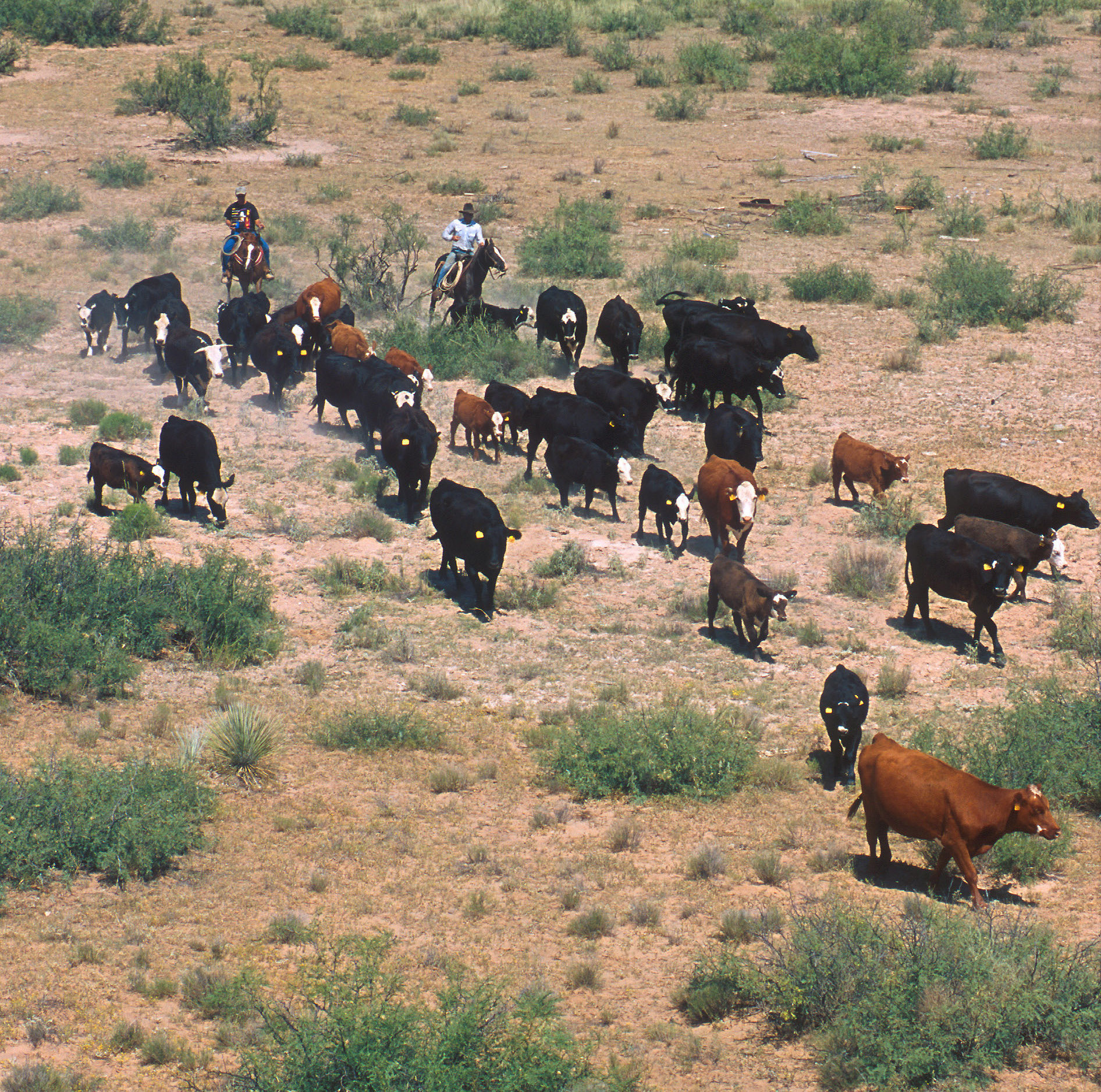
Cattle roundup, New Mexico
Ferguson works under cover on Stafford’s ranch, posing as a “stray-man,” hired to roam the hills and brakes in search of cattle that have wandered off from the herd. In reality, he is a range detective, with a license to kill, no questions asked. He soon finds evidence of rustling, and Leviatt and a pal Tucson seem the likely culprits.

One day, following them from the ranch, he finds the two men turning over Two Diamond cattle to another pair of rustlers. Confronting Leviatt and Tucson when they return to the ranch, Ferguson is forced to draw on the two men, killing them both. The grateful ranch owner, Stafford, makes Ferguson his new range boss.

Romance. After all that, it may come as a surprise that much of the novel is devoted to a romance that blooms between Ferguson and Mary Radford, who lives with her brother nearby. The one twist in the story is that Mary is an aspiring writer, and after meeting Ferguson, she busies herself writing a western novel.

Cattle crossing the Rio Grande
The central characters are based as close to life as she can make them. The hero is the handsome, two-gun-wearing Ferguson, and the villain is the despicable range boss of the Two Diamond, Leviatt. As the object of his unwelcome attentions, she has reason to hold him in contempt.

Envious of Ferguson’s apparent success in wooing the girl, Leviatt misinforms her of Ferguson’s true purpose at the ranch. He’s been hired, he says, to kill her brother, Ben. When Ben is then wounded in an ambush, she assumes that Ferguson is the gunman. Feeling betrayed, she greets Ferguson with a rifle at his next visit and the promise to use it should he ever return.

Mary is his first true love, and he falls hard for her. At first he is charmed by learning that she is a writer. Then he is hurt when he believes for a while that her affections are only a pretense to learn what she can of him for her novel. When she rejects him, after misunderstanding his true intentions for wooing her, he is thrown into a truly painful melancholy.

No worries, however. Exposing the real rustlers, Ferguson quickly finds himself back in Mary’s good graces. The novel ends as she seeks Ferguson’s help with the ending of her novel. Will the lovers marry and go back East, or will they stay in the West?

They’ll stay in the West, he tells her. The cabin where the heroine and her brother have been living will be enlarged to make room for the hero, he says, and for the arrival of little heroes and heroines. Embarrassed, she stops short of putting “such a thing as that” into her book.

Thursday, January 17, 2013

Max Evans, The Hi Lo Country (1962)


sawtoothbooks.com
Max Evans says in the introduction to the 1995 edition of this novella that he set out to capture the “Old West” of the 1940s-50s, before it became mythologized like all the earlier ones. His central character, Big Boy Matson, is a larger-than-life cowboy full of the give-em-hell spirit of the generation before him. He scorns the modernizing of cattle ranching and would sooner ride a horse than drive a pickup to do his job.

Big, strong, and fearless, he is a fighter and drinker, who defies civil conventions when they get in the way of his free-for-all style of life. When he sets his eye on another man’s wife, Mona Birk, there’s no stopping him. It doesn’t matter that her husband is the foreman for the biggest and richest cattleman around.

Plot. We know from page one that Big Boy gets killed. The son and grandson of men who died from gunshots, he is remembered by the story’s narrator, Pete West, who has been his best friend. Pete is a small rancher and more than a little drawn to Mona himself. Marriage to a girlfriend, Josepha, is much postponed as Pete suffers miserably under Mona’s spell.

Meanwhile, Big Boy openly flaunts his affair with her and gets on the wrong side of just about everybody but a handful of close associates. “That always happens,” Pete says, “when someone’s his own man and goes his own way.” His demise is temporarily averted when Mona’s husband is goaded to draw a gun on him at a dance. The brawl that follows leaves Birk’s cowboys thoroughly thrashed and Birk himself next to dead.

New Mexico Fair rodeo, 1940
Matters worsen on a drunken double date, as Josepha persuades the other three to have their fortunes told by a local witch. Not only is Pete’s fortune disturbingly dark, but he is driven to an unwelcome understanding of Mona and his unrequited desire for her. Big Boy’s death finally comes, in a way that is both surprising and inevitable. Pete is elsewhere at the time, so we have only the report of those present, and they are each unreliable.

Storytelling. Max Evans has a fiercely loyal following among western readers. The Hi Lo Country is testament to his gifts as a storyteller. While committed to a realistic portrayal of the West that he knows from his own experience, he gives us that realism once removed. With its first-person narration, it offers the further reality of a western style of storytelling.

Much of the novella is a collection of shorter stories told about the people who are among the residents of Hi Lo country. With the settlement of Hi Lo at its center (pop. 500), this country is ranchland extending over much of northeast New Mexico and adjacent parts of Colorado and Texas. There are Anglos here and Mexicans, all of them scratching out a living. Social life is almost exclusively to be found in the two bars in Hi Lo.

Homesteaders, New Mexico, 1944
The country is prone to drought, and the withering winds blow, hot or cold, 300 days of the year. Maybe not since Dorothy Scarborough’s The Wind (1925) has it been so much a feature of a story about western life. Cattlemen watch their herds die for lack of water and feed. Or blizzards overwhelm them, as they did in the winter of 1948-49, which Evans records here.

Like the many stories told by Pete and Big Boy as they get steadily drunker in either of Hi Lo’s bars, the novella is itself another barroom story. Well crafted, it holds the hearer’s attention with the hard-to-believe account of a fiercely independent and colorful character.

It is the West transformed and memorialized by the West’s own way of regarding itself—as a harsh land with a harsh climate producing extreme behavior. And in the telling, there’s an entertaining avowal of acceptance. What doesn’t kill you may or may not make you stronger, but it sure as hell can make a good story.

Along with Joseph Conrad, one might add to that, “Pass the bottle.”

Thursday, October 18, 2012

Edgar Beecher Bronson, The Red-Blooded (1910)


Bronson’s memoir Reminiscences of a Ranchman (1908) was reviewed here a while ago. The Red-Blooded is a collection of further memoirs and some fiction published two years later, half of it set in the frontier West. Here are a few samples.

“Loving’s Bend.” Bronson begins the book with an account of Texas cattleman Joe Loving. Telling a story that was told again by Larry McMurtry in Lonesome Dove, Bronson describes Loving’s fatal encounter with a band of Comanches on the Pecos in 1868. Riding some 60 miles ahead of his herd, in the company of a cowboy, Jim Scott, Loving was felled by a rifle shot that shattered his leg.

As Bronson tells it, the two men defended themselves by taking cover under a steep bank along the river, while the Comanches laid siege. Under cover of darkness, Scott escaped by floating down river a quarter of a mile, then walked without boots for a day and another night before being found barely alive by one of Loving’s cowboys.

Loving and Scott under siege
Fellow trail boss Charles Goodnight sent a rescue and found Loving about to lose his leg from gangrene. A surgeon was brought from Las Vegas, and Loving’s leg was amputated, but like Gus McCrae in Lonesome Dove, he did not survive.

“Triggerfingeritis.” This chapter is a tribute to the lawmen who fearlessly hunted down, eliminated, or drove away the most bloodthirsty of the bad elements on the frontier of the 1870s-1880s. Praising not just U.S. marshals, and sheriffs and their deputies, he includes stage and railway express guards, vigilance committees, and range detectives.

Among those he singles out for recognition are men with names like Boone May, Captain Jim Smith, Billy Lykins, Bill Stoudenmayer, Hal Gosling, Johnny Manning, Col. Albert J. Fountain, and Pat Garrett. With their services, Bronson argues, there was little need for judges and juries, and for each lawman mentioned he provides a lengthy character sketch.

Bronson counts Pat Garrett among his personal friends and says that with the exception of Col. Fountain, Garrett had “stronger intellectuality and broader sympathies than any of his kind I ever met.” Easy going in his private life, Garrett was also “exacting and painstaking” as a peace officer. Bronson notes that he was also an avowed atheist and suspects foul play in his death, which had occurred only recently, in 1908.

Sheriff Whitehill
“The Evolution of a Train Robber.” In this chapter, Bronson gives an account of a typical cowboy, Kit Joy, who supplies himself with the needed funds for a trip to San Francisco by turning to crime. Enlisting three accomplices, he holds up a train west of Deming. The engineer is shot during the robbery, and the four men soon have Sheriff Harvey Whitehill on their trail.

Tracing a piece of newspaper found near the scene to a merchant in Silver City, he is able to identify one of the robbers, whom he tricks into revealing the identities of the others. Jailed, the four men break out, with two other prisoners, and in the manhunt that follows, all but Joy are either shot or arrested.

When one of the posse pursuing them is found dead, the two living captives are hanged on the spot. Joy remains at large for weeks, until hungry and desperate he is shot in the leg by a rancher. After serving 14 years in a Santa Fe prison, Joy was released on good behavior and continued his life as a law-abiding citizen. At heart, Bronson says, he was a better good man than a bad one.

Tuesday, August 28, 2012

Run For Cover, 1955

Cast often as a tough guy, James Cagney is full of surprises. In this western from director Nicholas Ray, he plays a thoughtfully patient mentor of a young stranger (John Derek) he meets on the trail. Shot in the mountains of New Mexico and Colorado, the film achieves a kind of visual majesty, while the story it tells is a simple one of love and friendship.

Plot. In a plot contrivance that’s more than a little far-fetched, Cagney and Derek are taken to be train robbers and come into the possession of a company payroll. A posse with a trigger-happy sheriff opens fire on them as they ride to the next town, disabling Derek, whose shattered leg keeps him off his feet for several weeks.

Taken in by a Swedish farmer (Jean Hersholt) and his daughter (Viveca Lindfors), Derek is nursed back to health, while Cagney looks after him and helps out on the farm. Tender affection develops between Cagney and Lindfors, but Derek reacts badly when he discovers he’ll never walk without a limp again.

Cagney is offered a job as sheriff of the town, and he enlists Derek as his deputy. But the young man is not up to the responsibilities given him by the well-meaning Cagney. First he allows the town folk to lynch a prisoner while Cagney is out capturing another wanted man (Ernest Borgnine). Later, he lets Borgnine escape.

John Derek, James Cagney, Viveca Lindfors
A big bank robbery in town finds everybody in church, where one of the thieves recognizes Cagney as an ex-con who was once a prison cellmate. Persuading the citizens who hired him that he’d done time for a crime he didn’t commit, he keeps his job and takes a posse out after the robbers.

The tracks lead to forbidding badlands, and everyone turns back except Cagney and Derek, who turns out to have been enlisted by Borgnine as an accomplice for the gang. In the ruins of an Indian pueblo, Cagney confronts Derek as a miserable excuse of a man and a disgrace to his gender. Then, thinking Derek is drawing on him, Cagney shoots him down.

Thursday, August 16, 2012

George Tower Buffum, Smith of Bear City (1906)

This collection of frontier sketches could aptly be described as creative nonfiction. The fictionalized treatment of fact begins in the opening preface, in which Buffum applauds the American mining industry and its pioneers. Unlike other captains of industry, he claims, these men extract wealth that is “clean and untainted by the despoiling of their fellow man.” Viewers of Deadwood will be surprised to read that even “Uncle George” Hearst gets credit for never having been the cause of human suffering.

The stories Buffum has to tell are chiefly set in various parts of the West, where mining has been the main interest of those men and women to be found there. The yarns are of the kind you’d expect to be told over brandy and cigars in a turn-of-the-century gathering of traveling salesmen. And if Buffum is to be believed, he gathered them while covering a good many miles.

Outlaws. Famous Old West outlaws and the odd lawman are featured, including Curly Bill (Brocius), Soapy Smith, Clay Allison, and Billy the Kid. Bat Masterson also makes an appearance. Breezy, hard-to-believe tales, they are in fact short on historical fact.

As one example, western enthusiast Ramon Adams scoffs at Buffum’s garbled account of Billy the Kid’s arrest in his survey of Old West lore, Burs Under the Saddle (1964). Just about everything presented by Buffum as fact is incorrect, Adams notes, including the absence of Pat Garrett from the story. Two stories about Curly Bill even give completely different versions of how the man died.

The chapter devoted to Soapy Smith stands out over the others in the way it brings the man so vividly to life. Buffum claims to have seen Soapy on a street in Denver in 1879, gathering a crowd as he sells soap with the help of two assistants pretending to be customers. The soap comes wrapped up with money—as much as $100—and Soapy takes bids from the crowd until folks begin to figure out it’s a scam.

In Leadville and Creede, Soapy graduates to the saloon and gambling business. “A professional badman,” Buffum says, Soapy was also a “devoted husband and father.” When a parson arrives in Creede with a letter from Soapy’s wife asking him to contribute to the building of a church, he readily complies. Using his street-barker’s gift of oratory, he raises $300 from the assembled saloon patrons, and puts in another $400 himself.

Hotels. Many of the stories involve the proprietors or employees of various hotels to be found around the West. Most of them are described as repellant, the bed linen rarely changed, the food inedible. Given the proliferation of firearms, they are often also the scene of bloodshed.

A cook by the name of Mother Corbett at Snake River Crossing, Idaho, is known for serving up terrible food. Passengers passing through on the stage line are treated to a cold meal of tough beef, rancid bacon, or goat meat, with hot pepper sauce and biscuits hard as rocks—all for a dollar. When a whiskey salesman has the temerity to complain, she makes him eat serving after serving at gunpoint, until the stage driver begs her to release the man so the coach can depart.

Style. The stories are first-person narratives, basically long monologues. They employ a declamatory style meant to entertain with ironic circumlocutions and elevated word choice, for comic effect. In this example, the narrator describes how the threat of gunplay between two men quickly clears a saloon:

The messenger and the bar loungers made hurried departures, as business matters were getting too exciting and any delay might result in serious personal inconvenience and fatality.

In the spirit of Rex Beach’s collection of animal stories, collected in Pardners (1906), one of Buffum’s sketches is told by a burro called Satan. He tells of being taken on a prospecting trip into northern Idaho, where he discovers a silver deposit by following his nose.

The mine eventually falls under the supervision of John Hays Hammond, who makes a fortune and travels to South Africa. There his meddling in the Brits’ attempts to seize the Transvaal from the Boers lands him in prison with a 15-year sentence. After paying $125,000, Satan tells us, Hammond gets the sentence commuted and goes on to become a world famous mining authority—all thanks to Satan, the burro. Some irony here? Maybe.

The West. Violence, guns, and death predominate as themes in the stories, and together they portray the West as a place where life was cheap and few escaped misfortune. The narration assumes an attitude of detachment, as if reporting on the curious customs of the inhabitants of some colony far from the urban centers of the civilized world.

Rincon, New Mexico, is described as “a city of toughs,” where shootings are common. There are two stores, 50 saloons, two dancehalls, and one hotel. The hotel consists of a single large room with 40 beds. A dollar gets you one of them for a night. The cost if you’re already dead, however, is $5.00, as a traveler learns, who is told that one bed’s occupant is actually a body waiting for a coffin that’s to arrive the next morning.

And such was life in the West.

Wrapping up. George Tower Buffum (1846-1926) was born in New Hampshire, and little else is known about him. Another collection of his stories, On Two Frontiers was published in 1918.

Smith of Bear City is currently available at Internet Archive and for the nook. For more of Thursday’s Forgotten Books, click on over to Patti Abbott’s blog.

Illustrations: From the first edition by F. T. Wood

Coming up: Saturday music, more Bob Wills

Tuesday, May 15, 2012

Fort Massacre (1958)

Joel McCrae plays a twisted cavalry officer in this dark 1950s western. Not used to seeing McCrae play an anti-hero, I was surprised that he’s so convincing in the role. A sergeant and the highest-ranking officer after a deadly encounter with Apaches, he takes command of what’s left of a platoon.

Orders are to join up with the main column of company troops, but besides bloodthirsty Apaches intent on doing damage to them, he has to deal with the open hostility of his own men. They regard him as dangerously overtaken by his hatred of the Apaches, who were the cause of his wife and children’s deaths.

Plot. The men and horses are in desert country, and their first need is water. One of McCrae’s men (John Russell) and an Indian scout (Anthony Caruso) find a waterhole, but it’s already occupied by a war party of 50 Apaches. Over the objections of his men, McCrae leads them in an attack to seize the waterhole, which wipes out the Apaches and takes out a few of his own.

Two soldiers join them, having escaped a massacre of another company, which brings their number to eleven. Then they come upon a trader and his unpleasant wife, who do business in furs and contraband with the natives. Their single customer refuses to be taken captive and dispatches the platoon’s scout before escaping, which brings the number down to ten.

Trusting that more Apaches are in hot pursuit, they overnight at a fort-like pueblo ruin. “Fort Massacre,” one of the men mutters. Inside, they find an old, English-speaking Piute and his granddaughter, who have taken shelter.

As the Apache band arrives, McCrae and his men go into hiding. The Piutes manage to convince the Apaches that the white men have gone. They are about to leave when McCrae, unable to resist his murderous urges, opens fire. It’s another massacre, and all of the soldiers are killed as well, except for himself and Russell.

The Piute, a Christianized Indian by his own account, is appalled by McCrae’s actions and says he’s off to the fort to tell the Army the truth of what happened. Russell has remained indifferent to McCrae’s command throughout the film, but he draws the line here when McCrae raises his rifle to kill the old Piute. McCrae gets a fatal round from Russell instead.

Tuesday, May 8, 2012

The Hi-Lo Country (1998)

The Hi-Lo Country is an area of northeast New Mexico, celebrated by writer Max Evans in his novels. Published in 1960, The Hi-Lo Country was made into a film in 1998 by British director, Stephen Frears. Set in the 1940s, it recalls an even earlier era of the West, when cattle ranching and cowboys ruled the open range.

There isn’t a gun or a horse in the poster created for the film. Just a cowboy hat on the head of Woody Harrelson to suggest we are somewhere in the West. The 1940s car in the foreground erases any thought of “Hollywood western,” but a few minutes into this movie and you find yourself immersed in a world where cowboys still rule.

There are in fact horses and cattle in the film, fistfights, hard drinking, and a high-stakes game of poker. Small ranchers are up against a land-grabbing big one. Guns are drawn and shots fired. Men die and women mourn. It may as well be 1885.

Billy Crudup, Woody Harrelson
Plot. The film is about heart-and-soul cowboying. Its two central characters (Woody Harrelson, Billy Crudup) are men of a dying breed. Their friendship and loyalty to each other run deep and wide as the Cimarron. Of the two, Harrelson is the more daring, refusing to be constrained by any obstacle in the way of whatever he wants.

Returning from service in WWII, they partner with another old-timer who helps them start a cattle herd. Their chief antagonist is a cattle baron (Sam Elliott), amused by their efforts to buck the tide of economic determinism. Only big business succeeds now, he tells them. They will fail, and he knows it.

Curiously, what holds your interest in the film is not the conflict between the two cowboys and Elliott or their success or failure as ranchers. The emotional power has to do with the attraction both young men have for a married woman (Patricia Arquette), who is the wife of Elliott’s foreman.

Harrelson is the far more determined and reckless in his pursuit of her, and Crudup steps aside to let them carry on their affair, while seething with unrequited desire. Meanwhile, he half-heartedly takes an interest in a pretty Mexican girl (Penelope Cruz), who comes to understand that she will never win him.

Patricia Arquette
Romance. Love triangles in westerns are not new. A similar example recently reviewed here is the cattle-drive movie Texas (1941), where William Holden confidently takes Claire Trevor away from saddle-pal Glenn Ford. One big difference in that film is that Trevor is a spirited presence on screen, animated and comic.

Arquette’s character is a lovely walking shadow, emotionally drained by a life of boredom. Her sultry appeal to both men is believable yet mysterious. Like a good horse, Harrelson explains, she has “bottom.” He wants her with an undeniable lust that’s the same as his furious love of cowboying and the bond he’s long had with Crudup.

Wrapping up. Though shot entirely in New Mexico, the terrain of the film is often the human face itself. Many sequences are shot in closeup. Shoved so close to the characters, you can feel the heat of the emotions between them.

Sam Elliott fans will be surprised to find him both clean-shaven and a villain. He typically smirks in his scenes, the biggest big shot in the room, who knows nobody can touch him. With a few strands of hair sticking from under his Stetson, he can look slightly demented.

Woody Harrelson with director Stephen Frears
The surprise in 1998 must have been Harrelson’s full-bore performance as the rip-roaring Big Boy. After 200 episodes of his role as the slow-witted bartender in TV’s Cheers, he is totally believable as a larger-than-life cowboy. Billy Crudup, all masculine sensitivity and suppressed desire, makes an excellent foil, both physically and emotionally.

Critics and audiences seem to have found the film disappointing when it was released. Yes, it’s loosely structured, a few scenes seem curiously slow, and a scene set in a blizzard is confusing. But even at almost two hours, it was compelling enough to keep me riveted to the couch. In the end, the separate threads of the film fit smoothly together into a single powerful statement about taking risks and living freely, which has always been the appeal of the cowboy.

The music in the film deserves note, as does the script by screenwriter Walon Green, whose first writing credit in Hollywood was with Sam Peckinpah, for The Wild Bunch (1969). Another novel by Max Evans, The Rounders (1960) was made into a film in 1965, followed by a TV series, 1966-67.

The Hi-Lo Country is currently available at netflix, though unfortunately in a pan-and-scan version. For more of Tuesday’s Overlooked Movies, click over to Todd Mason’s Sweet Freedom.

Photo credits: imdb.com

Coming up: Frances Charles, In the Country God Forgot (1902)

Tuesday, April 10, 2012

The Sea of Grass (1947)

This Tracy-Hepburn domestic melodrama is set in the West and has some of the scale of George Stevens’ 1957 epic, Giant. But despite its dynamite cast, the film lacks what it needs most—wide screen and color.

Stock footage near the beginning of wind blowing in tall grasses and dramatic long shots of riders passing along the foot of a sheer cliff face promise some visual wonders. But with key exteriors obviously built on a sound stage and with the frequent use of process shots, you get the feeling that Tracy and Hepburn hardly left the comforts of home.

Plot. The film is based on Conrad Richter’s 1937 novel of the same name. Set on the open ranges of New Mexico, it tells a familiar story of a cattleman (Tracy) fighting an influx of homesteaders. Wearing his big, tan LBJ Stetson, he looks the part. But stiff and stern through most of the film, he rarely expresses the warmth that normally makes him a pleasure to watch on screen.

Tracy as Jim Brewton in The Sea of Grass
Hepburn, at the age of 40, is a bit spinsterish already to be playing an impulsive young woman who comes from St. Louis to the frontier to marry a man she hardly knows. When her sympathy is torn between her husband and the settlers he hates, the marriage begins to founder. Bored and left alone much of the time, she has a dalliance with a persistent suitor (Melvyn Douglas).

This is where the 1940s-style melodrama moves in on the plot. A second child is born, and close attention to the dialogue reveals that Douglas is the father. Hepburn eventually returns East for good, leaving the children with Tracy. The boy grows up to be the stereotypical rich man’s son (Robert Walker), misbehaving and counting on his father and the family lawyer to get him out of any trouble.

An exchange of gunfire over a card game turns him into a man wanted for murder. And by film’s end, Walker is dead himself. Tracy and Hepburn’s daughter (Phyllis Thaxter), long estranged from her mother, reunites her parents and after two hours we get to the last fadeout.

Cimarron National Grasslands, Kansas
Is it a western? Well, yeah. It has the familiar elements, including a large contingent of cowboys, herds of cattle, horses, guns, a ranch, a saloon, a frontier town.

What it does lack is a real western villain. Tracy’s cattleman may give the usual argument that the cattlemen tamed the frontier and for that reason deserve privileges that the homesteaders do not. But he’s right about something else. Turning the grasslands into farmland would be an ecological disaster. Recent memories of the Dust Bowl would have met with agreement from 1940s viewers. So he’s not the usual cattle-baron villain.

Douglas might qualify, as the man who lures Hepburn into adultery (and, oh, how gingerly that subject is portrayed). But he’s not a cad or a bounder either. To the end, he keeps trying to persuade Hepburn to marry him and provide a proper home for their son.

But maybe before all that, it’s a Tracy-Hepburn film, the fourth one they’d made together. Not quite a genre, but certainly a franchise, the combination of the two would become truly memorable in the romantic comedies that followed: Adam’s Rib (1949), Pat and Mike (1952), and Desk Set (1957).

1937 edition
Wrapping up. Deserving mention are the supporting actors, Harry Carey as a town doctor and Tracy’s longtime friend. Lifting the film from the melodramatic doldrums is the wonderful performance of Edgar Buchanan as Tracy’s cook. First gruff and ill tempered, he becomes an endearing presence in the ranch house, devoted to his employers and their children.

At two hours, the film has the feel of being inflated from Richter's modestly short novel. Director Elia Kazan is said to have been embarrassed by it. And to be honest, it hardly seems the work of the same man who directed films like A Streetcar Named Desire (1951) and On the Waterfront (1954).

Kazan’s reputation in Hollywood has been troubled by his naming names to the HUAC. And it’s an interesting irony that the screenwriter for The Sea of Grass, Marguerite Roberts, was blacklisted during the 1950s for refusing to do the same thing. Roberts, it should be added, returned to Hollywood in the 1960s and is probably best remembered for her screen adaptation of Charles Portis’ novel, True Grit.

The Sea of Grass is currently available at amazon and netflix. Tuesday’s Forgotten Films is the much-appreciated enterprise of Todd Mason over at Sweet Freedom.

Photo credits: Wikimedia Commons

Coming up: Elisabeth Grace Foley, The Ranch Next Door


Thursday, March 8, 2012

Florence Finch Kelly, With Hoops of Steel (1900)

Emerson Mead and young rider
This early western has a puzzling title unless you’re familiar with the fatherly advice of Polonius to Laertes in Shakespeare’s Hamlet. There in the same speech as “To thine own self be true,” you’ll find this nugget: “The friends thou hast, and their adoption tried. Grapple them to thy soul with hoops of steel.”

And, lo, the story Kelly has to tell is about three friends from Texas, as grappled together as the Three Musketeers. Two are young deputy U.S. marshals, while the third is a rancher, and when one of them is unjustly accused of murder, it’s all for one and one for all.

Plot. The story is set in New Mexico, in the deserts south of White Sands. There a range war has been going on between a Big Rancher, Col. Whittaker, and a bunch of small operators. Leading the colonel’s opposition is one of the three friends, Emerson Mead. Maybe not surprisingly, sympathies among the locals have divided along party lines, Republicans supporting Whittaker and Democrats siding with Mead.

Whittaker’s son Will has gone missing, and because he and Mead were known to be enemies, belief is strong that Mead has killed him. A search of the desert has not turned up a body, but Mead is tossed into jail anyway, where he stays until he is sprung by his two friends.

After the jail break, the ride into the night
Before long, he is arrested again and his friends engineer yet another escape. This time they take him from a train while he’s being transported to a jail in another town. Honorable man that he is, Mead eventually agrees to turn himself in and face charges if the body of Will Whittaker is ever found. When a search in the White Sands turns up a body, Mead is true to his word. He’s once more behind bars.

But not for long. While under escort to court on the day of the trial, he joins the frantic search for a lost child who has wandered off into the surrounding desert. He and the child’s sister find the boy, near death, and the often-feuding community is joined now in their support of him as he returns to trial. Talk of lynching is forgotten, and while apparently guilty of murder, it looks like he might get off with a prison sentence.

All is not over, however. Nick Ellhorn, one of the three “musketeers” returns from a trip to Mexico with convincing evidence of Mead’s innocence. And a tentative romance between Mead and a young lass, Marguerite, blossoms into matrimony.

Mead and the stampede in the storm
Themes. Though early in the development of what’s come to be known as the traditional western, Kelly’s novel has many of its elements and much of its spirit. The camaraderie of the three friends, their adventuring, and expert gunplay look forward to the Bar-20 novels of Clarence Mulford.

The friendship between the three central characters may be what male-bonding looks like to females. There’s a depth of devotion and loyalty in the portrayal that verges on the irrational. Of the three, Nick Ellhorn is arguably a clear case of arrested adolescence. When his buddy Tom Tuttle is held captive for a night by two men he encounters in the desert, Nick impulsively chases after them and doesn’t stop until he gets shot in the arm during an exchange of gunfire.

Later, he will open fire on Whittaker’s men when they follow Mead to arrest him. And when he sees Mead being taken prisoner, he gets weepy and emotional. That anything should come between the three men is more than he can bear. Both he and Tuttle assume that the three friends will never marry, and when Mead finally does, there’s a risk that Nick will go off on another of his benders.

Nick and Tom find a dying prospector
These, as his two friends know, often get him into trouble. On one of them during the novel, he assaults a Chinaman and Americanizes him by cutting off his queue. That incident costs Nick jail time and a hefty fine.

With Hoops of Steel is also an early example of a novel set in the desert Southwest. Kelly’s often comic treatment of small town politics would have found comparison with Alfred Henry Lewis’ stories of Wolfville, his fictional stand-in for Tombstone, Arizona. But she also has a flair for life-and-death drama, as when a character nearly dies in the desert from dehydration. There’s also room for a little romance

Romance. Nick Ellhorn and Tom Tuttle, we learn, have had many “sweethearts,” as they call them. These are, we gather, not romantic affairs. Their friend Mead, perhaps because of distant New England roots, has a more reserved attitude toward women. He is drawn to Marguerite Delarue, a pretty young thing, whose heart skips a beat in his presence.

But the flames of romance never quite catch, as he is too hopelessly shy to court her. He can be no more direct in his affections than to take her young brother for rides on his horse. Inexperienced in matters of the heart, she assumes the man does not care for her.

Wellesley lost in the desert
Another man also takes notice of her. Wellesley is a promising young commercial and financial wizard, a smooth operator from Denver, who is in the employ of Whittaker. He confidently considers himself a good match for any woman and coldly calculates that marriage to Marguerite would be in his best interests. Loyal to him and easy to manipulate, she wouldn’t get in his way.

Ironically, it is Wellesley who nearly dies in the desert and Mead and his two friends who save him. Neither man knows of the other’s interest in Marguerite, until Mead hears rumors started in town that she and Wellesley plan to marry. Meanwhile, her father, a Frenchman and therefore knowledgeable in such matters, counsels her not to believe the word of a man who speaks easily of love. The one to trust is the man whose romantic feelings leave him tongue-tied.

It’s only in the final chapters that Mead is able to let the whispered words “I love you” escape his lips. Standing fortunately within earshot, Marguerite understands by the feelings that suddenly swell in her breast that this is the man for her. Wellesley can go hang.

Wrapping up. Florence Finch Kelly (1858-1939) grew up on farms in Illinois and Kansas and attended the University of Kansas. A journalist, she wrote for newspapers in Massachusetts, California, and New Mexico and was for three decades a writer for the Book Review section of The New York Times. Her first novel, With Hoops of Steel is said to have been based on an actual murder. It was made into a feature-length film in 1918.

Sources:
Edward T. James ed., Notable American Women: A Biographical Dictionary
imdb.com

Image credits: Illustrations by Dan Smith (1865-1934)

Coming up:  Robert Ryan, The Day of the Outlaw (1959)

Thursday, December 15, 2011

Honoré Willsie Morrow, The Heart of the Desert (1913)

Georgia O’Keefe didn’t find the Southwest until more than a decade later, but it’s hard not to think of her in this story of a woman who undergoes physical and spiritual rebirth in the deserts of New Mexico. Rhoda Tuttle begins this story of romantic adventure as a severely neurasthenic young woman from the East, convinced that she is about to die.

Visiting friends at a desert reclamation project, she is courted by two suitors. Both of them are refined, gentlemanly products of an Eastern education, who slip into white flannels as the occasion calls for them. One, John DeWitt, is a white man of good breeding. The other is an Apache Indian, who has adopted an Anglo name, Charley Cartwell.

Rhoda, when she is not too dispirited to object, dismisses the solicitous attentions of both men. DeWitt wants her to marry him, but she does not want to burden him with her sick self and, she believes, imminent death. Charley, whose Indian name is Kut-le, triggers mixed feelings in her. Handsome, well polished, and courteous enough, he makes her uneasy.

And well he should. He is an Indian inside his khakis, and a thousand years of white civilization separate the two of them. Though he is trained as an engineer and has plans for study abroad at the Sorbonne, he is little more to her than a dressed-up savage. When he says he loves her and proposes marriage, flags go down all over the field.
  
Rhoda and Kut-le
Plot. Rejected by Rhoda, Kut-le calmly and coldly cuts to the chase. He changes into his Indian garb, which leaves his broad shoulders and handsome body next to naked, and he kidnaps her. For the reader ready for a no-holds-barred romance, this has to be a thrilling development. For Rhoda it’s mortifying and horrifying.

Tied to her horse, she undergoes all manner of agonies as Kut-le spirits her off into the desert, traveling by night in the company of three other Indians. One of them, a squaw named Molly, ministers to the angry, humiliated, and terrified Rhoda.

Meanwhile, a search party follows in pursuit, comprised of DeWitt and three other men. An army of cowboys at a nearby ranch combs the desert for Kut-le and Rhoda. The declared intention of everyone is to shoot the Indian on sight or string him up. DeWitt, intent on revenge, wants that honor for himself and says he’s grateful to live where “lynch law” would exonerate him in the eyes of any jury.

Kut-le, nonetheless, eludes capture, and weeks pass as they live off the land. The strenuous cross-country travel first worsens Rhoda’s health and then makes her stronger. Resting at a pueblo, she discovers that she’s come to love the desert. Contemplating its shifting colors and moods, she senses something of a mystery much larger than civilization itself. Though she’s never had to do a lick of work in the past, she volunteers to pitch in with the camp chores and learns to eat roasted desert mice.

In time, she begins to experience a kind of “Stockholm effect.” She regains some of her old respect for Kut-le, who has never been more than firm and friendly with her—a complete gentleman in all things, if you don’t count abduction. She even comes to admit her love for him. But marriage would mean crossing the “race barrier,” and that she doesn’t have the chops for. True love, he argues, overcomes all obstacles. She isn’t convinced.

She’s rescued, recaptured again, and finally set free. But when the search party finds Kut-le, she defends him and, to the amazement of all, confesses her undying love for him. Discovering that Kut-le would rather die than live without her, she agrees to marry him. DeWitt realizes he can’t win and gives up his desire for revenge. The couple is married at a conveniently located desert mission, and they ride off into the sunset.

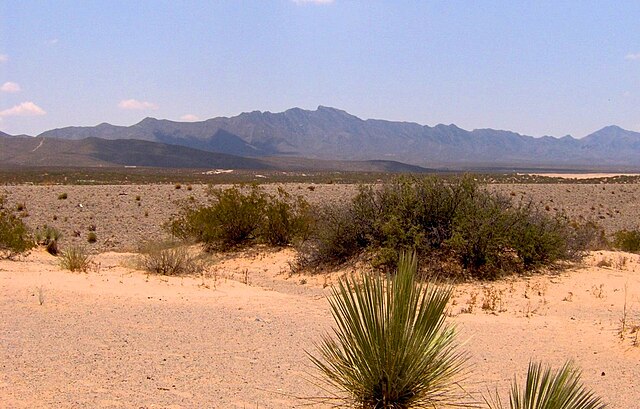
Mesilla Valley Desert, New Mexico (CC) Brian Stansberry
Race. Few if any early western novels tackle the subject of race and race relations so directly as this one. Frederic Remington’s John Ermine of the Yellowstone (1902) ventures into this territory but with unhappy results. His white man raised by Indians makes a similar play for the pretty daughter of an Army officer, but all the cards are stacked against them, even though there’s no racial divide to keep them apart.

Morrow has stacked them another way, making her male lead an Indian educated by whites. Gifted with superior intelligence, he exhibits mastery of both worlds, Indian and white. Rhoda, meanwhile, is beautiful and intelligent, capable of flourishing in the right conditions.

She has courage, strength of character, and the ability to think outside the box she’s been confined to by her “civilized” upbringing. Consider the strait-laced, rigidly constrained social world of Edith Wharton’s women by comparison. The result for Morrow is an interesting, though speculative, journey of what would later be called self-realization.

Her desert experience would have been lost on the shallow, empty-headed girl in Remington’s novel. His story is one of tragedy, its characters the victims of class and cultural differences. Morrow adds racial difference and writes a romance that is also a novel of ideas. Challenging the sexual fears that underlie racial prejudice, it surely must have been regarded by many readers as scandalous.

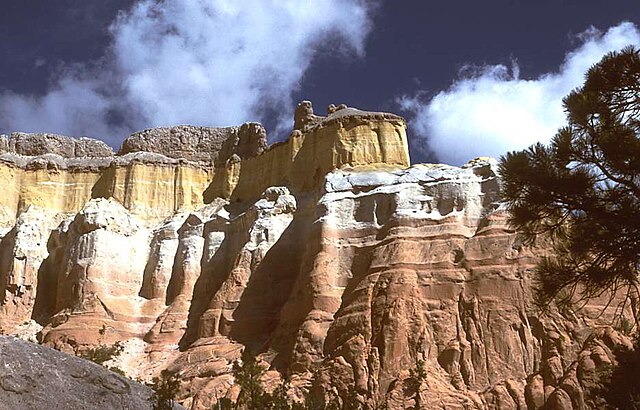
Sandstone cliffs, New Mexico
Wrapping up. Is it a western? While focusing on a love that hardly dared speak its name in 1913, its story is certainly set in the West, and its desert setting plays a major role in the action. Far from the ill effects of city living, it offers healing and rebirth for people enervated by civilization and its discontents.

Teddy Roosevelt, we know, was a big advocate of the strenuous life offered by the West, to toughen both body and spirit. Zane Grey’s first novel, with nearly the same name as Morrow’s, Heritage of the Desert (1910), maps out a similar course of therapy for its sickly protagonist. Both novels involve perilous treks across desert wastes, as do Peter B. Kyne’s The Three Godfathers (1913) and Harold Bell Wright’s The Winning of Barbara Worth (1911).

So Morrow’s story figures into the East vs. West theme to be found in most early western novels, with an emphasis on the West’s health benefits. It certainly goes a big step farther by throwing off social and cultural restraints entirely to find spiritual health in passionate interracial love.

Carlsbad Caverns National Park, New Mexico (CC) Daniel Mayer
Iowa-born, Morrow studied history at the University of Wisconsin and married twice, the second time to publisher William Morrow. Her books include a three-volume biography of Abraham Lincoln. The Heart of the Desert is currently available at google books, Internet Archive, kindle, and the nook. Friday’s Forgotten Books is the bright idea of Patti Abbott over at pattinase. 

Further reading: Short bio of Morrow as a “Famous Iowan”
Image credits: 
Illustration from first edition, W. Herbert Dunton
Wikimedia Commons

Coming up: Tom Mix, Just Tony (1922)