Saturday, March 24, 2012

Western writer inspiration, no. 29

Time for another omnibus of the week's #westernwriter inspirations posted each day at twitter, where you can follow me if your attention isn't already overloaded @rdscheer. As usual, click a pic to enlarge it.

Office and sutler store, Round Valley Agency, California, 1876
Morrison, Colorado / Denver, South Park, and Pacific RR, c1878
Rath & Wright's buffalo hide yard, with 40,000 buffalo hides, Dodge City, 1878
Lt. Col. Eugene M. Baker and army officers, Fort Ellis, Montana Territory 1871
Zuni Pueblo, New Mexico, 1879
Arapaho camp, Indian Territory, 1870s; photographer, William S. Soule
Freight Team entering Custer, South Dakota, 1876

Photo credits: Wikimedia Commons

Coming up: Ray Winstone, Tracker (2010)

Friday, March 23, 2012

Photo-finish Friday: men at work


It's 10:00 a.m. on a Wednesday morning, and the waiters at Café Pinot are spreading tablecloths for the al fresco diners who'll be crowding in here for lunch. One is joking to the other that he's learning how to make a bed. This downtown restaurant draws a well-heeled crowd and is next door to the LA Public Library on Fifth Street. For folks unfamiliar with the contraption in the foreground, it's an outdoor space heater.

Coming up: Paul Leicester Ford, The Great K & A Train Robbery (1897)

Thursday, March 22, 2012

Pauline Bradford Mackie, The Voice in the Desert (1903)

The desert Southwest had a strong appeal for early western writers at the turn of the last century, and it seems to have been women writers who discovered it first. Before this one, there was Florence Finch Kelly's With Hoops of Steel (1900) and Gwendolen Overton's The Heritage of Unrest (1901), both reviewed here recently.

The story of the novel could have taken place just about anywhere, except that the desert is so much at the center of everything. It permeates characters almost to the core of their being—theirs souls you could say. It’s there as a physical presence, beautiful and treacherous. In its unblemished purity, it seems also meant as a symbol of womanhood—more specifically the essence of womanhood, untouched by the social conventions of life in the city.

Plot. A young clergyman, Lispenard, and his wife Adele have been living for most of 15 years in the Arizona desert settlement of Sahuaro. They have two boys. While Lispenard is a “missionary” and has a small congregation, he gives much of his time to writing what are apparently books of moral philosophy.

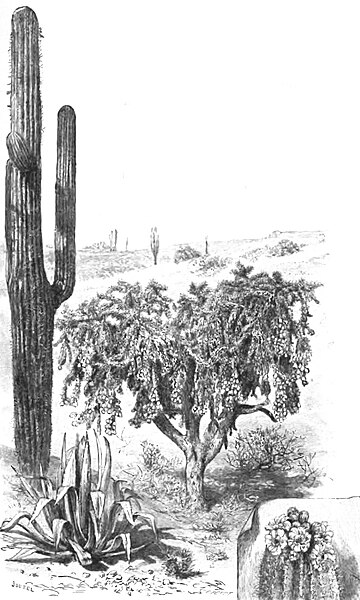
Desert flora, Arizona, 1900
An intellectual and in pursuit of a kind of ethereal spirituality, he is thoroughly happy living a spartan life in the desert. His wife Adele makes do with little and devotes herself to the raising of her two boys. While she continues to love and respect her husband, the magic of young romance has waned, and her practiced selflessness is wearing thin. She wants to be wanted.

The careful balance of their lives, financial and emotional, is upended when an old friend, Jarvis Trent, arrives in town. Trent and Lispenard were once chums, and both were rivals for the hand of Adele. After 15 years, Trent remains unmarried and still carries a torch for her. He’s also become a successful lawyer and has made a pile of money. She wonders whether she made the wrong choice.

So we have a love triangle that quickly turns into a quadrangle with another resident of the town. This one is the daughter of a local high-ranking military officer, now deceased. Also unmarried, she is a friend of the Lispenards and lives nearby in her father’s well-furnished Spanish-colonial house. She has been oddly named after a flowering desert succulent, Yucca.

Spanish-colonial courtyard, 1903
In fact, it’s Trent who makes the quadrangle, as Yucca has long been in love with the clergyman. His caring and tender friendship has transformed her from a simple small-town girl to a woman of some intellectual development. In a word, she worships him. Meanwhile, she remains close friends with Adele, whose feelings toward her are understandably mixed.

Without telling her husband, Adele asks for $500 from Trent and jumps on the next train back East with the two boys. She has family there, and her boys can go to proper schools. Trent returns to his lawyering and doesn't come back until two years later, when he makes an unsuccessful play for Yucca.

Home for the summer holidays, the two boys are caught in a sandstorm while on a walkabout in the desert, and they are lost for two days before they are found. His health apparently compromised by all the stress, Lispenard suffers heart failure on the last pages of the novel and expires.

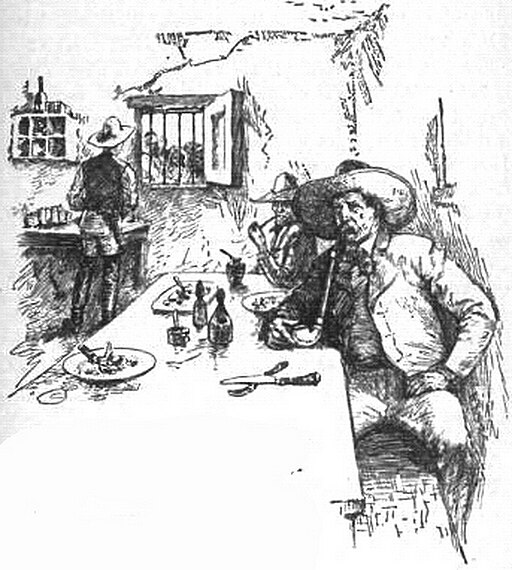
Diners, 1900
Themes. Never once ignoring the presence of the desert around them, the novel is committed like high-class soap opera to charting the course of her characters' shifting emotions. Mackie is fascinated by all the possible complications in their relationships. You keep thinking of D. H. Lawrence, who wrote of women in love and eventually found the desert Southwest himself. But in 1903, he was years away from writing his first novel.

Realizing the story is about a clergyman and his wife, you expect a certain amount of evangelizing. And if not that, at least a sanctimonious tone. Such is not the case. Hardly an advocate of conventional morality, Lispenard is a real outlier. Religious rituals, he believes, have no meaning in themselves. They point instead to greater spiritual truths, which can best be experienced through the beauty and austerity of the desert.

Rider and horse at well, Arizona, 1907
Romance. While you wait for the fires of romance to take over the reins of the plot, the women in the novel keep doing the sensible thing. An objective reader might well conclude that there’s not a man in the book that’s a match for either of them. While Mackie clearly likes men, she reveals an understanding of them that leaves her male characters looking a little shallow.

As one example, there’s the habit both Lispenard and Trent have of regarding Yucca as some kind of spirit or embodiment of the desert. Instead of seeing her as a person with her own individuality, they project onto her a bunch of notions that spring from somewhere in their deep, dark psyches. Jung would probably call it their Anima.

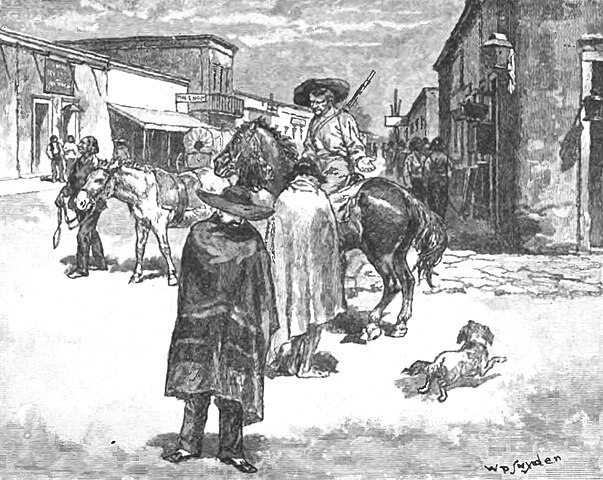
Street in Tucson, 1900
What the two men seem to see in her is a kind of beauty that is, like the desert, potentially treacherous. Not simply a beautiful woman, she is also a sorceress, a siren. Attracted by her beauty, a man can be lured to his ruin. There may be women in the world like this, but Yucca is not one of them. If anything, you can say her heart belongs to daddy, whose portrait in uniform dominates one room of her house.

So what we end up with is a kind of anti-romance. Folks bump up against the realities of each other’s unpredictable feelings and don’t live happily ever after. The romance of the desert, however, continues as strong at the end as it has been all along.

Pauline Bradford Mackie
Wrapping up. Pauline Bradford Mackie (b. 1873), the daughter of a clergyman, was born in Connecticut and went to public schools in Ohio. When she wrote this novel, she was also married to a clergyman, Herbert Müller Hopkins (1870-1910), who died in early middle age after a few years of marriage. Hopkins was a published poet and novelist himself. One suspects that he may walk the pages of this novel as the book-writing minister, Lispenard.

The Voice in the Desert is currently available for the nook and at Internet Archive. Friday’s Forgotten Books is the bright idea of Patti Abbott over at pattinase.

Sources: ancestry.com

Image credits: Wikimedia Commons
Photo of Mackie, Literary News, 1903

Coming up: Ray Winstone, Tracker (2010)
 

Tuesday, March 20, 2012

In Old Arizona (1928)

The Cisco Kid had killed six men in more or less fair scrimmages, had murdered twice as many (mostly Mexicans), and had winged a larger number whom he modestly forbore to count. Therefore a woman loved him.

The Kid was twenty-five, looked twenty; and a careful insurance company would have estimated the probable time of his demise at, say, twenty-six. His habitat was anywhere between the Frio and the Rio Grande. He killed for the love of it — because he was quick-tempered — to avoid arrest — for his own amusement — any reason that came to his mind would suffice.

So begins the O. Henry story “The Caballero’s Way,” first published in 1907. It was the introduction of a character, the Cisco Kid, who would have a long life in the movies, and on radio and TV. The Kid first hit the screen in 1914, with a silent version of O. Henry’s story, but his career didn’t take off until this film, In Old Arizona, an early talkie in 1928.

Warner Baxter won an Academy Award for his performance as the Kid and soon reprised it in sequels: The Cisco Kid (1931) and The Return of the Cisco Kid (1939). He was followed in the role by Cesar Romero, Duncan Renaldo, and Gilbert Roland. At almost 40, Warner was a bit long in the tooth to portray the author’s 25-year-old bandit. But he compensates for that by making the Kid something of an arrested adolescent.

The plot in a nutshell is that the Kid's firecracker of a girlfriend (Dorothy Burgess) takes an interest in a U.S. soldier (Edmund Lowe) and allows him to seduce her with a promise of taking her to New York. The Kid spends a lot of money to buy her a mantilla, and when he discovers she is two-timing him, he plots a deadly revenge. 

MGM Studios, Culver City, 1922
All-talk. It’s easy to fault the film for its clumsiness, as some modern reviewers do who forget that Hollywood was just learning how to make talking movies. Considering its incorporation of sound effects, singing, and synchronous sound captured with primitive microphones, it’s pretty remarkable.

What surely struck its first audiences was the strong New Yorkese of Edmund Lowe’s army sergeant, Mickey Dunne. He could be straight out of Damon Runyon. Warner and Burgess have exaggerated Mexican accents, and some characters speak mostly Spanish.

Burgess seems to have had no film experience at all, and her line delivery comes close often to braying. But in the long scenes between Lowe and Burgess, you can hear every word, and that must have been cause for celebration for the new man on the set, the sound technician.

When the movie poster says “100% all-talking,” by the way, there’s no arguing that point. Some scenes are almost nothing but talk-talk-talk, more like a filmed stage play. Lowe and Burgess have a long scene sitting at a table together that would seem endless if it weren’t a saucy seduction full of pre-Production Code innuendo.

The whole movie, for that matter, has risqué subtext. The two men tend to wear their gun belts with holsters placed in front rather than to the side. When they meet in a barbershop, there’s a silly moment where they offer a little more than polite admiration for the size of each other’s weapons.

Outdoor scenes. Watching an early sound film with scenes shot outdoors, you need to give credit to the filmmakers for pushing the limits of the new technology. Capturing synchronous sound was vastly difficult in the early days, and it drove movies mostly indoors onto sound stages for many years.

This was a problem for westerns, which had got much of their excitement from action filmed in the great outdoors. This film manages to incorporate some scenes that hark back to those good old days, as the Cisco Kid delivers a herd of cows to a buyer and then three men attempt to ambush and rob him later. Another outdoor scene starts with a quartet of soldiers singing in close harmony, and the camera pans around to other soldiers who greet the arrival of another man.

The opening scenes, set in a dusty Southwest town, were shot on what was probably the back lot, and the frame is filled with activity and extras as passengers noisily board a stagecoach. Later, in the desert, they are held up by the Kid, who takes the strongbox and gallantly leaves the passengers unmolested. I’m guessing that the film’s nomination for an Oscar was partly due to the relative sophistication of all this.

Wrapping up. For western fans, the film is worth seeing as a novelty. While elaborating considerably on the basic story as told by O. Henry, it preserves the comic irony of the original. The main change is the transforming of the upright Lt. Sandridge to the streets-of-New-York Sgt. Dunne.

One of its two directors, Raoul Walsh had a long, illustrious career, including westerns, but is probably best known for classics like The Roaring Twenties (1939), White Heat (1949), and High Sierra (1941).

In Old Arizona is currently available at netflix and amazon. Tuesday’s Overlooked Movies is the much-appreciated enterprise of Todd Mason over at Sweet Freedom.

Photo credit: Wikimedia Commons

Coming up: Pauline Bradford Mackie Hopkins, The Voice in the Desert (1903)

Monday, March 19, 2012

John Sayles, A Moment in the Sun

This will be the briefest review of one of the longest books I’ve ever read. At 955 pages, Sayles’ novel set at the turn of the last century comes in just short of Larry McMurtry’s Lonesome Dove. The difference between the two is that there’s not a single long-winded passage in Sayles. And there’s more packed into it per square inch even than McMurtry’s multi-character, multi-plotted cattle drive novel.

Like Lonesome Dove, I read this one because it comes square in the middle of a historical period I’ve been interested in. Taking place between the years 1897 and 1902, it portrays a moment in American history when the frontier had closed and the country took its first steps toward empire with the Spanish-American War.

The novel is largely about that war, a small part devoted to the adventure in Cuba and a much greater part to the war in the Philippines. There we are treated to points of view from three sides, white troops of volunteers, black U.S. Army troops, and the “insurgents” fighting them. And all of it is set in the larger context of life back in the States.

I can tell you the names of the handful of soldiers whose lives we follow with considerable intimacy from start to finish. But I can’t keep a mental list long enough to recall the host of other characters whose lives weave in and out of the rest of the narrative. Still, they are drawn with such clarity, I came to feel utterly familiar with every one of them.

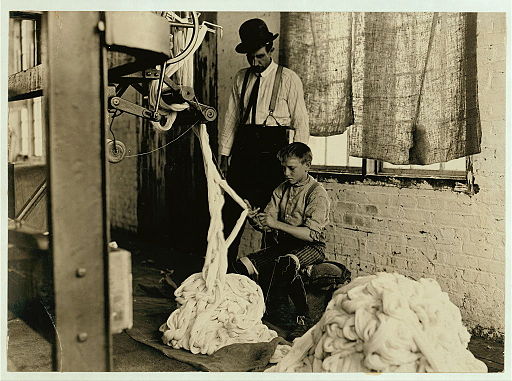
Boy working at spinning mill, Newton, North Carolina, 1908
To a great extent, the novel is about race relations. While two young black men take up arms to fight in the War, their families back home experience the convulsive upheavals that followed so-called Reconstruction in the South. We get the story of the “recapture” of Wilmington, North Carolina, as whites forcibly take an election away from the blacks and cause their flight to the North.

There’s much also about working people and the poor. We are witness to grinding, low-paid physical labor. One example being the work involved in the removal and disposing of dead horses from city streets. There’s work in the mines of Colorado and women working in sweat shops and scrubbing floors in mansions. And there’s child labor, as homeless boys hawk newspapers on curbs and street corners in Manhattan.

There’s also a glancing focus at the media itself as editors, correspondents, and cartoonists shape and sensationalize the news for public consumption. And one character is entranced by the possibilities of a new invention that takes moving pictures. One of its first uses is to film reenactments of battle scenes showing U.S. troops abroad.

Assassination of President McKinley, September 6, 1901
Historical figures walk the pages of the novel, among them the boomtown entrepreneur, Soapy Smith. We visit cigar factories in Tampa Bay, a military fort in Missoula, and the gold rush town of Skaguay, Alaska. One of the most absorbing chapters takes place entirely within a prison in upstate New York on the day President McKinley is shot at the Pan-American Exposition in Buffalo.

It’s the kind of book you can go on and on about, particularly when you know that you’ll probably never persuade another person to read it because of its length. And what’s ironic is that it’s so well suited to readers with short attention spans. Its 100-plus chapters are each like a tightly written short story. You can pick it up anywhere and read one without needing to know what came before it.

Set in another context, this novel covers the years leading up to the publication of Owen Wister’s The Virginian (1902). It’s curious and maybe telling that at a time of war abroad and political assassination at home, this romance of the Old West became a best seller.

A Moment in the Sun is currently available at amazon, AbeBooks, and for kindle and the nook. John Sayles also has a recent movie, Amigo (2010), about Americans troops in the Philippines, which is available at netflix.

Image credits: Wikimedia Commons

Coming up: Warner Baxter, In Old Arizona (1928)

Saturday, March 17, 2012

Saturday music: Dixie Chicks


In my perfect world, the Dixie Chicks would still be at the top of the charts.

Coming up: Warner Baxter, In Old Arizona (1928)

Western writer inspiration, no. 28

-->
Here is this week's omnibus of #westernwriter inspirations posted each day at twitter [click to enlarge]. If you are on twitter, you can follow me @rdscheer.

 
Kikapoo wickiup, Indian Territory (Oklahoma), 1880
-->
Furnace Creek, Death Valley, California, 1871
Harry Yount at Berthoud Pass, Colorado, 1874
Arapaho camp with buffalo meat drying near Fort Dodge, Kansas, 1870
Lynching of two vigilantes, Helena, MT, 1870
Land sale poster, Burlington & Missouri River RR, 1872
Navajo family, near old Fort Defiance, New Mexico, 1873
-->
 
Picture credits: Wikimedia Commons

Coming up: Warner Baxter, In Old Arizona (1928