Showing posts with label arizona. Show all posts

Wednesday, August 20, 2014

Patricia Grady Cox, Chasm Creek

Fans of historical western romance should find enough to like in this novel set in an Arizona mining camp. The central character, Esther Corbin, has been abandoned by her unreliable and, we learn, faithless husband, leaving her with four children on a hardscrabble farm.

Plot. We quickly learn that this story is a romance because we are soon introduced to a man much kinder and gentler than the run-of-the-mill males who populate the immediate vicinity, the Chasm Creek of the book’s title. Morgan Braddock has been deeply wounded by life on the frontier, and when we meet him, he is a wanted man—wanted for the bloody killing of another man in a fit of rage. 

Cox does not reveal the circumstances of that rage until much later in the novel. By then he has won the heart of the heroine, Essie, who would give both heart and soul to him if she were not already married.

Character. Cox takes an unusual step in her characterization of Braddock by giving him a close friend, a Navajo kidnapped in boyhood and raised in Mexico, where he has grown up with a Spanish name, Rubén, and adopted the Roman Catholic faith. He is now an old man and Braddock’s mentor and traveling companion. They are deeply bonded in their loyalty to each other.

Wednesday, July 2, 2014

John Duncklee, Tales From Corral Fences

I first came across John Duncklee while reading cowboy and ranching memoirs a while ago. Not a Westerner by birth, Duncklee learned about the cattle business the hard way. While a young man in his twenties, he leased a small ranch south of Tucson for three years during a long, severe drought in the 1950s.

His account of that experience, Good Years For the Buzzards (1994), is a well-written portrayal of a man whose intelligence is pitted against a number of challenges: the unpredictable weather, less than scrupulous stock buyers, the fluctuating markets for both cattle and feed, the vagaries of government programs, untrustworthy neighbors, and the risk of loss as disease and mischance threaten to decimate his herd.

A half century later, that experience informs many of the 24 short fiction and nonfiction pieces in Tales From Corral Fences. Some stories in the collection are a product of the imagination—maybe wishful thinking—as he pictures how a rancher’s life might take the form of a satisfying success story.

“Rancho Sierra Linda” tells of how a man builds a cattle business over the decades of a lifetime, making sensible decisions that keep his operation going through good times and bad. Such a man may even find a sympathetic woman to partner with him, and his attachment to her may go as smoothly as the rest of it.

Thursday, March 20, 2014

Richard S. Wheeler, Flint’s Gift (1997)


“Profiles in Courage” would have been a good title for this novel of life in a frontier settlement in Arizona Territory. The title character, Sam Flint, is a young newspaper editor who sets up his press in little Payday, agreeing to boost the town in the interests of its growth, in return for complete freedom to print all the news he finds fit to print.

Plot. His editorial encomiums to Payday’s edenic virtues soon bring settlers and new residents. And with them comes a pack of unexpected trouble. A cattleman, Clayton Buell, long used to free use of open range for his stock brutally resists the attempts of families to homestead on public land he deems his own.

Worse yet, a black-clad business entrepreneur, Odie Racine, throws up a saloon called the Golden Calf that draws in an unwelcome element for drink, gambling, prostitution, and related forms of crime and vice. To tighten her grip on the town, she introduces a protection racket, extorting the town’s business owners, under threat of being pulverized by a couple of her brass knuckled thugs. Soon, as the sheriff and judge yield to pressure, duly constituted authority, law and order have been undermined and compromised.

Mogollon Range, Arizona
As Odie and her goons monitor the content of Flint’s newspaper each week, he falls prey to her as well. Meanwhile, he has the ire of Clayton Buell to deal with. The rancher follows through on a threat to horsewhip him should Flint print a word about his unlawful tactics preventing homesteaders from settling on his range.

Tension and suspense build in the novel as Flint plots to save himself, the newspaper, and the town. One by one, others join him in resistance, each finding the courage to put their lives on the line.

Storytelling style. Wheeler is adept at this kind of storytelling. We get an ensemble of characters, with shifting points of view and one of them, the editor Flint, at the center. As they comprise a community, we learn what drives and motivates each of them, as well as their secrets and regrets. There grows in the reader a sense of loyalty to them, the kind that made of Gunsmoke an irresistible weekly formula on TV.

Monday, March 10, 2014

The Painted Desert (1931)


This early sound western is something of a novelty. Shot on location in scenic locations in Arizona, it shows a visual sensibility from the Silent Era, while featuring the onscreen talents of two actors we don’t associate with each other today—William “Bill” Boyd before fame found him as Hopalong Cassidy, and Clark Gable, before fame found him, period.

Plot. Boyd is the grown foster son of a cattleman (William Farnum), and yearns to see Farnum reconciled with a former partner (J. Farrell MacDonald), both of whom found him as a toddler in the desert. In a complicated plot, Boyd discovers tungsten ore on MacDonald’s land and tries unsuccessfully to get the two men to partner again in what promises to be a lucrative mining project. But a couple of decades of ill will have kept the two men enemies. Boyd then approaches MacDonald with a mining deal of his own, and soon they are in business together.

Boyd also has eyes on MacDonald’s pretty rifle-toting daughter (Helen Twelvetrees). This does not go down well with a new employee (Clark Gable), a ranch hand who hires on in the middle of escalated hostilities between the two former partners over access to water. He sabotages the mining operation and interferes with time-sensitive delivery of ore in repayment of bank loans.

Thursday, February 27, 2014

Dane Coolidge, The Texican (1911)


This early cowboy western is a rollicking political satire, the likes of which a reader would find difficult to duplicate in a western novel today. The Texican of the title is a freelance cattle rustler, Pecos Dalhart, who fetches up in Arizona, where he gets involved in a feud between two rival cattlemen, Ike Crittendon and John Upton.

Plot and character. Crittendon hires Pecos to alter the brands on any of Upton’s cattle he finds on the range. Meanwhile, the local sheriff, Boone Morgan, is alert to any signs of cattle theft, and when Crittendon falsely accuses Pecos of stealing a cow, he gets hauled in to the county jail, to await trial.

Pecos draws his pistol
Pecos, as Dane Coolidge describes him, was “born a Democrat and taught to love whiskey and hate Mexicans.” However, he has begun reading an anti-capitalist newspaper, The Voice of Reason, which has opened his eyes to the corrupt law enforcement system used by the rich to oppress the poor. Sheriff Morgan soon learns he has incarcerated an outspoken advocate of revolution.

Cracking heads, Pecos immediately overturns Morgan’s use of a prisoner-run kangaroo court for maintaining order in the jail. Joined by a friend and fellow revolutionary, Angevine “Babe” Thorne (jailed for drunk and disorderly), and winning the respect and protection of the Mexican prisoners, Pecos takes charge behind bars. He is soon getting preferred treatment from Hung Wo, provider of the jail’s meal service. 

Thursday, October 3, 2013

How to write like Elmore Leonard:
Gunsights (1979)


2002 edition
Elmore Leonard’s 10 rules of writing have been circulated widely on the Internet, but they are more obfuscation than revelation about the art and craft of writing fiction. Reading one of his westerns, Gunsights (1979), you can begin to glean what makes his novels so good.

In this novel, two men are on opposite sides of a conflict between a mining company and a scattering of settlers on an Arizona mountainside: Apaches, Mexicans, and former 10th Cavalry regulars. The two central characters were at one time friends and partners, and the novel begins in Sonora with their retrieval of an Apache chief and a white girl.

While there, they are involved in the shooting of a gang who have been after the same chief to collect a large bounty. Now one of the two former partners is employed by the mining company attempting to drive the settlers out of their homes. The other is an Indian agent, defending them.

This could be a set-up for a conventional western novel, the two men now enemies—one of them turned villain as he works for the mining company, the other heroically serving the cause of justice until there’s a final shootout. Well, that’s not what happens. It’s much better, and here are some reasons:

Strong characters. Leonard’s characters are not the usual stock characters found in traditional westerns. You cannot anticipate what they are going to do or say. That’s because they are smarter than you and me, and their intelligence is mostly intuitive.

1979 edition
Characters in this novel get into trouble when they think too much. It may only be a split-second thought before firing a gun, and the delay makes the difference between life and death. The ones who survive act when the feeling is right and wade in without knowing what’s coming next, just trusting their instincts. Thus, when they act, we are likely to be surprised by what they do.

Part of their strength as characters is their age. They are not youths as is often the case in conventional westerns. Bren Early and Dana Moon, the two central characters, are in their 30s. They have already grown up.

Plot. Characters like this drive a plot. Leonard plays with this idea by casting a group of newspaper reporters who have come to Arizona for a particular story. For them, the “plot” they are after is the conventional one—an armed confrontation between two men who used to be friends and partners.

But the two men refuse to cooperate because they are not enemies and have other priorities. For one thing, they don’t want to be bothered. For another, they have a mutual enemy in a third man from that incident south of the border a dozen years ago—a man they thought was dead. Looking for the plot they expect to develop, the news reporters continually miss what’s going on under their noses.

Villains. Leonard’s villains eventually die because they are ignorant. They can be brutally cold-blooded and therefore scary, but confronting a foe who isn’t afraid of them, they are at a disadvantage. If that foe is smart enough to outwit them, they are stymied. And if they are dumb enough to make a stupid mistake, like pay too little regard to a woman with a shotgun, they are dead men.

The conventional western often uses vengeance as the motivation for the main character’s actions. And the villain is finally avenged for some horrible misdeed. In Leonard’s novel, revenge is what’s driving the villain. He wants payback for a nasty gunshot wound that narrowly killed him and left him with a disfigured face.

Thursday, August 8, 2013

Elmore Leonard, The Bounty Hunters (1953)


This was Elmore Leonard’s first published novel, written in his late twenties. In it, already fully developed, is the trademark edge that he brings to his fiction. With its opening scene in a barbershop in Contention, Arizona, we get just that—an exchange of contentious dialogue that’s both bristling and funny. It’s the same mastery of verbal dispute between people at sharp odds with each other that makes “Justified” so much fun today.

Plot. Leonard’s central character is an Army scout, Dave Flynn, who escorts a fresh young lieutenant south of the border to bring back a renegade Apache chief. Flynn is a Civil War veteran who resigned his commission, disillusioned after witnessing a commanding officer’s act of cowardice. For the lieutenant, Bowers, the story tells of a fledgling officer learning how to use his wits and his own natural cunning instead of going by the book.

In Mexico, a bounty is being paid for Apache scalps. What the two men find is a gang of norteamericanos who are killing Mexicans and presenting their scalps for payment by chief of rurales, Lamas Duro. The rurales are a police force made up chiefly of untrained law enforcers and former bandits. Duro is a contemptible, terrified man, subduing his fears with steady drinking. The gang leader, Curt Lazair, is a soulless murderer of innocents, who has taken a young woman captive and is keeping her at the gang’s hideout.

Flynn rescues the girl. Meanwhile, Bowers discovers that Duro’s second in command, a veteran of the revolt against the French, is shamed by how he is being used as an instrument of injustice and incompetence. The novel’s climax involves both an Apache attack and armed retaliation by the men of the village against Duro. Motivation for all that happens in the closing chapters produces awkward and not so plausible complications.

Character. Flynn makes an enjoyable hero, much as Raylan Givens in “Justified.” He is sharply intelligent and steady, an individual too independent to take orders from men he can’t respect. He is his own authority, with a knowledge of the world and others learned the hard way. Yet he doesn’t venture all that far from social connections. Unwilling to give himself to a career in the Army, he still accepts a job as a scout for that same organization.

Flynn has seen it all. He’s witnessed the dishonorable behavior of men, shirking duty with impunity. Though disillusioned he could be utterly cynical, but he’s not. There is a man or two he still admires. Chief of scouts, Joe Madora, is one of them. He is astute, trustworthy, and a reliable friend. He also has a sense of humor. The Indian chief, Soldado Viejo, also wins Flynn’s respect. When the two meet, the scene evolves into a long match of wits that ends at best in a draw.

Tuesday, February 19, 2013

Monte Walsh (1970)


There’s an elegiac tone to this story of aging cowboys. The glory days are over for the men who used to ride the open ranges, and now they are hanging on to whatever work they can find in a shrinking rural economy. Distant corporate owners make the decisions about how the ranches are run. What used to be “money” is now “capital.”

Plot. Monte Walsh (Lee Marvin) and Chet Rollins (Jack Palance) are old saddle pals, resisting the changes being ushered in by the new century. Monte’s identity is inseparable from the riding and roping horseman he’s been all his life. A sharp shooter with a pistol, he can still ride an untamed horse, though it demolishes corral fences, knocks down porch roofs, and overturns a water tank.

Just like the old days, he enjoys a good drunk and a good fistfight. He also enjoys the company of a saloon girl (Jeanne Moreau) who cancels her “appointments” when he’s in town for a midnight call. She’s been holding out for a marriage proposal from him, and he’s been waiting to put enough “capital” together to properly provide for her.

Lee Marvin
Chet is cut from the same cloth, though he’s willing to hang up his spurs to marry the widow of a hardware shop owner and help run the store. The transition doesn’t trouble him so much, as he’s getting too old to be spending all day in the saddle.

Matters worsen when a corporate boss orders lay-offs, and their friend Shorty (Mitch Ryan) is let go with two others, simply because they are the youngest cowboys in the outfit. Desperate for a dollar, they try rustling, and then a hold-up attempt at the hardware store goes bad. Chet is killed by a shot from Shorty’s gun.

The losses mount up sharply for Monte, as death takes not only his pal but also his girlfriend, who is felled by poor health, consumption we assume. And he is left to a final confrontation with Shorty, whose hard-luck life has led him into a world of trouble.

Jack Palance
Comment. Monte Walsh is more a character study than a story, as if to say there are no more stories to be told of the frontier. The time of adventure is long over, as Jumpin’ Joe (Bo Hopkins) laments. Reduced to fixing fences, he finally puts an end to his misery with a spectacular ride on his horse over the edge of a sharp slope.

It’s a melancholy portrayal of westerners who have outlived the Old West. Dorothy Johnson tells a similar story in “The Man Who Shot Liberty Valance.” For Monte, it is one loss after another, but he sustains them with a kind of dignity and fortitude. In the end, he is not quite alone. There is still his horse, which we last see him talking to as they ride off into the sage.

Wrapping up. Based on a novel by Jack Schaefer, this is a beautifully photographed film, the wide-screen exteriors shot in Arizona. The realistic costuming is dusty and sweat stained. Marvin’s hats are especially true to the period. His slouch-brimmed Stetson is pushed up in front, and he trades it for a brand new, undented Boss of the Plains to wear to a funeral.

Lee Marvin and Jeanne Moureau
The performances are fine. The three lead actors seem well suited to each other. Palance is a warm and friendly presence. As saddle pals, the two men are like a pair of old, well-worn boots. Moureau and Marvin are believable as long-time lovers, as when they lie together in a post-coital glow and her arms keep getting in the way as he tries to roll a cigarette. Their final scene, as he sits by her deathbed, is a simple but tenderly moving farewell.

William Fraker, best known as a cinematographer, directed. The opening credits are shown over pen-and-ink renderings of Charles Russell paintings. Then as if to pin this faithful replica of the past to not one but two points in time, we get an echo of another era in the title song, sung by Mama Cass. The film was remade for TV in 2003 with Tom Selleck in the title role.

Monte Walsh is currently available at amazon and Barnes&Noble. For more of Tuesday’s Overlooked Movies and TV, click on over to Todd Mason’s blog.

Source: imdb.com

Coming up: Harry Leon Wilson, The Lions of the Lord (1903)

Thursday, January 24, 2013

Zane Grey, The Drift Fence (1933)


freeread.com.au
Zane Grey’s writing career was in full stride when this novel was first published in 1929 as a serial in the pages of The American Magazine. That year saw two other serials, in The Country Gentleman and Ladies Home Journal, plus short fiction in Collier’s and McCall’s.

Not much has changed since he found his basic western formula in his first novel, Heritage of the Desert (1910), reviewed here a while ago. A tenderfoot arrives in the Southwest, learns the ways of the West, wins the heart of a western girl, does battle with a nasty villain and his gang, and wins the approval of his superiors.

Plot. It is 1889 in open rangeland of Arizona, where cattlemen are being preyed upon by rustlers. Jim Traft, a young Missourian arrives at the invitation of his uncle, who wants to build a 100-mile fence to keep his cattle from drifting into the wrong hands. To put up the fence, Jim is made foreman of his uncle’s toughest group of cowboys, the Diamond outfit.

His cowboys don’t take kindly to being bossed by a tenderfoot, and they haze him mercilessly. To show his grit, he challenges them one by one to a fistfight and, as he beats them, gradually wins their grudging respect. They are finally just devil-may-care cowboys, not mean-spirited. The most likable of the lot is Curly Prentiss, who is among the first to befriend Jim.

The one mean one of the lot is Hackamore Jocelyn. He schemes to join up with the rustlers, who are led by a young gunman, Arch Dunn, also known as Slinger Dunn. Jocelyn instigates a plot to kidnap Traft and hold him for ransom from his rich uncle, then kill him, cut the fence, and run off a bunch of cattle.

Donkey rider, c1933
A young girl provides the story’s complications. Slinger Dunn has a sweet 16-year-old sister named Molly, who has won the heart of Jim Traft. He meets her at a fair and, before the day is over, gets a kiss from her and professes his undying love. From the start, they are star-crossed lovers.

Her brother, who has killed men before, attempts to put Jim out of the picture, and it’s something of a contest to see which of the two villains will be first to do the job. Molly defends her lover, throwing herself twice between Jim and a gun being drawn on him.

In the end, Jim wins her hand, and it is Jocelyn who dies, shot through the heart by Slinger Dunn. Molly’s brother is a good bad man after all, and in the closing chapter, Jim is offering him a job, to partner on a ranch he’s getting from his grateful uncle, and to go after yet another band of rustlers.

Character. Jim Traft is a man in the making. Decent and honorable but untested, he gladly assumes the responsibilities given to him, though the going is far from easy. In his favor is that he has both brains and brawn. He never loses a fistfight in the novel, even when one opponent attempts to “rooster” him, i.e. to kick him in the face with his spurs.

Hospital, Gleeson, Arizona, 1925
Never mind that this is hard to believe. Any one of a tough bunch of cowboys should have been able to beat a tenderfoot to a pulp. Forget that a tenderfoot would not have been given a foreman’s job over them in the first place.

In a reflective moment near the end, we find Jim wishing he could be more like the tough Slinger Dunn, a leader of men who survives several bullet wounds in a shootout with two gang members. Softening Dunn’s cold resolve, Jim also aspires to be like Curly Prentiss, a loyal friend with a playful sense of humor.

Romance.  Grey’s heroes fall hopelessly and head-over-heels in love. It almost undoes them they suffer so forlornly for the girls of their dreams. As in his first novel, Heritage of the Desert, the girl has to be rescued from the clutches of a darkly evil man. In this case, it is Hackamore Jocelyn, who has plans to leave the country with her, by force if necessary.

In part, it is also social class that comes between them. Nephew of a well-to-do cattleman, Jim seems far above Molly’s lowly station as the daughter of a poor settler. But Jim sees in her a natural simplicity, virtuousness and courage. Despite her “primitive” upbringing, she has the “instincts” of a lady. Later we discover that she is actually the granddaughter of Southern stock from Virginia. Her qualities are in the blood.

Tuesday, January 8, 2013

The Deadly Companions (1961)


Sam Peckinpah had only a short career in TV when he directed this his first film. The finished product is a little raggedy at points, but it’s a gritty western story with an excellent cast. Maureen O’Hara, who co-produced the film, is her glowing self, and Brian Keith turns in a solid performance as the grim avenger of a vicious wrong.

Plot. Keith rescues Chill Wills from the hands of several unhappy poker players, who’ve caught him cheating at cards. He befriends Wills and a trail buddy (Steve Cochran) who have plans to rob a bank. When other robbers get to the bank first, they join the locals who open fire on the fleeing gang. The young son of a dancehall employee (Maureen O’Hara) is accidentally shot by a bullet from Keith’s gun.

O’Hara insists on taking the boy’s body across Apache territory to a town called Siringo to have him buried beside his father. The three men follow as an unwelcome escort. Keith hopes to ease his conscience for killing the boy. The other two have reasons of their own, until they overplay their hand and Keith forces them to leave. While he sticks with O’Hara, he can’t get her to warm up to him. “Are you always that stubborn,” he asks her, “or are just hard to figure out?”

Maureen O'Hara, Brian Keith
The Apache make an appearance but turn out to be drunk and disorderly, fooling around with a stagecoach they’ve come into possession of until overturning it in a pond. One sober Indian, however, is more menacing as he aims some warning shots at Keith and O’Hara with bow and arrow. Found alone by him in a cave, O’Hara dispatches the Indian with a shotgun blast.

Arriving at Siringo, a long abandoned settlement, the two discover that Wills and Cochran have followed them. It’s now a showdown between the three men. Once a prolonged exchange of gunfire resolves their differences, O’Hara allows that maybe she’s underestimated Keith, and they ride off together into the sunset.

Steve Cochran, Chill Wills, Brian Keith
Twists. Brian Keith usually had such a sunny disposition in his films, it is unusual to see him so grimly and convincingly unsmiling. His character comes across as a bitterly proud man, a veteran of the Civil War, still wearing the yellow-striped pants of his Yankee uniform. His sullen attitude is underscored by a refusal to remove his hat.

Only later do we learn that he literally bears the wounds of his wartime service. At his hairline show the scars of being scalped by the Confederate soldier he’s sworn to avenge. The disfigurement is also a mark of his shame, as he regards himself unworthy of O’Hara’s affection once he’s won it.

Another twist in the casting is Chill Wills as a villain. Grizzled and dressed in cast-off clothes, he is a grimly comic figure.

Tuesday, November 27, 2012

El Dorado (1967)


This Howard Hawks western bears a strong resemblance to his previous western, Rio Bravo (1959). The elements are much the same, as if Hawks wanted to have another go at them. John Wayne appears again, this time as a hired gun. Particular about who hires him, he turns down a dirty job in the opening scenes offered by a land-greedy rancher (Ed Asner). Wayne ends up working instead with a sheriff (Robert Mitchum) to help a family keep their ranch out of Asner’s hands.

Plot. The family in question are the Macdonalds, with several grown sons and a feisty daughter (Michelle Carey). One of the boys takes a shot at Wayne and ends up dead. When Wayne brings his body to the ranch, Carey doesn’t believe his account of the incident and ambushes him. With a bullet now lodged near his spine, he is stricken at times by paralyzing pain that affects his shooting arm.

John Wayne
Drifting among the saguaros of the Southwest, he reluctantly picks up a trail buddy (James Caan), who has just killed his fourth man. Slow with a gun but quick with a knife, it seems he’s been avenging the death of an old friend, one man at a time. He adopts Wayne as a mentor.

When Wayne meets another gunman of his own professional caliber (Christopher George), he learns that the man has been hired by Asner to do the job he turned down. Wayne learns from George that while the sheriff, Mitchum, has a reputation as good with a gun, he is no longer a threat. He has been sidelined by two months of heavy drinking.

Wayne and Caan show up to give Mitchum a hand, and they wait for George and his gang. But Mitchum is in bad shape. He has hit bottom but doesn’t yet know it. The depth of his condition finally comes home to him when he is laughed at by the men in the saloon while buying another bottle of whiskey.

Robert Mitchum
As soon as the gang arrives there is trouble, and Wayne and Caan get to work getting rid of them, knocking off several in the first round. Mitchum gradually gets sober but, in an exchange of gunfire, gets shot in the leg. When Asner is taken prisoner, Wayne and the others are holed up in the jail and under siege.

All is resolved finally with a shootout at the saloon. Asner bites the dust along with George and other members of the gang we’ve come to know. Wayne takes some buckshot in his leg, and as Caan leaves to follow up on a rough meeting with Carey in the straw of a stable, Wayne and Mitchum hobble down main street, each of them on a crutch.

Tone. This is a loosely meandering film that sets up a good guys vs. bad guys conflict in the opening scenes and saves the final confrontation until almost two hours later. During that time there are several characters to get to know and some lengthy conversations.

James Caan, John Wayne
The tone of the film fluctuates between melancholy and lightly humorous, with a stretch or two of outright farce. When Macdonald says he doesn’t blame Wayne for his son’s death, Wayne turns to go, saying sadly to himself that it is not much consolation.

Meanwhile, there are several running jokes, one of them involving the riverboat gambler’s hat that Caan wears. As Mitchum slowly sobers up, he can’t remember who Caan is and keeps asking, “Who is he?” In another comic scene, Mitchum takes a much-needed bath, while everyone who visits brings him a bar of soap.

Mitchum’s alcoholism is also played for a while for laughs. When Wayne finds him passed out in a jail cell and dumps a bucket of water on him, Mitchum comes out with fists flying. Later, almost creeping away from the saloon with another bottle, he cradles it to his belly with both arms. In only a few minutes of screen time, we’ve gone from the Three Stooges to Lost Weekend.

Tuesday, November 13, 2012

Young Billy Young, 1969


Burt Kennedy wrote and directed this good-looking western, set among the saguaros of Arizona. And with Robert Mitchum and Angie Dickinson in the cast, it should have been a corker. But the best scenes in the film have to work hard to keep the whole film afloat.

Plot. Mitchum takes a job as sheriff in Lordsburg to introduce some law and order, where it may be needed but not wanted. Jack Kelly plays a local saloon owner (named John Behan, maybe a double of the sheriff over in Tombstone) who wants Mitchum out of town. Angie Dickinson entertains at the saloon and competes with the scenery in a black spangly one-piece and feather boa. We like her.

Talented but miscast Robert Walker, Jr., plays the title character, Billy Young, a handsome young drifter. He has just returned from Mexico where he and David Carradine were hired to kill some nasty federales. Mitchum offers Walker a job as deputy, but he declines, given the odds against a lawman’s staying alive in this lawless town.

Robert Mitchum
Carradine, it turns out, is the son of Frank Boone (John Anderson), an outlaw who once killed Mitchum’s son during a jailbreak in Dodge City. When Mitchum puts Carradine in jail, he hopes the move will flush Anderson out of the sagebrush, where he can settle an old score with the man.

Dickinson, meanwhile, is getting beaten up regularly by Behan. With the encouragement she gets from Mitchum’s tender attentions, she packs her bags. Conscience-stricken from years as a saloon dancer, she hopes to start a new life somewhere else.

There’s a shootout finally as Anderson and his gang arrive in town. Released from jail, Carradine shoots Behan, and Mitchum shoots Anderson, who gets run over by a stagecoach for good measure. In the final scene, Walker has agreed to wear a deputy’s star, Carradine is in jail again waiting the circuit judge, and Mitchum leaves town with a surprised Dickinson, who learns that she’s to become his wife.

Angie Dickinson
Pluses. There’s nothing really wrong with the plot of the film, but its story must struggle with several handicaps. Mitchum is not one of them, unless you have the temerity to fault his girth. His old cool manner is still there, rarely cracking a smile, but equally persuasive whether being stern or tenderly attentive, as he is in scenes with Dickinson.

Their scenes together, in fact, do much to buoy up the film. They show Kennedy’s particular strength as a writer, and you can point to other films written by him where the scenes between men and women come alive onscreen. The dialogue reveals their loneliness, their wish to be simply cared for, and their basic decency.

Minuses. Other scenes and sequences carry less conviction. The first fifteen minutes are given to Walker and Carradine’s boarding of a troop train in Mexico, their killing of a car full of officers, and their escape on horseback. The sequence could bristle with suspense and excitement, but it is ponderously slow and improbable. The playful, jazzy music track by Shelly Manne establishes the tone of the film as more comic than serious, which doesn’t help either. For a contemporary western that pulls this off far more successfully, turn to Butch Cassidy and the Sundance Kid (1969).

The focus of the film is also split between Walker and Mitchum. Walker is the title character and gets a lot of screen time, but it’s really Mitchum’s story that we care about. Casting Walker may well have been a play for a young audience (even using the word twice in the title), but the film doesn’t give his part of the story enough weight.

DVD cover
Wrapping up. The film was shot in Arizona, and the desert cinematography is handsome and definitely western worthy. The western town set looks realistic, though strangely vacant, as if there wasn’t money in the budget for extras.

Excellent character actor Paul Fix plays a crusty stagecoach driver, and Willis Bouchey is the town doctor. Other highlights include fistfights, a lengthy shootout, a stagecoach pursued by thieves being shot from their horses, and Angie Dickinson in a bubble bath. Of debatable merit is the ballad of Young Billy Young which is sung over the credits by Robert Mitchum.

The script was very loosely based on a Will Henry novel about Wyatt Earp called Who Rides With Wyatt (1955). There’s only passing interest in authenticity; Mitchum wears a thoroughly dusty black hat, but like most of the other men in the film, it has a modern-day potato-chip brim. Angie Dickinson’s stage outfit looks more Vegas showgirl than frontier saloon queen. It’s a western for fans who like their stories a little tongue in cheek.

Young Billy Young is currently available at netflix and at amazon and Barnes&Noble. For more of Tuesday’s Overlooked Movies and TV, click over to Todd Mason’s blog.


Coming up: Women writers of the West

Thursday, October 4, 2012

Adeline Knapp, The Well in the Desert (1908)

The well and the desert in the title of this novel may be more symbolic than literal. An early environmentalist, Knapp argues for the salutary and redemptive properties of a Thoreau-like retreat into the wilderness. There’s also something of Robinson Crusoe in the main character’s use of survival skills to create a sustainable life out of what nature provides.

Plot. A terminally ill man, Gabriel Gard, appears at a mining camp in Arizona. He’s a fugitive from the law, having escaped from prison where he’s served three years of a life sentence for killing another man. A lousy lawyer, Westcott, whose self-interest got him wrongly convicted in the first place, turns him over to the law again.

When a flashflood takes the life of the deputy returning Gard to prison, he strikes off into the desert, eventually fetching up at an elevation in the mountains, where he builds a shelter near a spring and lives undiscovered for two years. During that time, his health improves, he acquires a more spiritual outlook, and he happens upon chunks of ore rich with gold.

Arizona desert, c1904
His seclusion comes to an end when he rescues a man who has stumbled into quicksand. Thad Broome, a cowpuncher and hopeful prospector, turns out to be irksome company and discovers that Gard has found gold. Taking Broome back to civilization, he blindfolds the man to keep him from returning to lay claim to the mine himself.

Events then move swiftly as Gard takes it upon himself to see that matters are set right for a widow, Kate Hallard. Among documents taken from the drowned deputy, Gard has found the deed to the widow’s ranch, now claimed by the crooked lawyer Westcott.

At a nearby ranch, Helen Anderson, the young woman destined to be the love interest in the novel, returns from four years of higher education back East. She and Gard meet when she finds him injured in a fall from his horse. Recovering from his injury at her father’s ranch, Gard befriends the girl, but learns he has a rival in the self-same lawyer, Westcott.

There follow many neatly crafted plot complications as Gard and Westcott attempt to outwit and outmaneuver each other to gain control of (a) the widow’s ranch, (b) the gold mine, and (c) the affections of the lovely and charming Helen Anderson. By story’s end, Gard has been pardoned, Westcott and Broome have been out-foxed, the widow has her ranch, and Gard has married Helen.

Desert near Yuma
Character. Knapp gives us a man who is good as dead in the opening chapter, but whose survival instincts are sharpened by the physical trials he must endure. At first he is kept alive by the desire to avenge the lawyer Westcott’s betrayal of his trust. But as he takes lessons from the desert, his desire for vengeance wanes.

His spirit lifted by transcendent experiences in the mountains, he cleans up his act. The desert retreat and his return to health have shown him to be a survivor. His strength restored, he realizes that the wilderness has been the making of him.

Back in civilization, still believing himself to be a fugitive, he risks arrest and loss of his freedom by working to restore rightful ownership of her ranch to Kate Hallard. When Helen says his gold mine will make him a rich man, he tells her that advantages like wealth don’t make a better man unless he tries to make a better man of himself.

In a desert-inspired, philosophical mood, he tells Kate Hallard that the scheme of the world can’t be known. Only some Other has the whole picture and manages everything. “There ain’t anything in it for us to be afraid of but just ourselves,” he says.

Thursday, August 9, 2012

Alfred Henry Lewis, Wolfville (1897)

Alfred Henry Lewis (1855-1914), published a trio of books, Wolfville (1897), Wolfville Days (1902), and Wolfville Nights (1902). Each is a collection of sketches set in a fictional frontier settlement in the Arizona desert. Ominously called Wolfville, it was no doubt meant to emulate the very real town of Tombstone.

Cast of characters. The narrator of the sketches is a longtime resident of Wolfville, a man from Tennessee known as the Old Cattleman. The old man spends his time in the saloon or on the hotel verandah—usually drinking and smoking a corncob pipe—where the unnamed writer prods him into telling his yarns.

The yarns concern the dozen or so characters who live in or pass through Wolfville. Some of them cowboy for a living; one drives the stage; and one offers his services as the resident faro dealer at the Red Light saloon. One is the town’s doctor, and another is the town marshal. Mostly they seem to have a lot of time on their hands—time to sit around drinking and talking.

One of the women in town runs the OK Restauraw [sic], and another assists as lookout for the faro dealer, keeping an eye on the bets. The stories are similar to what you’d find in a TV sitcom. There’s this stable of characters, and each chapter finds them with some unexpected situation that throws them into a comical upset.

The Old Cattleman
Style. What makes these stories genuinely entertaining is the way they are told. The Old Cattleman speaks in a mix of Southern and Westernisms, drawing heavily from the language of cowboys, card playing, and gambling. Multi-syllable words straight from the dictionary are mixed freely with slang, malapropisms, skewed syntax, and chopped logic.

Pronouns include you-alls, we-alls, and they-alls. “Which” functions as an all purpose relative pronoun and can be found at the beginnings of sentences even as the first word of a story. Language is often figurative and mixed with unexpected analogies. A man is described as so obstinate that he “wouldn’t move camp for a prairie fire.” An action with no useful effect is said to be like “throwin’ water on a drowned rat.”

Cherokee Hall
Character. The test of character in Wolfville comes down to whether a man has grit. Of all the men in town, Cherokee Hall earns the most admiration, and partly for being beyond fathoming. As a gambler, he has a reputation for being always honest, and he calmly deals with even the most obstreperous players at the gaming tables.

He shows true heroism when he gallantly risks his life to save a coach full of passengers from an Indian attack. Surprised by a band of Apaches, Cherokee shows thoughtful concern for a woman passenger and her children. Asking the driver to stop for a moment, he leaps out with his guns and makes a stand.

When the coach arrives in Wolfville, its passengers unscathed, rescuers quickly come to his aid. They find him shot once but still alive, the bodies of Indians he’s killed lying around him. His actions demonstrate what is summed up as Doc Peets’ words to live by: “Life ain’t in holding a good hand but in playing a pore hand well.”

Women. Wolfville is a man’s world, and the men generally keep women at a safe distance. Using faro terminology, Cherokee advises the other men to always “copper a female,” betting on them to lose. The one exception is Faro Nell, who frequents the Red Light saloon and is regarded as one of the boys. She gets her name by being the lookout at the faro table for Cherokee, who calls her a “winner every trip.”

Wednesday, June 27, 2012

Dane Coolidge: photographer


Western writer Dane Coolidge (1873-1940) was also a photographer. Rummaging through old magazines online I came across an article by him about working cowboys in Arizona, fully illustrated with his photographs. The article appeared in a 1904 issue of Sunset Magazine. His book Cowboys of Arizona was published in 1938. His first novel Hidden Water (1910) was reviewed here at BITS a while ago. Find it here.


I like the hip-slung posture of the cowpuncher in the background. I believe it is supposed to be characteristic of the Texas cowboy. You see Paul Newman affecting it in the posters for the movie Hud.


Coming up: Charles Duff Stuart, Casa Grande (1906)

Thursday, May 10, 2012

Frances Charles, In the Country God Forgot (1902)

Desert water well, near Palomas, Arizona, 1907
The forgotten country of this novel’s title is the desert of southern Arizona. A cattle baron, Weffold, has laid claim to a fertile valley fifty miles out of Tombstone, and a severe drought has descended. A mean SOB, he’s made himself unpopular by fencing off his springs and tanks so only his own cattle can get to them.

He’s also the source of ill will and misery in his own family. A widower, Weffold is estranged from his son, Bax, who is now married with a little son of his own. Bax has returned to the ranch after a long absence, in poor health. His wife, Laurel, the daughter of a well-to-do Chicago family, is grieving the loss of a second child.

Some years before, a prospector has found gold on the Weffold land, making his own family back in New York fabulously wealthy. Two of four brothers have pissed away their share of the wealth, and a third has made some shady investments. The youngest of the four brothers, Claude, bails them out and comes West to run the mining operation.

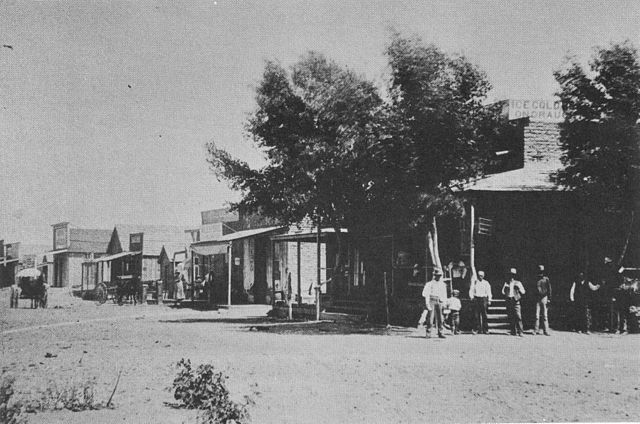
Fairbank, Arizona, c1890
Plot. Claude arrives the same day as Laurel’s sister, Robbie. They step off the same train and travel by stage together to the mining settlement. Used to the amenities of city life in the East, they are ill prepared for the austere desert environment. Eventually they come to regard each other as its chief saving grace.

Action in the novel proceeds at a snail’s pace. Charles seems fascinated by the behavior of people whose lives are at a standstill. Weffold is a glowering, ominous presence. Bax labors on, working to salvage the drought-stricken ranch, despite his father’s open contempt for him. Laurel is often lost in her grief. The young lovers, Claude and Robbie, are little more than children, untested by the world and inexperienced in romance. She flirts and teases; he is earnest and confused.

Matters lurch forward when Weffold determines to shut off the water supply to the mining camp. Claude tries to dig a well, without success, and is forced to shut down operations. Angry mine workers descend on the Weffold ranch, and Bax steps forward to confront them.

As he does so, he learns the long-secret truth about his mother that set his father against him. Bax also learns how truly contemptible the old man is. The revelations kill him, and a crisis involving the disappearance of his little son and the near death of Weffold himself finally produces a change of heart in the old bastard.

Winslow, Arizona, c1890
Character. There’s an old-fashioned sentiment at the heart of this novel. It holds that qualities of character in men are nurtured most importantly by their mothers. If a man is honorable and decent, he learned it at his mother’s knee.

We see the end result in Bax and Claude. There’s a patient generosity in both of them. Bax is an indulgent father and loving husband. Claude makes a big personal sacrifice to save his three half-brothers. He also gives up his big house as superintendent of the mines so that his bookkeeper’s family isn’t crowded into a much smaller one.

Women. The gender divide runs fairly deep in this novel. Women believe themselves to be the true civilizing influence in their husbands’ lives. Despite his upbringing, Laurel says, Bax has had to learn how to see the world the way she does. Her sister finds Claude similarly handicapped. Though eager to please her, he’s all thumbs at reading her shifting moods.