Monday, April 9, 2012

Old West glossary, no. 28

Montana cowboys, c1910
Here’s another set of terms garnered from early western novels. Definitions were discovered in various online dictionaries, as well as searches in Cassell’s Dictionary of Slang, Dictionary of the American West, The New Encyclopedia of the American West, The Cowboy Dictionary, The Cowboy Encyclopedia, The Barnhart Dictionary of Etymology, The Oxford Dictionary of Idioms, and The Shorter Oxford English Dictionary.

These are from Frances McElrath’s The Rustler, about a ranch foreman who goes rogue in Wyoming; Paul Leicester Ford’s The Great K&A Train Robbery, about the theft of some letters from a railway mail car; and Frank Lewis Nason’s To the End of the Trail about gold fever in Colorado. Once again, I struck out on a few. If anyone has a definition for “bad quarter,” “fancy humps,” or “clean bite,” leave a comment below.

Bain wagon = a high-wheeled utility wagon produced from 1840 in Kenosha, Wisconsin. “A number of saddle-horses and Bain wagons and lighter vehicles were hitched to the rail fence in front of the house.” Frances McElrath, The Rustler.

bangtailed = a horse or other animal with its tail cropped square. “He rode upon a diminutive flat saddle on a bangtailed roan.” Frances McElrath, The Rustler.

bird = a first-rate person, animal, thing. “Say! she’s a bird. Little minin’ fever over at Moab. Lot of Eastern men come in there, an’ she picked ’em. Picked ’em clean.” Frank Lewis Nason, To the End of the Trail.

bluecoat = soldier. “I did my best to be good company to the bluecoats, and had a first-class dinner for them on my car.” Paul Leicester Ford, The Great K&A Train Robbery.

Brussels carpet = a kind of carpet with a woolen pile and a stout linen back. “A Brussels-carpet saddle-blanket bound with leather rested on the horse’s back.” Frances McElrath, The Rustler.

bucket shop = an unauthorized office for speculating in stocks or currency using the funds of unwitting investors. “That keeps more men broke than a Wall Street bucket-shop.” Frank Lewis Nason, To the End of the Trail.

button = a fused metal globule, e.g. gold. “I saw the assayer himself. He says it’s straight. Showed me the button.” Frank Lewis Nason, To the End of the Trail.

cave canem = beware the dog. “From behind their barrier of thorns, every plant and shrub bristling a cave canem to the tactless marauders who should seek to prey upon them.” Frank Lewis Nason, To the End of the Trail.

coony = sly, cunning. “‘Ketched Jim, hev’ you,’ said the sheriff; ‘well, you must hev’ been pretty cooney to hev’ done that.’” Frances McElrath, The Rustler.

country rock = a geological term meaning the rock native to an area. “I’m all right now. I’m on country rock.” Frank Lewis Nason, To the End of the Trail.

crash = coarse, thick linen. “It made me open my eyes, thinking that anything so pretty could be used for the same purposes for which I use my crash bath-gown.” Paul Leicester Ford, The Great K&A Train Robbery.

divvy = a share, portion. “I’m onto a lay now that promises to pan big. If it does, I’ll divvy square.” Frank Lewis Nason, To the End of the Trail.

double express = a double-barreled hunting rifle. “My brother and I each have a double express with us, and do you think we’d sit still in our seats?” Paul Leicester Ford, The Great K&A Train Robbery.

draw it easy = an expression of disbelief or derision. “Tough! Say, that’s drawin’ it aisy. LaSals’s good enough for me.” Frank Lewis Nason, To the End of the Trail.

float = gold that is washed or otherwise separated from its source. “Chunks of float that had become detached from the main vein and were mingled with the broken rocks of the slide.” Frank Lewis Nason, To the End of the Trail.

forced draft = proceeding at full speed or intensity. “Lord Ralles by this time was making almost as much noise as an engine pulling a heavy freight up grade under forced draft.” Paul Leicester Ford, The Great K&A Train Robbery.

fox = to ornament with a strip of leather. “He wore . . . dark cassimere trousers ‘foxed’ with buckskin around the waistband and the bottom of the legs, and with diamonds of buckskin on each knee.” Frances McElrath, The Rustler.

harp = harmonica, mouth organ. “The men laughed loudly at his jokes, and one of them accompanied the singing with a ‘harp.’” Frances McElrath, The Rustler.

Horse Shoe = brand of plug tobacco, produced by the Drummond Tobacco Company in St. Louis. “‘Women,’ observed Tips, planting his diminutive, high-heeled boots on the table, and chipping off a bit from his square of horseshoe.” Frances McElrath, The Rustler.
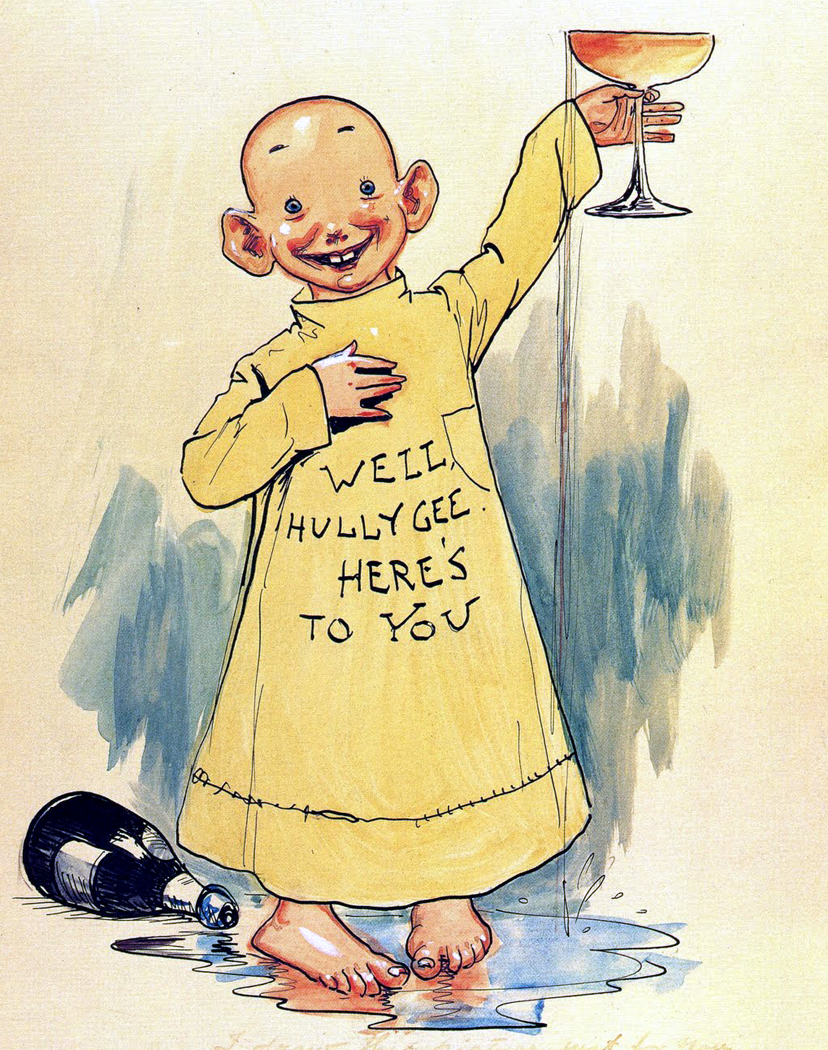
The Yellow Kid
hully gee = a mild oath (“Holy Jesus”) associated after 1895 with early cartoon character The Yellow Kid in R. F. Otcault’s Hogan’s Alley. “Women are hully-gees for stirrin’ up rows!” Frances McElrath, The Rustler.

jay = a simpleton, novice, newcomer. “Said she wa’n’t flyin’ fur no damned jays.” Frank Lewis Nason, To the End of the Trail.

Jerusalem crickets = a mild expletive. “‘Jerusalem crickets!’ was his comment as he measured the aim.” Paul Leicester Ford, The Great K&A Train Robbery.

lay = any form of enterprise, often fraudulent, illegal, or unethical. “Ain’t one of the girls but ’ud fight ter hold yer up if yer were broke. Wisht I had that lay.” Frank Lewis Nason, To the End of the Trail.

meat = prey, potential victim. “If he’s yer meat, jest say so, and’ I’m mum.” Frank Lewis Nason, To the End of the Trail.

plunge = to spend money or bet recklessly, to run into debt. “Say! But ye’re the stuff! Always light on yer feet. Gawd! How yer used ter plunge, too.” Frank Lewis Nason, To the End of the Trail.

round up = to get or accumulate. “I’ll chip in now, and more when I round up.” Frank Lewis Nason, To the End of the Trail.

runner = engineer of a railroad train. “I described to her how sometimes the train was flagged by a danger signal, and when it had slowed down the runner found himself covered by armed men.” Paul Leicester Ford, The Great K&A Train Robbery.

sinker = a dollar. “Got ten thousand sinkers, an’ ninety thousand more coming.” Frank Lewis Nason, To the End of the Trail.

Sisera = an oppressor of the ancient Israelites, finally defeated in battle, where it is reported even the stars fought against him (Judges 5:20). “It’s always darkest before the dawn, and the stars in their courses are against Sisera.” Paul Leicester Ford, The Great K&A Train Robbery.

stuff = woolen fabric. “‘I’m tendin’ the calves,’ she added, hastily slipping her book into the pocket of her dark stuff dress.” Frances McElrath, The Rustler.

take a flyer = to take a chance or a risk. “I’ve taken fliers in prospecting; I’m out of it for keeps.” Frank Lewis Nason, To the End of the Trail.

taradiddle = a petty lie. “Considering that it was about six-thirty, I wanted to ask who was telling a taradiddle now.” Paul Leicester Ford, The Great K&A Train Robbery.

tip the wink = to warn. “By merely tipping them the wink, they’ll have you out of this.” Paul Leicester Ford, The Great K&A Train Robbery.

traveling glass = a drinking glass with carrying case; drinking cup with lid. “I screwed the cover on the traveling-glass, and put it with the sandwiches in the bottom of the stage.” Paul Leicester Ford, The Great K&A Train Robbery.

trig = neat, trim, smart, well dressed. “When the trig-looking couple galloped up to the dingy ranch she was standing in the doorway.” Frances McElrath, The Rustler.

traps = personal effects, belongings, baggage. “Mike got a few necessary traps together and started.” Frank Lewis Nason, To the End of the Trail.

trump = an admirable person. “That’s what I call a trump of a girl, worth loving for a lifetime.” Paul Leicester Ford, The Great K&A Train Robbery.

Image credits: Wikimedia Commons

Coming up: Spencer Tracy, The Sea of Grass (1947)

Saturday, April 7, 2012

Saturday music: Dolly Parton


Dolly sings phenomenal bluegrass on this one. Great late-night driving music.

Western writer inspiration, no. 31

Here is this week's omnibus of #westernwriter inspirations posted each day at twitter, where you can follow me @rdscheer if your attention is not already overloaded. As usual, click the pic to enlarge.

Santa Barbara Mission, California, 1876
Rio Grande, near Pole Creek, Hinsdale County, Colorado, 1874
No. 8. Roundhouse at Armstrong, Kansas, 1873
Camp Halleck, Nevada, 1872; photographer, Timothy H. O’Sullivan
Barracks, Fort Wingate, New Mexico, 1873; photo by Timothy H. O’Sullivan
Camp of Iron Sack, head chief of the Kiowa-Apaches, Indian Territory, 1873
Deadwood, Dakota Territory, 1876

Photo credits: Wikimedia Commons
"No. 8 Roundhouse," courtesy of Southern Methodist University, Central University Libraries, DeGolyer Library

Coming up: Spencer Tracy, The Sea of Grass (1947)

Friday, April 6, 2012

Photo-finish Friday: men at work


Here are the Nguyen brothers, Andy and Tommy, who operate the Los Saigon food truck to be found some days on Jefferson Blvd. near where I work in LA. You've heard of Tex-Mex. These guys have their own style of Nam-Mex. Their hottest (literally) menu item is the "Chino Latino," described as a "crispy Bahn Mi filled with succulent carne asada." The spin on this treat will curl your tongue. Two great guys full of stories about growing up Vietnamese in Southern California. Learn more about Los Saigon here.

Photo-finish Friday is the bright idea of Leah Utas over at The Goat's Lunchpail.

Coming up: Spencer Tracy, The Sea of Grass (1947)
 

Thursday, April 5, 2012

Frank Lewis Nason, To the End of the Trail (1902)

This is a mining camp story set in western Colorado, written by a geologist. Born in Wisconsin, Frank Lewis Nason (1856-1928) was a graduate of Amherst and worked as a mining engineer in Central America, Canada, and various western states. Well into middle age when he began writing novels, he already had a long list of publications on geological subjects.

While you might expect this novel to be coldly or at least stiffly scientific, it reveals a tempest-tossed imagination. It’s about the destructiveness of gold fever and the misfortunes of a weak man who succumbs to it.

Plot. The narrator lets us know early on that Herbert Ingalls and his pretty wife Mary have made a big mistake leaving the East to start up a new life in the West. Neither of them has the chops for it. Will power, stamina, and nerve they’ve got in good supply. What they lack is good sense.

They start out with a hastily purchased goat farm. Western living would have panned out for them by the end of the novel if they’d just stuck with the goats. But no. There’s a big gold strike in the mountains nearby, and Ingalls decides he won’t settle for anything less than a fortune. He wants to go for the gold.

Chase, an educated and reserved man he hires to look after his goats, cautions Ingalls against acting rashly. Alas, it takes more than cautioning. Ingalls willfully falls in with a bad bunch determined to fleece him. An imposing saloon owner, Hilda Bergstrom, known as "Big Swede," suckers him into a deal that has him mortgaging his farm for partnership in a worthless claim.

Chase, who knows her to be a fraud, extricates Ingalls from her grasp, but Ingalls gets himself right back into trouble again. Drunk and disorderly in Big Swede’s saloon, he picks a fight with one of her partners in crime, Smutty Mike. In a melodramatic conclusion, there are gunfire and casualties.

Frank Lewis Nason
Character. Nason is, without doubt, fascinated by the corruptive lure of gold fever. He wants to show how the prospect of sudden wealth makes fools of men who lack strength of character. In the case of Ingalls, he loses his head and becomes the prey of his own worst impulses.

Chase, on the other hand, is a model of upright manhood and clear thinking. We learn that he has been trained back East as a lawyer. He’s also been in the West long enough to know you have to be careful who you trust. Most people on the frontier are either ignorant or unscrupulous. Or both.

East vs. West. The West, Nason’s narrator observes, is a land of excess. Living there requires the strength of character to survive the process of natural selection. The West is for those who live large, whether for good or ill. Where only the fittest survive, a man has to keep his head while taking big risks.

By comparison, a man of weak character is never put to this kind of test as long as he resides among the civil conventions of Eastern society. There, where risks are few, a mediocre man can live his life propped up by those around him. He gets his strength from the social structures that define him. Few western writers are so forthrightly analytical in their portrayal of the difference between East and West.

San Juan Mountains, Colorado,1875
Women. Two women figure in the story, each a foil of the other. Mary Ingalls has genteel interests and likes to pass the time by taking her sketchbook and paint box out into the desert. A prospector friend, Peter, disapproves of her paintings because they are too timid. He tells her she needs to find the courage to tackle big landscapes, where she might show some evidence of having an artist’s soul.

The Big Swede is a corker. Something of a siren, she turns men into putty. She’s also a clever schemer and a sharp manipulator, both of which make her a keen businesswoman. At the first news that a boomtown is about to spring up near a newly discovered gold field, she’s got her bags packed. Within days she’s bought lots in the new town and is throwing up a canvas tent to house a saloon and gambling den.

Wrapping up. Informed in its depiction of prospecting and mining, the novel is interesting for its immersion in that world. Its knowledge of crooks and chicanery also grounds the novel in a believable world.

While at points it shifts into high melodrama, one can argue that the book is really meant to be a tragedy. If you can work up sympathy for the characters, it’s that they are at the trail’s end of a long series of bad choices. Even Chase, who has the qualities of a hero, leaves a reader somewhat cold. For all his qualities, he is proof that no good deed goes unpunished.

Nason went on to publish a number of other novels, and he seems to have eschewed both slick and pulp magazines. Alas, like many other writers of popular novels at the time, he is largely if not totally forgotten today. To the End of the Trail is currently available at google books and Internet Archive and for the nook.

Friday’s Forgotten Books is the bright idea of Patti Abbott over at pattinase.

Image credit: Wikimedia Commons
Photo of author, Frank Leslie's Popular Monthly, 1902

Coming up: Spencer Tracy, The Sea of Grass (1947)

Tuesday, April 3, 2012

The Lonely Man (1957)

Jack Palance is the lonely man of the title of this dark western about a gunman trying to retire from a life of crime. He’s had 14 years of killing and thieving, including the death of a sheriff. His wife is among the dead, either pushed or jumped from a cliff into a canyon—also killed by him if we can believe his embittered son (Anthony Perkins).

Plot. Palance has come home, looking for his boy. He wants to make amends and, as it turns out, to make a man of him. Perkins hates the old man with a contempt that is consuming him. He is churlishly immature and resentful, even as he agrees to join Palance who wants to start a new life somewhere.

Run out of town wherever they go, Palance takes Perkins to the only place he’s still welcome, the ranch where he once lived with a woman who still loves him (Elaine Aiken). Here he settles in, intending to round up and break mustangs for a living.

But his past catches up with him. First a former partner in crime (Robert Middleton) shows up. Next it’s Claude Akins with a gang of four men, who have plans to steal some gold and want Palance’s horses. Finally, it’s a revenge-driven Neville Brand, with a bunch of his own friends, who has scores to settle.

Perkins gets to see his pa and Middleton in action as some quick gunplay resolves differences with Akins. Then in the film’s closing scenes, like the deadly shootout in many a western saloon, Palance eliminates Brand and his cronies. This he accomplishes with the help of Perkins, who has gained a measure of respect for the father he has hated.

Themes. The story takes place in a grim world where hatred is the ruling passion. Palance’s steely gunman stands out by contrast. We rarely see him lose his grip on whatever emotions roil within him. Administering some well-earned tough love on Perkins, he shows the limits of his patience with the boy, but his cool is generally enviable.

In similar roles, Eastwood would have given the character his trademark slow burn, and there would have been moments of tender vulnerability from Alan Ladd. Gregory Peck would have given us a subtext of unspoken regrets. Palance is much harder to read. He has coldly resigned himself, maybe long ago, to an unforgiving world where no one can be trusted.

But he’s not cold-hearted, just very self-contained. When Aiken, in a pair of very tight jeans, tries to warm him up, we find that even sexual desire in him has been switched off. And we discover a secret he’s kept from everyone, that he’s losing his sight. For a man who has stayed alive by being quick and accurate with a gun, this development is a death sentence.

Wrapping up. I liked this film for its unsentimental honesty. It never once backs away from what it has to say about the loneliness of a world where it’s every man for himself. Brand’s continual storming gets a little tiresome, and one would like a stronger performance from the one woman in the cast. Aiken isn’t up to it. Otherwise, this noirish 50s western holds up well.

Shot in the Alabama Hills of central California, The Lonely Man was filmed in black and white, using Paramount’s widescreen process, VistaVision. Tennessee Ernie Ford sings the movie’s theme over the credits. The tune, played on a harmonica, gets a nicely mournful treatment at key moments during the film.

The Lonely Man is currently available at amazon and netflix. Tuesday’s Overlooked Movies is the much-appreciated effort of Todd Mason over at Sweet Freedom.

Coming up: Frank Lewis Nason, To the End of the Trail (1902)


Monday, April 2, 2012

Dustin Farnum: The first Virginian


I came across this image of Dustin Farnum (spelled Farnham here) in his role as The Virginian in the stageplay version of Owen Wister's novel. It appeared in the February 1904 issue of The Critic. The writer made  this comment:

The play as a play has not made as favorable impression as has the acting of Mr. Dustin Farnham in the role of the Virginian. Mr. Farnham fills the bill absolutely. If he can play other parts as he plays the part of the Virginian his success as an actor is assured.

The play turned out to be hugely popular, and Farnum (1874-1929) went on to Hollywood, where he reprised the role in an early Cecil B. DeMille version of The Virginian (1914) and continued making films through the Silent Era.

Coming up: Jack Palance, The Lonely Man (1957)