Showing posts with label colorado. Show all posts

Thursday, January 1, 2015

Francis Lynde, Empire Builders (1907)

There are train spotters and railroad enthusiasts, but so far as I know, no one today writes fiction for this particular market. Anyway, not since Agatha Christie’s Murder on the Orient Express (1933). Travel by railway was still novel enough at the turn of the last century, however, to keep writers like Francis Lynde (1856–1930) selling books with plots about railroading.

This one is typical of his others and concerns a young superintendent of a line running from Denver into the Rocky Mountains. Stuart Ford is an ambitious fellow, who hatches a plan to extend the line to eventually connect Chicago and the West Coast. His chief competitor is the Transcontinental with its eye on hauling freight to and from the same regions of the West, profiting from the mining and crop-raising industries. In other words, there is a lot of money to be made for the railroad that can first lay its tracks there.

Thursday, November 20, 2014

Robert J. Conley, Quitting Time (1989)

This short novel is a curious cross between a standard western and an Agatha Christie murder mystery. The central character, Oliver Colfax, is something of a range detective, with a license to kill, should he be so inclined. But he’s grown weary of the work that has been his livelihood and is looking to retire from being a gunman for hire. It is, as he says, “quitting time.”

Considering a job for a Colorado cattleman who believes he is the victim of rustlers, Colfax travels to a small frontier town, drawn in part by the opportunity to see a touring theater company perform Shakespeare’s bloody tragedy, Titus Andronicus. Agreeing with the cattleman to find out who, if anybody, is rustling his stock, Colfax gets to work and determines before long that a gang of cowboys at a nearby camp are the only likely suspects.

Wednesday, November 5, 2014

Jenny Shank, The Ringer

Review and interview

Frontier fiction did not end with Louis L’Amour. Its themes and issues continue among today’s writers who place their stories west of the 100th meridian. Jenny Shank’s The Ringer is a fine example of how the frontier, despite Frederick Jackson Turner, has never really closed.

Set in modern-day Denver, this novel takes up two topics that date back to the origins of frontier fiction: the use of deadly force in law enforcement and the conflict between whites and the region’s ethnic populations, especially Spanish-speaking inhabitants who have long lived in the lands of the Southwest, taken in conquest by the U.S. government from Mexico.

Thursday, October 9, 2014

Willa Cather, The Song of the Lark (1915)


Willa Cather, c1912
Willa Cather was a fine writer, with a special take on what it was like to grow up in a small town on the plains among descendants of immigrant homesteaders. The Song of the Lark tells of a young woman, Thea Kronborg, with a talent for music, who as the daughter of a minister finds friendship and approval not among her peers but among older men: a railway brakeman, the town doctor, and a piano teacher. They coach her through childhood and into adulthood, encouraging her to develop her musical abilities.

Plot. Cather follows her heroine to Chicago to study with a pianist, who discovers that she has an even greater talent for singing. Eventually, she goes to Germany to train as an operatic singer, and by novel’s end, she has been cast in roles that have her drawing enthusiastic audiences at the Met in New York.

Thursday, August 28, 2014

Richard Wheeler, Flint’s Honor

This is the third in Richard Wheeler’s series about frontier newspaper editor, Sam Flint. We catch him this time arriving in a silver mining settlement in Colorado. He’s been drawn there by a cruel editorial in the town newspaper, The Silver City Democrat, which smugly reported the suicide of a prostitute as a victory for the town’s morally righteous and a blow at the corruptive influence of vice.

Flint discovers that real estate is at a premium in town, and he has to settle for rental space in the very apartment where the prostitute took her life, harassed by the sheriff and his thug deputies, and unable to pay the heavy taxes levied by the town on those deemed undesirable.

Plot. Setting up shop as a rival newspaper, The Sentinel, Flint learns that his competitor, Digby Westminster, has the town sewed up, with a monopoly on the news and the advertising revenue. He manages a virtual cartel of local merchants, permitting them to avoid competitive pricing of their goods and services. Local law enforcement is also all too friendly with Westminster, and judge and prosecutor use their influence to keep Flint uninformed of any shady mishandling of public trust.

Tuesday, August 5, 2014

Benjamin Dancer, Patriarch Run

I wasn’t sure what to make of this novel when I was approached by its author to read for a possible review. It sounded to me like YA fiction, though that turned out to be only one element of its active blending and bending of genres: coming-of-age story, cautionary tale, international espionage thriller, and kill-or-be-killed western set in modern-day Colorado.

In an afterword, Dancer says the novel is about fathers. We are given a clue of that already in the title, and though the pivotal character is an 18-year-old boy, it would not be misleading to claim patriarchy and fatherhood as themes underlying the narrative.

Father. So let’s start with the father in the novel. He is in many ways a man of heroic stature that any boy might even romanticize about: skilled with weapons, an operative in the service of national security, his missions cloaked in secrecy. The problem is that he is an absentee father, having mysteriously disappeared, except to materialize on the news from surveillance footage as a suspected terrorist bomber.

Monday, June 9, 2014

Alethea Williams, Walls for the Wind

Review and interview

I frequently puzzle over the gender divide in western and frontier fiction. Actually, it’s there in most fiction, a fault line between novels written mostly by and for women and those written by and for men. 

I don’t have statistics to support the claim, but I believe it’s generally agreed that women read more fiction than men, while women’s fiction has a harder time finding an audience and being recognized. For westerns, any measure of excellence is usually to male writers: Zane Grey, Louis L’Amour, Max Brand, Elmore Leonard.

Background. Part of this owes to the nature of the genre. The traditional formula western is itself dominated by male characters, and women are typically only secondary to their stories. The men get most of the action, while the women lack what can be called “agency.”

If a character holds interest for the reader, it’s because they have the ability and opportunity to overcome obstacles and exert control over whatever difficult situation they happen to find themselves in. That may involve firmness of resolve and a fearless form of risk-taking that go against gender stereotypes for women, which generally ask of them to remain feminine, soft, and vulnerable.

When they figure into the plot of a western, they are there typically to be rescued or cause trouble. Since Owen Wister’s Molly in The Virginian (1902), they are also present to provide a plot thread involving romance. At novel’s end, they are often headed for matrimony with the male hero, who has fallen in love with them.

Monday, December 2, 2013

Mark Mitten, Sipping Whiskey in a Shallow Grave


Review and interview

This is a heckuva western novel that more than lives up to its unusual title. Mitten knows the conventions of the genre and then turns them inside out to create a sprawling narrative that ranges all over the state of Colorado. The cast of characters includes working cowboys, the worthy citizens of several Rocky Mountain settlements, and the members of an outlaw gang.

Their lives converge on a fatal day in 1887 when a stage hold up is interrupted by a cattle drive. A traditional western might start with an incident like this, but Mitten puts it squarely in the middle of his story. The first half of the novel is prologue to it, as we meet his characters and get into the rhythm of their lives, both for good and ill.

The second half portrays the aftermath as it follows a dozen or more characters as they disperse in all directions. Their lives intersect with those of multiple other characters, and for a while Mitten is tracing their adventures along eight different storylines. The cast of characters eventually numbers 75 or more men, women, and children. That includes cameos by the likes of Doc Holliday and Soapy Smith.

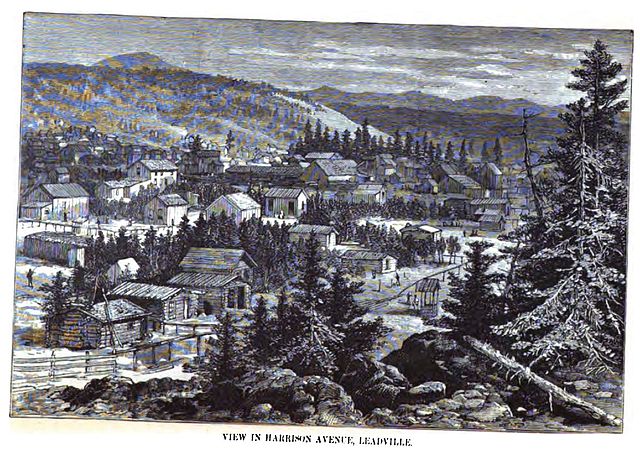
Leadville, Colorado, c1880
Plot. Mitten’s novel is a tightly plotted chain of cause, effect, chance, and coincidence. Complex as a chess game, it mimics the unpredictability of life itself. And it continually discovers that nothing is ever as simple as the conventions of western genre fiction would have us believe.

The title of the novel refers to a scene in which cause, effect, chance, and coincidence meet again as they have before in the novel. One of the outlaws escapes being shot for a horse thief by hiding in a grave he is digging for another man. He happens to have a bottle of whiskey with him.

In the end, the incident that begins it all—the shooting of a sheriff—is finally resolved and justice is served. And not without some ironies. Meanwhile, life goes on for the other characters (at least those who survive), as the events and incidents of the novel take them onward, leaving the past behind. Mitten seems to be saying, nothing ever really ends, and a reader may sense the possibility of future sequels.

Style. Mitten shows a gift for dialogue and the vernacular. When a cowboy sees a man in a slicker (something new in 1887), he admires it and says, “Need me one of these.” That’s the kind of line you can hear being said.

The narrative also shows an unusual appreciation for the impact of death. Characters experience shock and grief when someone is killed, and the feelings do not soon wear off. Mitten notes how death hits hard those least accustomed to it. A bunch of young cowboys are shaken as the posse they are riding with comes upon the bodies of two men shot dead.

Monday, October 21, 2013

James D. Best, The Return


You know you’re in good hands with James Best. This new “Steve Dancy Tale” is told with the usual economy, clarity, and attention to detail. Best’s characters are fully three-dimensional and spring to life in a few words of dialogue. Best of all, you enjoy their company.

I like Steve Dancy. He’s an Easterner who has adapted in a few short years to the West, where he has interests in the silver mining town of Leadville, Colorado. He comes with a social pedigree that he never flaunts, and he has grown up the son of a firearms merchant. He has a head for business and is a good judge of character.

He tells his own stories, and Best is one of the best at first-person narration. Dancy is articulate and intelligent, the sort of man who draws similar men to him, so you like his friends, too. They are, as he says, honest and true. In this story, one of those friends is a woman, who offers Dancy some very adult and levelheaded long-term romance.

Leadville, Colorado
Plot. You think this story is going to take place entirely in Leadville, as it sets up the initial conflict. A nasty protection racket has sprung up in town, and one by one the shopkeepers and other places of business are being forced to make weekly cash payment to a gang of thugs. It’s either that or trouble, from broken windows to arson.

Dancy, his friend Jeff Sharp, and their business partner Virginia Barker stir up enough support to stage a protest, and they are joined by six Pinkerton agents from Denver. Soon the thugs are sent packing. And before we know it, Dancy, Sharp, Mrs. Barker, and Captain Joseph McAllen of the Pinkertons are involved in quite another gambit. This one takes them back East.

There, they work as a team of investigators for none other than Thomas Edison. The famous inventor retains them to find out whether a project to bring electric lights to lower Manhattan is being sabotaged by competitors vying to grab up the market for this new technology.

Monday, September 16, 2013

Ann Parker, Silver Lies


Review and interview

Some make a killing while some just get killed in this western mystery set in Leadville, Colorado, during the silver rush of 1879-1880. And the mysteries multiply after the novel’s central character, a saloon owner, finds there’s a body in the frozen mud outside her alley door.

In the pages of this novel, author Ann Parker has persuasively created a whole social world sprung into being by the discovery of silver in the Rocky Mountains. Inez Stannert and her partner, Abe Jackson, keep the beer and whiskey flowing at the Silver Queen for everyone from the silver barons to the Cornish miners who labor underground.

At the novel’s start, Bridgette O’Malley is the cook in the kitchen supplying bread and stew. And on Saturday nights, the town’s leading citizens gather for a game of high-stakes poker, with Inez dealing the cards. However, a third partner in the business, Inez’ husband, has gone missing for most of a year.

Leadville, Colorado, c1880
Plot. The death of an apparently decent and trustworthy assayer is passed off as an accident by the town’s truculent marshal. But it leaves Inez more than a little curious, especially when the man’s office has been broken into and ransacked. Something suspicious is going on in town, and she is determined to find out how it came to have fatal consequences for the assayer.

The mystery deepens as we meet more characters. A newcomer to town, the Reverend J. B. Sands, raises a number of questions as he seems unusually worldly for a man of the cloth. Thoroughly handsome, he is also something of a lady-killer, and Inez finds herself being romanced by the man.

Romance. Male readers unused to romance fiction will find the story shifting into quite another key as Rev. Sands and Inez flirt with intimacy and then yield to it. Love scenes are way different when told from a woman’s point of view. There’s maybe nothing in fiction more revealing of the gender gap.

For one thing, romance emerges from a field of sexual politics in which men are used to dominating and—especially in the frontier West—outnumbering women. Hollis, the town marshal, is an extreme example, openly hostile to women. Sands, by contrast, is a smooth operator, and there’s some question whether his real motives might be sharply at variance with his polished manner.

Intimacy requires both trust and surrender. When it leads to unmet expectations and fear of betrayal, there is a heavy debt of injured pride. That leads to stormy scenes between mismatched lovers, and this novel has its share of them.

Street scene, Leadville
Themes. Injured pride may well have been the title of the novel, as it runs as a theme from beginning to end. Discussing Milton’s Paradise Lost, one character describes the fallen angel, Lucifer, as the victim of it. And injured pride is a condition that sooner or later gets most of the novel’s characters into difficulty, including Inez.

The wintry weather is another constant theme in the novel, as characters trudge through the town’s frozen streets. Snow is forever falling, and we are often reminded of the cost to the hems of full-length skirts as women navigate the sludge and mud-caked walks.

An after-Christmas soiree at one of the town’s hotels offers a welcome reprieve from the weather. The chapters describing this elegant event are a genuine pleasure, from the Eden-like greenery and the invited guests in evening dress to the string quartet enthusiastically mangling Vivaldi and Mozart. For contrast, there’s the overheated and dimly lit interior of the town’s high-class whorehouse.

Snow, Leadville, August 1882
Women. Parker picks as a point of view character a woman who would have the freedom and independence of few other women on the frontier. As a saloon owner, she is freer to mingle with the rougher elements of town and much less constrained by the requirements of respectability.

Still, as a woman, she deals with being openly stared at by ill-mannered men, and she is also vulnerable on the worst streets of town. Thus, she carries firearms, sometimes concealed, sometimes not. For anonymity, she sometimes dresses as a man. This gets her access at night to a whorehouse, where she is in search of information from one of the prostitutes.

She is also not answerable to the most exacting dictates of Victorian morality. Having Abe Jackson, a black man, as a business partner would have raised eyebrows among readers of frontier fiction 100 years ago. Her affair with Rev. Sands would have absolutely shocked them. A married woman tempted to extramarital sex—and with a man of God—would have branded her as a “fallen woman.” The thrills she feels when being touched by him and her awareness of his body in and out of his clothes would have branded her as wanton.

On a scale of relative iniquity, however, Parker places her heroine well above the brazen madam of the town’s classiest “parlor house.” She also ranks above the coolly arch proprietor of yet another whorehouse, in Denver, who smokes cigarettes as she discusses the finer points of her trade and her customers.

Prospectors crossing a stream
Style. The tone is straightforward throughout, with an undercurrent of suspense, as the stakes rise and the threat of malice escalates. Now and again there comes an outburst of graphic violence. In the end, as an element of psychopathology is unmasked and takes over, the violence gets pretty nasty.

The novel has a Dickensian cast of characters, including the surprising appearance of none other than Bat Masterson. There are a couple moments of humor, as when the Rev. Sands enters the saloon and Inez hears the newly hired piano player segue into “What a Friend We Have in Jesus.” And one of her employees, a back-bar flunky named Ulysses, is called “Useless” by everyone.

The mystery itself is densely plotted, and so many unanswered questions and speculations crop up that even a seasoned mystery reader may well feel bewildered. At the end, a life-threatening crisis takes the focus, leaving several details unexplained. Finally, there’s been so much going on that it takes a couple of chapters of denouement to sum it all up, including the romantic subplot.

Wrapping up. Overall, Silver Lies is enjoyable on many levels, particularly for its portrayal of a booming frontier mining town, crawling with life 24 hours of the day. It was first published in 2003 by Poisoned Pen Press and has recently been released as an ebook. It is currently available at amazon and Barnes&Noble for kindle and the nook, also at Powell's Books and Abebooks. You can visit Ann Parker’s website here.

Interview
Ann Parker, Photo by Charles Lucke


Ann Parker has generously agreed to spend some time at BITS today answering questions about the writing of Silver Lies. I'm happy to turn the rest of this post over to her.


Talk about how the idea for this novel suggested itself to you.
Silver Lies, and indeed all the novels that follow, evolved out of a desire to explore this particular area of Colorado—Leadville in particular—during a specific time—the boom years of the Colorado Silver Rush. When I first became interested in this timeframe of Colorado history, we were deep into the dot-com boom here in California, and I was intrigued by the psychological and economic parallels between these particular “get-rich-quick” times of vast enthusiasms and optimism that, to some extent, flies in the face of reality.

Only a few ever rise from rags to riches in any given boom… but many who fall under the spell of overnight success get swept up in the hope that, despite the numbers to the contrary, THEY will be one of the lucky ones. Then, there are the pragmatic types who see the golden opportunity in feeding the dreams… The folks in Leadville, for example, who “mined the miners.”

Did the story come to you all at once or was that a more complex part of the process?
The story evolved as I wrote the first draft. When I pondered the possibility of writing a book, the opening scene came to me in a flash and with a feel in my gut: Here is the beginning. I had no idea why assayer Joe Rose was in such a fix or what he was doing in one of the nastiest back street alleys in Leadville’s red-light district in the darkest hour of a cold winter night, nor who was out to get him.

My writing process… particularly for this first book… was akin to driving in the night with the headlights on. Every chapter I wrote illuminated the next. It wasn’t until the final third of the book that I could see to “the end.” At that point, I grabbed a little yellow sticky note—about two inches square—and scribbled down a handful of key scenes I needed to finish the story. That was as close to an outline as I got for Silver Lies.


Talk a bit about editing and revising. After completing a first draft, did it go through any key changes?
Oh my yes. Since my initial writing process was one of discovery and I wasn’t following a pre-set outline or story arc, my first draft was massive: about 160,000 words (600+ pages). I was told that, for it to be marketable, I had to shrink it down. A lot.

I threw out subplots, stripped out characters that didn’t forward the story, and added another suspect or two (because, despite its length, I really didn’t have enough suspects). I also worked on paring down the language. I tend to be very wordy in my first drafts—channeling the 19th century, perhaps. Even after all this, the end result is still pretty long as far as first novels go: over 110,000 words.

Wednesday, August 14, 2013

Jory Sherman, Snake Eyes


I’ve come to think of the traditional western as existing in a parallel universe. It posits a western landscape peopled by people such as ourselves. But it’s a kill or be killed world. And it grants a man the right to be judge, jury, and executioner whenever he sees an injustice. It asks the question, what if you could just take up a gun, hunt down bad men, and blow them away?

Like many another western, that’s what happens in this recent novel by Jory Sherman. The central character, Brad Storm, is a Colorado rancher who works part time for a Denver detective agency. In this story, he tracks down and kills a murderous cattleman trying to drive a family of Basque sheep men off the range.

By the end of the novel, Storm has actually ended the lives of a fair number of men. They include several cowboys working for the villain, a nasty German by the name of Schneck, or as he likes to be called, “Snake.” Schneck, as we discover, is a kind of proto-Nazi, so evil and heartless that he murders defenseless women and children.

An existential hero. Sherman, one of the genre’s most skillful writers, gives us a hero who is both smart and fast with a gun. He is in full possession of all six senses, some of them heightened, and he is likened to a lone wolf or mountain lion stalking its prey. But he isn’t just a cunning and efficient exterminator. We get a glimpse into his soul—or into the space where his soul might be—and we find it a lonely place of shadows and uncertainty.

Rocky Mountains
In many ways, Storm is an existential man. Like survivors of the war in Europe, whose experience shattered their beliefs in a rational world looked after by a benevolent deity, he doubts that life has meaning. Beyond the present moment, he wonders, what else is there?

We exist to no purpose except to keep existing, moment by moment, before Death finally overtakes us. It may be springtime in the Rockies, the streams full of snowmelt and the grass green with new growth. But it is still a cold and chilly season for Storm.

The Basques hold a funeral for one of their own, to show respect for the dead, but Storm is so inured to loss that he refuses to participate. Mourning should be a private affair, he says. The dead are gone and don’t need anyone’s respect. He also doesn’t care to witness the grief of others, especially the tears of women. And he begrudges the Church’s intrusion on the ritual of burying the dead, co-opting what was originally a “pagan practice.”

Friday, April 19, 2013

Marion Reid-Girardot, Steve of the Bar-G Ranch (1915)


Never mind the subtitle of this novel, which promises “A Thrilling Story of Life on the Plains of Colorado.” Steve of the Bar-G Ranch is for the most part a ranch romance. Steve is a handsome young cowboy who falls in love with a pretty young thing from back East and wins her heart and hand despite the obstacles that divide them.

Plot. Steve Gardeau is top cowboy on the family ranch 25 miles east of Denver. His foster brother, Blackie, has competed with him since boyhood for every honor a young man might desire, including the interest of any pretty girl. As congenial and even-tempered as Steve is, Blackie is resentful and vindictive. When Steve catches the eye of the schoolteacher, Miss Little, Blackie is furious.

For Miss Little, Steve is the pick of the lot, and she makes every effort to wring a marriage proposal out of him. But he’s not so easy to catch, especially as a summer visitor from New York, Eloise Parker, shows up. Miss Parker has welcomed the opportunity to get away from a pesky suitor, the millionaire, Reggie Van Rennssler, but he insists on accompanying her on her western adventure.

Steve
Steve is undaunted by the presence of this other man. Meeting Miss Parker at a Fourth of July picnic, he quickly gives her all his attention. She is flattered and allows him to befriend her. Snobby Reggie gives up and goes back to New York, trusting that she will eventually come around and marry him for his money.

Romantic feelings grow between Steve and Miss Parker, and emotions reach a peak during a camping trip with friends in the Rocky Mountains. Caught in a snow squall at a high elevation overlooking a scenic view, they confess their mutual love and agree to marry.

After that, all goes downhill for a while as Miss Parker is called back to New York by her ailing mother, who refuses to approve of the marriage when she learns of it. Steve takes the news hard, and Miss Little goes to work on him again, hoping to get him on the rebound.

Business takes Steve to Boston, where he happens to meet Miss Parker and falls madly in love all over again. Back in Colorado, he joins a hunt for horse thieves, and when they are found, Blackie is discovered among them. In an exchange of gunfire, both Steve and Blackie are seriously wounded and taken to a hospital in Colorado Springs, where each clings to life.

Camp wagon
Learning of the incident, Miss Parker is overcome and falls into a faint. Startled, her wheelchair-bound mother leaps to her feet and experiences complete recovery from 15 years of paralysis. Eager to see the West, she accompanies her daughter to Colorado, and finding her bed-ridden lover, Miss Parker attends his return to health.

Falling in love with the West, her mother gives her blessing to her daughter’s marriage to a cowboy. Meanwhile, Miss Little settles for second best with Blackie. Though under guard for his part in the ring of horse thieves, he escapes with the help of Steve, who puts him and Miss Little, dressed as sisters of mercy, on a train to Mexico.

Romance. Maintaining appearances is more often than not the order of the day in matters of romance.  Miss Parker observes that it is better to keep a man guessing about a woman’s true feelings. Once a man thinks he’s won her, he takes her for granted and “considers the matter settled for life.” By comparison, were he to win a fortune, he would never let it out of his thoughts.

To hold a man’s interest, you can’t let him suspect you like him or, worse yet, that you are out to snare him. He will quickly get cold feet, lose interest, or get resentful that he is not doing all the pursuing. Thus, as Steve becomes increasingly flirtatious, with “half-serious, half-jesting declarations of love,” Miss Parker falls into a state of confusion, not wanting to appear to encourage him. 

Thursday, April 18, 2013

John Reese, The Land Baron (1974)


This is the third book in the trilogy, Jesus on Horseback, John Reese’s tribute to his fictional frontier community, Mooney, Colorado. Reese was a reporter and labor editor for William Randolph Hearst’s Los Angeles Examiner, and he is like other western writers who worked in the news business. He has that particular understanding of community that crosses social boundaries and divisions. He knows that despite upstanding facades, crooks and phonies abound. And his opinion of the human condition ranges from salty skepticism to heartfelt sentiment.

Plot. Like other writers, Reese has insisted that plot springs from the characters that populate a story. The Land Baron is chock-full of them, each sharply and often humorously drawn. The man at the center of it all is Sheriff Abe Whipple, and in his role as an officer of the law, his duties make him an attentive observer of the lives of everyone else in Mooney.

The central storyline concerns the arrival in Mooney of a land speculator, Asa R. St. Sure, known to one and all as “Tapeworm.” Full of birdshot from an unknown assailant when we first meet him, he is the sad case of a man who’s come west hoping for a change in a string of bad luck—only to find more of it. Who-shot-Tapeworm becomes the thread on which depends the many people and incidents that make up the novel.

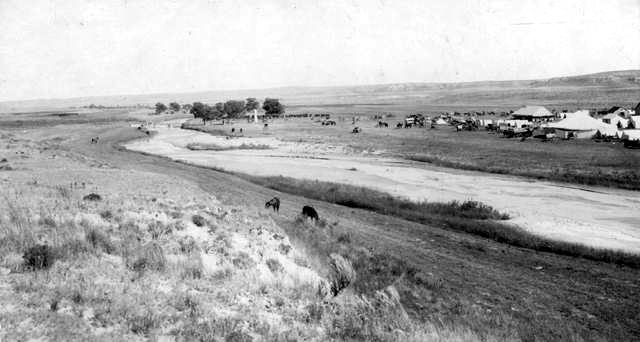
Prairie, northeast Colorado, 1917
The wheel of fortune turns for Tapeworm when he comes upon inside information that the railroad is building a spur into town. With his oldest daughter’s inheritance from his first wife, he snaps up whatever real estate he can get his hands on. He’s also developing commercial properties in anticipation of the boom he expects the railroad to bring.

Among the cast of characters is his daughter, Virginia, whose fish-out-of-water husband runs off with a carnival performer. When one-armed Elmo Huger, an outspoken Baptist, takes on work as her ranch foreman, he’s humiliated when she freely admits that he’s assumed the place of her former husband in her bed.

There’s a 71-year-old Englishman, Dickerson Royce, who does nothing but drink up a quarterly remittance. A villain, Mike Timpke, who lurks mysteriously on the sidelines, manages to live as an outlaw though he is terrified of guns. There’s Alec McMurdoch, banker and former cowboy, whose horse loses a high-stakes race while he’s trying to take a piss in the weeds with an enlarged prostate. And so on.

Sod house, 1901
Narration. The novel has a narrator, Pete Heath, who has a little ranch outside of town where anyone from immigrants to fugitives can take shelter for a few days, maybe trading horses, no questions asked. You catch his voice now and then in his slightly ungrammatical use of English, with words like “retch” (reached), “catched,” and “overhalls,” and expressions like “He done it.”

Pete is a repository of rumor and local scuttlebutt. Sheriff Whipple may drop by for his opinion on a matter, given whatever news might have reached Pete’s ears. In the few scenes like these, the narration slips into fist person, and it’s a little surprise to be reminded that we are being told a story by someone in the story itself.

Reese achieves a clever sleight-of-hand, by having a marginal character who is also an omniscient narrator. The segues between third- and first-person narration neatly place the novel in an older, oral tradition. Like stories told around the campfire, liberties are taken by the storyteller who pretends to know what someone was thinking, saying, and doing, though they were not present as a witness. And we happily suspend disbelief.

Monday, April 1, 2013

David M. Jessup, Mariano’s Crossing


Reading this novel set in the Old West, I was reminded at times of two other historical novels, Snow Falling on Cedars and The Kite Runner. Neither of those books are westerns, but they deal with similar themes—racial and ethnic bigotry and relationships across class boundaries. In all three, there is also a thread of menace.

Plot. We know from the start that a 15-year-old girl, Lena, has died. We don’t know who or what killed her. Her mother, Takansy, a Flathead Indian, has spirited her body away to a last resting place in a cave. She wants to prevent her husband, Medina, a Mexican, from burying the body in the ground.

Meanwhile, John Alexander, the son of a local sawmill operator, is searching for the girl. We gather there has been a romantic attachment between the two that her father has been attempting to prevent. Flashback then to 10 years previous, and in the rest of the novel the entire story of all four characters is told, leading up to its tragic conclusion.

Style and structure. This is an old-fashioned novel in the measured pace of its unfolding. The setting is Medina’s trading post, at a spot on the Oregon Trail called Mariano’s Crossing. Over the decade of the story’s telling, we observe as a community springs up around it and settlers arrive to homestead the land.

There are three point-of-view characters, Takansy, Medina, and John Alexander, each chapter devoted to one of them. For John, they are years that mark his coming of age and his falling in love with Lena.

The girl is torn between the three of them, each with their own plans for her life. Medina sees marriage to a man of means and sends her away to a Catholic school in Denver to get a first-class education. Takansy trains Lena as a horsewoman and schemes to take the girl back to her tribe in Montana. John Alexander arranges to elope with her.

Stage station, Larimer County, Colorado, 1870
However, we never know which of the three Lena owes her allegiance to. She seems to go along with whomever she is currently talking to. Meanwhile, there is some doubt whether she might be secretly involved with another student at her school.

There are a few other characters who seem interesting, and you wish you could get to know them better. Takansy’s son from her first marriage, Louis Papa, is one. And there is his congenial father, Papín, a French-speaking frontiersman who comes for a visit. Arah Sprague, an apparently thoughtful schoolteacher, would have given us an interesting portrayal of this little community. Even Kit Carson, on his last legs, passes through and would have provided a wise and colorful perspective.

Friday, March 29, 2013

Robert Ames Bennet, Out of the Depths: A Romance of Reclamation (1913)


Isobel
This is one of a crop of early westerns with civil engineers as main characters. As in some other examples, the action of the story involves the development of an irrigation project designed to convert arid land into a “fruited plain.” The novel’s central conceit is the parallel it wants to draw between the reclamation of both land and a man’s worth as a productive member of society.

Plot. Bennet’s main character is a man who rises from the depths of a wasted life to become the doer of heroic deeds. Lafeyette Ashton is a self-indulgent, lazy bum, who has grown up in the lap of luxury and received the finest education. Lacking any kind of work ethic, he has been disowned by his father, his regular remittances reduced to zero. Left to fend for himself, he’s on his own in the West, a hapless tenderfoot.

His foil in the novel is the brilliant young engineer, Thomas Blake, whose daring achievements have made him renowned. Blake is everything Ashton is not. In him, not an ounce of energy goes to waste. Generous and good-humored, he not only throws himself into the most challenging engineering projects; he is a loving husband and devoted father.

A map of the watershed
Their paths cross in western Colorado on the ranch of cattleman Knowles. Blake comes at the invitation of Knowles’ daughter, Isobel, to determine whether her father’s rangeland can be irrigated. Blake goes to work, with Ashton as a reluctant assistant.

It turns out that the two men have a history. While a student of engineering himself, Ashton had once stolen an idea for the design of a bridge from Blake, who had then exposed the theft. While Blake has long dismissed the incident, Ashton is still eaten up by professional jealousy.

They set to surveying the surrounding watershed, which includes a stream that runs at the bottom of a very deep, narrow canyon. And the two men climb down almost sheer cliffs to take measurements. Not only does Blake’s irrigation scheme turn out to be feasible, but he discovers a seam of gold-bearing quartz. Wealth abounds for all concerned.

Wake-up call
Romance. Complicating matters is that Ashton has fallen in love with the rancher’s daughter. She may or may not like him much in return. Sympathetic when she learns of his predicaments, she expresses “motherly tenderness” for his suffering. But it is hard to tell from her bantering conversation the actual depth of her feelings for him.

Meanwhile, she so obviously worships Blake that Ashton’s jealousy drives him mad. He suspects something irregular between them and becomes concerned about preserving her reputation. In the descent into the canyon, he thus plots to make Blake the victim of a fatal accident. When Blake breaks a leg all on his own, Ashton learns that the man he so despises is actually the long-lost brother of Isobel.

Experiencing a wave of guilt for his murderous thoughts, he has a sudden change of heart. He makes a perilous climb back to the canyon’s rim and directs a rescue that has only a slim hope of success. While help and a doctor are sent for, he descends again in the middle of the night by the light of a lantern to take food and first aid to the fallen man.

Convinced now that he is no better than worthless scum, Ashton wants only to see that Blake is returned to safety. That accomplished, he hopes to simply disappear from the face of the earth. But Isobel confesses her love for him, and Blake has only gratitude for his bravery and his heroic efforts. He offers Ashton a job and a future as resident engineer owning a share of an ambitious irrigation project.

Monday, January 7, 2013

John Williams, Butcher’s Crossing (1960)


Some would call this an anti-western. It reflects the dark underside of the 1950s and overturns some of the mythology of the West. It’s central character is a young man who flees the deadening effects of civilization as it’s practiced in 1870s Boston and heads out West to find adventure on the frontier.

William Andrews is 23 years old and wants above all to experience the wildness of the West, to immerse himself in its freedom. In that freedom, he expects to find goodness, hope, and vigor. He is a living example of Emerson’s belief in self-reliance and the wholesomeness of unspoiled nature.

Plot. Arriving in a settlement called Butcher’s Crossing, in central Kansas, he bankrolls a bison hunter who claims to know of a hidden herd in the mountains of Colorado. Bison hides are selling for $4.00, given market demand and the growing scarcity of the animal. Not only will the hunt be an adventure, it will turn a profit of thousands of dollars for them.

The trip to Colorado and back, with three experienced hunters, turns into an unexpected odyssey of many months. The party is headed by Miller, who is expert with a buffalo gun. He hires an experienced skinner, Schneider, and persuades the older Charley Hogue to go with them as driver of their oxen-drawn wagon. Andrews is to help with the skinning.

Bison hide yard, Dodge City, Kansas, 1878
It takes weeks to travel across western Kansas and eastern Colorado. Taking a shortcut across the arid prairie, they run out of water and nearly die of thirst. All the time, until Miller finds them, there is doubt that his herd of bison even exists.

But they do exist, in the thousands, surviving summer by summer in a mountain valley. Finding them, Miller gets right to work, and before long the hides pile up far beyond the number they can take back in one trip to Butcher’s Crossing. Over Schneider’s objection, Miller stays on, intending to wipe out the entire herd.

But he waits too long, and they get snowed in. The final third of the novel is an account of their fierce struggle to survive the winter. With the hides, Miller constructs a shelter and “sleeping bags” for them to keep from freezing to death. They live on game and a carefully rationed supply of coffee.

When enough snow has melted from the mountain pass leading out of the valley, they pile the wagon high with hides and head back to Kansas. That journey is marked by an accident that reverses their fortunes once again. Yet more bad news awaits their arrival at Butcher’s Crossing.

Dead bison in snow, 1872
History vs. myth. The killing off of the bison herds is an accepted fact of western history, but seldom if ever has it been the subject of a novel. Williams describes grimly but matter-of-factly the systematic conversion of thousands of living animals to skinned carcasses. Somehow, none of the men regards what they are doing as the extermination of a species.

Meanwhile, the relentless killing and skinning has an effect on them more deadening than the worst to be had in tired old civilized Boston. Andrews is first physically repulsed as he butchers one of the animals. He desperately washes the blood from himself and his clothes in an ice-cold mountain stream. Then he gradually succumbs to the machine-like process of slaughter.

He half realizes that instead of the thrilling excitement of living wild and free, he is being numbed by death and bloodshed. The irony is that the myth itself does not die for him. By novel’s end, he heads off again westward, with no destination in mind, but only a belief that he will eventually find what he is looking for.