Monday, January 6, 2014

Richard S. Wheeler, The Richest Hill on Earth


Review and interview

This is a novel for every reader who wanted Deadwood to go on indefinitely. In The Richest Hill on Earth, Montana writer Richard Wheeler turns his particular storytelling skills to an account of the copper mining town, Butte, at the turn of the last century. Here there are familiar names: William Andrews Clark and the other copper kings as they dig fabulous fortunes from a mountain slope near the Continental Divide. And there are the many who do the digging, as well as those scratching out a living above ground.

Besides the widow of an Irish miner and a woman with second sight, Wheeler’s novel follows an ambitious newspaperman and an enterprising mortician. There are also glancing appearances by a cop on the beat, a miner dying of consumption, a union boss, a woman on the hunt for a wealthy husband, and the residents of the red light district. Meanwhile, the bustling and rapidly growing town is a blighted, noisy, toxic environment, the often-wintry air laden with arsenic.
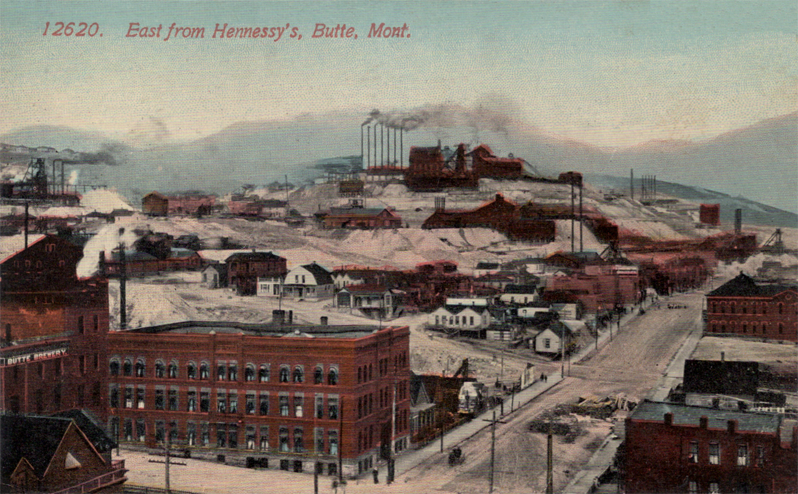
Butte, Montana, c1910
Plot. The stories of the novel’s several characters interweave. What lies at the center of them is a portrayal of monumental avarice that feeds the appetites of a few and leaves a host of others hungry. There are a lot of ways to take an attitude toward such extreme social disparity. You can imagine what a writer like Emile Zola or Victor Hugo would do with the material. And you would end up with Les Misérables. A Dickens might give us a Bleak House.

Wheeler finds a more ironic tone. One irony is that he does not villainize the three capitalists who compete for control of this “richest hill on earth.” They are no more evil than nearly anyone else around them, just vastly cunning in their deployment of their resources, and largely unaffected by the consequences for others. Pitting three of them against each other—Clark, Marcus Daly, and Augustus Heinze, Wheeler encourages a fascination in this gladiatorial contest among titans.

Sunday, January 5, 2014

One sentence journal, Dec. 29 – Jan 4

Parking lot supervisor

Time marches on . . .


12/29, Sunday. I recommend the mindful preparation of a batch of chicken vegetable soup with Tord Gustavsen on the CD player and a winter wind gusting outside the kitchen windows as a perfect way to spend a Sunday morning.

12/30, Monday. How is it, I keep wondering, that a blogger friend in Switzerland, who hardly knows English, knows ten times what I do about American pop culture?

12/31, Tuesday. Department of Simple Pleasures: I have rigged up lights around the house to turn themselves on and off during the evening and into the night, and it delights me that a string of them over one kitchen cupboard is already warmly glowing in the morning darkness, lighting up a corner of the room as I get up to make coffee.

1/1, Wednesday. The desert has its own bird population, and my favorite has to be the cactus wren whose rollicking call is a great greeting for the new year as I step out into the back yard, the rays of the rising sun lighting up the mountains and valley below with a golden glow.

1/2, Thursday. Under a brilliant, cloudless, sun-bright sky, a Costco parking lot supervisor, muttering and ruffling his feathers, observes as I return my shopping cart.

1/3, Friday. A new wrist brace on my left hand and an appointment on the calendar in three weeks to see a doc about what seems to be a case of carpal tunnel, I am discovering how much I have taken the gift of two fully functional hands for granted—and incidentally how hard it is to type with just one.

1/4, Saturday. Three days crossed off my new calendar, and I’m feeling the new year already beginning to slip away.


Image credits: Ron Scheer

Coming up: Richard Wheeler, The Richest Hill on Earth

Saturday, January 4, 2014

Glossary of frontier fiction: G
( gold cure – “The Gypsy Countess”)


Below is a list of mostly forgotten terms, people, and the occasional song, drawn from a reading of frontier fiction, 1880–1915. Each week a new list, progressing through the alphabet, “from A to Izzard.”


gold cure = treatment of alcoholism consisting of hypodermic injections of strychnine and atropine, the solution being gold in color; also “jag cure.” “I took my friend Major Hampton’s advice, availed myself of the gold cure at his expense, an’ by the great horn spoon, I’ll never drink nary another drop.” Willis George Emerson, Buell Hampton.

gold tip = cigarette holder. “They out with their gold tips after lunch, and maybe you think they don’t know how.” Gertrude Atherton, Perch of the Devil.

golden glow = a tall plant cultivated for its large, yellow double flower heads. “He’d better screen the fence with golden glow, set out pretty thick the whole way, between the nasturtiums and the fence.” Samuel Merwin, The Road-Builders.

golondrina = a poisonous weed native to the Southwest; used formerly to treat rattlesnake bite. “The little pinto one had died of a rattlesnake bite, from which no golondrina weed had been able to save it.” Gwendolen Overton, The Heritage of Unrest.

gomme / gum = a sugar syrup with gum arabic as an emulsifier used in many classic cocktails. “You’ll get your death-a-cold if you stand round soaked like that. Two whiskey and gum, Joe.” Frank Norris, McTeague.

Thursday, January 2, 2014

Lee Hoffman, The Valdez Horses (1967)


A warning should come with this western novel: “May Break Your Heart.” Hoffman lets the bittersweet sadness of her story creep up on you unsuspected for the length of this short novel rather like Jack Schaefer’s Shane (1949). In a similar narrative device, Hoffman has her story told by an older man remembering an episode from his youth. The boy, Jamie Wagner, is a teenager looking for work when he comes upon the horse ranch of Chino Valdez, a reclusive man of few words.

Plot. Chino does not welcome the boy and has no job for him, but he does not object much as one day leads to the next and Jamie stays on. He does whatever chores he can find to do and watches Chino with his horses. Eventually, he stays for good, and much of the novel is simply about the slow, slow building of a relationship between the two.

Wednesday, January 1, 2014

The year in snapshots


Somehow another year has flown by. Here’s a glance back at mine before charging ahead into 2014.

January. Day trip to Los Angeles; a stop at Starbucks in Union Station.

February. An early spring day at Whitewater Conservancy.

Tuesday, December 31, 2013

Top 10 westerns for 2013


Here in no particular order are the best of the westerns reviewed at BITS in the last year. (Click through on the titles to read the complete reviews.)

Preview audiences reportedly were roused by such strong reactions to this film that many left the theater in protest. Sam Peckinpah’s The Wild Bunch immediately won a reputation for its graphic violence. Because of or in spite of that, it quickly found a place on most western fans’ top 10 list. Over 40 years later, it remains a powerful and absorbing story.

There’s an elegiac tone to this story of aging cowboys. The glory days are over for the men who used to ride the open ranges, and now they are hanging on to whatever work they can find in a shrinking rural economy. Distant corporate owners make the decisions about how the ranches are run. What used to be “money” is now “capital.”

Steve McQueen starred in this rambling movie set mostly in the West. Its central character goes by different names until almost the end, when he calls himself “Nevada Smith.” The film was a prequel, based on a character in Harold Robbins’ 1961 potboiler, The Carpetbaggers. That novel had been made into a film in 1964, the character of Nevada Smith played by Alan Ladd  as a Tom Mix-style cowboy actor.

Monday, December 30, 2013

Top 10 recent frontier fiction for 2013


While a chief interest here at BITS continues to be early and mid-century frontier fiction, we also enjoy following recent developments in the genre. Below is a listing in no particular order of ten novels and short story collections that got thumbs up during 2013. (Click through on the titles to the complete reviews.)


This collection of western stories from David Cranmer’s Beat to a Pulp imprint is a welcome addition of new short fiction to the genre. As followers of his online zine already know, Cranmer has a fine eye and ear for picking writers with a gift for storytelling.

This is a heckuva western novel that more than lives up to its unusual title. Mitten knows the conventions of the genre and then turns them inside out to create a sprawling narrative that ranges all over the state of Colorado. The cast of characters includes working cowboys, the worthy citizens of several Rocky Mountain settlements, and the members of an outlaw gang.

Published in 2001, this novel captures something of the sobering mood of that year. It’s about life and death and choices with unexpected consequences. Not really a story, it’s a character study of a young man emotionally marked by wartime atrocity. A Union soldier, still in his teens, he is witness to a clumsy and ghastly execution by hanging.