Sunday, January 12, 2014

One sentence journal, Jan 5 – 11


Jerk Alert
Time marches on . . .


1/5, Sunday. So I sit up watching CBGB last night, and today I’ve got the Talking Heads singing “This ain’t no party, this ain’t no disco, this ain’t no fooling around” repeating in my head.

1/6, Monday. A walk around the neighborhood unleashes an unending chorus of dogs barking from yards and houses, each setting off the next like falling pins or block-long strings of firecrackers.

1/7, Tuesday. Thanks to whoever and wherever I was on January 1, 1988, when I mixed a cassette tape called “Uppers,” which I put in the player today and discovered it was clips from old comedy albums by Woody Allen, Bill Cosby, Groucho Marx, Lily Tomlin, and Steven Wright.

1/8, Wednesday. Gratitude Department: On a walk today in Palm Springs, making breezy laps around the Wellness Park, we are gratefully reminded of a similar outing a year ago using a walker and still deep in the oh-so-slow recovery process following spinal surgery.

1/9, Thursday. With my left arm half-numb and half-useless with a wrist brace, my usual clumsiness has increased by a factor of at least 10, and I am giving up thoughts for now of growing old gracefully.

1/10, Friday. Not given much to rants, I would sure as hell anyway like to see the recycling truck dump a full load in the front yards of the don’t-give-a-damn jerks who discard their old TVs and furniture in the desert.

1/11, Saturday. Finishing up draft 6 of the book on early frontier fiction I’ve been writing, after deciding a couple months ago (with the help of a candid reader) that draft 5 needed a major overhaul, and in a day or two it’s off to an editor.


Last week: Dec 29- Jan 4

Image credits: Ron Scheer

Coming up: Ben Bridges, Draw Down the Lightning

Saturday, January 11, 2014

Glossary of frontier fiction: H
(habit – hickory shirt)


Below is a list of mostly forgotten terms, people, and the occasional song, drawn from a reading of frontier fiction, 1880–1915. Each week a new list, progressing through the alphabet, “from A to Izzard.”


habit = a costume designed to be worn by a woman on horseback; riding-habit. “You’re not going to try to ride Ginger in a habit!” William Lacey Amy, The Blue Wolf.

Woman in riding habit
habitaw = a backwoods dweller, e.g. trapper, hunter (French, habitant). “Why, she’s hotter now ’n Billy Buell got last October when that loony haibtaw cook o’ ourn made up all our marmalade and currant jelly into pies.” Edgar Beecher Bronson, The Red-Blooded.

hackle = an instrument with steel pins used to comb out flax or hemp. “Upon either thigh he had countless scars, as though he had been whipped with a flax hackle.” Cy Warman, Frontier Stories.

hair brand = a brand made by burning the hair but not the hide. “You ponder on that and get it fixed proper in you—no hair-brand—but plumb well in.” Frederick Niven, Hands Up!

hair mattress = a beard. “Have you seen that there feller up ’t the casa? Him with the hair mattress on his face?” Adeline Knapp, The Well in the Desert.

Hair wreath, 1800s
hair wreath = decorative wreath made from the hair of dead and/or living people. “And I suppose there is a hair wreath and perhaps some worsted flowers in deep frames on the wall.” Mary Etta Stickney, Brown of Lost River.

hairpin = a fool, simpleton. “I’m my own boss, as I say, and I’m goin’ to stay my own boss if I have to live on crackers an’ wheat coffee to do it; that’s the kind of hair-pin I am.” Hamlin Garland, Main-Travelled Roads.

half-calf = leather book binding. “He waved a hand at the formidable rows of half-calf and circuit bindings in his bookcase.” A. M. Chisholm, Desert Conquest.

half-hitch = a knot made by passing the end of a rope around the rope and then through the loop thus made. “All the time Llano had been throwing half-hitches of his rope at the flying hoof.” Edgar Beecher Bronson, Reminiscences of a Ranchman.

Half hitch knot
half-seas over = drunk, intoxicated, inebriated. “Tryon came down a few minutes ago, considerably more than half-seas over, and said he was ready to take his engine and the first section of the east-bound midnight—which would have been his regular run.” Francis Lynde, The Taming of Red Butte Western.

halo = Chinook jargon for no, not. “Halo cuss word—no bad word—no. D-a-m, ‘dam’.” A. M. Chisholm, Desert Conquest.

Thursday, January 9, 2014

Elmore Leonard, Hombre (1961)


After the muddled The Bounty Hunters (1953), Elmore Leonard’s skill as a novelist took a quantum leap forward with this novel. Hombre is a tense western thriller that is also a fascinating study of an enigmatic character. That character is John Russell, the “hombre” of the title.

The story is set, like other Leonard novels, in southern Arizona. The year is 1884. A stagecoach is held up by road agents, and all the passengers are set afoot in the desert. The robbery doesn’t go quite as planned, and the passengers are able to retrieve a saddlebag full of money. They strike off across the desert, pursued at some distance by the thieves, who have taken a woman hostage.

Character. Russell is a young white man raised during his boyhood by Apaches. The narrator, one of the passengers, believes he is three-quarters white and one-quarter Mexican. There is about him a coolly calculating mentality that often puts him at odds with the other passengers. However, he has superior survival skills, and though he seems indifferent to them, the urge is strong to stick with him.

The premise of the plot is brilliant in its simplicity. Yet there is a complicity of cross-purposes among the handful of characters that allows several stories to be told at once. For starters, if they stay together, do they let Russell make all the decisions? Then does survival depend on confronting their pursuers or running and hiding?

Tuesday, January 7, 2014

Zen (2011)


Bit of a departure today, this is a review of the BBC series Zen, with Rufus Sewell as Italian police detective Aurelio Zen. The character is based on the novels of British crime fiction writer, Michael Dibdin. Unaware of the existence of this series, we came upon it at amazon, where it and countless other movies and TV shows are streamable free with amazon’s Prime service.

The series is set in modern-day Rome, where Sewell’s Zen is, one gathers, nearly the only resident not guilty of some crime, whether petty or capital. Merely by having a reputation for rectitude, he gets reluctantly involved by high placed government officials in cases of murder and kidnapping. And there’s always more at stake than simply solving the crime. Typically, he is being pressured to achieve results that are at complete cross purposes with each other, with his own life and career on the line no matter how things turn out.

Meanwhile, his personal life is nothing to brag about. He and his wife are separated and headed for divorce. Like the stereotypical Italian male, he lives with his mother. A leggy and stunning colleague (Caterina Marino), another casualty of marriage Italian style, has her eye on Zen. Almost diffident, he lets her make all the seductive moves.

Monday, January 6, 2014

Richard S. Wheeler, The Richest Hill on Earth


Review and interview

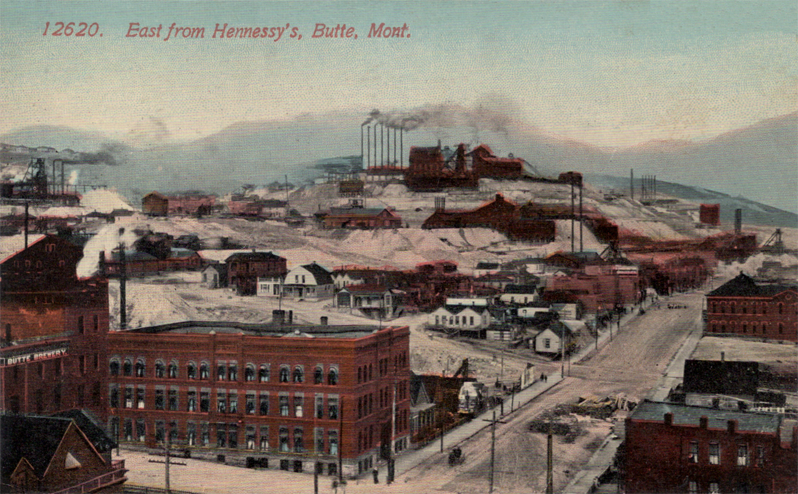
This is a novel for every reader who wanted Deadwood to go on indefinitely. In The Richest Hill on Earth, Montana writer Richard Wheeler turns his particular storytelling skills to an account of the copper mining town, Butte, at the turn of the last century. Here there are familiar names: William Andrews Clark and the other copper kings as they dig fabulous fortunes from a mountain slope near the Continental Divide. And there are the many who do the digging, as well as those scratching out a living above ground.

Besides the widow of an Irish miner and a woman with second sight, Wheeler’s novel follows an ambitious newspaperman and an enterprising mortician. There are also glancing appearances by a cop on the beat, a miner dying of consumption, a union boss, a woman on the hunt for a wealthy husband, and the residents of the red light district. Meanwhile, the bustling and rapidly growing town is a blighted, noisy, toxic environment, the often-wintry air laden with arsenic.

Butte, Montana, c1910
Plot. The stories of the novel’s several characters interweave. What lies at the center of them is a portrayal of monumental avarice that feeds the appetites of a few and leaves a host of others hungry. There are a lot of ways to take an attitude toward such extreme social disparity. You can imagine what a writer like Emile Zola or Victor Hugo would do with the material. And you would end up with Les Misérables. A Dickens might give us a Bleak House.

Wheeler finds a more ironic tone. One irony is that he does not villainize the three capitalists who compete for control of this “richest hill on earth.” They are no more evil than nearly anyone else around them, just vastly cunning in their deployment of their resources, and largely unaffected by the consequences for others. Pitting three of them against each other—Clark, Marcus Daly, and Augustus Heinze, Wheeler encourages a fascination in this gladiatorial contest among titans.

Sunday, January 5, 2014

One sentence journal, Dec. 29 – Jan 4

Parking lot supervisor

Time marches on . . .


12/29, Sunday. I recommend the mindful preparation of a batch of chicken vegetable soup with Tord Gustavsen on the CD player and a winter wind gusting outside the kitchen windows as a perfect way to spend a Sunday morning.

12/30, Monday. How is it, I keep wondering, that a blogger friend in Switzerland, who hardly knows English, knows ten times what I do about American pop culture?

12/31, Tuesday. Department of Simple Pleasures: I have rigged up lights around the house to turn themselves on and off during the evening and into the night, and it delights me that a string of them over one kitchen cupboard is already warmly glowing in the morning darkness, lighting up a corner of the room as I get up to make coffee.

1/1, Wednesday. The desert has its own bird population, and my favorite has to be the cactus wren whose rollicking call is a great greeting for the new year as I step out into the back yard, the rays of the rising sun lighting up the mountains and valley below with a golden glow.

1/2, Thursday. Under a brilliant, cloudless, sun-bright sky, a Costco parking lot supervisor, muttering and ruffling his feathers, observes as I return my shopping cart.

1/3, Friday. A new wrist brace on my left hand and an appointment on the calendar in three weeks to see a doc about what seems to be a case of carpal tunnel, I am discovering how much I have taken the gift of two fully functional hands for granted—and incidentally how hard it is to type with just one.

1/4, Saturday. Three days crossed off my new calendar, and I’m feeling the new year already beginning to slip away.


Image credits: Ron Scheer

Coming up: Richard Wheeler, The Richest Hill on Earth

Saturday, January 4, 2014

Glossary of frontier fiction: G
( gold cure – “The Gypsy Countess”)


Below is a list of mostly forgotten terms, people, and the occasional song, drawn from a reading of frontier fiction, 1880–1915. Each week a new list, progressing through the alphabet, “from A to Izzard.”


gold cure = treatment of alcoholism consisting of hypodermic injections of strychnine and atropine, the solution being gold in color; also “jag cure.” “I took my friend Major Hampton’s advice, availed myself of the gold cure at his expense, an’ by the great horn spoon, I’ll never drink nary another drop.” Willis George Emerson, Buell Hampton.

gold tip = cigarette holder. “They out with their gold tips after lunch, and maybe you think they don’t know how.” Gertrude Atherton, Perch of the Devil.

golden glow = a tall plant cultivated for its large, yellow double flower heads. “He’d better screen the fence with golden glow, set out pretty thick the whole way, between the nasturtiums and the fence.” Samuel Merwin, The Road-Builders.

golondrina = a poisonous weed native to the Southwest; used formerly to treat rattlesnake bite. “The little pinto one had died of a rattlesnake bite, from which no golondrina weed had been able to save it.” Gwendolen Overton, The Heritage of Unrest.

gomme / gum = a sugar syrup with gum arabic as an emulsifier used in many classic cocktails. “You’ll get your death-a-cold if you stand round soaked like that. Two whiskey and gum, Joe.” Frank Norris, McTeague.