Friday, November 4, 2011
Photo-finish Friday: out and about
Two pics today. Above is a flight of steps leading from Fifth Street in downtown Los Angeles to the top of what was once the city's wealthiest neighborhood, Bunker Hill. In decline after WWI, its Victorian era houses were subdivided into multi-family residences and by mid-century it was a neglected, low-rent area. To get a glimpse of it back then, watch the documentary-style movie The Exiles made by a USC film student in 1961 (an interesting film about urban Native Americans, currently available at Netflix).
Today Bunker Hill is the location of several high-rise office buildings, providing the profile of the LA skyline often seen in movies and TV series set here. Walk up those 101 steps, turn around, and you get a view of what lies below: the Los Angeles Public Library.
It's mid-morning in the pics above, but starting around noon these steps will be filled with office workers on their way for lunch. A few will be like me when I used to work near here, headed for the library to hang out with books and book-lovers.
Photo-finish Friday is the bright idea of Leah Utas over at The Goat's Lunch Pail.
Coming up: Buchanan Rides Alone (1958)
Thursday, November 3, 2011
Harold Bell Wright, The Winning of Barbara Worth (1911)
As few but historians of popular fiction will know, Harold Bell Wright (1872-1944) was once a best-selling author. Five of his novels show up on the Publishers Weekly top-ten list for the years 1910-1919. He is remembered as the first American novelist to sell a million copies of a single book and the first to make a million dollars as a writer.
Though a son of the Midwest, Wright embraced the West as both subject matter and point of view. Living in various parts of Arizona and Southern California, he enjoyed freedom and independence from restrictive Eastern values. Troubled with pulmonary illness, he found the arid Southwest conducive to his health. The desert, as he describes it, is also good for the health of the soul.
The Winning of Barbara Worth was his first hugely popular novel set in the West. Its popularity is easy in some ways to account for. It appeals to a broad audience of readers concerned about core moral and ethical issues that still have a following today. Wright decries the corrupting influence of greed and adopts a Golden Rule style of morality that believes personal gain can be had while advancing the welfare of others.
![]() |
| Finding Barbara's mother in the desert |
Plot. The central conflict in the novel is between Jefferson Worth, a small town western banker, and James Greenfield, a venture capitalist from New York. Both men are advocates of Good Business, understood as the investment of money and other resources in the making of more money.
Both are major players in a scheme to bring water from the Colorado River to a vast expanse of fertile but arid desert. The story is, in fact, a fictionalized account of the reclamation project that brought irrigation to California’s Imperial Valley in 1901. Greenfield only wants to get rich quick, with as little outlay as possible. Worth, more the visionary, risks all to make the desert a place that profits all its future inhabitants.
Caught between them is a young man, Willard Holmes, Greenfield’s adopted son and chief engineer. Holmes knows from the start that the intake from the river is cheaply constructed and vulnerable to floods. Bound by his loyalty to the company, he says nothing when told to keep his mouth shut. Aware of Greenfield’s devious efforts to drive Worth into bankruptcy, he says nothing of that either.
Labels:
book review,
california,
western fiction,
western writers
Tuesday, November 1, 2011
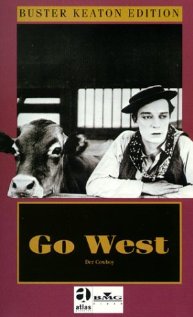
Go West (1925)
The western gets tweaked in this silent comedy from Buster Keaton. Instead of a horse or a sweetheart, Buster becomes attached to a Jersey cow (played by “Brown Eyes,” a distant relative of Elsie the Borden cow), who follows him through a series of deadpan adventures.
Following Horace Greeley’s advice to “Go West,” Buster hops a boxcar full of barrels and is deposited sometime later in the midst of sand and sagebrush. Soon he is employed at a cattle ranch, where he is put in charge of the milking. Placing a bucket under a cow’s udder and waiting for the milk to flow, he’s puzzled when he doesn’t get results. When he tries to ride a large mule without cinching the saddle, the outcome is predictable.
He somehow arrives at the supper table each day just as the meal is over. In a card game with two cowpokes he objects to a deal from the bottom of the deck. The dealer’s response is to “smile when you call me that.” Pistols are drawn, but Buster’s is so small it falls to the bottom of his holster.
There’s plenty of real gunplay when the cowboys from another ranch attempt to stop a train full of cattle from getting to market. Buster ends up alone on the train, headed for Los Angeles with all the cows.
A long, inspired sequence involves Buster and his herd of cattle loose in the streets and sending citizens fleeing in all directions. Firefighters somehow become involved, turning their fire hoses on a detachment of policemen. Finally, rounding up the cows and getting them headed to the stockyards requires the wearing of a red devil’s costume.
While a few moments of the slapstick comedy are forced, much of the film is still laugh-out-loud funny after all these years. Keaton, who seems to have taken all his own pratfalls, blows, and spills, must have been black and blue after a day’s shooting. His rough humor and blank expressions actually wear better with time than Chaplin’s comic sentimentality.
Go West is currently available at netflix and amazon. Jazz musician Bill Frisell has recorded a soundtrack for the film, which is currently available at amazon. Overlooked Movies is a much-appreciated enterprise of Todd Mason over at Sweet Freedom.
Coming up: Harold Bell Wright, The Winning of Barbara Worth (1911)
Monday, October 31, 2011
Blackthorn
I wanted to like this movie, and for much of it, I did. Then it seemed to run out of ideas and lose its way. When it was over, I wondered how it might have saved itself. I’m no screenwriter, so I have no answers.
At some stage of script development, the film seems to have been about friendship. It’s the 1920s and Butch Cassidy (AKA Blackthorn) has been living peacefully alone in Bolivia on a little spread raising horses. Deciding it’s time to return home, he is joined by a young thief (Eduardo Noriega) who is on the run from a bunch of vigilantes.
An uneasy friendship grows between the two men, and Butch is visited by memories of his years of camaraderie with Sundance and Etta. Butch and his new companion each save the life of the other and eventually come to call each other friend. The movie sets up an expectation that Butch will have one last escapade with a partner in crime and pass on some kind of legacy to his young companion.
The friendship even drifts toward Brokeback Mountain territory, as Butch rubs chewing tobacco into the saddle sores on his partner’s bare backside. But as the two men separate and agree to meet later, the film puts more effort than needed into insisting it’s not gay.
About two-thirds into the story, a former Pinkerton agent (Steven Rea) learns of Butch’s continued existence and in a scene between them, the plot starts going off the rails. Rea’s character delivers a long monologue that might have been OK in a Tennessee Williams play but comes across here as a writer’s confused search for clarity.
The movie then veers away from the kind of ending it once promised, which would be OK if it came up with something better. Alas, it turns into what it hopes is a dark, ironic vision of loss and betrayal. Not that there’s anything wrong with that, but it doesn’t fit with what’s gone before. So it’s both disappointing and bewildering.
The photography and music in the film are quite good. Sam Shepard and Spanish actor Eduardo Noriega are fine, and it’s good to see Stephen Rea again. Filmed in both English and Spanish, the movie was shot on location in Bolivia. Not exactly a waste of show fare, Blackthorn has no trouble persuading us that Butch survived his apparent demise. But what it wants to do with that premise ends up being more than it’s able to deliver.
Coming up: Buster Keaton’s Go West (1925)
Saturday, October 29, 2011
Western writer inspiration, no. 9
Here is this week's omnibus of #westernwriter inspirations posted each day at twitter [click to enlarge]. If you are on twitter, you can follow me @rdscheer.
Image credits: Wikimedia Commons
Coming up: Buster Keaton's Go West (1925)
| Cattle drive, Deep Springs College, Big Pine, Californa |
| Loops and Horses are Surer Than Lead. Charles Russell, 1916 |
| Crowley P. Dake, U.S Marshal, Arizona Territory (1878-1882) |
| Calgary Stampede parade, 1923 |
| Throwing a cow. Palo Duro, Texas |
| Cowboys around the chuck wagon, Belle Fourche, Dakota Territory, 1887 |
| The original Hopalong Cassidy, Frank Earle Schoonover, 1905 |
Image credits: Wikimedia Commons
Coming up: Buster Keaton's Go West (1925)
Labels:
charles russell,
cowboys,
western writer inspiration
Friday, October 28, 2011
Photo-finish Friday: out and about
There's a big dance club with a Spanish-speaking clientele in my neighborhood. Out front is this sign listing the house rules in Spanish, with an English translation. For fiction writers with a ready imagination, they offer a wide variety of plot possibilities.
Photo-finish Friday is the bright idea of Leah Utas, over at The Goat's Lunchpail.
Coming up: Buster Keaton's Go West (1925)
Thursday, October 27, 2011
Tom McNeal, Goodnight, Nebraska (1998)
In observance of turning 70 today, I'm reviewing a book from my home state, Nebraska, set in my favorite part of it, the treeless, rolling terrain of the Panhandle. The Goodnight of the title is a small town, surrounded by the uncompromising harsh beauty of the landscape, where the characters' lives depend much on the ability to withstand solitude and isolation.
Randall, the young protagonist, contracts into a self-protective stoniness as he fetches up here on his own like a shipwreck victim. Marcy, the girl who becomes his sweetheart, strives for a hard-won personal independence from her hard-working farmer parents. The teenage couple's late-night lovemaking and eventual marriage are an against-all-odds attempt to keep from being swallowed up by the indifference of the natural world and the conventional expectations of their small-town world.
Given the explosiveness of young Randall's character, his insensitiviy, and his distrust of others, it's a welcome surprise when he grows to steady and responsible manhood. So is his loyalty to Marcy and his willingness to regard her as an equal in love and marriage. He even agrees to her leaving him for an adventure of her own in California. Her discovery of him asleep in his pickup, parked in the driveway at her apartment house, the smell of rural Nebraska still filling the cab, is a wonderful portrayal of the bond that holds them together.
Another long sequence in the novel describes a hunting party that grows progressively unnerving, as the more trigger-happy in the group get steadily drunker and more frustrated at the lack of game. There is an ominous threat of trouble as you follow them, page after page, and eventually learn of the dark deeds of the day.
Tom McNeal's Goodnight, Nebraska is currently available at amazon, AbeBooks, alibris, and Powell's Books, and for kindle and the nook. Friday's Forgotten Books is the bright idea of Patti Abbott over at pattinase.
Coming up: Buster Keaton's Go West (1925)
Subscribe to:
Posts (Atom)