Showing posts with label cowboys. Show all posts

Thursday, October 23, 2014

Andy Adams, Campfire Tales

William H. Hudson collected these 51 stories told by cowboys around the evening campfires in four books by Andy Adams (1859-1935): The Log of a Cowboy (1903), A Texas Matchmaker (1904), The Outlet (1905), and Cattle Brands (1906). 

By the rules of trail drive storytelling, they are factual, as actually happened, and without exaggeration. Storytellers were not allowed to be boastful or to be interrupted.

The collection makes for an entertaining read, as subject matter ranges over all sorts of topics, and stories are told with a certain cowboy attitude that brings them to colorful life.

Andy Adams, 1904
Among a few of my own favorites: 1) an account of a marathon of “bear sign” (i.e., doughnut) making, 2) Bat Masterson supervising a fractious crowd gathered for a public speaking event, 3) a case brought before Judge Roy Bean, 4) an explanation for why the Chisholm Trail forks as told to a gullible new man, and 5) a dispute between a disagreeable trail boss and his riders over the count of a herd.

First published in 1956 by the University of Texas Press, Andy Adams’ Campfire Tales was reissued in 1976 by the University of Nebraska Press, with an expanded and informative introduction. The book is currently available at amazon, Barnes&Noble, and AbeBooks. For more of Friday’s Forgotten Books, click on over to Patti Abbott’s blog.

Further reading/viewing:
BITS review, Andy Adams, The Outlet, Part 1, Part 2

Image credits: Adams’ photo, The Critic, 1904

Coming up: TBD


Thursday, April 3, 2014

Video: Read the book

While waiting to get up to speed with Dragon Dictate, it came to me I might try converting this to a video blog for a while. So today is kind of a trial run.

When I was teaching Advanced Writing to university students, I had a Call to Action unit, in which they had to take what they'd learned from their research all term, find an issue in need of attention, and make a short call-to-action video. As I did all my assignments along with them, I did this one, too.

I'm reviving it here for followers at BITS, who might crack a smile at my amateur movie-making efforts. And while you may not agree completely with my argument, remember that we are not just lovers of westerns. We love books, too.


Image credits: Wikimedia Commons

Coming up: Glossary of frontier fiction

Thursday, February 27, 2014

Dane Coolidge, The Texican (1911)


This early cowboy western is a rollicking political satire, the likes of which a reader would find difficult to duplicate in a western novel today. The Texican of the title is a freelance cattle rustler, Pecos Dalhart, who fetches up in Arizona, where he gets involved in a feud between two rival cattlemen, Ike Crittendon and John Upton.

Plot and character. Crittendon hires Pecos to alter the brands on any of Upton’s cattle he finds on the range. Meanwhile, the local sheriff, Boone Morgan, is alert to any signs of cattle theft, and when Crittendon falsely accuses Pecos of stealing a cow, he gets hauled in to the county jail, to await trial.

Pecos draws his pistol
Pecos, as Dane Coolidge describes him, was “born a Democrat and taught to love whiskey and hate Mexicans.” However, he has begun reading an anti-capitalist newspaper, The Voice of Reason, which has opened his eyes to the corrupt law enforcement system used by the rich to oppress the poor. Sheriff Morgan soon learns he has incarcerated an outspoken advocate of revolution.

Cracking heads, Pecos immediately overturns Morgan’s use of a prisoner-run kangaroo court for maintaining order in the jail. Joined by a friend and fellow revolutionary, Angevine “Babe” Thorne (jailed for drunk and disorderly), and winning the respect and protection of the Mexican prisoners, Pecos takes charge behind bars. He is soon getting preferred treatment from Hung Wo, provider of the jail’s meal service. 

Monday, December 16, 2013

Alfred Wallon, Showdown in Abilene


Review and interview

Originally published in 1981—in German—Showdown in Abilene was the first novella in Alfred Wallon’s Rio Concho series. Published now for the first time in English by Piccadilly Publishing, it’s in many ways a love letter to the American West.

Plot. With an abbreviated story that could well fit neatly into a one-hour TV western episode, Wallon introduces readers to a trail boss, Jay Durango, and his crew of cowboys. They have just arrived in Abilene, Kansas, after a summer-long cattle drive from Texas.

Encouraged to have a good time in town by the marshal, Bear River Tom Smith, but to stay out of trouble, the cowboys make an attempt to comply. But under the influence of too much alcohol, they cause a disturbance at the Opera House. Before long, they’re cooling off in jail.

More serious trouble is in store for Jay Durango. A pair of villains abduct him and hope to leave him dead in a shadowy corner of the red light district. Arson figures in to further plans for a bank robbery while a section of town burns. Bullets finally fly proving once again that crime rarely pays.

Railway, Abilene, Kansas, c1867
Pleasures of the text. There are many things to enjoy about the story and the storytelling. In Wallon’s hands a reader senses the pleasure of spinning a yarn from the familiar elements of the material. His characters are not only full of life. They are sketched in with hints of backstory that make you curious about them.

Durango, for instance, has what seem to be troubled memories of soldiering for the Confederacy. Returning to Texas, he’s in hopes of a new beginning. Billy Calhoun, the young son of the rancher he works for, was for two years abducted by Quanah Parker’s Comanches. He rankles at Durango’s attempts to supervise him. There’s even brief reference to a black cowboy, Bob Rennington.

Tuesday, October 8, 2013

Cowboys in early frontier fiction


Cowboy, 1898
The cowboy western originated with the dime novels of the nineteenth century. These were exaggerated tales of adventure in the Wild West. But when did cowboys first appear in mainstream popular fiction?

Vaqueros. In early examples, set in California, they appear as vaqueros, and remind us that the actual horsemen who herded cattle in the frontier West were itinerant agricultural laborers. In Maria Amparo Ruiz de Burton’s The Squatter and the Don (1885), a californio ranch owner has vaqueros among his employees. They figure into the plot as a herd of cattle are driven through a winter storm in the mountains above San Diego. 

A foil to the central character of Gertrude Atherton’s Los Cerritos (1890), Carlos Castro is the chief vaquero at a neighboring ranch. He is a burly giant of a man, so full of energy he is like a volcano waiting to erupt. His comrades adore him for his “enormous vitality” and his “rude magnetism.” Though a horse thief, he is always acquitted of any crime. He is opposed to americanos moving onto California rangeland, picks a fight with and grievously wounds one of them, and sets fire to his ranch.

Ranch hands. English-speaking cowboys make an early appearance in Charles King’s Dunraven Ranch (1890). They are employed on a mysterious ranch located near a cavalry outpost in Texas. Eager to solve the mystery, a young lieutenant pays a call with several troopers, who are of Irish descent. The visit develops into a donnybrook between the cavalrymen and the ranch hands, who are English.

Three ranch hands are minor characters in Marah Ellis Ryan’s Told in the Hills (1890), set in western Montana. Jim the youngest is an innocent, who gets excited when the cavalry arrives to set up camp near the ranch. Another, Andrews, is occasionally sent to the nearest settlement for the mail, but tends to stay overlong and come home drunk.

Cowboys are a “wild combustible element” in Arthur Paterson’s A Better Man (1890). They gather in numbers in the saloon of a New Mexico frontier settlement. Some are given to drunkenness and insulting women. The novel’s central character, a rancher, assembles a small army of them to ride all day and night to rescue an innocent man, who has been found guilty in a hurried trial and sentenced to be hanged.

Cowboys. Owen Wister may have popularized the cowboy, but in his early western stories written for Harper’s and collected in Red Men and White (1896), they are dubious characters. Two crop up in “A Pilgrim on the Gila.” The story’s narrator learns that one of them is avoiding a woman who is two months shy of claiming him as a common-law husband. Later, the two cowboys are among a dozen road agents who hold up an army paymaster and make off with the strongbox.

The Great K&A Train Robbery
The cowboys in Paul Leicester Ford’s The Great K&A Train Robbery (1897) talk in stereotypical lingo. Asked if he is carrying a weapon, one responds, “Do I chaw terbaccy?” Threatening another man, one calls him a “stinkin’ coyote” and tells him to stay put “or I’ll blow yer so full of lead that yer couldn’t float in Salt Lake.”

Colorful, yes, also ungovernable and potentially dangerous. They are frequenters of saloons, eager to accept a wild rumor as fact, and quick to rush a suspected wrongdoer to justice. Believing the young hero of the novel to be a train robber, they try to lynch him from a telegraph pole.

Cowboys of a similar stripe appear in two of Cy Warman’s Frontier Stories (1897). Given to gunplay and playful troublemaking, they can easily find themselves on the wrong side of the law. In one of them, several cowboys play a trick on a band of Indian cattle thieves. Finding the cremated remains of one of them, they leave a handwritten curse in the man’s skull that frightens the thieves away.

Warman’s “A Cowboy’s Funeral” starts out with some hijinks of a half-dozen cowboys, who have ridden 200 miles to a town in Utah to mail a letter. They get drunk and start firing their pistols until a bystander is accidentally shot and killed. They make a hasty retreat into the desert, but when the sheriff gives chase, one of them is shot dead.

When the cowboys put enough distance between themselves and the law, they stop and make camp. There they pass the bottle before eventually putting the dead man into a grave. One cowboy leads them in a version of “The Streets of Laredo,” which the narrator describes as “plaintive and pleading—a sort of mixture of negro minstrel and the old time Methodist revival song.”

Wednesday, March 27, 2013

Cowboy names, no. 3


Hairoil Johnson
Lately I have posted a couple lists of cowboy names from the early westerns I have been reading. Here is the last set of them for now. My favorite out of this bunch is Eleanor Gates’ cowboy, Hairoil Johnson.

Henry Wallace Phillips, Red Saunders
Wind River Smith
Agamemnon G. Jones
Cock-Eyed Peterson
Bronc Thompson

Eleanor Gates, Alec Lloyd, Cowpuncher
Hairoil Johnson
Buckshot Milliken
Monkey Mike
Skinflint Curry
Chub Flannagan

G. Frank Lydston, Poker Jim, Gentleman
Three-Fingered Jack
Tennessee Dick

Dennis H. Stovall, The Gold Bug Story Book
Shorty Sanders
Faro Fett
Eucher Buck
Spanish Fly
Buck Tyson
Pegleg Jim

Edgar Beecher Bronson, Reminiscences of a Ranchman
Llano Lew
Tobacco Jake

Edgar Beecher Bronson, The Red-Blooded
Lee Skeets
Racketty Smith
Mancos Mitch
Lame Johnny
Bill Ball
Chillili Jim
Tit Moody

Pauline Wilson Worth, Death Valley Slim and Other Stories
Shorty Rogers

Charles G. Roberts, The Backwoodsmen
Bird Pigeon

Samuel Merwin, The Road-Builders
Purple Finn

Robert Alexander Wason, Happy Hawkins
Happy Hawkins
Cast Steel Judson
Tank Williams
Slinky Bill
Buck Harmon

Charles Alden Seltzer, The Two-Gun Man
Roper Jones
Wrinkles
Skinny
Lazy
Soapy

Max Brand, The Untamed
Whistling Dan
Jim Silent

If you missed the other lists, they can be found here and here.


Image credits:
Hairoil Johnson, illustrator, George Gibbs

Coming up: Robert Ames Bennet, Out of the Depths (1913)

Wednesday, March 13, 2013

Cowboy names, no. 2


Roger Pocock, Curly, 1904
A week or so ago, I posted a bunch of the names of cowboy characters I've been collecting. They are all from the early westerns I'm reading. They got such a big response from readers, I'm offering some more today. A few this time, like Gumboot Annie, a saloon keeper, are from other walks of life.

Roger Pocock, Curly
Low-Lived Joe
Alabama Kid
Beef Jones
Thimble-Rig Phipps
Pincushion Shorty
Cranky Joe
Mutiny Robertson
Cocky Brown
Lying Ike
Bowlegs
Doc
Crazy Hoss
Black Stanley
Texas Bob
Dog-gone Hawkins
Pieface

Frederick Niven, Hands Up!
Yuma Bill
Panamint Pete
Merry Mike
Bucket Bill

Alice and Grace MacGowan, Aunt Huldah
Eldom Bayliss
Roach Porterman
Kid Barringer
Lengthy Malone
Lon Prendergast
Bunt Tarver
Bige Kervis
Long Forbes
Kansas Charlie
Billy Bascom

Marie Manning, Judith of the Plains
Joplin Joe

Lewis B. France, Pine Valley
Shanghai Dickson
Baltimore Hatch
Champagne Terrant

Marguerite Merington, Scarlett of the Mounted
Chilkat Jo
Dandy Raish
Bully Nick
Gumboot Annie
Lucky Durant

Herman Whitaker, The Settler
Carrots Smith
Michigan Red


Image credit:
Illustration by Stanley L. Wood from Roger Pocock's Curly 

Coming up: Max Brand, The Untamed (1919)

Friday, March 1, 2013

Robert Alexander Wason, Happy Hawkins (1909)


This rambling novel is narrated by a cowboy working on and off at a ranch called the Diamond Dot, somewhere in Wyoming. A foreman for the ranch owner, Jabez “Cast Steel” Judson, he spends most of his time as a companion for Judson’s daughter, Barbie. At the start of the novel, she is six years old, and at novel’s end she is grown up and married.

During those dozen or so years, Happy leaves the ranch for long periods of time, working on other ranches or traveling about. He spends two winters as watchman at a mining camp. In San Francisco, he takes a job handing out free samples of chewing tobacco.

Plot. There are several stories in the novel. One of them is a log of Happy’s picaresque wandering and adventures. Two others are mysteries that Happy eventually solves as he comes across clues during his travels.  One of these has to do with Barbie’s parentage and a dispute over either a woman or a silver mine called the Creole Belle.

Happy Hawkins
The other concerns two brothers who have come from England to America, their whereabouts now unknown. Depending on which of them is still living, one of them is heir to a title and family estate back home. In the end, the two mysteries converge. And we discover that we have known at least three of the characters involved in them, living with their secrets and under assumed names.

Romance. A fourth story weaving through all the others is a love story—really a love triangle, with Barbie at the center. As she grows into a young woman, the friendship between Happy and her evolves from affection to ever deeper affection. In time, he realizes that he loves her.

But she falls head over heels for a younger man, Dick, whom her father hires as manager of the Diamond Dot. Then a game of cards with a visitor to the ranch turns abruptly menacing, and Dick is revealed as a gambler with a bad reputation. After an exchange of gunfire, he flees and Barbie is left with a broken heart.

A dispute over a game of cards
Eventually, a neighboring rancher woos her, and with the encouragement of her father, she agrees to marry the man. But Happy can see that, in her heart, she still yearns for her absent lover, who by report turns out to be married to a woman he keeps in Laramie.

On the day of the wedding, even as the bride and groom are about to take their vows, Dick reappears to stop the ceremony. The woman in Laramie is not his wife but the sweetheart of a dead friend. Not only that. She is Barbie’s long lost mother. The wedding resumes, with a quick change of grooms, and Barbie and Dick live happily ever after.

Yet it’s a melancholy resolution to this strand of plot, since it leaves Happy alone and empty handed. He and Barbie have confessed their feelings for each other, but he knows well enough that he would always have been second in her affections.

Barbie
Women. Barbie is a character found in several early western novels. She is fiercely independent and outspoken. She can ride and rope like a man, and she has the undying devotion of every cowboy who works for her father. She has been gifted with superior intelligence, hates school because book learning is too easy, and is forever at odds with her teachers.

Growing up, she refuses to wear skirts and wishes she’d been born a boy. It takes uncommon persuasion to get her to dress and behave like a woman. This changes when her father sends her away to get a college education. But it doesn’t change her disposition, which remains flinty and argumentative, especially as her father refuses to tell her anything about her mother.

Among the novel’s various mysteries, a minor though unusual one has to do with one of the ranch’s cowboys, Monody, who turns out to be a woman. Big, ugly, and ungifted with graces, she has befriended the young Happy and often tenderly “mothered” him, so that the bond of friendship between them has grown deep.

Mortally wounded in a gun battle with horse thieves, she makes him promise to let no one undress her should she die. Keeping that promise, he prevents the doctor from examining her. Only in death does he finally understand her secret, and he continues to honor her wishes by thinking of her as a man.

A shootout with horse thieves
Structure. This episodic novel seems much like several stories that have been loosely cobbled together. The mysteries that are revealed at the end run more like a motif in the novel rather than a matter of narrative focus. They are in fact so convoluted that the clues to them are bewildering. Once explained, they are like the synopsis of another novel more extensively and thoroughly plotted than this one.

It makes more sense to think of the novel as a long character study. At the center of it is the narrator and title character, Happy Hawkins. A thoughtful man given to wandering about and having adventures, he has his opinions and points of view. With his particular sense of humor, he makes a believable and entertaining storyteller.

Monody
Wrapping up. About author Wason (1874-1955) there’s little to be found in the standard references. A biographical sketch in Who’s Who describes him as growing up in Ohio and leaving high school after one year. He is portrayed there as clerking in a general store, serving in the Army during the Spanish-American War, and tramping and “roughing it” in the West. His fiction shows an interest in moral and social philosophy, and he identified himself as a Socialist.

Wason has a half dozen or so novels to his credit and a handful of stories in the early pulps. Happy Hawkins appears in two more novels, Friar Tuck (1912), reviewed here a while ago, and Happy Hawkins in the Panhandle (1914). His last novel-length work was a science fiction serial, The Man Who Never Died, which appeared in 1915 in Bernarr Macfadden’s health and fitness magazine, Physical Culture.

Happy Hawkins is currently available online at google books and Internet Archive and for kindle and the nook. For more of Friday’s Forgotten Books, click on over to Patti Abbott’s blog.

Image credits: Illustrations from the novel by Howard Giles

Coming up: Saturday music, Tommy Edwards

Thursday, February 21, 2013

Cowboy names, no. 1


Cherokee Hall
A while ago, I got to noticing the imaginative names that early western writers give to their cowboy characters. Curious and amused, I started collecting them. None are names that were bestowed at birth. Women characters, by the way, rarely go by anything but their actual names, unless they are habitués of saloons, dancehalls, or gaming parlors.

Here are thirty or so from a half dozen authors, starting with Owen Wister himself, whose Virginian would be the best known example of a man whose given name is unknown. My favorite is Henry Herbert Knibbs’ cowboy, Bud Light.

Owen Wister, Lin McLean (1897)
Toothpick Kid
Limber Jim
The Doughie
Jerky Bill
Dollar Bill
Honey Wiggin

William MacLeod Raine, Wyoming (1908)
Beet Collins
Soapy Southern
Chalkeye Dave
Denver Halliday

Henry Herbert Knibbs, Overland Red (1912)
Bud Light
Billy Dime
Pars Long
Silent Saunders

Alfred Henry Lewis, Wolfville (1897)
Short Creek Dave
Texas Thompson
Cherokee Hall
Tucson Jennie
Faro Nell
Jaybird Bob
Rainbow Sam
Curly Bill
Doby Dawson
Mace Bowman
Piñon Bill
Crawfish Jim
Cimarron Pete
Slim Jim

Caroline Lockhart, Me—Smith (1911)
Banjo Johnson
Babe Britt
Arkansaw Red
Meeteese Ed
Old Man Rulison

Randall Parrish, Bob Hampton of Placer (1906)
Long Pete Lumley
Sandy Winn
Three-Finger Boone
Bad-Eye Connelly
Silent Murphy

Image credit:
Drawing of Cherokee Hall, Frederic Remington

Coming up: Harry Leon Wilson, The Lions of the Lord (1903)

Friday, January 11, 2013

Therese Broderick, The Brand (1909)


The Brand takes its title from a key moment in the novel’s closing chapters as Broderick’s feminist message is burned permanently into the hide of its villain. But the novel’s subtitle, A Tale of the Flathead Reservation, promises somewhat more than it delivers. Full-blooded Indians are mostly peripheral to its story of a “quarter-breed’s” forbidden love of a white woman.

Plot. Young Bess Fletcher arrives by train in Montana with her brother Jim. They are on their way to the cattle ranch of Jim’s college pal, Henry West, a fellow Harvard graduate. The ranch is on the Flathead reservation close to Polson and Flathead Lake. Jim, who has lived and worked on the ranch before, has been hired as Henry’s foreman.


Bess Fletcher
The West is all new to 20-year-old Bess, who is enraptured by its promise of “untrammeled freedom.” She will hear nothing, she says, of “don’ts and can’ts.” However, a Big Don’t governs much of the plot of the novel.

Henry West is a handsome man, well polished and a gentleman. One look at Bess, and he recognizes her as the sweetheart he has long dreamed of and yearned for. He is, alas, only three-quarters white and, for her, on the wrong side of the color line.

Meanwhile, she is being courted by David Davis, the government agent of the Flathead reservation. He is an oily and manipulative character, entirely too pushy in his seductive advances. Henry despises Davis but has a horrible secret involving the honor of his dead sister, Helen, which prevents him from speaking up about the man. We gather that Davis was the contributing cause of her death, though Broderick is not specific about the details.

Bess was schooled by convent nuns and is an innocent about affairs of the heart. She feels no real affection for Davis but is too polite to turn him away. In time, she persuades herself that he is the right man for her. But on the day of their wedding, seeing Davis for the first time, her bridesmaid recognizes him. He is the man who once seduced and abandoned her sister—which brings an abrupt end to the ceremony.

Indian farmer, Flathead Reservation, 1914
Character. An irony in the novel is that Henry is as thoroughly schooled in matters of character as any of the other men. Being an exemplary gentleman is as close as he can come to being white. At first meeting, Bess finds him “splendid,” and Jim tells her,

At college he was so superior in mind, ability, and morals to the majority of his colleagues, that every one looked up to him. He was one of them and no gathering was quite complete without Henry West.

She says to her brother, “I had no idea there were such men as he away out here in the West! No wonder you rave over him and always sing his praises.”

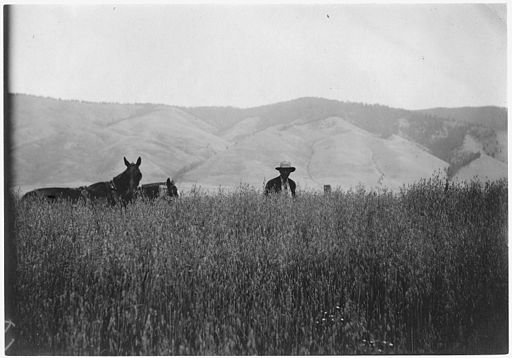
Oats field, Flathead Reservation, 1912
Villainy. Davis (or Davies as he is revealed at the end) is first and last a cad. If he is guilty of the usual corruption ascribed to government agents of Indian reservations, we get no hint of it. But we gather that he freely takes liberties with the native women. We get a sample of this when Bess has playfully dressed and made herself up as a squaw, and he mistakes her for an Indian. Altogether, he is a lesson in the employment of seductive maneuvers to weaken a woman’s resistance.

Even revealed at last for his truly evil self, he is fiercely unrepentant. We see the full extent of his cunning when he returns to take Bess by force. She has to pull a revolver on him to defend herself. He doesn’t relent until Henry drags him to the branding fires where the ranch’s brand “HW” is burned into his chest. That means “Honor Women,” Henry tells him.

Friday, September 14, 2012

Edgar Beecher Bronson, Reminiscences of a Ranchman, 1908

1910 edition
Edgar Beecher Bronson (1856-1917) was one of those larger than life writers and adventurers of the 19th and early 20th century. Born in Pennsylvania, he began as a youthful newspaper reporter for The New York Tribune. At nineteen, he was already a model of nerve and persistence. Covering the 1875 Henry Ward Beecher adultery trial in Brooklyn, he crossed the ice-covered East River on foot with his report when there was no boat to ferry him over.

Bronson was a member of that “strenuous” generation praised by Theodore Roosevelt. He anticipated TR’s interest in the West by giving up his reporter’s job and going west to cowboy and then take up ranching. This book is his memoir of that frontier adventure.

The new outfit
Cowboy to rancher. Through a connection with field geologist Clarence King, he found his way to a horse ranch in Wyoming where he endured several months as a tenderfoot among seasoned punchers. His accounts of rising to the challenge show him remarkable for his tenacity, eventually winning the respect of the other men and his employer.

Before long, he is in Texas, buying up cattle to drive north, with the intention of ranching on the plains. Still in his early twenties, he is out of his depth dealing with dishonest traders and trying to boss trail hands who resent his lack of experience and his Yankee origins.

Holding his herd in Wyoming, he is one of the first cattlemen to venture north of the North Platte River. He winters there with several of his men in a dugout near Fort Laramie. The structure is 18-feet square, with rawhide mattresses in the bed frames, a fireplace, a mountain lion skin on the floor, and tomato can cases nailed to the walls for shelves.

"Shet y'r yawp."
He has problems in Wyoming with rustlers, who take 70 or more of his cattle to Deadwood. In that wild mining camp, over 200 miles away, meat on the hoof is worth a small fortune. Catching a night coach, he is able to track down his cows and, after some hard bargaining, buy them back from a shady and threatening butcher.

By 1877, he has settled in the Nebraska panhandle, just south of Fort Robinson, hundreds of miles from any duly constituted authority. He is on his own, with 8-10 ranch hands, to keep cattle and horses on his range and out of the hands of rustlers and the Sioux.

Chief Dull Knife
Indians. With the Sioux resisting efforts to move them off their traditional lands, and Custer's recent encounter with them at the Little Big Horn, there is also the risk of retaliation. Bronson has several moments in tight spots with them when he’s fully aware that he may be breathing his last.

His understanding of the dilemma faced by the Indians makes him largely sympathetic with them. He admires their courage and ingenuity and gives a long account of Dull Knife’s breakout from Indian Territory. The tribe’s amazing trek northward defied multiple efforts of the U.S. government to intercept them. Fighting valiantly to the last in bitter winter cold, starved and scarcely clothed, they win Bronson’s unreserved respect.

Two chapters are devoted to what Bronson believes are the last Sundance ceremonies by Sioux tribes gathering at the agency near Fort Robinson. There in the spring of 1880 or 1881, he and several other whites observe days of rituals and dancing by an assembly of 10,000 Ogallala Sioux and 2,000 Brules.

Mutiny
Moving on. In 1882, at the age of 26, Bronson saw the writing on the wall. The range was getting overstocked, and homesteaders were arriving in droves. He’d had five good years and knew that staying on he chanced being wiped out by a killing winter. Against the wishes of his loyal cowhands, who were ready to take up their guns and drive the nesters out, he sells the ranch and returns east.

His last summer on the prairie finds him in Ogallala, Nebraska, at the height of its rip-roaring bad old days. There, with one hotel, 20 saloons, dancehalls, and gambling joints, all in a single row facing the railroad tracks, the town is surrounded by the herds of 12 or more trail outfits. He estimates that there are 20-30,000 cattle fresh from Texas.

The fierce, triple-digit heat gives way to a sudden storm front, which sends the temperature down 40-50 degrees F. After torrents of rain, the river floods, driving residents in the hotel to the second floor, raising fears that the whole town will be swept away. A tornado is sighted in the flashes of lightning, but it misses the town.