Showing posts with label california. Show all posts

Thursday, October 30, 2014

The Spinners’ Book of Fiction (1907)

Living in San Francisco at the time of the 1906 earthquake, Ina Coolbrith (1841–1928) lost her home and a priceless personal library in the fire that consumed the city. With her interest in the arts and her connections in both San Francisco and New York, she had helped found the Overland Monthly with Bret Harte and encouraged the careers of Jack London and Isadora Duncan among many others.

Following the quake and fire, Coolbrith's friends, including California writer Gertrude Atherton, helped out with financial support. A collection of stories, The Spinners’ Book of Fiction was published with all proceeds to go to Coolbrith. Sixteen Bay Area writers contributed to the anthology, as well as several illustrators and artists. 

Here are a few samples:

Friday, August 1, 2014

Bret Harte, Frontier Stories (1887)

Born in Albany, New York, Bret Harte (1836–1902) was not a Californian most of his life as I have long thought. He arrived there in 1853, just after the gold rush, and left again in 1871. While there, he began a writing career, publishing his best-known short stories, “The Luck of Roaring Camp” (1868) and “The Outcasts of Poker Flat” (1869). In later years, he took overseas assignments in the foreign service, and at the end of his life, he was living in England.

Frontier Stories is a collection of seven short stories and novellas, all set in the 1850s –60s, in or not far from San Francisco and the gold fields. The storytelling style owes much to literary predecessors like Robert Louis Stevenson and Walter Scott, who specialized in historical romance with an element of mystery. For me, two stories held the most interest, both of them novella-length.

“A Ship of ’49.” In this story, a French ship called the Pontiac was run aground on the muddy shore of the Bay during the excitement that flooded the settlement of San Francisco with new arrivals during the gold rush. Warehouses and commercial buildings have sprung up around it. Broken up into apartments, it is now used as rental space for tenants with various degrees of success in often dubious enterprises.

Monday, June 2, 2014

The Big Trees (1952)

Kirk Douglas once said, “I've made a career of playing sons of bitches.” The role he plays in this western is one of them.

Plot. Here he plays a lumberman in 1900 who takes advantage of a new federal law that permits him to legally jump timber claims in California. There he has his eye on the old growth giant redwoods. And nothing stands in his way but a religious community of Quakers, who regard themselves as stewards and protectors of the trees.

Spokesperson for the community is one of the faithful, a woman (Eve Miller) who attempts to persuade Douglas to harvest as much of the forest as he wants but to save the beloved sequoias. He is in no mood to make a deal until he has to fend off the schemes of determined competitors, and only then does he reluctantly come around.

Thursday, January 23, 2014

John Reese, They Don’t Shoot Cowards (1973)


In a John Reese western, nothing is likely to be what it seems. Despite a wide, well-traveled trail across the genre’s terrain, you can expect Reese to take you someplace you haven’t been before. Try guessing what this novel is about from the title, the cover art, and the cover copy (“Cahoon had a killer’s reputation and a yellow streak down his back”), and you’ll be maybe 10% right.

Characters. The premise of the novel is actually not so unusual. A man has acquired a reputation as a gunman, but has nothing of the required constitution or skill. Honker Cahoon’s is the story of an ordinary drifter cowhand trying to keep from attracting trouble. The problem is his frighteningly scarred face and a peculiar disorder—like a form of Tourrettes. When terrified, he explodes in angry outbursts so threatening that even the meanest men are intimidated.

And Reese gives his condition a further twist. Cahoon loses his hearing during these episodes and has no idea what he is saying. He lives in fear that someday he will meet a real gunman who decides to draw on him.

1974 edition
He is befriended early in the novel by a 14-year-old runaway, claiming to be 18, whose name, Johnny Smith, sounds so fictional Cahoon calls him Beansie. Against his better judgment, Cahoon cannot resist entertaining the impressionable boy with tall tales of imagined confrontations with notorious gunmen. The two get a job in a bustling mining camp in the California Sierras, supplying slaughtered beef for Bill Shenker, the owner of a highly profitable tent saloon.

Trouble brews as the camp’s merchants hire a gunman, Dewey Score, to provide protection from a criminal element, and they grant him the authority to collect his own pay. Soon he is raising the price of his services and demanding a share of Shenker’s substantial profits. Thanks to young Beansie, who never misses a chance to brag about Cahoon’s assumed prowess with a gun, the two men are destined to confront each other.

Monday, October 7, 2013

Thomas D. Clagett, The Pursuit of Murieta


This novel is a lot like a Budd Boetticher western. It has the structure of a movie plot, and much of the action takes place a good distance from civilization. A group of male characters deal with life and death issues like what to do with and what to believe about a man they have captured. And a woman riding with them has an agenda of her own.

Plot.  At the center of the story is real-life Mexican bandit Joaquin Murieta who harried the americanos flooding into California after it became a state. Something of a Robin Hood, he reputedly stole from the wealthy to distribute among the poor. He was a popular hero among the disenfranchised and a pain in the backside of law enforcement, which found itself plagued with not one but several “Joaquins” roaming the state.

The story begins with a scene of unprovoked yanqui violence against Murieta and his wife as they attempt to return to Mexico after an unfruitful sojourn in the California gold fields. Then it jumps ahead to 1853 during a few days in which Murieta is pursued by a contingent of rangers tasked by the governor with bringing him in. They finally run him down in the mountains above San Gabriel Mission.

Lt. Ambrose Quick, the young man in command, has trouble keeping order among his men and deciding whether to believe their captive when he claims to be Murieta. Addie Moody, a saloon girl who has joined them has revenge in mind. Her sister was raped and killed by a man she believes is Murieta.

Style and structure. Like a movie, the novel has a single central conflict, pitting two men against each other: Murieta and Lt. Quick. One of them is more admirable than the other, but neither of them is a villain. That honor goes to one of Quick’s men, Ned Needle, who is a hateful bigot, driven by sneering contempt for everyone.

As in a movie, the characters tend to be types whom we quickly recognize. Besides the bigot Needle, there’s a drunk, a self-important sheriff, his featherbrained daughter, and a mysterious Mexican woman. Addie Moody is the outspoken prostitute with more intelligence than any of the men. Besides Lt. Quick, only one of them actually breaks out of the pattern created for them and makes a choice that amounts to a change in their character.

Quick is interesting for starting out a man with aspirations far beyond his capacity to achieve. He wants to be mayor of Los Angeles, but has no qualifications for the job. He hopes that capturing Murieta will sweep him into office. Before the story is over, he makes some difficult decisions and some unwelcome discoveries that both lift and lower him in our estimation.

Many of the characters in the novel are based on actual historical figures. Ten or more of them walk from the pages of history. Maybe most surprising is to find “Judge” Roy Bean running a saloon in the little settlement of San Gabriel. Andres Pico, retired Mexican general runs horses on the verdant ranges of the San Fernando Valley.

Monday, September 30, 2013

Bob Stockton, Counting Coup


Coup were the bragging rights earned by Plains Indians on the field of battle between tribes. Counting coup was the ceremonial recital of a warrior’s achievements, be they merely touching an enemy, striking, wounding or killing him and taking a scalp. This historical novel is a recital of episodes in the frontier life of trapper, scout, and Indian fighter, Kit Carson. 

Plot.  The central character is Tom Adams, formerly a captain in the Union Army during the War Between the States. Adventure has drawn him to California, and the novel is structured around his interviews with Jeb Ford, a man who knew Carson.

Ford is a crusty mountain man who fetches up in Carson City, Nevada, where Adams has taken a job as agent for Wells Fargo express. Much of the novel reads like a verbatim transcript of Ford’s graphic recollections of encounters with hostile Indians. The closing chapters retell the story of engagements between Americans and Californios in the war with Mexico.

Quite a number of other historical figures walk the pages of the novel, including John Fremont, Gen. Kearny, Sam Clemens, and Commodore “Fighting Bob” Stockton, a predecessor of the book’s author. They are joined by a dozen others, unknown or forgotten, ranging from a ship’s captain, a telegraph operator, and a barmaid to “Emperor” Joshua Norton I, a deranged but beloved man who roamed the streets of San Francisco. For me, the most fascinating part of the novel came at the end, where Stockton describes what happened in later life to each of his characters.

San Francisco, Portsmouth Square, 1851
Also of interest is what we learn of the Wells Fargo’s express business, running coaches and freight wagons between Sacramento and Carson City, Nevada. And readers get a short history lesson from the days of California’s Bear Flag Republic and General Kearny’s near defeat at the hands of Gen. Pico outside San Diego.

As winter descends in Stockton’s novel (and in Ann Parker’s Silver Lies, reviewed here recently), a reader is reminded of how westerners had to endure snow and bitter cold. The traditional Hollywood western, usually shot in Southern California or Arizona, made the West seem always summery. But the novelist, without needing to resort to special effects, can let the snow fly and the temperatures drop.

Tuesday, September 24, 2013

John Rose Putnam, Into the Face of the Devil


Putnam writes a straight-up traditional western, with good guys, villains, gunplay, and a little romance. Instead of ranches and open range, it is set on the flanks of the Sierras during the California gold rush. The story is told by its 16-year-old narrator, Tom Marsh, alone in the world after the death of his father and brothers. Events in the novel, as they involve him, make it a coming-of-age story.

The plot makes apt use of the genre’s well-established conventions. A pretty girl, Lacey Lawson, arrives in a mining camp ominously called Hangtown. She is looking for her father, who has gone missing. Rivalry for her affections with a hard-drinking miner gets Tom on the wrong side of the novel’s villain, known as K.O., the “devil” of the title.

Tom narrowly misses being shot dead in an ambush, and the danger for him mounts as he determines to search for Lacey’s father. Right away there’s a mystery. Who is her father and what is he doing in the gold fields? Is he investigating criminal activity or is he a criminal himself? Is he dead or alive? And who is the mysterious K.O.?

Putnam takes us on a ride on a fast horse through the ins and outs of the plot as it swiftly unfolds. Against the wishes of older and more sensible men, Tom attempts to pursue the villain single-handed and gets in way over his head. The novel is a sequel to Putnam’s previous gold rush novel, Hangtown Creek.

Into the Face of the Devil is currently available in paperback and ebook formats at amazon.

Coming up: Political correctness

Thursday, September 19, 2013

Richard Wheeler, Sierra (1996)


Above all, this is a love story. You may not think so, considering how much of the novel is devoted to the gaining of wealth. But in the end, the effort to get rich turns out to be a dubious enterprise. The four young characters at the heart of the story learn that the love of another is more precious than gold.

Set in the years 1847-1851, during the time of the California gold rush, the novel has the scale and ambition of Larry McMurtry’s Lonesome Dove. It uses a sliver of American history, portrayed vividly and in depth, to deal with down-to-earth human themes. And it’s easily an equal of McMurtry’s novel—often superior to it.

Plot. You get two main plots for the price of one in Sierra, and they only briefly touch each other. One is a love-at-first-sight story of the daughter of a Californio ranchero and a young volunteer just discharged from the Army at the end of the Mexican-American War. The other tells of a newly married Iowa farmer who crosses the continent to look for gold in California, leaving behind his pregnant wife.

The volunteer, Stephen Jarvis, and his novia, Rita ConcepciĂłn, are star-crossed lovers. Neither speaks the other’s language, and her family is dead set against him. Hoping to put together enough money to marry, Jarvis takes a job at Sutter’s Fort in the Sacramento valley. By chance, he is on a crew building a sawmill for Sutter when gold is discovered in the streambed of the millrace.

49er panning for gold
In a year’s time, he has acquired a fortune worthy of the girl he has given his heart to, but her family has married her off to a man from a rancho family much like their own. Heartbroken, Jarvis goes into business as a supplier of goods and materials for the wave of gold-hunters descending on California. With a natural head for business, he becomes wealthy many times over.

The Iowa farmer, Ulysses McQueen, has a much different story. Little more than a boy on an adventure, he has a grueling experience from almost the moment he leaves home. Death from disease, accident, and misfortune wait at every step of the way, and he arrives in California too late to make an easy fortune. Meanwhile, he puts off writing his wife back on the farm until she wonders whether he has died. She finally sets off to find him.

That takes you midway into this richly detailed novel. And Wheeler builds considerable suspense as obstacles mount up, preventing the happy reunion of both couples. Meanwhile, we meet a host of characters who inhabit the novel’s teeming social fabric.

Story and history. One achievement, among many, is the way the novel illuminates and enlivens a moment in time already fixed in place by national myth. Wheeler immerses the reader in a tumultuous period of history, at the time of a convulsive leap ahead in economic, political, and social change. His characters are being swept along by forces far beyond their understanding, chief among them their own desire to get rich quick.

Not only are characters unaware of their place in history. They know so little of their own present. The novel reminds us of the length of the news cycle before the advent of electronic communications. Mail delivery is sporadic, and they must wait months for letters to travel between East and West. Characters rely heavily on word of mouth, which may or may not be reliable.

Tuesday, September 10, 2013

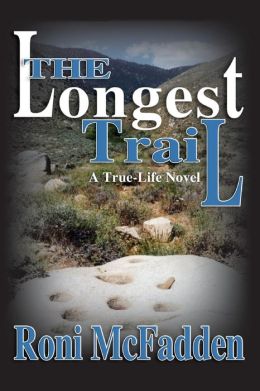
Roni McFadden, The Longest Trail


I didn’t think I was going to like this book, and then it kind of grew on me. It calls itself “a true life novel,” but it seems more precisely a memoir. Author McFadden tells of a few key years as a teenager in the 1960s. With a rocky home life and school days full of misery, she has only a love of horses to keep her from taking more dark turns than her life has already taken.

A friendly stable owner and horse trainer befriends her, and before long she is accompanying him as he packs groups of hunters into the Sierras in eastern California. Learning how to pack horses, set up camp, and cook for them, she acquires the self-confidence and independence to pass through a difficult adolescence.

We get to know some of the horses she is responsible for, each with his or her own personality and temperament. And we learn that hunters are rarely good at even finding game to shoot. Drinking and playing cards are more their idea of enjoying the woods, and she has little respect for them.

There is the occasional crisis as when four horses disappear into the night, frightened by something so terrifying that it takes days of searching to find them. Spending time alone at the base camp, three miles off the highway, she is faced with having to put down one of the horses with a broken leg. Another horse nearly dies of snakebite, but her swift thinking keeps the animal alive.

California Sierras, 1972
She herself becomes aware of the long history of former Native American inhabitants of the area and begins to feel that spirits of them are watching over her. She has both waking and sleeping dreams about them. The vividness of these dreams is the only suggestion of fictionalizing in the book.

This is not a tell-all memoir. Her relationship with John, her mentor, for all his importance to her, is not given much depth. A romance with an older boy is only implied. The many young friends who congregate off-season at the base camp are simply names, only one of them emerging from obscurity by reason of all the practical jokes played on him.

Readers interested in the life of high-altitude trail packers should also look for Willard Wyman’s High Country (reviewed here a while ago). The Longest Trail is currently available at amazon and Barnes&Noble and for kindle and the nook.

Image credit: Wikimedia Commons

Coming up: Gary J. Cook, A Murder of Wolves

Friday, September 6, 2013

Horace Annesley Vachell, Bunch Grass (1912)


This collection of stories set among ranches and homesteads in Southern California was the early work of an English writer who became a prominent novelist and London playwright. Born into wealth and privilege, Horace Annesley Vachell (1861-1955) emigrated to California in 1883, where he operated a cattle ranch with his father-in-law. These 20 stories, published over a decade after his return in 1900, draw humorously and thoughtfully on that experience.

Character. Of strength of character, the stories demonstrate a frontier tenacity of spirit. As Vachell notes in his Foreword:

The virtues that counted in the foothills during the eighties were generosity, courage, and that amazing power of recuperation which enables a man to begin life again and again, undaunted by the bludgeonings of misfortune.

The unnamed narrator of the stories and his younger brother, nicknamed Ajax, are rarely touched by genuine adversity. While they discover that cattle ranching scarcely pays the bills, they have the advantage of owning a former land grant with grass and water enough in the good years. For the homesteaders who venture onto the poorer, dryer land, survival is a tenuous struggle.

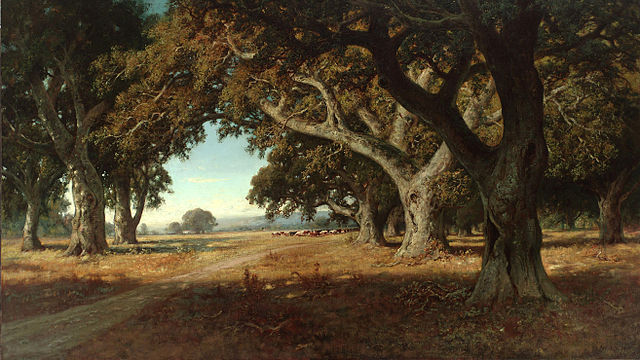
William Keith, California Ranch, 1908
For their part, the brothers don’t always exercise good judgment in a story. Ajax sometimes meddles in the lives of other characters with unexpected results. With no more knowledge of women than can be gained from a “profound study of high literature,” he plays matchmaker for a bashful bachelor. Discovering too late that the bride-to-be expects her groom to take the temperance pledge, Ajax has to invent a scheme to break the engagement without risking a breach of contract suit.

One of the best stories in the collection is surely “One Who Died,” about two English remittance men. It illustrates how the West absorbed men who came there as outcasts from homes far away. Gentlemen they may be, but they lack character. Free to continue living indolently, they are an embarrassment only to themselves.

Reinventing themselves at will, the two men in this story fake the death of one of them to collect funeral expenses from the family back in England. With the money, they buy a saloon and become prosperous. All goes well until the father of the “dead” man comes to California to visit his son’s grave. From beginning to end, the story makes for a memorable moral tale.

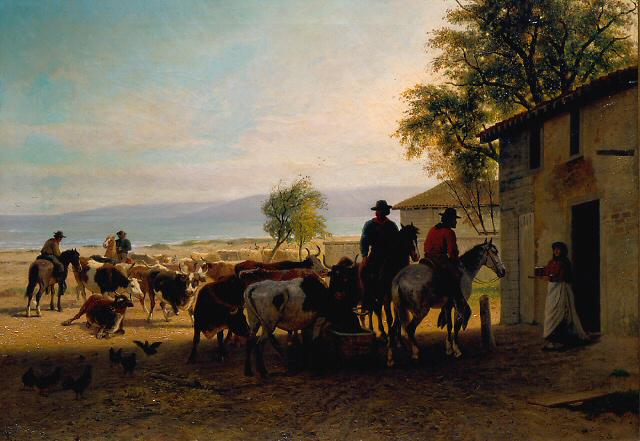
William Hahn, Ranch Scene, Monterey, California, 1875
Women. In the opening story, “Aletha-Belle,” the young woman of the title is a book agent, selling a sentimental volume door-to-door about motherhood, called The Milk of Human Kindness. Given the kind of salesmanship required of her line of work, she is expected to have “the hide of a rhinoceros, the guile of a serpent, the obstinacy of a mule, and the persuasive notes of a nightingale.” But she turns out to be a “thin, slab-chested figure” with a “prim New England accent,” who looks no more then 18.

Friday, August 9, 2013

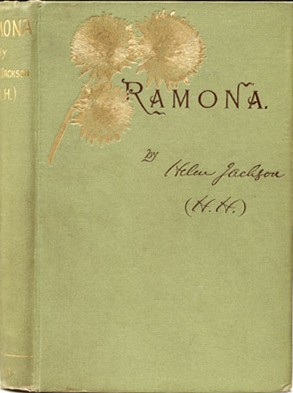
Helen Hunt Jackson, Ramona (1884)


First edition
Massively popular in its day, Ramona was the work of a well-meaning social activist in her declining days, and it seems ill-mannered to say anything disagreeable about her book. But there’s no way around it. Reading this long novel today is a chore.

Meant as an Uncle Tom’s Cabin to waken sympathy for the ill-treated native populations of Southern California, the publication of Ramona awoke instead an appetite for romance. Set on a Spanish land grant ranch in its dying days, it evoked a colonial past that is more myth than history. And its once-upon-a-time story of a sweet-tempered girl under the heartless thumb of a wicked foster mother comes straight from fairy tales.

Plot. Briefly, the title character is the mixed-blood daughter of a white father and an Indian mother. Given by the father to his childless former sweetheart unhappily married to a wealthy man, she is later bequeathed to the woman’s sister, who unwillingly agrees to raise her.

The Señora Moreno is a widow who rules over what’s left of a grand old ranch between the San Fernando Valley and the sea, and convenient to the Camino Real. The missions along that route of the Franciscan Fathers between San Diego and San Francisco are now crumbling. And the land once deeded to Spanish lords is falling into the hands of greedy, heartless Americans.

San Jacinto, (C) Ron Scheer
Alessandro, a young Indian sheepherder on the Moreno ranch, falls in love with the girl, Ramona, and the two elope, covering their tracks so well that no one is able to find them for years. During that time, misfortune follows misfortune for the young couple.

They are thrown out of their home by land developers, and their first child dies for lack of medical attention. They retreat to a hidden valley on the flanks of San Jacinto, a mountain now overlooking Palm Springs. Deranged with hopeless melancholy, Alessandro is shot and killed by a white man for the misappropriation of a horse.

Ramona is eventually found near death by Felipe, the son of the now-deceased Señora Moreno. Having rescued her and the couple’s second child, he offers marriage. Though Alessandro remains her true love even in death, Ramona accepts, and they leave California to live in Mexico.

Cahuilla woman, Edward S. Curtis
White and nonwhite. Jackson does Indians both a service and a disservice in her novel. She portrays them as uniformly sympathetic, but to achieve this she renders them as both child-like and dependent on the good will of the whites who have come to live among them. Peaceful by nature, they have been taught by the missionaries to be industrious agricultural workers. They have also gratefully absorbed without apparent conflict the pieties of the Church, with its veneration of the saints.

Simple and trusting folk, the Indians are powerless against the unscrupulous land grabbers who swarm into California after it becomes a part of the U.S. With the help of Congress and the courts, their rights to ancestral lands are being swiftly abolished. And as wards of the state, they find their lives being managed by Indian agents with little real concern for their welfare.

Confused like children in a suddenly alien and hostile world, they are ennobled by Jackson who makes them patiently accepting of their tragic fate. As they grieve their losses, there is anger among them but little resistance. They flee before the hated Americans like Adam and Eve from the Garden, starving and without shelter.

Friday, May 31, 2013

Frank Norris, McTeague (1899)


This is a cunningly harsh story of ignorance and avarice. It barely qualifies as an early western, and
then only in its last three chapters. The previous 20 chapters take place in a small neighborhood in San Francisco.

Readers of Cornell Woolrich’s Waltz Into Darkness will find much that’s familiar in this dark tale of obsession. It takes place in an amoral world among ordinary people with little more than a gift for self-preservation. Its central character, McTeague, is a man of brute strength and minimal intelligence. Self-employed as a dentist, he is set on the road to ruin when the girl he is to marry wins $5,000 in a lottery.

Plot. Like any good tragedy, the plot of the story is a simple one. McTeague falls in love with Trina, the girl friend of his best (and only) friend, Marcus. Generous to a fault, Marcus steps aside so that McTeague can court her. When she wins the lottery, Marcus feels the first twinges of jealousy. Not only has McTeague taken his girl; he has suddenly become a rich man.

Zasu Pitts and Gibson Gowland, Greed, 1924
Or so both men think. Trina has other ideas. The money awakens her inner Silas Marner, and she refuses to spend a penny of it. All goes well enough until Marcus’ resentment erupts into an open feud with McTeague. When Marcus leaves San Francisco to be a cowboy in southern California, the Health Board shuts down McTeague’s practice. Seems he’s never been to dental school. He blames Marcus for reporting him to the authorities.

Unable to get and hold another job, McTeague slides into a decline that has the couple living in abject poverty. Trina’s continued refusal to spend any of her lottery money enrages him, and his treatment of her grows abusive. Eventually, he kills her and makes off with the $5,000.

A fugitive now, McTeague fetches up in southern California. Restless with anxiety that there is safety only in moving on, he strikes out alone across Death Valley. There on the alkali flats under a blistering sun, a member of a sheriff’s posse catches up with him. The man turns out to be Marcus, eager to settle scores with McTeague.

Trina and McTeague, the wedding, Greed, 1924
Afoot and out of water, they engage in a life-and-death struggle over the bag of stolen money. When Marcus is killed, McTeague discovers that in his last moments Marcus has handcuffed the two of them together. So the story ends, like a Shakespearean tragedy, with all three of its central characters either dead or about to be so.

Character. In writing this novel, Norris deliberately places his narrative far outside the usual world of popular fiction. It offers up a coldly realistic view of his characters, who have few if any redeeming qualities and lack the intelligence to reflect with any depth on their lives. With only limited powers of reason, they are unable to resist their impulses and desires, often acting on animal instinct.

Literary history places Norris in company with French novelist Emile Zola and other naturalist writers. Trapped by heredity and social conditions, McTeague and Trina live insignificant lives amidst the great mass of the proletariat. Norris elevates them by casting them as principals in a tragedy. But he does not dignify or romanticize them. They are dead souls in a soulless world.


Thursday, April 4, 2013

Gertrude Atherton, Los Cerritos (1890)


Following on the heels of Helen Hunt Jackson’s early-California romance, Ramona (1884), this novel makes clear in its subtitle that it’s a “Romance of the Modern Time.” Set in the post-gold rush years, it tells a story already familiar to readers of Maria Amparo Ruiz de Burton’s The Squatter and the Don (1885). It concerns the disputed ownership of a former Spanish land grant.

Plot. Settlers have put down roots on a large tract of land in Central California believed to be otherwise unclaimed. When a deed owner belatedly surfaces, a wealthy man in San Francisco, Alexander Tremaine, buys the property. He intends to drive off the squatters and build a big country home for himself.

Joaquin Murietta
Visiting the former 50,000-acre rancho, known as Los Cerritos, Tremaine meets and falls in love with a 17-year-old girl, Carmelita Murietta. She is the daughter of the famous bandit Joaquin Murietta and a well-born young woman who ran off with him. Both are now dead, and Carmelita has grown up in the home of an uncle.

Carmelita has befriended the Jesuit priest of the local mission, about whom there is some mystery. She does not know that he left a lover to become a priest and that, unknown to him, she has taken up residence at an isolated house nearby. She languishes there, having given up hope of a happy life in the world outside. Carmelita also doesn’t know that Tremaine is the man who has bought Los Cerritos. Nor does she know that he is already married.

The settlers determine to take up arms against Tremaine, to fight for possession of the land. They are led by a burly giant of a man, Carlos Castro, who attacks Tremaine, breaking his wrist and putting a knife into his shoulder. Ready to finish him off with a pistol shot, he discovers that Carmelita has his gun, and he flees when she threatens to shoot him.

Tremaine decides in the end to avoid further confrontation with the squatters, even as they surrender to the sheriff who comes to evict them. Instead, Tremaine offers them a deal. They can keep their land provided they work hard and are truly productive, showing some ambition instead of passing the time in drinking, gossiping, and idling.

Central California
The unpleasant Mrs. Tremaine objects. She has plans of her own for their 50,000-acre get-away, and she doesn’t intend to share it with any but guests of her own choosing. Atherton handily dismisses both her and the bothersome Castro by having them trampled in a cattle stampede.

Romance. Carmelita is the romantic heroine of the novel. She has the intelligence and sensibilities of her mother and the independence and social conscience of her father, who robbed only from the rich. A child of Nature, she gravitates to the old growth forests on the mountainsides above Los Cerritos.

Tremaine, rich with inherited wealth, is a lost soul in the world. Money can’t buy him love. Something of a dreamer, he scorns the materialistic world of the well to do and yearns to escape from it. He is immediately taken with the simplicity and honesty of Carmelita. With her, for the first time in his life, he feels he has found a companion.

Tuesday, December 18, 2012

The Red Pony (1949)


This film about a California ranch family at the turn of the last century is not exactly a movie for the whole family. Its central theme of a 10-year-old boy learning about death and disappointment has moments that would disturb the 10-year-old in all of us. It is the work of John Steinbeck, who wrote the screenplay and the stories it is based on.

Less tragic than his Of Mice and Men, it still finds an under layer of darkness in the California sunshine. It introduces themes of family discord that would find full expression in his novel East of Eden, also set in California in the early years of the twentieth century.

Plot. Little Tom Tiflin (Peter Miles) is given a pony, which he is training with the help of a ranch hand, Billy Buck (Robert Mitchum). The boy’s father (Shepperd Strudwick) is an unhappy man, never having adapted to life in the country after marrying his wife Alice (Myrna Loy). The emotional distance that has grown in the marriage intensifies when her father (Louis Calhern) arrives for an extended visit.

Peter Miles, Robert Mitchum
Calhern with his long white hair and beard could be a double for Buffalo Bill Cody. And he has a similar past, as a man who once led wagon trains of pioneers to the West. He loves to recount those exciting days, but his son-in-law has long ago grown tired of his stories and finally says so in an outburst that the old man overhears.

There’s also distance between father and young son. The boy is enamored of Mitchum, a coolly competent cowboy, who says he’s half horse, having been fed horse milk as a baby. In Greek mythology that would make him a centaur, a creature embodying untamed nature, as well as being a teacher. Billy Buck is both.

The problem with Billy is that he’s not altogether reliable as a teacher. He casually makes promises that he can’t keep. After he’s assured the boy that it won’t rain while he’s at school, the pony lets himself out of the barn in a terrible storm and takes a fever. Mitchum says the pony will recover, but despite his efforts it slowly worsens.

Myrna Loy, Robert Mitchum
While the boy takes to sleeping in the stall with the pony, it escapes again and is found dead, the buzzards already feeding on it. The boy is shattered by the discovery and in a horrific scene tries to strangle one of the birds as it struggles fiercely with bloody talons.

The lessons learned are hard ones. The boy discovers he cannot trust the word of grown-ups, even the man he admires. The grandfather learns that as a man who was once a leader of men, his day in the sun is over. The boy’s father takes a leave of absence with his brother in San Jose—a kind of homecoming. But he comes to realize that he is a “stranger” to others wherever he lives.

Finally, the life of Mitchum’s mare hangs in the balance, as he believes the colt in her is turned wrong. Sharpening the knife he’s used to doctor the pony, he is ready to kill the mare to save the colt. The emotionally wrought boy steals the knife, and while Mitchum leaves the barn to retrieve it from him, the mare safely gives birth to the colt. True to his word, Mitchum gives the colt to the boy. In the last scenes, we see the adults together, all smiles, as the boy rides his new pony across the fields of the ranch.

Myrna Loy, Shepperd Strudwick, Peter Miles
Comments. Long a B-movie factory, Republic Pictures was the surprising producer of this feature film with an all-star cast. Shot locally in Agoura, California, and in Technicolor, it has the look and feel of Steinbeck country in central California. The effect is partly due to the rain-soaked earth underfoot in many scenes.

Myrna Loy is everybody’s lovely mother, a composed woman of private emotions, who keeps house, cooks meals, and plays classical music on the piano. Robert Mitchum, a star of cowboy movies from the war years, plays a ranch hand with the actor’s usual cool confidence.

Steinbeck’s script has many fine moments, as when Calhern’s garrulous old man laments how the drive to adventure westward has died out of people. “It was a job for men,” he tells his grandson. “Now only little boys want to hear about it.” Later, he scolds Mitchum for being unaware of a rule against sitting on another man’s bed.

Tuesday, November 20, 2012

The Young Land (1959)


There must have been high hopes for the young Patrick Wayne when this film was made in 1959. Son of Hollywood star John Wayne, gifted with good looks and already experienced in front of the camera in several John Ford westerns, he was ready to launch his own screen career.

From the first scenes of this film, however, you can tell that something is amiss. You feel the need for the guiding hand of a John Ford to bring life to the performances and the action. Except in rare moments, the film never really seems to be more than a walk-through of the script.

Plot. The entire story takes place in an Old California village just after the war with Mexico. The population, a mix of Anglos and Mexicans, is still getting used to being part of the U.S. Old animosities continue as before. And now, when a gringo (Dennis Hopper) kills a Mexican in a gun duel, there’s some question of whether it was self-defense or homicide.

Circuit Judge Isham (Dan O’Herlihy) arrives in town with U.S. deputy marshal Stroud (Cliff Ketchum) to hear the case. Acting sheriff in the village (Patrick Wayne) has already jailed Hopper. He is then pressed by O’Herlihy to maintain order as Hopper’s friends get drunk in the cantina and vaqueros from surrounding ranches ride in for the trial.

Patrick Wayne
To make sure we don’t miss the trial’s significance in this time and place, a local don (Roberto de la Madrid) arrives to see how “American justice” works. He and O’Herlihy, a stuffy Yankee patrician, provide a commentary on the proceedings. As a handpicked jury hears the case and then takes a long time behind closed doors to come to a verdict, the two men exchange politely thoughtful observations.

Outside the courtroom, tensions mount, and de la Madrid’s daughter (Yvonne Craig) attaches herself like glue to the otherwise preoccupied Wayne. Now that she’s an “American girl,” she’s eager to exercise her liberties. Hopper’s friend (Ken Curtis) first picks a fight with Wayne and then reluctantly agrees to be a guard in the jail as Hopper awaits the verdict of the jury.

When the verdict is delivered, Hopper and Wayne are called upon to provide an action-packed ending in the streets of the village. Justice is finally done, but it’s Old West-style, with guns and horses.

Dennis Hopper
Performances. The standout performance in the film is Dennis Hopper, who burrows into his character so deeply he never once leaves you doubting the guilt of his character. Cocky and ill mannered, he is a grinning sociopath. Ken Curtis is entertaining as a congenial outlaw. Cliff Ketchum is believable as a lean and crag-faced marshal.

Wayne is affable as the young sheriff but doesn’t have (or wasn’t given) much range to enliven the role. In some scenes, he seems to be working hard just to remember the lines. You wish, too, that he’d been given a better hat. The one he got from costuming makes him look more like a plantation owner than a western sheriff. For Yvonne Craig, this was one of her first feature roles. She would later become known as Batgirl in the final season of TV’s Batman (1967-1968).

Friday, November 9, 2012

Ross Macdonald, Find a Victim (1954)


California writer Susan Straight recommended this novel recently when discussing writers of the West who deserve being re-read. Crime fiction is a little outside my usual interest here at Buddies in the Saddle, but Straight is a personal favorite (Blacker Than a Thousand Midnights, Between Heaven and Here), so I looked for a copy.

It’s tempting to read this Lew Archer mystery as a western. It has many of the western genre’s elements, though it is set in the mid-twentieth-century. Archer is far from LA, out in the Central Valley headed for Sacramento when he stops for a hitchhiker who is dying of a fatal gunshot wound.

There’s a dusty, hot town in the middle of nowhere, a Stetson-wearing county sheriff, some “rustling” (though of a truckload of booze, not cattle), more gunplay and fistfights, a saloon, assorted Mexicans and Chinese, a shootout, a chase, and a day-trip into the Sierras.

Macdonald’s storytelling style is as spare as the genre western. As the novel’s central character, Archer has the unsentimental attitude of a cowboy hero who has had more than enough of outlaws and being shot at by them. Like the cowboy, Archer is a drifter across a kind of wilderness, where there is no attachment to keep him from moving on when he chooses.

Hitchhiker, Bakersfield, 1940
Where the analogy begins to break down is the sheer complexity of Macdonald’s plot. The story begins with the simple question of who shot the hitchhiker. But as Archer’s curiosity gets him piecing together bits of back-story, there unfolds little by little a miasma of small-town chicanery. The question of who killed the hitchhiker turns into one of what the hell is going on here?

Another difference from the black-and-white world of the western is the many shades of moral turpitude among the men and women Archer meets. Though most remain legally innocent of wrongdoing, all share a degree of culpability, for all have made choices that have led to murderous consequences.

Though I don’t remember reading Macdonald before, I do know Hemingway, who had many imitators among western and crime fiction writers. Here is the novel’s opening paragraph:

He was the ghastliest hitchhiker who ever thumbed me. He rose on his knees in the ditch. His eyes were black holes in his yellow face, his mouth a bright smear of red like a clown’s painted grin. The arm he raised over-balanced him. He fell forward on his face again.

I also immediately found familiar Archer’s frequent morose observations of life’s vicissitudes.

The hospital was visible in the distance, a long white box of a building pierced with lights. Nearer the highway, the lighted screen of an outdoor theater, on which two men were beating each other to the rhythm of passionate music, rose against the night like a giant dream of violence.

San Luis Obispo County, California
Maybe unfairly, the grim tone reminded me of parodies of hard-boiled fiction, dating back to The Firesign Theater’s Nick Danger. A similar deadpan, death’s-head humor lives on today in the wry, tough talk of Elmore Leonard’s Raylan Givens.

Find a Victim surely falls under the heading of “classic” crime fiction. It is enjoyable on lots of levels, from the erotic to the existential. The frequent acknowledgement of women’s breasts would be the recurrent nod to Eros. And Archer himself comments on the perennial companionship of sex and death.

Ross Macdonald
What’s existential is the moral groundlessness of the world Macdonald writes of. Archer and the people he meets are worn down by the failure to make any meaning of the empty lives they live. Archer’s intelligence heightens his awareness of that dilemma. It is also a refuge for him. Less intelligent, damaged, and otherwise compromised people fall by the wayside.

Find a Victim is currently available at amazon and Barnes&Noble, and for kindle and the nook. Used editions can be found cheap at Abebooks. For more of Friday’s Forgotten Books, click on over to Patti Abbott’s blog.


Photo credits: Wikimedia Commons
Ross Macdonald photo from Bantam edition, 1972

Coming up: Saturday music, Carl Perkins