Showing posts with label los angeles. Show all posts

Thursday, May 15, 2014

Raymond Chandler, The Long Goodbye (1953)

I’m tempted to write this as a review of a western novel. There are so many threads of connection with the themes of earlier frontier fiction. It even has a county sheriff in it. Set in Los Angeles, circa 1950, it echoes a frequent complaint about the West, that its promise has been betrayed by a get-rich-quick mentality and the hedonistic, materialistic culture it fosters.

Private investigator Philip Marlowe is the last of a dying breed, living by a code of conduct that has him making personal sacrifices for people he respects and unwilling to charge them a fee for his services. Like Monte Walsh, the aging cowboy in Jack Schaeffer’s novel of the same name, he refuses to yield to the forces of change, which have meant the death of a way of life based on honorable values.

Plot. One of those values is the trust to be placed in another man’s friendship, which means doing an unusual favor, no questions asked. Which is how the novel begins, as Marlowe agrees to drive an acquaintance, Terry Lennox, to catch a plane in Tijuana.

Before long, Marlowe becomes far too intimately embroiled in a murder, as the body of Mrs. Lennox turns up quite gruesomely dead. And soon, for reasons he will eventually discover, he is being retained by a book publisher to babysit a novelist, Roger Wade, whose heavy drinking is preventing him from completing the draft of his next bestseller.

Los Angeles, c1950
Character. Bumping up against the rich and powerful, whether a wealthy owner of a newspaper or racketeers with intimidating thugs to do their dirty work, Marlowe is constantly the object of scorn for his lowly profession and his relative poverty. Whether from cops or thugs, which are hard to tell apart, he rarely gets any respect. Before we are long into the novel, he’s doing jail time, as he refuses to cooperate with police efforts to locate Lennox.

Questioned about his ethics, which seem to keep him broke and never far enough out of trouble, he explains to a friendly cop, “I’m a romantic, Bernie. I hear voices crying in the night and I go see what’s the matter. You don’t make a dime that way.”

Monday, October 7, 2013

Thomas D. Clagett, The Pursuit of Murieta


This novel is a lot like a Budd Boetticher western. It has the structure of a movie plot, and much of the action takes place a good distance from civilization. A group of male characters deal with life and death issues like what to do with and what to believe about a man they have captured. And a woman riding with them has an agenda of her own.

Plot.  At the center of the story is real-life Mexican bandit Joaquin Murieta who harried the americanos flooding into California after it became a state. Something of a Robin Hood, he reputedly stole from the wealthy to distribute among the poor. He was a popular hero among the disenfranchised and a pain in the backside of law enforcement, which found itself plagued with not one but several “Joaquins” roaming the state.

The story begins with a scene of unprovoked yanqui violence against Murieta and his wife as they attempt to return to Mexico after an unfruitful sojourn in the California gold fields. Then it jumps ahead to 1853 during a few days in which Murieta is pursued by a contingent of rangers tasked by the governor with bringing him in. They finally run him down in the mountains above San Gabriel Mission.

Lt. Ambrose Quick, the young man in command, has trouble keeping order among his men and deciding whether to believe their captive when he claims to be Murieta. Addie Moody, a saloon girl who has joined them has revenge in mind. Her sister was raped and killed by a man she believes is Murieta.

Style and structure. Like a movie, the novel has a single central conflict, pitting two men against each other: Murieta and Lt. Quick. One of them is more admirable than the other, but neither of them is a villain. That honor goes to one of Quick’s men, Ned Needle, who is a hateful bigot, driven by sneering contempt for everyone.

As in a movie, the characters tend to be types whom we quickly recognize. Besides the bigot Needle, there’s a drunk, a self-important sheriff, his featherbrained daughter, and a mysterious Mexican woman. Addie Moody is the outspoken prostitute with more intelligence than any of the men. Besides Lt. Quick, only one of them actually breaks out of the pattern created for them and makes a choice that amounts to a change in their character.

Quick is interesting for starting out a man with aspirations far beyond his capacity to achieve. He wants to be mayor of Los Angeles, but has no qualifications for the job. He hopes that capturing Murieta will sweep him into office. Before the story is over, he makes some difficult decisions and some unwelcome discoveries that both lift and lower him in our estimation.

Many of the characters in the novel are based on actual historical figures. Ten or more of them walk from the pages of history. Maybe most surprising is to find “Judge” Roy Bean running a saloon in the little settlement of San Gabriel. Andres Pico, retired Mexican general runs horses on the verdant ranges of the San Fernando Valley.

Monday, December 10, 2012

Dagoberto Gilb, The Flowers


The flowers in the title of this novel are actually the name of an apartment building, Los Flores, in what seems to be East or South Central Los Angeles. Its narrator is 15-year-old Sonny, whose mother has married the owner of the building, where they live in one of the ground floor units. The renters at Los Flores represent a cross-section of the inner city, Chicanos, whites, and blacks.

Sonny’s Mexican family has been in the U.S. so long that Spanish is his second language. He has to have the gender-mangled name of his Anglo stepfather’s apartment building explained by his only friends from high school, a pair of bookish twins, Joe and Mike. Los Flores, one of them says (Sonny isn’t sure which one, because for a long time he can’t tell them apart), means not “the flowers” but “the Flores family.”

Plot. The novel meanders like a novel it somewhat resembles, Catcher in the Rye. Like Holden Caulfield, Sonny is no longer a boy yet not old enough to be a man. For him, 15 is an uncomfortable and aimless limbo where life is this series of mostly unconnected incidents dominated by the adults around him.

Apartment patio garden, Los Angeles
His Anglo stepfather is an overbearing hard ass, with firearms and the mounted heads of game animals on his walls. Though married only a few months, Sonny’s bored mother is already stepping out on the man. A lonely pot-smoking girl in a messy apartment upstairs seduces him. An ex-cop with an intimidated wife bullies him. Another couple teasingly taunts him for stealing the adult magazines that don’t fit into their mailbox.

An albino man who runs an unlicensed used car business on the street in front of the building wants to give him a car. A stranger he thinks is a pervert takes to stalking him when he’s walking the streets. Meanwhile, he falls in love with a girl who’s as good as being held prisoner in one apartment by her parents.

While Sonny is often told how important it is to have an education and he apparently goes to school, not once are classes or teachers mentioned. School has so little meaning for him that it doesn’t seem even to exist. Instead, completely on his own, he decides to learn French, which makes him smile as he uses it, partly because it puzzles everyone else.

For the most part, Sonny is a reliable narrator, except for the long wait before he admits that he not only sneaks into people’s homes when they’re away but steals any money he finds. Then, snooping in his stepfather’s desk, he discovers $1,000 stashed away. As events begin to push him toward a decision point about the girl he’s sweet on, that stash of money becomes increasingly an object of narrative interest.

Wall mural, Los Angeles
Themes. The prevailing condition of life for Sonny is that nearly everyone either lies to him or is covering up something. He swims in a virtual sea of mendacity. His mother even implicates him, asking him to keep from her husband that she serves him store-bought salsa instead of making her own, then asking him to hide the cans in the garbage.

Having grown up with all this, Sonny accepts it as normal. He listens for what people are not saying, weighing their words for hidden meaning, catching nuances of inflection. For himself, Sonny has learned to be thoroughly guarded and untrusting. Here he is talking to his mostly inattentive mother about getting paid by his stepfather for a job he’s done:

“Don’t make any trouble,” she said. This was another kind of tone with another meaning. It wasn’t, I could tell, about me but about her and him, her and her trouble. “You hear me? I’ll give you money if you need it. You know that.”

I knew that? How did I know that? When did I know that? “I want it and he said he’ll pay me, right? He said he would. I believed him.” I was feeling like I was on my toes a little.

“If he doesn’t, I will. If you really need it, I’ll get it for you.”

If I really need it? I couldn’t believe she said that. “He will.” And no, she wouldn’t. She wouldn’t remember, and if she did, or I reminded her to remember, she’d either deny she offered or say she would later.

She stopped and, distracted, sponged the kitchen counter as if she’d already forgotten we’d had this conversation and then turned back to me, eye to eye. “Please tell him that I left the salsita in the refrigerator.”

For everyone in the novel, the purpose of talk is to pretend to communicate while disclosing as little as possible.

Friday, July 20, 2012

Photo-finish Friday: under wraps


It's arguably the most photographed larger than life-size piece of statuary in LA, especially if you count the webcam focused on this spot from this website.

Wrapped up now, pedestal and all, while the immediate area is being repaved, the figure under the cover looks like a creature rising from a horror-movie swamp. And for gridiron rivals of this particular institution of higher learning, it is no doubt similarly repellant. Not to mention true art lovers, who are likely to avert their eyes.

Never mind, visitors from around the world practically line up to have their photo taken with it. As you can see below on a recent day.


Photo-finish Friday is the bright idea of Leah Utas over at The Goat's Lunch Pail.

Coming up: William Holden, Escape from Fort Bravo (1953)

Friday, July 13, 2012

Photo-finish Friday: June gloom


June in LA is a month of gloom. Most days overcast and kind of murky. It can start in May and carry on into July, which is when I shot this on a day-trip into the city earlier this month. Gray sky overhead and the Hollywood Hills in the distance, looking like they're ready to disappear in a fog bank. It's called a marine layer, and it gets monotonous.

But when it gets to 115 degrees out here in the desert, which it has been this past week, you kind of yearn for some of that old "gloom." Doesn't look great, but it's a lot like outdoor air-conditioning. Beats the alternative.

Photo-finish Friday is the bright idea of Leah Utas over at The Goat's Lunch Pail.

Coming up: Saturday music, George Strait


Sunday, July 8, 2012

Subway español

Spanish was the only foreign language taught in my small-town high school in Nebraska. At the time, studying Spanish meant no more to me then the unexpected benefit of understanding the grammar and parts of speech of my own first language, English. Little did I know that I’d someday be living in a bilingual world, where many people’s first language would be Spanish. So fifty-odd years later, my memory of high school Spanish gets regular exercise.

To be honest, unless I’m in another country, I’m not all that tolerant of hearing other languages being spoken in public places. Shopping at Costco in West Los Angeles when I lived there was like a stridently noisy trip to the United Nations. Then again, Costco tends to bring the worst out of people anyway.

But Spanish is a loving tongue. In LA, you hear it on the bus and in the streets. It’s on a big share of the radio stations, where there’s all kinds of spirited or soulful Mexican music for the listening. You read it on billboards and on the headlines of the city's Spanish-language newspaper, La Opinión. It goes naturally with the palm trees and the sunshine.

Yeah, OK, it’s not all sunshine. There are not-so-loving gangs with guns and tattoos, who converse in Spanish, too.  But this is not about them.

For me, living and working in LA, Spanish got to be associated with food. With the amused and patient help of the bilingual employees at the local Subway, I learned to carry out an entire transaction for the purchase of a sandwich en español—or more properly, “Spanglish.”

Para llevar (to go) I’d learned a long time ago, and con mucho gusto, a pleasantry whose unexpectedness usually generates a smile. But at Subway, where each sandwich is made to order, the transaction involves a whole lexicon of idioms.

A foot-long, I learned, is a pan grande. If you don’t want your pan grande toasted, you say, frío. And then there are the words for all the rest of the makings, some of which I wasn’t even sure how to spell, like trigo (wheat) and pavo (turkey). Lechuga (lettuce), I’ve long loved the way that word rolls off the tongue. After numerous tries, I finally mastered sal y pimienta (salt and pepper). But for some reason I could never remember the word for pickles.

I know my numbers, but paying with a debit card meant there wasn’t that long pause while I mentally translated them into numerals. While it was probably not encouraged, I’d sometimes get a “discount” by the cashier for my entertaining use of the language. Occasionally even a cookie. Then out the door with muchas gracias, hasta luego, buen día and whatever other phrases came to mind.

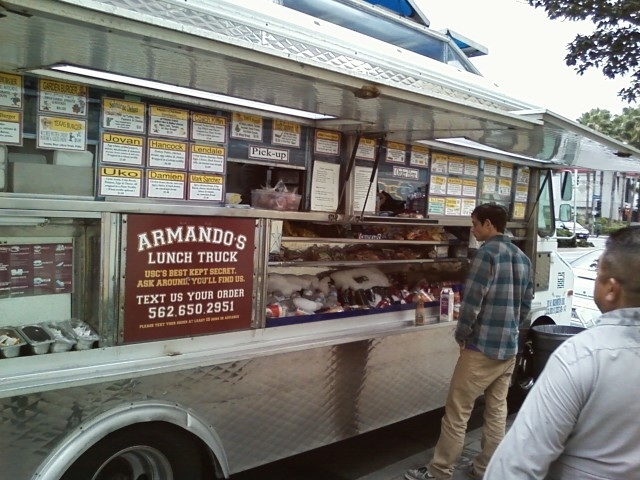
Armando's on Jefferson Blvd, Los Angeles
From the crew in the Mexican food truck that parked on the street outside the building where I worked, I learned a few finer points. Burrito, of course, I knew. Everybody does. Learning to ask for un burrito de desayuno (breakfast burrito) made my day one morning. So was learning to ask for picante (hot sauce), despite my obviously Anglo features and non-picante accent.

None of this helped at all, by the way, when I spent several weeks in Madrid a couple summers ago. Madrileños seemed to understand my Mexican-inflected Spanish, but I couldn’t understand a word of that rapid-fire, lisping Castilian they’ve got going there.

Now that my days of retirement have removed me from daily patronage of fast foods and food trucks, I’m finding that my Spanglish is slipping. This week, on a trip into the city, we made a stop in Riverside at a Subway and discovered I’d begun forgetting some of the words already.

Gonna have to do something about that. It’s like losing a friend.

Any second-language stories, Spanish or otherwise, are welcome.

Coming up: John D. Nesbitt, One Foot in the Stirrup

Friday, June 22, 2012

Photo-finish Friday: airship


It's a bird. It's a plane. It's a dirigible. I snapped this on a calm winter day in downtown LA a few months ago. Dirigibles make for a playful change from the constant traffic of big airliners gliding overhead to LAX. When you can hear them above the sound of the traffic, they make a soft, purring noise.

Stopping in a crosswalk to take this pic, I irritated the impatient driver of a Hummer, who honked at me to get out of the way so he could make a left turn. Such is the life of a pedestrian in the city of motorists on the brink of road rage.

Photo-finish Friday is the bright idea of Leah Utas over at The Goat's Lunch Pail.

Coming up: Saturday music, Charley Pride

Friday, June 8, 2012

Photo-finish Friday: shoot


Walking to-from work, I often came across film production students shooting movies. Here a teacher is calling out instructions to a film crew while holding a big reflector to catch light from the late afternoon sky. The camera (easily lost in all the activity) is right in the center of the picture. One of the fellows with his back turned is about to be (digitally) shot. 

While living and working in Los Angeles, I saw scenes like this many times , but it still surprises me how many filmmakers it takes standing just off camera to produce that fleeting image on some future screen.

Photo-finish Friday is the bright idea of Leah Utas over at The Goat's Lunch Pail.

Coming up: Saturday music, Bob Wills

Friday, May 18, 2012

Photo-finish Friday


Here we are at the corner of Sunset and Echo Park in LA. All of two sides of this building have been not just graced but enlivened with colorful sidewalk-to-roof wall murals. I snapped this on my last morning in town before heading home to retirement. A closer side view can be seen below.


Photo-finish Friday is the bright idea of Leah Utas over at The Goat's Lunch Pail.

Coming up: Wayne D. Dundee, Manhunter's Mountain

Friday, April 27, 2012

Photo-finish Friday: out and about


Snapped this mini-mural of Tony Curtis one morning recently on the freeway going to work. Where else but LA? Besides City Hall in the background (where I always imagine Jack "Just the facts ma'am" Webb and one of his partners), maybe the most noteworthy thing about the pic is that the morning traffic is not bumper-to-bumper.

Photo-finish Friday is the bright idea of Leah Utas over at The Goat's Lunch Pail.

Coming up: William Holden and Glenn Ford, Texas (1941)


Friday, March 9, 2012

Photo-finish Friday: out and about


Yet another in the inexhaustible supply of Los Angeles wall murals. This giant portrayal of members of the Los Angeles Chamber Orchestra truly graces the sides of a parking structure facing northbound traffic on the 110 Freeway downtown. It recently observed its 20th anniversary, noted here in the LA Times with some history and a photo that favors the south-facing musicians better. I snapped this from the back of a bus just as the bearded violist was about to slip behind the trunk of a palm tree.

Coming up:  Robert Ryan, The Day of the Outlaw (1959)

Friday, March 2, 2012

Photo-finish Friday: out and about


I snapped this one a while ago at a street fair in downtown LA. In the center of the pic is a LAFD firefighter posing for photos in front of a backdrop of raging flames. What I like is that big smiling face while everything else is mostly out of focus.

Photo-finish Friday is the bright idea of Leah Utas over at The Goat's Lunchpail.

Coming up: Gunsmoke, radio series (1952-1961)

Friday, February 24, 2012

Photo-finish Friday: out and about


Here's another in the series "The Wall Murals of LA County." This one can be found on Hill Street near 4th, not far from the office towers on Bunker Hill.

Coming up: Glenn Ford, William Holden, The Man From Colorado (1949)

Thursday, February 23, 2012

Dagoberto Gilb, The Magic of Blood

Gilb is one of a kind. I don't remember reading stories like these before. They capture the lives and inner worlds of men who make a living as construction workers, day laborers, auto mechanics, and factory workers both on the job and during stretches of unemployment.

Most are struggling to provide food and shelter for a young family; some are still single. For the most part they are Mexican-Americans living in El Paso and Los Angeles. Modest men, they take pride in themselves and their work, they drink beer, and they have women on their minds.

As a journeyman carpenter, Gilb is familiar with the work of putting up buildings, the dynamics among men on a worksite, and the way they think about themselves, their lives, and what they do for a living. Most stories are told in the first person in a stream of conscious style like someone leaning against a bar talking, with a beer in hand.

Dagoberto Gilb (CC) Larry D. Moore
A teenager working in a laundry becomes involved with a young woman on the job while overdosing on a song by Vic Damone in "Vic Damone's Music." A tile layer becomes obsessed with another man's runaway wife in "Getting a Job in Dell City." Two city workers have too many beers and drive a new truck off the road in "The Truck." A man gives a ride to his estranged father in the middle of the night in "Something Foolish."

A tyrannical construction foreman is intimidated by a laid-off worker in "Churchgoers." A filling station mechanic labors grimly into the night to fix a car in "Al, in Phoenix." Two musicians spend the night with a couple girls they pick up on the road to Austin in "I Danced With the Prettiest Girl." And my favorite story, "Nancy Flores," is about a school boy's first romance brought to an end by another boy's crude joke, while years later his job brings him together with another of her old flames.

There are 26 stories in this collection, and every one of them is a revealing glimpse into the life of an individual, with his pride and shame, desires and disappointments, fears and small triumphs. First published in 1994, it belongs on any shelf of literature of the American Southwest.

The Magic of Blood is currently available at amazon and AbeBooks. Friday's Forgotten Books is the bright idea of Patti Abbot over at pattinase.

Photo credit: Wikimedia Commons

Coming up: John Syales, A Moment in the Sun

Friday, February 10, 2012

Photo-finish Friday: out and about


Here's another in the continuing series of wall murals in Los Angeles. This huge portrayal of Jesus in the clouds can be found on the south-facing side of a massive Korean church in central LA, the Glory Church of Jesus Christ. The structure was built in 1924 for the upcoming Olympics and functioned until recent years as the Grand Olympic Auditorium, site of boxing, wrestling, roller derby, and punk rock events.

Photo-finish Friday is the bright idea of Leah Utas over at The Goat's Lunchpail.

Coming up: Gwendolen Overton, The Heritage of Unrest (1901)

Friday, February 3, 2012

Photo-finish Friday: out and about


Angels Flight, the funicular and world's shortest railway on the slope of Bunker Hill in downtown Los Angeles, gets a new paint job. Photo-finish Friday is the bright idea of Leah Utas over at The Goat's Lunch Pail.

Coming up: James Stewart, Audie Murphy, Night Passage (1957)

Friday, January 20, 2012

Photo-finish Friday: out and about


On a walk to catch a bus, I noticed this appealing sign on the side of a building at Washington Blvd. and Oak Street in central Los Angeles. DANCING TONITE. The second-floor windows under it look out from a large open space that may once have been a ballroom. I figure it was a happening night spot in another era, and I get a mental image of low-cut print dresses, wide tides, fedora hats, hip flasks, and the sound of a swing band on warm nights.

Photo-finish Friday is the bright idea of Leah Utas over at The Goat's Lunch Pail.

Coming up: Old West glossary

Friday, January 13, 2012

Photo-finish Friday: out and about


A river runs through it. My commuter train paused for a moment on a bridge over these untroubled waters one morning this week. We're a few minutes from Union Station in Los Angeles. Yes, it's the Los Angeles River.

It didn't end up this way because city fathers preferred a concrete sluice to grassy banks, sand bars, and trees. For decades in the early history of the city, the river refused to stay in one place. A rainy winter would send it flooding wherever it pleased across the LA basin, wiping out everything in its path. Enough was finally enough, and miles of concrete were poured with the above result. Problem solved. But it makes you want to sing "Cry Me a River."

Photo-finish Friday is the bright idea of Leah Utas over at The Goat's Lunch Pail.

Coming up: Clint Eastwood, Pale Rider (1985)