Showing posts with label owen wister. Show all posts

Monday, April 2, 2012

Dustin Farnum: The first Virginian


I came across this image of Dustin Farnum (spelled Farnham here) in his role as The Virginian in the stageplay version of Owen Wister's novel. It appeared in the February 1904 issue of The Critic. The writer made  this comment:

The play as a play has not made as favorable impression as has the acting of Mr. Dustin Farnham in the role of the Virginian. Mr. Farnham fills the bill absolutely. If he can play other parts as he plays the part of the Virginian his success as an actor is assured.

The play turned out to be hugely popular, and Farnum (1874-1929) went on to Hollywood, where he reprised the role in an early Cecil B. DeMille version of The Virginian (1914) and continued making films through the Silent Era.

Coming up: Jack Palance, The Lonely Man (1957)


Monday, December 26, 2011

Progress report

Owen Wister
Have you ever started out on a project that just kept growing? A year and a half ago I got the idea I’d like to read the novels of the writers who helped invent the western. There was Owen Wister and Zane Grey, and a gap of about a decade between them. I figured there was maybe a dozen writers at the time trying their hand at cowboy westerns. It would not be a big job.

Acquiring a few reference books, like Tuska and Piekarski’s Encyclopedia of Frontier and Western Fiction and Geoff Sadler’s Twentieth-Century Western Writers, I found there were a good deal more than a dozen. The notion of a “cowboy western” also enlarged until I was considering any fiction set in the West. Western writers of the time were also telling exciting stories about mining, railroading, and engineering projects. Cowboys sometimes figured in them; sometimes not. So the notion of a “cowboy western” got fuzzy and then kind of leaked away.

The period I was looking in expanded, too. There were more western writers than I expected to find who were publishing before Wister. If you think about it, there were “westerns” to be read from almost the beginning of American fiction. From the days of the first white settlements, there was always a “West” out there beyond civilization. I arbitrarily chose to draw the line at 1880.

At the other end of the period, I came to see WWI as an important watershed and chose to stop with 1915. That was also the first year after The Virginian that a western novel reached the annual top-ten best seller list at Publisher’s Weekly. It was Zane Grey’s The Lone Star Ranger. (His The U.P. Trail would go to no. 1 in 1918.)

What made the project doable at all was the purchase of a nook and the availability at Barnes & Noble of nearly every book I was looking for at .99 or free. So far, I have read the first novels or story collections of 48 writers, starting with Mary Hallock Foote’s The Led-Horse Claim (1883) and ending with George W. Ogden’s The Long Fight (1915). Meanwhile, my TBR pile of early westerns has kept growing.

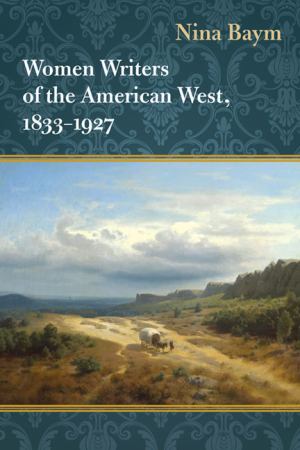
The light was at the end of the tunnel a week ago until I got my hands on a copy of Nina Baym’s Women Writers of the American West, 1833-1927. It’s an old story, and we know how male writers took over the genre of western writing. Women, it turns out, were also publishing volumes of fiction about the West. I’d found a few of them before now: B. M. Bower, Mary Austin, Kate Boyles, and Carol Lockhart. Now I’ve got a bunch more. Which is a lot of reading, but definitely cool. I like the idea of a more balanced picture.

So I am now miles away from the book I’ve been putting together about these writers. There’ll be about 75 of them when I’m finished. Maybe a year from now, you’ll hear me shout on the western wind, “I’m done!” In the meantime, I’m enjoying this project even more now than before, and I continue to believe I’ll be pleased with the end result and that readers and writers of westerns will find it fun and informative reading.

I’d be interested in hearing stories by anybody else who's had similar experiences.

Photo credits: Wikimedia Commons

Coming up: Tom Mix, Sky High (1922)

Thursday, August 11, 2011

Owen Wister, Lin McLean (1897)

I came across a reference to this novel a few years ago in Dane Coolidge’s Bat Wing Bowles (1913). He notes there that Lin McLean was one of the few books you could find in nearly any cow-country bunkhouse in the West. So I read Lin McLean and loved it, and together these two writers got me hooked on the early-early westerns of that period.

Not quite a novel, Lin McLean is a series of stories centered around its title character, a young cowboy learning the lessons of life. Cowboys had been shooting up the Wild West in dime novels for decades. With Lin McLean, Wister reintroduced him to mainstream popular fiction as a three-dimensional character.

Reinvented. Lin McLean first appeared in 1892 when Harper’s Magazine published Wister’s story “How Lin McLean Went East,” which was later to be the opening chapter of the book. Wister, the product of European schooling and a Harvard education, knew the West from frequent travels there. He had a writer’s gift of observation and the ability to reproduce in words the types of men he found there.

If you’ve ever met cowboys, you recognize them in the manners, speech, and attitudes of Wister’s men on horseback. Call it a mix of hell raising, reserve, deep sentimentality, and arrested adolescence. Among Easterners at the time, “cowboy” meant “outlaw.” Wister cast his hero instead as a hard-working, fun-loving “cowpuncher.”

Lin McLean
Plot. The story is set in Wyoming during the open range era of the 1880s. Young Lin McLean has been cowboying for several years. Hearing a sermon on the parable of the Prodigal Son, he is moved to return East for a visit. There he discovers that his sole surviving sibling is embarrassed having a cowpuncher for a brother. Saddened to learn so young that you can’t go home again, he returns to Wyoming, a lost soul.

Meeting a railroad restaurant waitress, he decides in haste to marry. It’s a bad match, but he’s saved by the discovery that she’s already married to another man, Mr. Lusk. She returns to her husband, leaving McLean something of a laughing stock on the range.

Spending a lonely Christmas in Denver, McLean meets a bootblack, Billy, who turns out to be a runaway from the Lusk household. Concerned for the boy, he takes him along back to Wyoming. The arrival of a girl named Jessamine from Kentucky has McLean considering marriage a second time.

This plan is derailed when she learns he’s been married before. Mrs. Lusk makes a dramatic exit with an overdose of laudanum, and McLean, his bride-to-be, and Billy are finally happily together in the last scene.

Wednesday, August 3, 2011

Frederick Remington, illustrations

I've been reading Owen Wister's collection of western stories Red Men and White (1896). It is generously illustrated with drawings by western artist Frederic Remington (1861-1909). I'll include some of them when I post a review tomorrow, but here is the whole set.

"Ain't you going to sell something?"
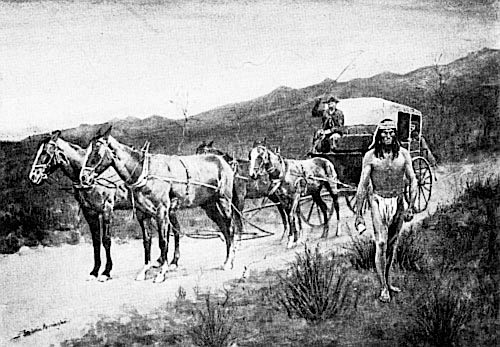
An Apache
Boasting Indian fashion
Jock Cumnor's awakening
"Don't nobody hurt anybody."
Each black-haired desert figure
He hesitated to kill the woman
His plan was to walk and keep quiet

Wednesday, June 29, 2011

Crime in early western fiction

Cover, 1902 edition
This may seem like a stretch, but the early western novel is more than a little about crime and criminals. I’m talking here specifically about the flood of novels that followed the huge popular success of Owen Wister’s The Virginian (1902).

The scores of writers of these westerns are unknown today except for Zane Grey. Most of them (again, with the exception of Grey) are as good as Wister. Many had long careers in the pulps and in hard cover, their stories often made into Hollywood films.

The essential themes of the western are on full display in The Virginian, and that includes an interest in the criminal mind. Wister’s imitators followed suit, inventing the genre as they went. So let’s start with Wister.

Trampas, the villain of the novel, qualifies on many counts as a sociopath. The historical West had its share of misfits, which is often how they got on the frontier in the first place. And Wister, writing from first-hand knowledge, didn’t have to dream up this bad guy.

Trampas is a cauldron of barely contained rage. Meanwhile, he can competently hold down a job as a cowboy – not an easy occupation. Still, engaged in a continuing battle of wits with our hero, the Virginian, he carefully avoids open conflict. He backs down when challenged with "When you call me that, smile" [Illustration at left].

Wister, Harvard-educated and from a prominent Philadelphia family, is curious about what makes such a man. In the characters of Steve and Shorty, he shows how two men are corrupted by their association with Trampas.

Both descend into thievery out of weakness of character, stealing horses and rustling cattle instead of working at an honest living. Steve, though he’s the Virginian’s long-time friend, is captured and hanged. Shorty could make a career of handling horses, which he has a gift for, but he's lured by Trampas' promises of easy money. Trampas then shoots him dead as the two men flee from the vigilantes, but with a single horse between them [Illustration below].

So far, the story has two elements that make it a western on the one hand and crime fiction on the other. It’s a western because it takes place on the “lawless” frontier. I put that word in quotes because there were in fact two kinds of law out there: duly constituted and something called the code of the West.

Thursday, February 10, 2011

Owen Wister, Lin McLean (1898)

Owen Wiste
This forgotten book is doing double duty as also a preview of Wyoming Week here at BITS, which starts on Monday.  As a favorite western destination of the young writer Owen Wister, Wyoming was the setting for his bestseller western, The Virginian (1902). Before that, it had already appeared in Wister's dispatches for Harper's Monthly Magazine, which found readers eager to read about life on the frontier.

One of Wister's early fictional characters was a cowboy called Lin McLean. Western writer Dane Coolidge observed that a copy of the collected stories, Lin McLean, could be found in almost any bunkhouse across the West in the first decades of the twentieth century. Its hero, an early version of Wister's Virginian, had the same boyish charm and natural nobility.

Though he comes from Eastern stock, he's a son of the plains, a man of homespun character, mostly unschooled, but both fiercely egalitarian and gentlemanly. An excellent horseman, good with a gun, handsome and gallant in his courtship of women, he is respected by all. Generous to a fault, he also takes under his wing a boy who has run away from a home that we'd describe today as thoroughly dysfunctional.

Harper's Monthly, 1895
A series of short stories strung together into a novel, Wister's book is really a romance in a western setting. It is still the time of the open range and frontier towns of Wyoming in the 1880s, an era already regarded as long past, just a decade later at the time of Wister's writing. There are no gunfights or outlaws.

While the book is chiefly a portrayal of an admirable young man, its storyline has to do with the winning of a young woman's hand - two women, actually. Each of them betrays him, one for lack of principle and the other for principles too highly refined.

Altogether, the book is an enjoyable and entertaining read that, besides its occasional quaintness, is fully enjoyable more than 100 years after its writing. Wister has a gift for both humor and poignancy. While the realities of cowboying, homesteading, and working with cattle hardly get a mention, his depiction of the Old West ranges easily from farce to sentiment to the starkly grim.

Little Laramie River, 1905

McLean's visit to Denver at Christmas suggests something of Dickens' London, and the account of a funeral comes as close as anything to black humor. As a precursor to The Virginian, these stories raised many issues that get fuller treatment in the later novel.

There are even glimpses of the Virginian himself, who gets brief walk-ons, with references to his own longstanding courtship of the schoolmarm from Vermont. With both men, Wister did more than anyone to invent the cowboy hero as he came to be known by everyone, from the bunkhouse to the parlor and eventually to the movie screen.

Lin McLean was adapted to film by John Ford in 1918 and retitled, A Woman's Fool, starring Harry Carey. The novel is available free online here and here, and at Abebooks.

Picture credits: wikimedia.org

Coming up: Wyoming Week