Tuesday, October 11, 2011

The Westerner (1940)

There are laugh-out-loud moments in this often-comic film about Judge Roy Bean (Walter Brennan) and an accused horse thief (Gary Cooper), a drifter who claims to have met Lily Langtry. From the details, you can tell the screenwriters did some homework, but they have not let facts get in the way of a good story.

Plot. At the heart of the film is the friendship that grows between Bean and the drifter, Cole Harden. When the jury finds him guilty, Bean sentences him to hang, then suspends the sentence when Harden says he can produce a lock of Lily’s hair. The two actors get many scenes together in the film, and they are a genuine pleasure.

Meanwhile, there’s a range war going on between cattlemen and a community of homesteaders busy putting up fences. Bean sides with the cattlemen and Harden tries to be a peacemaker, but to no avail. He stops an armed confrontation between the settlers and Bean, but he can’t stop the cattlemen from setting fire to the settlers’ crops and farmsteads.

Romance runs a respectable third among the storylines as a homesteader’s daughter (Doris Davenport) attempts to rein in drifter Harden. She wants him to settle down proper; he wants a lock of her hair. The one of Lily’s he’s promised to give to Bean is, of course, a fiction. 

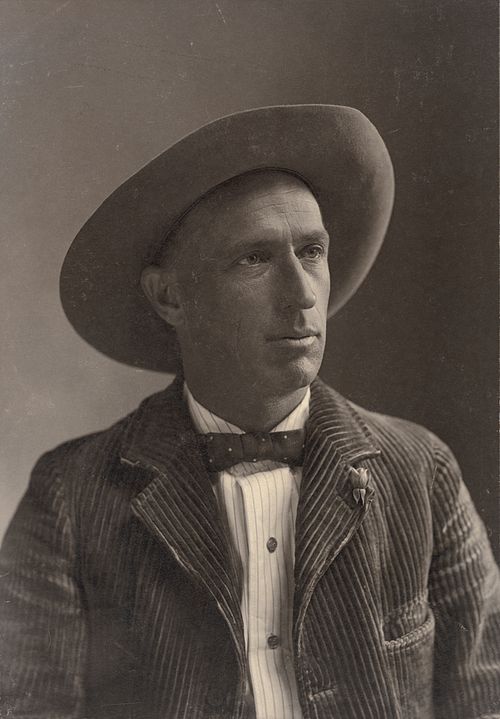
Judge Roy Bean
Action and realism. Besides a shootout and a hanging at the opening of the film, a couple fistfights, the fire, a chase on horseback, a gunfight in a theater, and several additional fatalities, the film is fairly low-keyed. Director William Wyler paces the dialogue slowly to linger on reaction shots, which Brennan and Cooper produce with relish.

Much of the film was shot on location, near Tucson, and the ramshackle town, the desert and mountains give the film a nicely realistic feel. The effect is heightened by Gregg Toland’s black and white photography, which captures dramatic skies and is often in deep focus.

There’s a remarkable fistfight between Cooper and one of the homesteaders, which is played in almost complete silence, just the sound of body blows. As the two men trade punches, they stir up a cloud of dust. Finally the camera focuses on the shadows of the two men on the ground, until one of them drops into the frame, beaten.

Cooper, in a later scene, shows the marks of the fight on his face. Then he gets painfully into his saddle, acknowledging that a man who’s been in a fight will have some aches from it afterwards. Knocked from his horse in another scene, he walks stiffly with a limp when he finally gets back on his feet.

There’s dust and dirt aplenty in some scenes. The actors’ clothes and hats are often thick with dust. The streets of town show the marks of much use, with bits of trash and what could very well be horseshit.

Besides Cooper’s 1940s-era red-tag Levi’s, lapses in verisimilitude come mostly with the “homesteaders,” and I put that in quotes because I believe there was never any federally administered homesteading in Texas. The roomy log house where some scenes take place seems lavishly furnished for dirt farmers who’d only recently arrived.

Wrapping up. This film is a must-see for Walter Brennan fans. In his mid-forties when the film was made, he already has the gravelly old-man’s voice and ragged beard that were his trademarks. In many ways, the film is his, and he received a well-deserved Supporting Actor Oscar for his performance. Also in the cast are Chill Wills and (briefly) Dana Andrews, both early in their screen careers.

Jo Swerling and Niven Busch get credit for the screenplay, which was based on a story by Stuart N. Lake. Busch’s script for the noir western Pursued (1947) was previously reviewed here. Lake wrote a biography of Wyatt Earp, on which My Darling Clementine (1946) was based, and he provided the story for Winchester ’73 (1950).

The Westerner
is available at netflix and amazon. Overlooked Movies is a much-appreciated enterprise of Todd Mason over at Sweet Freedom.

Sources: imdb.com 

Photo credit: Wikimedia Commons

Coming up: Cornell Woolrich, Waltz Into Darkness (1947)

Saturday, October 8, 2011

Western writer inspiration no. 6

Here is this week's omnibus of #westernwriter inspirations posted each day at twitter [click to enlarge]. If you are on twitter, you can follow me @rdscheer.

Montana cowboys herding cattle
A Bad Hoss. Charles Russell, 1904
The Horse Rustler, William Herbert Dunton (1878-1936)

Luke Short, gambler and gunfighter (1854-1893)
Cowboys branding cattle, 1891
Cowboy dinner-time, c1890
Roundup on the prairie, c1890

Photo credits: Wikimedia Commons

Coming up: The Westerner (1940)

Friday, October 7, 2011

Photo-finish Friday: out and about


What you miss with this photo is the thunderous sound of a huge marching band, which is having practice outside whenever I get off work. Backs to us is a row of 23 bass horn players. As a high school bass horn player, I know what it's like to pack, unpack, travel, march, and do routines with those big cumbersome instruments. So whenever I see a marching band, my attention is immediately drawn to them.

The band leader, whose voice betrays years of being yelled into permanent hoarseness, is amplified and runs the show like General Patton. In fact, I think of this band as the nearest thing to a paramilitary organization. They make such a powerful sound, you can hear them for blocks.

Photo-finish Friday is the bright idea of Leah Utas over at The Goat’s Lunchpail.

Thursday, October 6, 2011

John Neihardt, Lonesome Trail (1907)

Illustration for "The Nemesis of the Deuces" 
Born in Illinois, John Neihardt (1881-1973) grew up in eastern Nebraska and as a young man lived in Bancroft, near the Omaha reservation. A poet, he developed a life-long interest in Native American cultures. Much of his writing concerns the settlement of the West and the displacement of the Indians.

Lonesome Trail
was his first collection of stories, many of which had appeared in the magazines. He lists seven of them in the opening pages of the book: Munsey’s, Tom Watson’s, Overland Monthly, Scrap Book, All-Story, Smart Set, and The American Magazine.

Style and tone. While a few of the stories are about whites on the frontier, most of them are about Indians. And most of those attempt to assume an Indian point of view and style of storytelling. They have a sober, weighty tone not unlike the accounts of figures in the Old Testament.

They’re told with a matter-of-fact style that accepts the norms and customs of another culture without question. While Native Americans surely had a sense of humor and a capacity for irony, these stories are more high-minded in their purpose. They seem meant to carry the weight of life lessons, not simply to entertain.

Missouri, Oto, Ponca Indians, Karl Bodmer (1809-1893)
His portrayal of the Omaha, Ponca, and other tribes he knew can apparently make some claim to authenticity. Susan La Flesche-Picotte, the first Native American doctor, provided a note with one of Neihardt’s stories in a 1907 issue of Munsey’s. There she commended Neihardt for showing Indians as “beautiful, noble, and dignified” and for his “insight into the mysticism and spiritual nature of the race.”

Neihardt was a poet, and you realize at times you are reading the words of a writer with a poet’s sensibility. This happens typically when he has occasion to describe the prairie or the weather. There’s not a lot of this, however. Neihardt has stories to tell, and he seems intent on moving on to what happens next, with a kind of stark simplicity.

"The Look in the Face," Munsey's July 1906
Theme. Nearly all the 20 stories in the collection have a single theme. From the first, “The Alien,” about a half-breed who tries to befriend a wolf, to the last, “The Nemesis of the Deuces,” about a guilt-ridden drifter, they are about loss and isolation. Usually there’s a murder.

In “Feather for Feather,” White Cloud claims wrongly that he’s earned a feather by taking a Sioux chief’s scalp-lock in battle. In fact, he stole the scalp-lock from Little Weasel, who kills White Cloud in a fit of rage. Expelled from the tribe for killing a tribesman, Little Weasel gains re-entry—and gets his feather—by starting a prairie fire that burns over the tribe’s camp.

In “The Scars,” a man tells of transporting a prisoner from Pierre to St. Louis, where he is to be hanged for murder. The killing we learn, was in self-defense, and the victim had once left his killer to die so that he could marry a woman they both loved. When the prisoner fails to seize an opportunity to make an escape, he explains to his escort that he is not a coward just because he is going to be hanged. 

Achieving manhood. A frequent theme in the stories is the transition from boyhood to manhood, usually achieved in a Dream of greatness that comes as part of a ritual of initiation. Greatly to be desired is a dream of being a great warrior, pitiless and strong, as one mother hopes for her son. A dream of a great holy man or medicine man is also welcome. It means a direct line to Wakunda, the Great Spirit.

Neihardt’s stories are typically about failure to have a dream that promises greatness. His young males or more often than not disabled, physically weak, or taken by other less manly interests. Failing to achieve manhood means being relegated to the ranks of the women, whose job is to carry water and wood. Or such males may leave the tribe altogether, to wander on their own.

"The Lonesome Trail" published Feb. 1906
In “The Singer of the Ache,” an Indian boy fails to have a fortuitous dream. Instead, he has a vision of a woman in the moon, which has the effect of filling him with melancholy. A disappointment to the tribe, he happens to see a white woman on a northbound steamboat. He follows it, but eventually returns, having never found her. He is expelled from the tribe as a fool. 

Red and white. Whites and Indians cross paths in only a few of the stories. In “A Political Coup at Little Omaha,” Neihardt segues into farce, as Republican and Democratic candidates for Congress attempt to win the Indian vote by fair means or foul, and in total ignorance of their constituents.

Only a handful of stories are just about whites. In a dark tale, “The Revolt of a Sheep,” a man awaits execution for the slow and painful killing of a priest who has fathered a child by the man’s wife. In “The Nemesis of Deuces,” a man mournfully tells of a friend who gave up his life in a prairie fire so that one of them could escape on their only horse. 

John Neihardt's study, Bancroft, Nebraska
Wrapping up. Neihardt’s Indian stories may seem a little beyond the margins of the western with its usual concerns. But a look at the geography and the climate of Neihardt’s stories, and you recognize them as familiar “western” territory. For that reason it makes sense to include them in the big picture of western fiction.

The Lonesome Trail is currently available online at google books and Internet Archive.


Image credits:
Illustration for "The Nemesis of the Deuces" by F. E. Schoonover
Illustration for "The Look in the Face" by E. M. Ashe
All-Story cover,  FictionMags Index
Wikimedia Commons

Coming up: The Westerner (1940)

Wednesday, October 5, 2011

Overland Journeys in Early Western Fiction

On Thursday, at 8:00 a.m., I'll be presenting this paper at the Western Literature Association conference in Missoula, Montana. Thought you might like a preview.

In the brief time I have this morning, I’m going to try connecting a few dots in a way that’s related to the theme of this conference, “Bodies, Rest, Motion: Stasis and Mobility in the North American West.” I want to talk in particular about overland journeys by people traveling alone across sections of the frontier, and how that idea shows up in the fiction of a couple early western writers. 

Charles Lummis
Charles Lummis. First I’ll mention two real-life journeyers, who traveled alone across the North American landscape in the late 19th century. One of them was Charles Lummis, who as something of a publicity stunt went on foot from Cincinnati to Los Angeles in 1884, a distance of 3500 miles, which took him 143 days. He wrote it all up for the newspapers as he went, and his book about that trip A Tramp Across the Continent was published in 1892.

He stayed on in Los Angeles and became a prominent and controversial citizen. His large collection of Indian artifacts became the basis of the Southwest Museum of the American Indian, which is now part of the Autry Museum of Western Heritage.

Roger Pocock. Another long-distance traveler was a Brit by the name of Roger Pocock, who was something of an adventurer. In 1899, he rode on horseback from Fort McLeod in Alberta to Mexico City, a distance of 3600 miles. In no particular hurry, he took 200 days to make the trip across Montana, through Indian territory and along the Outlaw Trail into the Southwest and on into Mexico. He claimed to have met Butch Cassidy, but then so did a lot of people.

Pocock was a novelist who returned to England and went on to found the Legion of the Frontiersman of the Commonwealth, a kind of amateur intelligence-gathering organization in the years leading up to World War I. 

Old Stage-Coach of the Plains, Remington
Others. The West had for decades been traversed by scientific expeditions, cattle drovers, U.S. cavalry, homesteaders, railroad builders, gold and silver prospectors, freighters, traders, and outlaws—not to mention the original inhabitants, typically moved about under duress.

Most had somewhere to go and something to get done, and few of them traveled alone. Like Lummis and Pocock, there were also those who crossed it as an adventure, a high-risk personal journey that was a test of endurance.

Western writers. As the history of the West morphed into mythology, this mythology was preserved and elaborated by the growing ranks of writers about the West. In their fiction the western landscape emerged as a sometimes forbidding terrain on which a mythic drama was played out over and over.

Typically that drama was about an individual, almost always a man, who was given or took upon himself a difficult task. Often that task involved a lonely, perilous cross-country journey, either on foot or on horseback. Today I’d like to touch on a few instances of that as time permits.

All of us know Owen Wister, who did much to help invent the genre of the western novel. He was by no means the only writer of stories set in the West at the time. In 1883, Mary Hallock Foote had a novel about silver miners in Colorado called The Led-Horse Claim. Her letters and papers, by the way, were eventually the source material for Wallace Stegner’s Angle of Repose almost a century later.

Charles King
In 1890, Charles King, an officer in the U.S. Army, had a novel set in Texas called Dunraven Ranch about the uneasy relations between a cavalry outpost and a nearby cattle ranch. Starting in 1897, Alfred Henry Lewis published the first of three comic novels set in an Arizona town called Wolfville, a thinly disguised fictional stand-in for Tombstone.

In 1899, Mollie Davis had a range-war novel set in Texas called The Wire-Cutters. That same year, Canadian author Ralph Connor produced the first of several novels, called The Sky Pilot, about an itinerant preacher on the range. Also in 1899, Frederic Remington, the painter, had a novel set in Montana, named after its half-breed protagonist, Sundown Leflare.

In 1901, a year before The Virginian, Stewart Edward White’s mining camp novel The Westerners was set like Deadwood in Dakota Territory. There another half-breed character runs a dancehall, corrupts the morals of a young woman, and plots against a prospector he dislikes. Then in the same year, we get Henry Wallace Phillips’ collection of short stories named after their main character, Red Saunders. 

And here we can see a shift taking place. Red is a big, healthy, physically strong, good-humored cowboy, with plenty of gumption and nerve. Living and working in Dakota Territory, he may be found attempting to escape a band of bloodthirsty Indians or joining his friends to help a love-sick cowboy elope with the rancher’s daughter. He’s a cousin of Owen Wister’s Lin McLean, a Wyoming cowboy who’d already appeared in a collection of stories in 1897. 

TR and John Muir at Glacier Point
The strenuous life. Teddy Roosevelt’s arrival in the White House seems to have ushered in a new twist on this material. An advocate of the strenuous life, he regarded the West as terrain for development of character. Out here, far from civilization, men like himself could prove their mettle.

And so we begin seeing more instances in western fiction of men who make a display of their manhood with long, lonely, sometimes perilous overland journeys. I’m going to talk about just two of the dozens of early western writers whose imagined West was captured between the covers of novels. One is Zane Grey. The other is Eugene Manlove Rhodes.

Zane Grey. Grey’s first novel was The Heritage of the Desert (1910). It tells the story of a man, Jack Hare, who recovers from an undisclosed sickness of both body and soul in the clean desert air of southern Utah. He is first of all saved from death by the patriarch of a Mormon family. But the real boost to his physical and spiritual health is the love he comes to feel for a half-breed Indian maiden, Mescal, who lives and works at the family compound. She is, alas, destined to be the second wife of the rancher’s villainous son.

Zane Grey at Penn, c1895
The test of Hare’s character comes in a long, protracted journey across the desert sands in search of Mescal, who has run off on her wedding night. He nearly perishes in his search for her, and when he finally finds her, they make a slow return to the ranch, along a route that takes them through the Grand Canyon. There in this magnificent setting, their love is cemented, if not consummated. More important, Hare has shaken off his former self and taken command of his life. By the end of the novel, he has defeated his enemies and won Mescal for himself.

Grey in this early novel is not yet the top-ten bestseller writer he would become a few years later, with The Lone Star Ranger (1915) and The U. P. Trail (1917). This novel is heavily melodramatic and suffers from having only one point-of-view character from beginning to end. It’s also an Easterner’s mythologizing of a West that Grey knew from very little first hand experience.

Eugene Manlove Rhodes. By contrast, Rhodes had grown up in New Mexico, had cowboyed, prospected, and held a number of frontier occupations. He apparently had known some shady characters as well. He was a Westerner who always wrote of the West, he said, with a regard for accuracy that kept him true to his subject.

Eugene Manlove Rhodes
Unlike Grey, who was apparently an indifferent student at the University of Pennsylvania, where he had a baseball scholarship, Rhodes was largely self-taught, too poor to attend college except for one year, which he financed himself. He is remembered as a voracious reader, who often read books while riding a horse.

His love of language and literature shows through in his stories, which are often cleverly told, while displaying a deep feeling for the integrity of his characters. His novel Bransford of Rainbow Range (1913) involves a long horseback ride along the Tularosa Valley all the way across the Rio Grande to Mexico. The protagonist, Jeff Bransford, is being pursued by the law for a crime he didn’t commit.

Rhodes does a reprise of this ride in Paso Por Aqui (1926). Again, the character is on the dodge from the law, and the description of riding, riding, riding is told at a pace that replicates the experience of covering long, sparsely populated distances. And each time, his rider is put to the test, proving the quality of his intelligence, his manhood, and his integrity.

As someone who grew up on a remote farm in Nebraska during the 1940s and 1950s, I recognize Rhodes’ account of time spent alone and in the open. While my traveling was on a tractor, back and forth across quarter-mile long fields of corn and hay, I know the inner experience he describes. To be there with your own thoughts hour after hour under a big sky of sun and clouds. In the chill air of early morning and the dry, hot wind and dust of mid-day. No radio, no iPhone. I know why cowboys sang, and why they talked to their horses. 

Cornfield near Mitchell, Nebraska, 1910
Wrapping up. What I’m driving at here has something to do with how both these writers use a similar plot device for very different ends. Grey in this early novel saw the West as the setting for myth, romance, and melodrama. The overland journey is a quest, and surviving the rigors of travel, his character lays claim to his manhood.

Rhodes sees the West in all its dusty, gritty reality. It’s a life in a harsh climate that is not softened by myth and romance but by humor and irony. Adversity is to be expected. It comes to a man unbidden. Only one already in full possession of his manhood accepts its challenges.

And manhood for Rhodes is measured by cleverness and frontier resourcefulness, not a fast draw or a fistfight. Jeff Bransford escapes the men who are on his trail by brazenly outwitting them. In Grey’s novel, the hero’s adversaries are villains, and he doesn’t get the best of them until they’ve been shot dead.

And this difference marks the way to the traditional and more popular western that flourished with Zane Grey. While Rhodes’ portrayal of westerners and the West has had its followers, the mainstream of Western fiction evolved in the style of Grey’s first novel. As a result, the long overland journey of the western novel itself has taken place in the romanticized West of melodrama, gunplay, and bloodshed.

Photo credits: Wikimedia Commons
Photo portrait of Eugene Manlove Rhodes, Journal of the Southwest, 1967

Coming up: John Neihardt, The Lonesome Trail (1907)

Tuesday, October 4, 2011

Destry Rides Again (1939)

This comic western from 1939 has James Stewart as Thomas Jefferson Destry, who comes from Tombstone to clean up the lawless town of Bottleneck. Though a gunslinger with a dead aim, which he gladly demonstrates, he declares that he’s going to do the job without the use of firearms.

Plot. He arrives 20 minutes into the film, carving napkins rings and delivering aw-shucks lines that make him seem no threat to the saloon-keeping crook who runs the town. Playing Kent, the villain, with his usual smooth relish, is Brian Donlevy. His partner in crime is a chanteuse called Frenchy, played with sultry comic flair by Marlene Dietrich, at her best.

Kent and his henchmen have done away with the previous sheriff, and until Destry finally gets his back up by film’s end, they don’t see him as a problem. They take possession of a ranch, won with a bit of trickery in a card game. Destry even supports their claim, since they have it in writing.

Trouble begins to brew when Destry gets over curious about the disappearance of the previous sheriff. When a body turns up, suspicion settles on Kent. Before long the new sheriff is dead, too, shot in the back.

Accounts are finally settled as Destry gets out his guns and with some dynamite mounts an attack on the saloon. There in a melee between the saloon customers and a force of outraged women of the town, Donlevy attempts to gun down Destry. But his gunfire takes the life of Frenchy instead, who has put herself inconveniently in Destry’s arms. And Kent meets his end, with a shot from the now-armed Destry.

Comedy. I’m no big fan of western comedies, and I could name a few. But this one beats them all for sheer fun. Hard to say exactly what makes it work. On the one hand, it’s a sober-sided story about a town run by a slick bastard who cheats an honest man out of his ranch and kills an officer of the law to cover it up.

Then it can veer off into broad farce, as when a married man loses his pants in a card game with Frenchy. When his wife comes into the saloon to sling a few insults, Frenchy isn’t above slugging it out with her. Their furniture-smashing fight is a wild parody of every barroom brawl ever seen in a western.

As for Dietrich’s character, she’s a fun-loving dancehall queen, who knows she’s gorgeous and can have any man she wants, married or not. Yet there’s an honest woman in her somewhere fighting to get out, and Destry’s friendship stirs up feelings she’s long hidden from herself. A woman with a past, she’s destined by the Hollywood Production Code to die with no more than a kiss from the man she’s come to have some feelings for.

So the film is not all scenes of knee-slapping glee. The town drunk reforms when he’s appointed to fill out the term of the previous sheriff and is shot for his efforts to bring law and order to the town. His death is played for all the honest sentiment to be wrung from it.

The farce balances the sentiment, and at the center is the bemused character of Destry himself, who wants no more than to be an honorable man and do the right thing. And that is surely the key to what makes this film such a pleasure.

Some credit surely goes to veteran director George Marshall, with a mile-long list of film projects going far back into the silent era. Fifteen years later he directed the remake, Destry (1954), with Audie Murphy. Screenplay credits go to three writers: Felix Jackson, Gertrude Purcell, and Henry Myers. The script was based (no doubt very loosely) on a novel of the same name by Max Brand.

Destry Rides Again is currently available at netflix and amazon. Overlooked Movies is a much-appreciated enterprise of Todd Mason over at Sweet Freedom.

Sources:
imdb.com

Coming up: Overland Journeys in Early Western Fiction

Saturday, October 1, 2011

Western writer inspiration #5

Here is this week's omnibus of #westernwriter inspirations posted each day at twitter [click to enlarge]. If you are on twitter, you can follow me @rdscheer.

Cowboy boots, (CC) Cyril Mayer

A Bronc to Breakfast by Charles Russell, 1912

Zydeco cowboy, Geno Delafose, (CC) I, Sumori

Buffalo Bill's Wild West; poster, c1899

Cattle roundup, Great Falls, Montana, c1890

South Dakota cowboys branding cattle, 1888

Texas cowboy by Stanley L. Wood (1866-1928)

Image credits: Wikimedia Commons

Coming up: Overland Journeys in Early Western Fiction