Showing posts with label eugene manlove rhodes. Show all posts

Wednesday, October 5, 2011

Overland Journeys in Early Western Fiction

On Thursday, at 8:00 a.m., I'll be presenting this paper at the Western Literature Association conference in Missoula, Montana. Thought you might like a preview.

In the brief time I have this morning, I’m going to try connecting a few dots in a way that’s related to the theme of this conference, “Bodies, Rest, Motion: Stasis and Mobility in the North American West.” I want to talk in particular about overland journeys by people traveling alone across sections of the frontier, and how that idea shows up in the fiction of a couple early western writers. 
Charles Lummis
Charles Lummis. First I’ll mention two real-life journeyers, who traveled alone across the North American landscape in the late 19th century. One of them was Charles Lummis, who as something of a publicity stunt went on foot from Cincinnati to Los Angeles in 1884, a distance of 3500 miles, which took him 143 days. He wrote it all up for the newspapers as he went, and his book about that trip A Tramp Across the Continent was published in 1892.

He stayed on in Los Angeles and became a prominent and controversial citizen. His large collection of Indian artifacts became the basis of the Southwest Museum of the American Indian, which is now part of the Autry Museum of Western Heritage.

Roger Pocock. Another long-distance traveler was a Brit by the name of Roger Pocock, who was something of an adventurer. In 1899, he rode on horseback from Fort McLeod in Alberta to Mexico City, a distance of 3600 miles. In no particular hurry, he took 200 days to make the trip across Montana, through Indian territory and along the Outlaw Trail into the Southwest and on into Mexico. He claimed to have met Butch Cassidy, but then so did a lot of people.

Pocock was a novelist who returned to England and went on to found the Legion of the Frontiersman of the Commonwealth, a kind of amateur intelligence-gathering organization in the years leading up to World War I. 

Old Stage-Coach of the Plains, Remington
Others. The West had for decades been traversed by scientific expeditions, cattle drovers, U.S. cavalry, homesteaders, railroad builders, gold and silver prospectors, freighters, traders, and outlaws—not to mention the original inhabitants, typically moved about under duress.

Most had somewhere to go and something to get done, and few of them traveled alone. Like Lummis and Pocock, there were also those who crossed it as an adventure, a high-risk personal journey that was a test of endurance.

Western writers. As the history of the West morphed into mythology, this mythology was preserved and elaborated by the growing ranks of writers about the West. In their fiction the western landscape emerged as a sometimes forbidding terrain on which a mythic drama was played out over and over.

Typically that drama was about an individual, almost always a man, who was given or took upon himself a difficult task. Often that task involved a lonely, perilous cross-country journey, either on foot or on horseback. Today I’d like to touch on a few instances of that as time permits.

All of us know Owen Wister, who did much to help invent the genre of the western novel. He was by no means the only writer of stories set in the West at the time. In 1883, Mary Hallock Foote had a novel about silver miners in Colorado called The Led-Horse Claim. Her letters and papers, by the way, were eventually the source material for Wallace Stegner’s Angle of Repose almost a century later.

Charles King
In 1890, Charles King, an officer in the U.S. Army, had a novel set in Texas called Dunraven Ranch about the uneasy relations between a cavalry outpost and a nearby cattle ranch. Starting in 1897, Alfred Henry Lewis published the first of three comic novels set in an Arizona town called Wolfville, a thinly disguised fictional stand-in for Tombstone.

In 1899, Mollie Davis had a range-war novel set in Texas called The Wire-Cutters. That same year, Canadian author Ralph Connor produced the first of several novels, called The Sky Pilot, about an itinerant preacher on the range. Also in 1899, Frederic Remington, the painter, had a novel set in Montana, named after its half-breed protagonist, Sundown Leflare.

In 1901, a year before The Virginian, Stewart Edward White’s mining camp novel The Westerners was set like Deadwood in Dakota Territory. There another half-breed character runs a dancehall, corrupts the morals of a young woman, and plots against a prospector he dislikes. Then in the same year, we get Henry Wallace Phillips’ collection of short stories named after their main character, Red Saunders

And here we can see a shift taking place. Red is a big, healthy, physically strong, good-humored cowboy, with plenty of gumption and nerve. Living and working in Dakota Territory, he may be found attempting to escape a band of bloodthirsty Indians or joining his friends to help a love-sick cowboy elope with the rancher’s daughter. He’s a cousin of Owen Wister’s Lin McLean, a Wyoming cowboy who’d already appeared in a collection of stories in 1897. 

TR and John Muir at Glacier Point
The strenuous life. Teddy Roosevelt’s arrival in the White House seems to have ushered in a new twist on this material. An advocate of the strenuous life, he regarded the West as terrain for development of character. Out here, far from civilization, men like himself could prove their mettle.

And so we begin seeing more instances in western fiction of men who make a display of their manhood with long, lonely, sometimes perilous overland journeys. I’m going to talk about just two of the dozens of early western writers whose imagined West was captured between the covers of novels. One is Zane Grey. The other is Eugene Manlove Rhodes.

Zane Grey. Grey’s first novel was The Heritage of the Desert (1910). It tells the story of a man, Jack Hare, who recovers from an undisclosed sickness of both body and soul in the clean desert air of southern Utah. He is first of all saved from death by the patriarch of a Mormon family. But the real boost to his physical and spiritual health is the love he comes to feel for a half-breed Indian maiden, Mescal, who lives and works at the family compound. She is, alas, destined to be the second wife of the rancher’s villainous son.

Zane Grey at Penn, c1895
The test of Hare’s character comes in a long, protracted journey across the desert sands in search of Mescal, who has run off on her wedding night. He nearly perishes in his search for her, and when he finally finds her, they make a slow return to the ranch, along a route that takes them through the Grand Canyon. There in this magnificent setting, their love is cemented, if not consummated. More important, Hare has shaken off his former self and taken command of his life. By the end of the novel, he has defeated his enemies and won Mescal for himself.

Grey in this early novel is not yet the top-ten bestseller writer he would become a few years later, with The Lone Star Ranger (1915) and The U. P. Trail (1917). This novel is heavily melodramatic and suffers from having only one point-of-view character from beginning to end. It’s also an Easterner’s mythologizing of a West that Grey knew from very little first hand experience.

Eugene Manlove Rhodes. By contrast, Rhodes had grown up in New Mexico, had cowboyed, prospected, and held a number of frontier occupations. He apparently had known some shady characters as well. He was a Westerner who always wrote of the West, he said, with a regard for accuracy that kept him true to his subject.

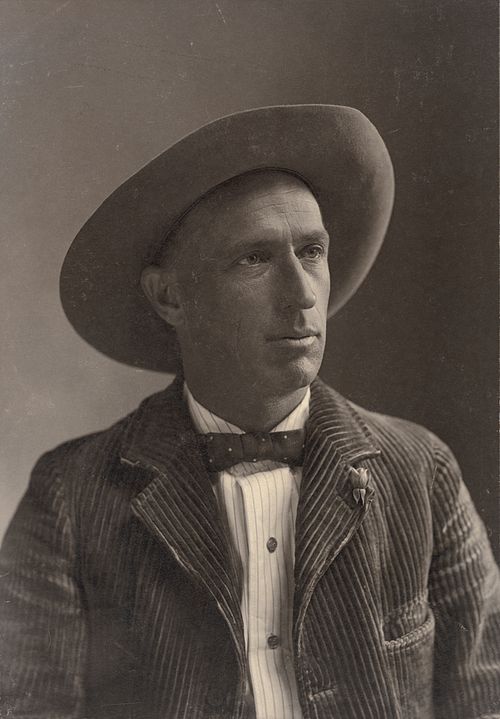
Eugene Manlove Rhodes
Unlike Grey, who was apparently an indifferent student at the University of Pennsylvania, where he had a baseball scholarship, Rhodes was largely self-taught, too poor to attend college except for one year, which he financed himself. He is remembered as a voracious reader, who often read books while riding a horse.

His love of language and literature shows through in his stories, which are often cleverly told, while displaying a deep feeling for the integrity of his characters. His novel Bransford of Rainbow Range (1913) involves a long horseback ride along the Tularosa Valley all the way across the Rio Grande to Mexico. The protagonist, Jeff Bransford, is being pursued by the law for a crime he didn’t commit.

Rhodes does a reprise of this ride in Paso Por Aqui (1926). Again, the character is on the dodge from the law, and the description of riding, riding, riding is told at a pace that replicates the experience of covering long, sparsely populated distances. And each time, his rider is put to the test, proving the quality of his intelligence, his manhood, and his integrity.

As someone who grew up on a remote farm in Nebraska during the 1940s and 1950s, I recognize Rhodes’ account of time spent alone and in the open. While my traveling was on a tractor, back and forth across quarter-mile long fields of corn and hay, I know the inner experience he describes. To be there with your own thoughts hour after hour under a big sky of sun and clouds. In the chill air of early morning and the dry, hot wind and dust of mid-day. No radio, no iPhone. I know why cowboys sang, and why they talked to their horses. 

Cornfield near Mitchell, Nebraska, 1910
Wrapping up. What I’m driving at here has something to do with how both these writers use a similar plot device for very different ends. Grey in this early novel saw the West as the setting for myth, romance, and melodrama. The overland journey is a quest, and surviving the rigors of travel, his character lays claim to his manhood.

Rhodes sees the West in all its dusty, gritty reality. It’s a life in a harsh climate that is not softened by myth and romance but by humor and irony. Adversity is to be expected. It comes to a man unbidden. Only one already in full possession of his manhood accepts its challenges.

And manhood for Rhodes is measured by cleverness and frontier resourcefulness, not a fast draw or a fistfight. Jeff Bransford escapes the men who are on his trail by brazenly outwitting them. In Grey’s novel, the hero’s adversaries are villains, and he doesn’t get the best of them until they’ve been shot dead.

And this difference marks the way to the traditional and more popular western that flourished with Zane Grey. While Rhodes’ portrayal of westerners and the West has had its followers, the mainstream of Western fiction evolved in the style of Grey’s first novel. As a result, the long overland journey of the western novel itself has taken place in the romanticized West of melodrama, gunplay, and bloodshed.

Photo credits: Wikimedia Commons
Photo portrait of Eugene Manlove Rhodes, Journal of the Southwest, 1967

Coming up: John Neihardt, The Lonesome Trail (1907)

Monday, December 13, 2010

Eugene Manlove Rhodes, stories

Today I’m taking a quick look back at Eugene Manlove Rhodes. I have a copy of a story collection, The Rhodes Reader, assembled by W. H. Hutchinson in 1957. This is truly a “forgotten book” available only from used book sellers, even though reprinted a couple of times since then.

Hutchinson begins the book with an essay on western fiction at a time when as a genre it was still going strong, both in print and on screen. The heyday of pulp fiction was past, but he predicts that the western is here to stay. He only laments that it hasn’t been taken seriously as a narrative genre since Zane Grey first drew scorn from the literary establishment.

In his essay, he argues that Grey fixed the genre in a formula of three elements: “virgins, villains, and varmints.” Each is defined by a limited selection of stereotypes. He attributes this in part to a simple fact. Western writers, including Grey, were chiefly “outsiders” from east of the 100th meridian, writing about a West they knew only selectively and from partial experience.

Grey vs. Rhodes. Grey, as we’ve seen, was writing about a mythic West. He favors action and melodrama set against a panoramic backdrop of mountain, desert, and canyons. Romance is elevated to grand passion. Villains are evil and must die. It is escapism pure and simple.

After reading writers of western fiction who were his contemporaries, you soon notice his utter lack of wit and humor. If there is irony in his writing, it can be heavy-handed. He was no master of the light touch.

The son of a dentist, Grey grew up in Pennsylvania and Ohio. He went to the University of Pennsylvania on a baseball scholarship and was apparently a middling student. It’s worth noting that he knew the West as a place for adventuring. He wrote for Field and Stream, which featured his articles on hunting mountain lions and deep-sea fishing.

Sacramento Mountains, New Mexico
Rhodes, Hutchinson reminds us, grew up in Nebraska and Kansas before resettling with his family in New Mexico. He worked there as a cowboy, miner, freight hauler, and in at least a dozen other jobs from an early age. The characters in his stories were men he actually knew. It is said that he wouldn’t write a word that would ring false to any of them.

There are virgins, villains and varmints in his fiction, but he presents them with a feeling for the human comedy. To know all is to forgive all. The virgins are clever and surprisingly daring in their refusal to be sidelined because of their gender – or their need of rescue. Violence between adversaries is avoided if possible. Life is hard enough without willfully making it worse.

Rhodes was mostly self-educated and a voracious reader from an early age. His fiction is full of literary allusions and a playful love of language. There is wit and humor and a brand of irony that make light of adversity and the harsh conditions of western life. It is a “western” sensibility.

So today I’m briefly looking at a few of his first stories, all of them published before 1910.

Monday, October 25, 2010

B. F. Day, Gene Rhodes Cowboy

This curious biography of writer Eugene Manlove Rhodes was published in 1954. Reading it takes you right back to that post-war decade, if you were around then, for Day was a writer for Reader’s Digest. The style and tone of that monthly magazine are unmistakable. It existed at the dead center of American mainstream culture. A wholesome, family-friendly periodical, it embodied the unquestioned values of its middle-class audience. My father, a working man all his life, with an eighth-grade education and a life-long curiosity about most everything, hardly missed an issue.

In this splintered age, it’s hard to imagine a publication that  appealed to such a huge popular audience. But it did. It even encouraged book-reading of a kind, publishing each month 4-5 current novels in “condensed” form. In my book-starved boyhood, far from a public library or bookstore, I remember reading them.

Day’s short biography of Eugene Manlove Rhodes brought that all back. Not in a nostalgic way, but as an object lesson in how the values of a time and place get embedded in a writer’s tone, style, and choice of details.

To meet the expectations of her 1950s audience, Day takes a life that was full of contradictions and complications and smooths it all over until it fits into a familiar pattern. In this case, it’s the story of a striver and a scrapper from humble beginnings who makes a name for himself as a writer, with the encouragement of a loving wife.

The wife. Rhodes’ widow, May, apparently contributed generously to the writing of this book. Day dedicates the book to her. In 1897, she was recovering from an illness, the mother of two boys by a previous marriage, and wrote Gene a fan letter after reading two of his published poems.

His reply to her was 20 hand-written pages, signed “Love, Gene,” and a long-distance romance bloomed between them. The only thing separating them was 2,000 miles. She lived in Apalachin, New York. After marrying in 1899 and living together in New Mexico for a while, they both returned East so May could look after her ageing parents. And so Gene gave up cowboying and became a farmer, devoting what time there was to writing – and amusing himself .

Tuesday, September 21, 2010

Four Faces West (1948)


This is the film based on Eugene Manlove Rhodes’ novel Pasó Por Aquí, first published in 1926. In that novel, a young man robs a storekeeper and while on the run finds a Mexican family dying of diphtheria in an isolated cabin. He nurses them back to health and is found there by Pat Garrett.

The film is an interesting example of how a story that originates in print is bent to fit the expectations of a Hollywood audience. You can begin with the title. It morphs from Spanish to English, and it’s not even an attempt at translation. Meanwhile, Four Faces West is a generic title that doesn’t fit the story. There are several possible combinations of four characters in the film, and they’re all heading south, not west.

The hero. Made today, the film would star a younger actor as the central character, Ross McEwen. Which would be a lot closer to what Rhodes had in mind. His McEwen has a young man’s impulsiveness and high-risk resourcefulness. He robs the storekeeper because he needs the money, but he throws it all away when the posse is about to nab him. That he has the moral integrity to stop and help this sick family has to come as a surprise.

Joel McCrae’s portrayal is more in keeping with a 1940s Hollywood cowboy stereotype. At 43, McCrae plays him as a sincere guy, down on his luck. He robs a bank to get a $2000 “loan” to send to his father. We are to recognize him as a basically good man driven to a desperate act. Later, when he wins money playing cards, he wants to begin repaying the “loan.”

The film’s outcome depends on whether he stops running from the law and turns himself in. This would prove that he’s not a coward and not a criminal. In Rhodes story, on the other hand, he’s already proven this by giving up his run for the border to save the Mexican family.

He has no further debt to pay society, and Pat Garrett as the moral center in the story, recognizes this. While the film ends with Garrett (Charles Bickford) taking McEwen into custody, the original story ends with the two men gathering firewood together and not acknowledging each other’s true identity. A nurse from the East learns that this is the way of the West.

Romance. Hollywood likes a love story, and the writers have injected one here. The nurse Jay (called Fay in the movie) who appears only at the beginning and end of Rhodes novel, becomes a central character in the screen version. She is played by Frances Dee, Joel McCrae’s wife in real life. Bitten by a rattlesnake before jumping on a train bound for El Paso, McEwen is treated by Fay. And the screenwriters have them travel to Alamogordo together.

Along the way, she gets to like him but begins to suspect that he is the man wanted for bank robbery. There’s a big reward out for his capture, dead or alive. In true Hollywood style, his attraction to her keeps him from hurrying on to safety in Mexico. He stops for a time in Alamogordo, but Pat Garrett and the rest of the posse eventually track him there.

Wednesday, September 15, 2010

Book: Pasó Por Aquí

There’s a playful mood throughout Eugene Manlove Rhodes’ Good Men and True and Bransford of Rainbow Range. This novel, Pasó Por Aquí is pretty thoroughly serious.

Adobe Church, Cordelia Wilson, New Mexico, c1920
It is a study in qualities of character, as it seems to have been understood in the West. And it boils down simply to the Golden Rule. Do unto others. This is Rhodes’ story most often regarded as his best. Though not his last work (it was first published in February 1926 in Saturday Evening Post), it feels like a writer in middle-age looking back over his career.

In 1926, Rhodes was 57 and returning to New Mexico after an absence of twenty years. It’s said that coming back was a disappointment for him. The New Mexico he’d known was gone – gone with Pat Garrett, killed on a lonely road in 1908.

The story. There are familiar Rhodes elements in this story – a man being pursued by the law, detailed descriptions of long rides on horseback, an intelligent and articulate woman, and characters pretending to be someone else, with an assumed name. The location is also familiar, the Tularosa Valley.

Main Street, Hope, New Mexico, c1900
Like Good Men and True and Bransford of Rainbow Range, the novel starts with a conversation. This time it’s a scene of idle badinage between a young woman and a young man who is trying to court her. She is a nurse at the Alamogordo Hospital. He is an Easterner, of no particular talent and subscribing to no particular work ethic.

They learn of a robbery that has taken place in Belen, far off in central New Mexico, near Albuquerque. The robber held up a storekeeper at the point of a shotgun, which later turned out to be not loaded. About to be apprehended by a posse, he threw down the money he’d taken and escaped again.

The hero. There’s a comic touch to all this, but the tone turns more serious as the point of view shifts to the young man on the run. His name is Ross McEwen and he’s riding, riding, riding south, until he’s passing through the Tularosa Valley on his way to Mexico.

Yucca, White Sands, New Mexico
It’s not easy going because the valley has become settled with ranches. He marks his progress by the windmills he steers clear of, staying out of sight of riders he sees in the distance.

He’s hungry and thirsty and his horse is wearing out from the long ride. Eventually, he ends up on foot, crossing the White Sands. There he comes upon an isolated cabin where a Mexican family has fallen sick with diphtheria. And without a second thought, he stays with them, tending to them in a desperate and exhausting attempt to keep them alive.

Pat Garrett
A signal fire eventually draws to them none other than Sheriff Pat Garrett, who sends his deputy to Alamogordo for food, water, and medical help. Seeing the exhausted young man, he tells him to get some sleep. Though the young man calls himself by another name, it’s clear Garrett knows who he is.

The story resolves itself (again, no spoilers; read it) in a way that’s a lesson in integrity. The black-and-white world of standard brand morality loses traction out here in the West. What we get is a man on the wrong side of the law who behaves heroically, while a law-abiding one (the Easterner) is little better than a jerk.

Western melancholy. Reading about the West, you often find under the can-do surface a deep current of melancholy – a sense of loss. It takes many forms. For some it is about promises unfulfilled, and the West has surely seen as many dreams dashed as fulfilled. Maybe more.

Long before there were environmentalists, westerners lamented the loss of the wilderness, the demise of the buffalo and other wildlife, the loss of the open range and the freedom of the frontier.

It was said of Rhodes that he was a melancholy man himself. It’s not hard to think of reasons. His life was not easy. As the oldest of his siblings, he went to work at an early age. And while people remembered him fondly, he was the kind of person who found solace in books. One gathers that he would have gladly stayed on in college to complete his education if there’d been the money.

After the Snowfall, Cordelia Wilson, New Mexico, c1920
In his novels, he seems to create a hero like himself, but who lives in a world cut more to his size. It’s filled with loyal friends, and when he falls in love, the girl has a temperament that suits him, and she loves him back. It’s a comic world, where difficulties are overcome with wit and intelligence. And all is grounded in the New Mexican landscape that he loved.

The melancholy, alas, emerges in Pasó Por Aquí. What is past beyond retrieving, Rhodes seems to be saying, is the West where a person’s character counted. Like Wister in The Virginian, he puzzles over what makes a person “good.” But he comes up with another answer.

In this novel, self-sacrifice while coming to the aid of the undefended is the evidence of true worth in an individual. To give all where it’s needed is the true test of moral integrity. It matters more than reputation, which may be either good or bad, and it outweighs any misdeeds that may get someone into trouble. What this resembles is the unwritten Code of the West, which existed before the arrival of the law.

Maybe it’s a sentimental view – the good-bad man we often find in westerns. But Rhodes frames it in a much larger vision. The perspective is that of not just a single lifetime but of time itself. Surely the vastness of the western landscape invites this point of view.

El Morro, western New Mexico
Summing up. The title of the book, as one of the characters explains, can be found among the inscriptions on a sandstone bluff in western New Mexico. Since Spanish colonial times, it’s been known as El Morro (The Headland). It stands today on the Ramah Navajo Indian Reservation.

Inscription, El Morro, 1709
For centuries, travelers who have stopped there for water have left their mark on the stone. Pasó por aquí. I passed by here. In the novel the phrase becomes the summing up of a life. Everything we do adds up to this simple fact. We come, we go, and in the meantime, while we are here, we can choose to give more than we take.

Rhodes lived only a few years in New Mexico and then moved on with his wife to Pacific Beach, California, near San Diego, where he died in 1934. He had been in poor health and was penniless. At his request, he was buried on the site of his old ranch in the San Andres Mountains. On his gravestone are the words, Pasó por aquí.

A few of Rhodes stories were made into films. This novel was adapted and released in 1948 as Four Faces West, with Joel McCrae as Ross McEwen and Charles Bickford as Pat Garrett. I'll be getting back to this story when I've had a chance to see it.

Meanwhile, anyone wishing to do some in-depth research on this well-deserving western writer will find what sounds like a truckload of his papers, letters, photos, and manuscripts at the Huntington Library in San Morino, California.  The catalog mentions seven boxes of material, with a total of 1,433 items.

         
Picture credits:

1) Adobe Church, Cordelia Wilson, New Mexico, c1920
2) Hope, New Mexico, c1900, freepages.family.rootsweb.ancestry.com
3) Yucca, White Sands, wikimedia.org
4) Pat Garrett, wikimedia.org
5) After the Snowfall, Cordelia Wilson, New Mexico, c1920, wikimedia.org
6) El Morro National Monument, Ramah Navajo Indian Reservation, NM, wikimedia.org
7) Inscription at El Morro, nps.gov/elmo

Coming up: Rex Beach's story collection, Pardners (1906)

Tuesday, September 14, 2010

Bransford of Rainbow Range, part 2

Rhodes' novel first appeared as a five-part serial called "The Little Eohippus" in the November and December 1912 issues of Saturday Evening Post.  When it was published in book form the following year, it went by the title Bransford in Arcadia, or The Little Eohippus. Arcadia is the name of a town where some of the story takes place. The eohippus is the name given to the ancestor of the horse. It was a small mammal with toes instead of hooves.

Charlotte Perkins Gilman, c1900
It plays a part in the plot as a pocket-size turquoise figurine carried by Jeff Bransford. Its role is occasion for a verse that gets quoted in the novel:

Said the little Eohippus;
“I’m going to be a horse!
And on my middle fingernails
To run my earthly course!”

The lines are from a poem, “Similar Cases,” by American sociologist and writer, Charlotte Perkins Gilman (1860-1935), an early feminist.

You can make a little or a lot out of all this. The oddness of a small horse with toes reflects something of Rhodes himself, the book-reading cowboy with two years of college and a head full of ideas. He also shows no discomfort putting the words of a feminist writer into the mouth of his cowboy hero.

Romance. All of which brings us to the role played by Ellinor Hoffman, the young woman who falls for him and gets him into so much trouble. Of all the early western fiction I’ve read so far (and I’ve still got a ways to go), Ellinor fits most easily into a cowboy world.

Young Woman in Green, William Glackens, c1915
She is intelligent and resourceful – in ways we don’t fully appreciate until the end of the novel. She’s also “finished,” in the way that word used to mean. Pretty as a picture, clever, witty, and a match for Bransford. She falls in love with him at first sight, as he does with her.

The nearest thing like them is B. M. Bower’s two sweethearts in her Chip of the Flying U. Only her story is more of a ranch romance. Bertrand Sinclair, in Wild West, also has this kind of love-story somewhere in mind, but the sweetheart of his cowboy hero is a marginal character. Added value, but not central to the story.

Owen Wister may also have been trying for this kind of romance. The Virginian has a similar chivalrous respect for a woman’s honor. Just as he lights into Trampas for an ungentlemanly remark about the schoolmarm, Jeff defends Ellinor. After an ungracious remark by a companion, he says, “If you slur that girl again I’ll not shoot you – I’ll naturally wear you out with this belt.”

But Wister’s romance is weighed down under class differences and the old East vs. West debate. His schoolmarm Molly is hard to like, and the Virginian’s affection for her hard to fathom. When she finally agrees to marry him, it’s only after he’s exhausted all her defenses.

I’m guessing we’re seeing two influential women from Rhodes’ life in his fictional Ellinor. One is his mother, a woman well educated by nineteenth-century standards and something of a free-thinking activist during her lifetime. The other was his wife, a widow with two sons, who first came to know him through his poetry.

The Real Thing, 1900
They fell in love at long distance through the U.S. mail. From the evidence, she was also no shrinking violet, but a force in his life that got him to leave New Mexico to live near her family in upstate New York. She also stood by him through what must have been difficult years of marriage – Rhodes was no great provider. And she’s remembered as a generous keeper of his literary legacy after his death.

The romance between Bransford and Ellinor is greatly idealized, but it reveals a lot about Rhodes’ view of women. They can be both disarming and irresistible, yes, but Rhodes doesn’t just idealize them. If Ellinor is any example, they are easily the equal of men in intelligence and courage. Maybe even a little more than equal.

More fun. Rhodes apparently has long had a following among readers familiar with the cowboy West. Hard to put your finger on it, but it surely has something to do with his kind of ironic, tongue-in-cheek humor. With his love of language, he can surprise you with where he’s going with a sentence.

When Jeff and Ellinor first meet, the “delicious intimacy” quickens his pulses “to a pleasant flutter” and causes “a certain tough and powerful muscle to thump foolishly at his ribs.” The organ under question goes unnamed there, but you understand that his physical reaction affects not just his heart.

Photo by Erwin Smith, 1909
Rhodes’ narrator occasionally interrupts the telling of the story to chime in, reminding us of ourselves, his readers. After Jeff persuades her to sing him a song, Rhodes declines to describe the sound of it:

No, you shall not be told of her voice. Perhaps there is a voice that you remember, that echoes to you through the dusty years. How would you like to describe that?

By that question, I think we are invited to participate in imagining the scene ourselves. Later, when Billy, a young rival of Jeff’s affections, makes an extra effort to arrest Jeff after the robbery, the narrator playfully butts in again:

How old are you sir? Forty? Fifty? Most actions are the result of mixed motives, you say? Well, that is a notable concession – at your age. Let it go at that. Billy, then, acted from mixed motives.

Later again, when Jeff is giving the prospector’s camp a lived-in look, the narrator remarks:

He took the little turquoise horse from his pocket and laid it in the till of the violated trunk. Were you told about the violated trunk? Never mind – he had done any amount of other things of which you have not been told.

Talk about withholding information. And Rhodes pulls a fast one as Jeff befriends two of the men who are part of the search party looking for him. After he presents himself as a prospector by the name of Tobe Long, the point of view shifts to Griffith, one of the two men.

Cowboy, c1901
For pages, we observe Jeff only through the eyes and gut feelings of Griffith, who is torn first this way and that by his suspicion that this prospector is really the Jeff Bransford they’re looking for. Dramatic irony is often fun, and this is a cleverly entertaining example.

The narrative voice in Rhodes stories reminds me a lot of Baxter Black and any number of modern-day cowboy poets who are masters of ironic storytelling. They use the same verbal flights to pump drama into humorous accounts of everyday western life. Here a horse named Goldie throws Jeff Bransford/Tobe Long:

Mr. Long sat in the sand and rubbed his shoulder: Goldie turned and looked down at him in unqualified astonishment. Mr. Long then cursed Mr. Bransford’s sorrel horse; he cursed Mr. Bransford for bringing the sorrel horse; he cursed himself for riding the sorrel horse; he cursed Mr. Griffith, with one last, longest, heart-felt, crackling, hair-raising, comprehensive and masterly curse, for having persuaded him to ride the sorrel horse. Then he tied the sorrel horse to a bush and hobbled on afoot, saying it all over backward.

Details. Despite the adventure and romance in the story, it has a lived-in feel as well. The landscape is so meticulously detailed, readers today say they can pick out the views of the Tularosa Valley Rhodes is describing. His description of the mining camp reveals a photographic memory for detail as well. Right down to the miner’s supper of canned corn fried in bacon grease.

I’ve got a bunch more post-its sticking out of my copy of this novel for details that want to be included here, but I’ll end with this one. I think it sums up Rhodes perfectly. As Jeff is crossing the Rio Grande, he takes a book from his pocket and puts it under his hat, to keep it dry. The book is Alice in Wonderland.

Further reading:


W. H. Hutchinson, “The West of Eugene Manlove Rhodes,” Arizona and the West, 9,.3 (1967), 211-218.

W. H. Hutchinson. A Bar Cross Man: The Life and Personal Writings of Eugene Manlove Rhodes. Norman, OK: University of Oklahoma Press, 1956.


Image credits: All images from wikimedia.org

Coming up: Rex Beach and more early western movies

Monday, September 13, 2010

Book: Bransford of Rainbow Range

The novels of Eugene Manlove Rhodes are short, and I’ve been reading more before moving on to another early western writer. He’s also fun to read and an increasingly curious character as I learn more about him.

Eugene Manlove Rhodes, 1913
This novel was published in 1913 after Rhodes had left New Mexico to live with his wife and his in-laws in upstate New York. The New Mexico he remembered was taking on a nostalgic glow. Anyone who has spent a winter in upstate New York will understand how deeply the warmth of that glow can be missed.

The set-up. We last saw Jeff Bransford being rescued by his friends from the cellar in Juarez where he was being held hostage (see last week’s review of Good Men and True). This novel finds him again up to his ears in trouble, pursued by the law for a bank robbery and the near-fatal shooting of a night watchman.

He is, of course, innocent of either crime. However, his one alibi is a pretty young thing, Ellinor Hoffman. She it is who was with him at the time of the robbery. But, alas, their meeting was unchaperoned. Given the Victorian-era regard owed to a woman’s respectability, it is an alibi he cannot use in his own defense.

Allowing himself to be arrested the following day and taken before the justice of the peace, he pleads not guilty, but to no avail. Not only is he unable to account for his whereabouts at the time of the robbery. There is evidence linking him to the crime scene. He’s looking at doing time – and far worse if the night watchman croaks.

There’s only one thing to do, and he does it. He makes a dramatic escape – leaping through a second story window of the courthouse. In a moment he’s borrowed another man’s horse and is well out of town before a posse is organized to give chase.

Prospector, 1916
The ruse and another chase. Jeff finds himself pursued by four men on horseback while the rest of the posse heads off in another direction. When two of the men catch up with him in the mountains, he has transformed himself into a prospector and offers to help them catch the man they’re after.

A night and another day pass with no success, of course. Grub is sent for from the next town, and when it arrives it’s delivered by a youth who then assists Jeff in making a getaway. Under cover of darkness, they head south toward Mexico, the other men in hot pursuit.

Thursday, September 9, 2010

Book: Good Men and True

Previously, we gave due regard to the early years of Eugene Manlove Rhodes in New Mexico, where he began as a writer. This time, let’s look at his first short novel, Good Men and True (1910).

Literacy was not uncommon among early cowboys. While whiskey, gambling, and women are the usual stereotype, accounts of the West show an appetite for reading that also ran deep. Not just dime novels, but anything in print. And that ranged from labels on canned goods to the classics. The Police Gazette was also a favorite, as Charlie Siringo recalled. Even the illiterate could “read the pictures.”

Bull Durham book list (see larger)
It’s worth remembering that packets of Bull Durham smoking tobacco came with coupons redeemable for paperbound books. There were, Rhodes says, 303 titles in this library of yellow-backed volumes, mostly fiction, all of them in the public domain. They included Rider Haggard, Oscar Wilde, Robert Louis Stevenson, A. Conan Doyle, James M. Barrie, and so on. You can see the entire list here. Since virtually all cowboys smoked, it didn’t take long for a bunkhouse to accumulate its own library.

Meanwhile, Rhodes has said that he grew up in a house with books: Shakespeare, Dickens, Scott, Whittier, Longfellow, Tennyson, Byron, Burns, Poe. And he obviously read them. The framework of his western stories is largely – though not totally– literary. He lovingly embeds the cowboy West into the great tradition of western literature.

There’s also a contemporary feel in them, akin to O. Henry and Twain. Good Men and True has their tongue-in-cheek cleverness in spades. Its plot is improbable and completely believable, because you want it to be, and its down-to-earth characters are thoroughly likable.

El Paso, 1886 (detail; click here to see entire map)
The plot. The story takes place in the sister cities of El Paso and Juarez (way out there at the western tip of Texas where the Rio Grande comes romancing out of New Mexico). Our hero is a 36-year-old cowboy by the name of Jeff Bransford. In the opening chapters, he befriends the clerk of a lawyer who owns the ranch where Bransford is foreman. The young clerk’s name, George Aughinbaugh, gets its own sentence.

George has recently arrived from Kansas City and is eager to make a new friend of Jeff. Their familiarity with the classics is quickly evident, and they have an entertaining conversation. Their attention visits for a moment the typewriter that the clerk has been using – that and a typing drill to improve dexterity on the machine: “Now is the time for all good men and true to come to the aid of their party.” Hence the book’s title and its plot in a nutshell.

Wednesday, September 8, 2010

Eugene Manlove Rhodes

Eugene Manlove Rhodes (1869-1934) is not exactly a forgotten western writer. He earned considerable appreciation among others, including Texas folklorist J. Frank Dobie, who praised his fiction and admired him as a man. A one-volume collection of Rhodes’ work is still in print. A scholarly collection of his life and letters was published in 1956.

Gene Rhodes
He is still remembered in New Mexico, where he cowboyed and ranched for many years as a young man. He arrived there in 1881, he liked to say, the year Billy the Kid was shot. The town of Alto, New Mexico, has a web page devoted to him. Another western writer, William MacLeod Raine, wrote a book about him.
He worked for pay from the age of thirteen, and seems to have been fearless, resourceful, and a real scrapper. Self educated from the library of books in his family’s home, he loved ideas and had a way with words. He seems to have been at ease with all kinds of people – a real old-fashioned American democrat – even if some of them were wanted by the law.
He was apparently also one of those generous souls who’d give you the shirt off his back, even when he had only one – which may have been often the case. Sadly, in his last days he was penniless, politely requesting an advance on a novel just to put food on the table. I wouldn’t call it a writer’s life, but many writers have that same expansive spirit and resist the constraints of self-interest.
Early years. Born of homesteaders in Tecumseh, Nebraska, and spending his boyhood on dirt farms there and on the plains of Kansas, he’s someone I can truly identify with. Before he reached adolescence, his family had moved once more, to south-central New Mexico.

If there’s a place on earth where each of us is supposed to be, as a friend once said to me, Rhodes found that place in the “land of enchantment.” In those years, when greed and corruption were pervasive among men who never quite broke the law, it was a rough time to be coming of age. But Rhodes forever loved this arid region of deserts and mountains. (For the early history of this area and how it came to be known as Jornada del Muerto, read more here.)

San Andres Mountains, New Mexico
Settled first by miners and then cattle ranchers, it was bordered on the west by the Rio Grande river and on the east by the San Andres Mountains, extending south to Las Cruces. Located in Apache territory, it saw some of the last armed conflict with Indians.

Growing up. As a teenager, Rhodes worked wherever he could find a job – with overland freight runners and prospectors, as a well digger, and in road construction, branding cattle, horse herding, haying. His most frequent employer was the Bar Cross ranch, which ran cattle on the open range. He did not have a boyhood, he said later, until he attended the University of the Pacific for two years in San Jose, California.

Back in New Mexico, he briefly taught school, then homesteaded, running cattle and horses in a canyon, still named after him, in the San Andres Mountains. These mountains are now in the White Sands Missile Range (and closed to the public). They lie between the Jornada and the Tularosa Basin to the east. His stories are set in places throughout this region. At his request, he was buried in the San Andres.

Though remembered as a hard worker, he lacked the interest in actually running a ranch. Located in a remote, mountainous area, his place became instead a hang-out for acquaintances, some of whom just happened to be robbers and thieves. One of them, to avoid arrest, shot and killed a deputy sheriff in Rhodes’ horse corral. 

In his defense, one has to recall the code of the West, which asked no questions of another man's past and cooperated as little as possible with duly constituted authority - given that it was often in the hands of men without a strong record of lawfulness themselves. You closed your eyes when someone left, as someone has said, so you could say afterward that you didn't know which way they went.

Rhodes and Pat Garrett. Just 30 years old in 1899, he found himself on the wrong side of a dispute involving lawman Pat Garrett. Rhodes had befriended two men wanted by Garrett for the alleged killing of a special prosecutor who’d been hired by the state Stockgrower’s Association. As Rhodes accompanied them by train to turn themselves in for trial, the three men found themselves on the same railroad car with Garrett. If Garrett recognized them, he chose not to say so.

The Desire of the Moth, 1916
Years later, Walter Noble Burns disparaged Garrett in his bestseller The Saga of Billy the Kid. Rhodes took issue and wrote his own “Defense of Pat Garrett,” which was published in Sunset magazine in 1927. Garrett as a lawman had also acted as a gun-for-hire, Rhodes reasoned, and he shouldn't be blamed if over the years this eroded his character.

The close call on the train was a tense moment in the life of a free-spirited young man who’d already had his share of close calls. Despite his penchant for writing poetry, he was also a compulsive poker player, who usually lost his money, and a fierce opponent in a fist fight. As J. Frank Dobie described him, “he was as gay, gallant, and witty as he was earnest.”

Meanwhile, in 1899, he was also carrying on a long-distance romance with a woman in upstate New York, who would soon become his wife. Eventually leaving New Mexico to live with her and his in-laws, Rhodes began writing and publishing short stories in the magazines. His first novel was Good Men and True (1910), which I’ll be talking about next time.

Sources:
W. H. Hutchinson, A Bar Cross Man: The Life and Personal Writings of Eugene Manlove Rhodes, Boston: Houghton Mifflin, 1956.

J. Frank Dobie, Life and Literature of the Southwest, Dallas: SMU Press, 1952.

Further reading:

Picture credits:
1) Photo of Rhodes, nobodyshorses.com
2) San Andres Mountains, wikimedia.org
3) Book cover, The Desire of the Moth, altonewmexico.us

Coming up: Early western films