Monday, May 13, 2013

Matthew Mayo, Dead Man’s Ranch


Review and interview

Every good western is a contest between the conventions of the genre and a writer’s resistance to them.
It’s a fight to keep the characters and plot from slipping into the well-worn grooves made by others. Like driving a pickup down an old farm road, the trick is to stay out of the ruts without going into the ditch.

The challenge has to be doubly demanding when adding to the franchise created by someone else. The job then is to credibly continue the legacy of one of those bestselling western writers whose names appear larger than the titles on their book covers—in this case, Ralph Compton. It takes an inventive mind and a masterful hand to enliven an old form with new ideas, and Matthew Mayo brings both to the craft of storytelling.

Plot. Dead Man’s Ranch is one of those rare cases of a western that has a title with a direct connection to the story. The death of a man leaves the ownership of his ranch in question, and on that hangs much of the action of the novel. An acquisitive neighbor intends to get the ranch by any legal means possible. His son wants it even if it means breaking the law.

The rancher’s common law wife and her son figure the ranch belongs to them, while the dead man’s first-born son, raised by his mother’s family back East, considers himself the legitimate heir. Add a bloodthirsty villain with nefarious designs of his own, and you have the full contingent of characters all on the same collision course.

You might expect a lot of gunplay with the ranch going to the last man standing, but Mayo has something else up his sleeve. The guns don’t come out until the final showdown, and until then, it’s anyone’s guess how it’s all going to turn out.
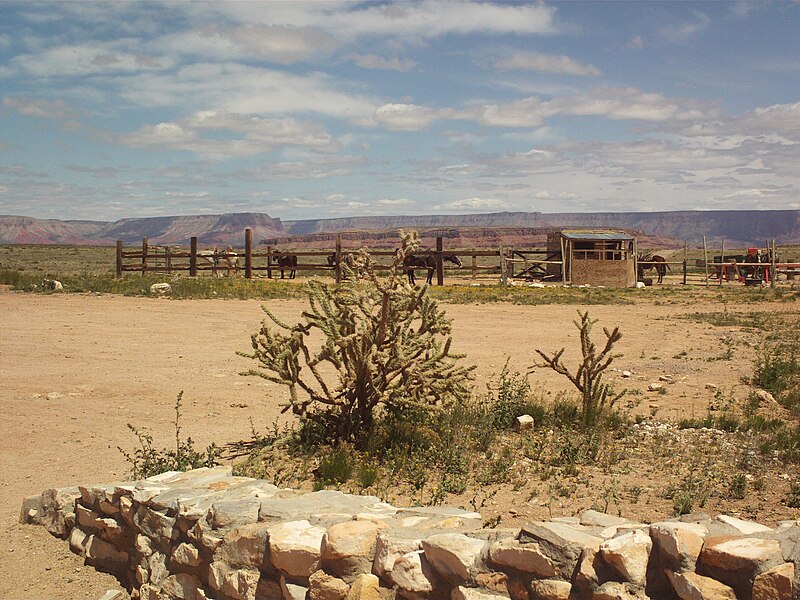
Ranch corrals, Arizona
Storytelling. I’ll leave it to you to read the book and discover the rest of the plot. What’s interesting is the way Mayo tells his story. Instead of a strong central character who helps to resolve the conflict, the novel shifts focus from one person to another, as tensions mount and they dig themselves deeper into trouble.

You expect the greenhorn, as a stock western character, to step off the train into the middle of this mess, learn the ways of the West, and see that justice is done. That doesn’t happen. Instead he gets sidelined by a bushwhacking that leaves him gut shot and thinking he’s tried to kill someone else.

The sinister villain in the novel is a phantom figure to everyone except us. A kind of Fantômas lurking in plain sight, he dispatches one person after another thinking he’s knifing his way into some money. His name, by the way, is Mort Darturo, a play on the French word mort, meaning “death,” and Le Morte d’Arthur, a medieval romance about King Arthur.

A number of secondary characters cross the pages, including the likable Sheriff Tucker, seen at one point putting a roof on his privy. There’s also a down-at-heels saloon swamper, Squirly Ross, and a black ranch cook called Hiram Bain. Squirly introduces a note of genuine humor when he relates a long tale of being abducted by Apaches. Hiram qualifies as the most decent man of the whole bunch, and he seems destined to wed Esperanza, the proud and resourceful Mexican housekeeper of the dead rancher.

There are other minor characters, the most finely drawn of them being Mitchell Farthing, an aging cowhand who has a fatal encounter with Darturo. In just a few pages, Mayo gives him a colorful personality and a back story that make you more than sad to see him go.

Ranch house, Montana
Looking back. Mayo’s novel makes an interesting comparison to westerns of 100 years ago. A central theme of this novel is the parallel stories of three men, each trying to prove himself a man. This is a plot thread to be found over and again in early westerns, which are typically about the building of character.

Here we get the greenhorn fresh from the East, the rancher’s son tired of living in the reflected glory of his old man, and the son of the dead man scorned as a “half breed.” Each struggles to achieve self-respect and to earn the respect of others. The hold that alcohol has on two of them is a complicating factor. In pre-Prohibition fiction, it would also reflect a bias toward temperance to be found in some novels.

A bigger difference between the two eras is the portrayal of a black man. Black cooks are not uncommon in early westerns, but they rarely do more than walk on as perfunctory and often comical characters. If they are allowed to say anything, it will be in the broadly ungrammatical and uneducated accents of the Deep South.
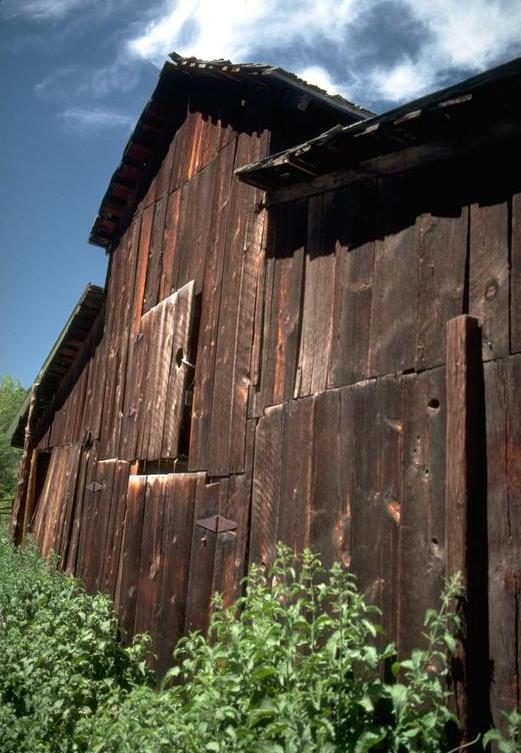
Ranch barn, Oregon
By contrast, Mayo’s Hiram speaks fluent, standard English, as do most of his other characters. He possesses intelligence and a calm reserve that is unintimidated by the white family for whom he’s long been employed.

The less likable characters in Mayo’s novel show their ignorance and lack of moral fiber by flaunting their racial prejudice. One hundred years ago, a character’s contempt for Mexicans would not have raised an eyebrow. Following the Mexican-American War, they were considered a conquered race not greatly different from the Indians.

Here it’s another matter. When a character is not duly respectful of Hiram, Esperanza, or her son, they brand themselves as bigots. Some people may complain about the inroads of political correctness, but I’d like to hear them argue that we should go back to the old days.

Wrapping up. Matthew Mayo tells a darn good story. Dead Man’s Ranch is briskly paced and peopled with a large and enjoyable cast of characters. For readers who like a little romance, I can add that the novel ends with a big kiss. This and other books by Mayo, who also writes nonfiction, are currently available at amazon and Barnes&Noble in both paper and ebook formats. And there's more about him at his website.

Matthew Mayo
Interview

Matthew has generously agreed to spend some time here today to talk about writing and the writing of Dead Man’s Ranch. So I’m turning the rest of the page over to him.

Matt, talk a bit about writing as Ralph Compton, another established author. How does a writer go about doing that?
Other than Ralph Compton’s name on the books, and a few general directives (keep it clean—no overt sex, no unnecessary cursing, etc.), the Compton novels are solely the efforts of the author hired to write them. 

I don’t think about Compton’s legacy or the line so much as I try to write the best book I can in the time given. That said, it’s an honor for me to contribute to the Compton line alongside so many writers whose work I’ve long enjoyed.

Would you have written this novel any differently if it were a Matthew Mayo novel?
No, I wouldn’t change much, primarily because I consider my Comptons to be Matthew Mayo novels. And they’re fun—they indulge my fondness for writing involved stories in which characters find themselves in situations they can’t shoot their way out of (but sometimes do!).

How did the idea for Dead Man’s Ranch suggest itself to you?
I was offered the slot, but the deadline was going to be tight, in part because of other book commitments. I don’t like saying no to opportunities, so I scratched my chin, rummaged in my computer, and pulled up an early draft of a novel I’d called Dead Man’s Ranch. The editor liked my synopsis and the title. That draft was roughly 75,000 words, and the Comptons are 80-85k, so I teased it out, rewrote sections, added a subplot, more minor characters and build-up scenes.

Is the published version similar to how you first conceived it or somewhat different?
The published version is better than I first conceived it, largely because I reworked it and rewrote it as I went along. I read somewhere that writing is rewriting, and at least for me, that’s true. If my schedule’s not too tight, I like the luxury of being able to go back over a manuscript until it tightens.

Saturday, May 11, 2013

Saturday music, Don Gibson


Donald Eugene Gibson, born 1928 in Shelby, North Carolina. "Oh Lonesome Me" recorded in Nashville and released in 1956. No. 1 on the country chart, crossing over to no. 7 on the U.S. charts.

Coming up: Matthew Mayo, Dead Man's Ranch

Friday, May 10, 2013

Willa Cather, The Troll Garden (1905)


Willa Cather (1873-1947) was a Virginian by birth, but lucky for the rest of us, she lived from the age of nine in little Red Cloud, Nebraska. And her life there on the Great Plains became the source of some of her best fiction:O Pioneers! (1913), The Song of the Lark (1915), and My Ántonia (1918).

The Troll Garden was a collection of stories written during her years living and working in Pittsburgh, after taking a degree in English from the University of Nebraska. Three of the stories are related to the West, two of them set in Kansas and Wyoming and the third about a woman from Nebraska on a trip to Boston. They portray the Plains as bruisingly harsh for men and women with certain creative and artistic sensibilities. Themes of repression, self-denial, escape, and entrapment run throughout.

Willa Cather Memorial Prairie, Nebraska
Character. Early westerns typically deal with the making of men who achieve or demonstrate their manhood through tests of their character. Cather’s stories echo that same concern. However, her men exhibit strength of character in gentler ways. No gunning down villains. Still, they are decent men—what the characters in other early westerns would call “white.”

They are armed only with a protective concern for the vulnerable and a contempt for the selfish, small minded, and thoughtless. Jim Laird in “The Sculptor’s Funeral” may be the finest example. He defends the memory of a dead man who acquired fame as an artist. Then he condemns his money-grubbing fellow townsmen for their ill will toward the man and their callous disregard of principle.

There is a sweeter poignancy in a man’s tender regard for a dying woman in “A Death in the Desert.” Everette Hilgare might resent his more famous brother and envy him for the privileges that go with fame, including the adoration he has won from the girl who was Everett’s first love. Still, he chooses generosity and patient kindness instead.

Laramie, Wyoming, 1908

East vs. West. Meanwhile, life on the prairie, far from the centers of culture, is portrayed as soul-crushing. And you wonder that Cather came around to celebrating the lives of the pioneers, as she eventually did. While the gravitational pull in other fiction is westward, almost all her characters in these stories are drifting eastward.

The plains are a troubling presence. They can be portrayed in the stories as calmly death-like, as in “The Sculptor’s Funeral”:

The lamps in the still village were shining from under the low, snow-burdened roofs; and beyond, on every side, the plains reached out into emptiness, peaceful and wide as the soft sky itself, and wrapped in a tangible, white silence.

Or they are stark with menace, as seen through the windows of a train in “A Death in the Desert”:

The grey and yellow desert was varied only by occasional ruins of deserted towns, and the little red boxes of station-houses, where the spindling trees and sickly vines in the blue-grass yards made little green reserves fenced off in that confusing wilderness of sand.

Poverty can exist anywhere, but rural poverty has a grimness all its own. In “The Wagner Matinee,” Cather gives this  description of subsistence living on a homestead:

I saw again the tall, naked house on the prairie, black and grim as a wooden fortress; the black pond where I had learned to swim, its margin pitted with sun-dried cattle tracks; the rain gullied clay banks about the naked house, the four dwarf ash seedlings where the dish-coths were always hung to dry before the kitchen door.

Wednesday, May 8, 2013

Larry D. Sweazy, The Gila Wars


Review and interview

It takes a while to realize what this new Josiah Wolfe, Texas Ranger, novel is truly about. Sweazy has a whole lot more on his mind than the unsuspecting reader is likely to notice. Count me among the unsuspecting. I must have been almost three-fourths through it before the pieces began falling together for me.

Josiah Wolfe (as mentioned here earlier) is a complex and interesting character. He fought for the Confederacy during the Civil War, and his battlefield experiences have left him somewhat troubled. Bloodshed and death haunt him.

Peace time, such as it is in post-war Texas, has been no less harsh for him. He has lost his loving wife and three daughters, all dead from influenza, and his service with the Texas Rangers keeps him away from his young son. Earlier novels in the series have told of difficulties that have left others unsure of him. His one partner is an unseasoned junior Ranger, Scrap Elliott, whose hair-trigger anger makes him explosive and unpredictable.

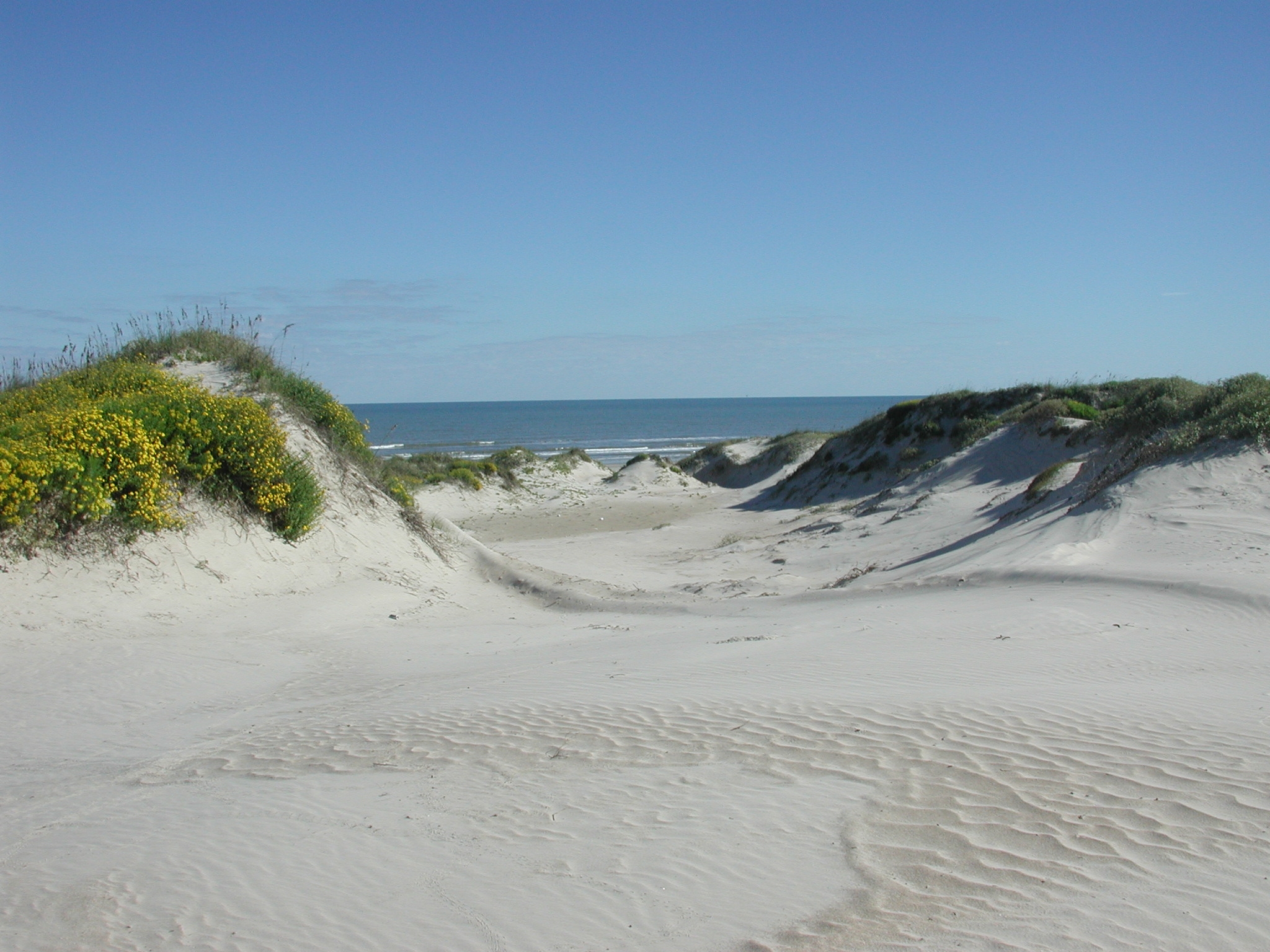
Padre Island, Texas coast
Plot. The “war” in this novel is a campaign to capture or kill a border lord, Juan Cortina, who has been raiding longhorns from the King ranch. The Rangers have word that a steamboat is to take a rustled herd on board and ship it from the Gulf coast of Texas to Cuba. Under the command of Captain Leander McNelly, they are sent out to intercept the shipment and put a stop to Cortina.

The novel takes an abrupt turn as Wolfe and Elliott head off together toward the grassy, low-lying flatlands along the shore. Their job is to act as spies and learn what they can, but a shooting incident in a cantina suddenly sidelines Wolfe, and he nearly dies of gunshot wounds. During his convalescence there he becomes attached to a young woman, Francesca, who cares for him.

Back in the saddle, he rejoins his company of Rangers, and there is a bloody battle with Cortina’s men as they attempt to rendezvous with the steamship. A death in that fight produces another abrupt turn, as Wolfe and Elliott escort the dead man all the way back to Austin. There he has some personal matters to attend to as he decides what to do with the rest of his life.

Padre Island, Texas coast
Themes. There is more than one “war” in the novel, as the title suggests. In addition to the one against Cortina, there is a deeply divided conflict in the very heart and soul of Sweazy’s central character. Killing and bloodshed have left Wolfe both physically and emotionally scarred. The traditional western hero is untouched by death. Killing serves a self-justifying purpose: to restore order and justice.

But in reality, we know that for some men at least, it comes at a cost. It may haunt them for a lifetime. As this novel proceeds, Wolfe becomes increasingly burdened by regret, guilt, and shame. Not a weak or fearful man by any means, he is just a man. Brave and courageous, as we all hope we might be in his shoes, but a man all the same.

There is a modern note of resignation in the novel’s attitude toward war. The Rangers’ battle against Cortina and his kind of thievery on the US-Mexican border calls to mind today’s unending “war on drugs” and the pervasive violence along that particular international boundary. The Rangers’ search and destroy mission on the alien coastal terrain easily recalls footage of troop movements in foreign lands on the evening news.

Wolfe continues to remember the War Between the States with bitterness. The dead and injured in the battle against Cortina remind him of the depression that follows killing, how it haunts sleep with dreams of walking with the dead. The war has become a bad memory without meaning. So are the deaths of his wife and children. It is an unforgiving world, and these experiences have left Wolfe without belief in a God or an afterlife.

There is a powerful scene between Wolfe and the camp doctor and mortician, Verlyn Tinker, a Yankee who served in the ambulance corps at Antietam. As a doctor, doing what he can to undo the damage done on the battlefield, he says he has learned to let the past go. Besides, he says, wars don’t end. New battles and new enemies come along to take the place of old ones. That is a belief not unfamiliar today.

Texas coast
Style. There are action, suspense, and excitement in the book, but it is also much of the time simply thoughtful, as Wolfe reflects on his life, the people he has known, and his situation. A large part of the story is devoted to the growing affection between Wolfe and Francesca and the dilemma this creates for him, especially as he starts the novel engaged to another woman back in Austin.

Characters are sharply drawn. Scrap Elliott makes a good contrast with Wolfe. Too young to have fought in the War Between the States, he imagines the killing fields as a place to freely release his rage. He is almost unhinged by his hatred of Mexicans. Easily insulted, he is always ready to explode and make trouble for himself and Wolfe. His short fuse and immaturity make him a volatile presence in the narrative. Running out of his usual patience, Wolfe finally socks him in the face, then regrets it.

The camp doctor, Tinker, comes across vividly, talking with Wolfe as he goes about his work. An older man, he has a worldly wisdom and a reassuring depth of character that calm Wolfe and the patients he’s treating. He also possesses a degree of moral stature that is reflected in his physical resemblance to Abraham Lincoln.

Western writers tend to be good about how things look and sound. Sweazy reminds us that the Old West had its characteristic smells, as well. Riding into the flat grassland along the Gulf shore, Wolfe and Elliott are ambushed, and “the putrid, rotting smell of the ground mixed with the metallic blood and the gunpowder.”

Death is often referred to as having a smell. Baths being infrequent, a man might “smell like a dead possum that had been baking in the sun.” Longing evokes olfactory memories, as when Wolfe recalls the scent of a woman’s toilet soap. Hungry, he is pleased by wood smoke and the smell of meat cooking on a campfire. In the doctor’s tent, he notes the smell of whiskey being used to clean a wound.

Wrapping up. This is another fine western from the pen of Larry Sweazy. It’s #6 in the Josiah Wolfe series and reportedly the last. A review of the previous volume, The Coyote Tracker can be found here. The Gila Wars can currently be found at amazon and Barnes&Noble in both paper and ebook formats.

Larry Sweazy
Interview
Larry Sweazy has generously agreed to spend some time here to talk about writing and the writing of The Gila Wars, and I’m turning the rest of this page over to him.

Larry, we last talked here in August 2012. How have the last nine months been for you as a writer?
I have started a new Western series that I’m writing for Berkley that will debut in late 2014. It features an ex-Confederate spy, Lucas Fume, who is wrongly imprisoned and must prove his innocence (the title is Vengeance at Sundown). It’s been an interesting challenge writing a new character. With Josiah there was the whole structure and history of Texas and the Texas Rangers to consider, and the loss of his family to deal with.

Lucas Fume is not affiliated with any organization (by design), and he’s a single, unmarried man, so the research and emotional journey has been different. But just as much fun. The structure is different, too. So, really, the last nine months have been pretty good. It’s always a good thing for me to know what I’m going to be writing for the next year or two.

Talk about how the idea for this story suggested itself to you.
I wasn’t sure that this was going to be the last book in the series when I started to write it, but it felt like it. I had written all of the Josiah Wolfe books sequentially, so I was ready for an end of some kind, or a new start creatively, even if it was just a break. Anyway, that was in my mind, and I wanted to wrap some things up that had started in book #1, The Rattlesnake Season, and had kind of arced through the series without full resolution.

And there was the Red Raid just sitting out there in history to frame the story around. It worked with my timeline. Cortina had played a role in the earlier books, so the event seemed perfect to bring things to as much of a close as was possible.

Tuesday, May 7, 2013

Kit Carson (1940)


The short-lived Bear Flag Republic of California came into being in 1846 with a revolt against the Mexican military authority of Gen. José Castro. Instrumental in that uprising were two figures well known from American history, explorer John C. Frémont and his scout, Kit Carson. Working together through the 1840s, they had opened up the West to immigration along the Oregon Trail.

This western portrays both men as heroes of westward expansion. Before tackling the Mexican forces under Castro’s command, they successfully escort a wagon train of settlers across hostile Indian country. For romantic interest, the two are involved in a love triangle with the daughter of a wealthy Californian.

Dana Andrews, Lynn Bari, Jon Hall
Plot. As the story begins, Frémont (Dana Andrews) is waiting with his troops and a wagon train bound for California at the fort of Jim Bridger (Raymond Hatton) on the Oregon Trail. Trapper Kit Carson (Jon Hall) and two companions (Ward Bond, Harold Huber) arrive, and Frémont tries to persuade Carson to take command of the train as wagon master.

Carson first declines, despite the appeals of a prominent member of the immigrant party, Dolores Murphy (Lynn Bari). They are fools, he says, to take women and children into Indian country. But apparently out of boredom, he changes his mind, and he and his two pals join the train.

The Shoshone waste no time giving them trouble and make a night attack in an effort to run off the horses. Two sentries on night duty are shot, and there is a fierce gun battle with numerous casualties. Meanwhile, we learn that the Indians’ rifles and being supplied by General Castro.

Capturing one of Castro’s lieutenants, Carson, Frémont, and Bond interrogate the man by tying him up and pitching knives and hatchets at him. And from him they learn what Castro has been up to. Seeing no need for a fair trial, Frémont calls up a firing squad and the lieutenant is soon disposed of. Barri is horrified at their cold-hearted savagery.

Kit Carson (1809-1968)
Determined to find a direct route through the Sierras, Frémont and his men part company with Carson and his wagon train. Carson argues that taking the long way around has numerous advantages, but Frémont cannot be dissuaded. And he marches off directly into an Indian ambush. The wagon train is soon under attack, too. Only after some heroics by Carson are the troops rescued and the Indians driven back.

Cut to the hacienda of Bari’s father in Monterey. There’s a fiesta in progress with dancing and drinking, but Carson is not much of a partier. Time to go check traps along the Platte, he says, and departs with Bond and Huber.

Discovering a camp of Mexican soldiers, they capture one of Castro’s officers, a congenial and rotund General Vallejo (Lew Merrill) who is an amigo of the americanos. He’s relieved to be taken captive, as it means sanctuary from Castro, who has grown suspicious of him.

Vallejo happily spills what he knows about Castro’s plans to run the americanos out of California and then declare himself emperor of not only California but all of Mexico. Someone brings out a bear flag, and the revolt is in full swing.  Attacking the hacienda where he believes the americanos have all gathered, Castro is held off by Carson, his pals, and a handful of others. Frémont’s troops then drive the Mexicans off, and the republic is born.

Saturday, May 4, 2013

Saturday music, Johnny Lee Mills


Johnny Lee Mills, born 1912 in Jewett, Texas, younger brother of Bob Wills. Played banjo for the Texas Playboys from 1934 until Bob's move to California in 1940. Remained in Oklahoma with his own group, Johnny Lee Mills and All the Boys, and switched to Western swing fiddle. "Rag Mop" written by Johnny Lee Mills and Deacon Anderson. Recorded and released 1950.

Coming up: Kit Carson (1940)

Friday, May 3, 2013

Arthur Stringer, The Prairie Wife (1915)


This is a novel that invites being read in different ways. For a while, I thought it was going to be a
satire, along the lines of Sinclair Lewis. Then it looked like it was going to turn into a melodrama about an unhappy marriage. After that it threatened to become a tragedy. But then nothing really adverse happened to anybody, and all ended quite happily.

The material is familiar, being about a young married couple making a life as wheat farmers on the Great Plains of Canada, somewhere between Winnipeg and Edmonton. In other western novels from the period, marriages founder as young wives fall victim to the malaise that comes with isolation and grueling work. The extremes of weather conditions take their toll, disease and accident claim lives, crops fail. Reality teaches harsh lessons if dreams themselves are not dashed completely. In this novel, we get a different kind of story.

Plot. Young Chaddie McKail arrives with her new husband, Duncan, on a 1,700-acre patch of western Canada that is little more than a dot in a sea of grass. They have a tiny cabin and a few out buildings, with a team of horses, farm implements, and a carriage to get to and from a distant settlement, Buckhorn. A hired hand, a Swede named Olie, helps out with the farm work.

The narrative extends from autumn of one year to autumn of the next. And as the story is Chaddie’s, it is mostly an account of frontier domesticity. The marriage passes from a honeymoon stage into a series of unexpected upsets and eventually settles into a bond between equals.

Duncan has planted his entire acreage into wheat, taking the risk of losing it all to prairie fire or violent weather. Both threaten, but the wheat escapes serious damage. Duncan, meanwhile, has been making trips that take him away for days and weeks at a time. We don’t learn until the end that he’s been scheming to have a railroad line built across his property, which will make him a rich man.

Romance. With a pair of newlyweds as central characters, we get a story that begins where most early western romances end. In novels where the heroine is a new bride, as in Emma Ghent Curtis’ The Fate of a Fool (1888), the couple has typically married in haste and the husband turns out to be a loser.

You expect that here, especially as the two have just married after a whirlwind shipboard romance, and she admits that she has become a wife before actually falling in love. But she has confidence in Duncan as a “gentleman” who is a civil engineer and has big plans to get rich quick. She enjoys calling him her “lord and master” and typically (and annoyingly) refers to him as “Dinky-Dunk.”

She has a swooning adoration of the man, whom you can tell between the lines is a bit stiff. Her playfulness sometimes shocks his Scots temperament. “I’m a wild woman,” she tells him. “You’ll never tame me.” He replies soberly that he won’t, but life will. She says she can’t let that happen and confesses that her high-spirited independence keeps her from feeling afraid out here on the lone prairie.

An English aristocrat named Percy Benson buys a nearby spread and becomes the McKails’ closest neighbor. A kindred spirit, he becomes Chaddie’s loyally platonic friend. Not in the best of health, he has come west for the arid climate.

When Chaddie becomes pregnant, Duncan hires a strapping young Finnish immigrant, Olga, who does both housework and field work. Built like a man and undaunted by physical labor, she’s a fortunate find since the war in Europe has depleted the labor market in western Canada.

The real romance, finally, is the tender sentiment that Percy begins to feel for Olga. Before long she is returning his interest, and by novel’s end the two are getting married. By then, Chaddie, who was deliriously in love with Duncan in January, has given birth to a boy in September.