Showing posts with label canada. Show all posts

Thursday, February 26, 2015

Luke Allan, Blue Peter: “Half-Breed” (1921)

Métis fur trader, 1870
Blue Pete, a Métis cattle rustler who leaves a gang of horse and cattle thieves to work as an informant for the North-West Mounted Police, first appeared in 1921 in a short story in Western Story Magazine by Canadian-born writer William Lacey Amy (later to be known as Luke Allan). That same year, the character appeared in Blue Peter: “Half-Breed,” the first of a long series of Blue Pete novels, published in both London and New York, the last of which saw print in 1954.

Blue Peter is a love/crime fiction story set on the Canadian frontier, where the North-West Mounted Police are stationed at Medicine Hat  to maintain law and order. Their main problem is a gang of horse and cattle thieves fearlessly operating along the international border with the U.S. and using the Cypress Hills, a rough patch of wooded terrain in southern Saskatchewan , to hide out (cf. Jackson Hole, Wyoming).

Plot. As the story begins, Blue Peter parts company with the gang in an exchange of gunfire, meets up with a young
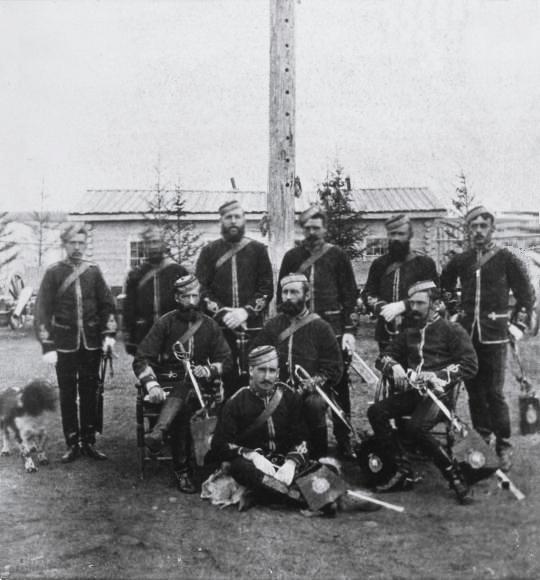
North-West Mounted Police Fort Walsh, 1878
Mountie, Constable Mahon, and is persuaded to work as an informant, sharing what he knows of the Hills and how they are used by the thieves to hide stolen stock; infiltrating the cowboys who work for ranchers on the open prairie, he reports any questionable behavior to the chief inspector at NWMP headquarters.
As it turns out, one family, the Stantons, are actively in cahoots with the gang. Caught in the act, two brothers, Jim and Joe Stanton, kill each other rather than allow themselves to be taken by the Mounties. Their sister, Mira, has been an accomplice in their thieving activities. She is an all-western girl, skilled as a rider and roper, pretty and independent-minded, embarrassed only by her lack of education and refinement.

Mahon, who has a girlfriend of his own, befriends Mira and helps her with the book-learning she desires. Meanwhile, grief-stricken at the loss of her brothers, Mira warms to him but holds him culpable for their deaths. In a fit of melodrama, she shoots and kills three of her four wolfhounds.

Romance. Blue Peter then comes to her rescue, offering her his cave in the Hills for shelter and his own companionship for solace. Standing trial for cattle theft, Mira is found guilty and sentenced to six months in prison. As she is being transported there by train and under guard, Blue Peter comes again to her rescue, and they are pursued on horseback by Mounties across the prairie. After the two are run aground, Mira surrenders herself to save Blue Peter, now a wanted man, from arrest.

Back at the cave, he waits mournfully through the winter for her release from prison. At last, with the coming of spring they are reunited.

Adventure. The latter part of the story is devoted to the capture of the gang, as exchanges of gunfire result in Mahon’s (now Sgt. Mahon) being wounded and the arrest and/or death of the rustlers. Blue Peter is also a casualty, shot as he saves Mahon’s life. At the end of the novel, there is reason to believe that Blue Peter’s wounds are mortal and once his body is found, Mira vows to bury him there in the Hills he loved.

For his part, Mahon has a granite monument carved as a memorial to the “half-breed” who was his friend. So the novel has this melancholy and sentimental ending. But like a modern-day TV series with a season finale lacking finality, Blue Peter and Mira live on to reappear for another adventure in a sequel, the Return of Blue Pete published in 1922.

The accuracy in the portrayal of Blue Pete is debatable especially in comparison with Frederic Remington’s mixed-blood title character in Sundown Leflare (1899), who speaks in broken, French-inflected English, and possesses no particular moral character. Physically strong and a creature well adapted to the natural world, Blue Pete has no faults. He is decent to the core, loyal, tenderhearted and willing to take a risk to help a friend. Outside of James Fenimore Cooper we do not find his likes in American frontier fiction.

Blue Peter: “Half-Breed,” is currently available online at Internet Archive and in ebook format at Barnes&Noble.For more of Friday's Forgotten Books click on over to Patti Abbott's blog

Further reading/viewing:

Blowing my own horn: For an in-depth, two-volume survey of early writers of frontier fiction, read How the West Was Written (to obtain a copy, click here). 

Image credits:
Wikimedia Commons

Coming up: new short stories


Thursday, February 12, 2015

Guy Vanderhaeghe, A Good Man

I wanted to like this novel more than I did. For its length (464 pages), it promises somewhat more than it delivers. I had the same reaction to the author’s The Last Crossing (reviewed here a while ago). There are a lot of ideas and food for thought in this novel about character, friendship, responsibility, Native Americans, the frontier, and U.S.-Canadian relations. But in the end it’s hard to say what it all adds up to. You can puzzle if you like over the title. Who among the novel’s male characters is the “good man”? Is there one at all?

Set in the late 1870s, partly in the Cypress Hills of Saskatchewan where Fort Walsh was headquarters for the North-West Mounted Police; but mostly in the frontier settlement of Fort Benton, Montana, on the upper Missouri River, the action takes place in the aftermath of Custer’s defeat at the Little Bighorn and settlers of the sparsely populated prairie live in terror of the Sioux and other tribes who seem to be organizing under the leadership of Sitting Bull to rid the West of whites altogether.

Thursday, April 17, 2014

Bertrand Sinclair, Big Timber (1916)


Looking for a theme song to go with this novel by Canadian writer Bertrand Sinclair, you might pick Bonnie Raitt’s “I Can’t Make You Love Me.” It’s a story set in the old growth woods of British Columbia, where a one-sided marriage of convenience leads to a good deal of heartbreak and disappointment.

Character. The central character is 22-year old Estella Benton, suddenly thrust on her own by the accidental death of a father who has left her penniless. Unprepared for the cold, unpredictable world, she is summed up by the narrator as “a young woman who had grown up quite complacently.” She has been “wholly shielded from the human maelstrom, fed, clothed, taught, an untried product of home and schools.”

As for the future, she has had no more than a vague notion of eventual marriage to a Prince Charming who would come along to sweep her off her feet—and maintain her in a life style to which she has been long accustomed.

Plan B finds her on a long train journey to remote British Columbia, on the banks of a lake north of Vancouver, where she joins her brother, Charlie, who has a start-up logging company. Obsessed with becoming wealthy, he has little regard for his sister’s personal welfare and puts her to work as camp cook, a grueling job that exhausts her and brings her to near despair.

Movie still, Wallace Reid, center, as Jack Fyfe
Romance. A rescuer and prince by almost any standard shows up in the manly form of Jack Fyfe, who has a well-run logging operation of his own. He partners with Charlie to deliver on a timber contract and befriends Estella, who discourages what she interprets as his unwelcome attention.

Any reader can see that he is filled with a gentle compassion for her and has fallen quite in love. But she will have none of this rough, handsome man of the woods. Nevermind that he has a fine intelligence and tender sensibilities. He frightens her, and for no apparent reason than her unwillingness to consider meeting him on equal terms, as a caring, considerate friend and potential life mate. For love to be true, she has to feel it as a delirious infatuation, and it’s not there.

Thursday, March 13, 2014

Margaret Laurence, The Stone Angel (1964)


Reading this novel about a 95-year-old woman from a prairie town in Manitoba, I kept thinking of how seldom frontier fiction tells the stories of frontier women. The genre has so long relegated them to the sidelines of action-adventure stories about men, it seems not even odd to find them mostly missing from the panoramic narrative of the West.

Hagar Currie in Margaret Laurence’s novel shows what it might have been like to enrich that picture with stories reflecting lives actually lived by women on the frontier. Named for the slave of Abraham and the mother of his son Ishmael in Genesis, Hagar has all the grit and survival instincts of her biblical counterpart. She is as much a feature of the western landscape as any adventuring man who has fetched up there.

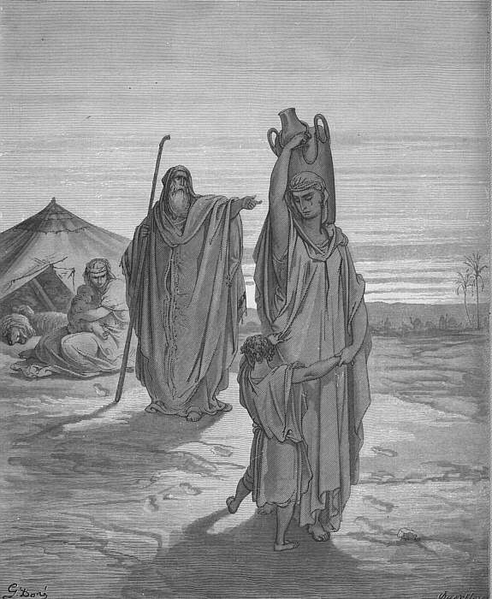
Abraham sending away Hagar
Plot. The novel is more a character study than a story with beginning, middle, and end. It has all those, actually, but not in chronological order. As memories of the past crowd into Hagar’s awareness of the present, we are able to piece together the circumstances and the sequence of events that have shaped her as the person she has become.

These are dominated by the men in her life: her father and brothers, her husband, her two sons. Her mother, dead in childbirth, is an unknown, commemorated in the novel as a sightless stone angel in a cemetery overlooking the town of Manawaka, where Hagar’s father is a merchant and storekeeper.

Against his wishes, Hagar marries a widowed homesteader, Bram (cf. Abraham) Shipley, and gives birth to two sons, one of whom, John, she much prefers to the other. Aching for independence, she leaves Bram, taking John with her westward to a housekeeping job for a wealthy man in Vancouver.

Tuesday, December 3, 2013

The Far Country (1954)


James Stewart and director Anthony Mann made several westerns together, and this one is unusual for being not all that great. The location photography in the snowy mountains of Alberta is impressive, but the casting seems often wrong, and credibility gets a painful stretch if you know much about geography and the Klondike gold rush.

Plot. The film opens in Seattle in 1896, where Stewart arrives with a herd of cattle he has driven from Wyoming to deliver by steamer to Skagway, Alaska. There, he and his sidekick (Walter Brennan) plan to take them over a difficult trail to Dawson in the Yukon. They expect the cattle to sell for enough money to buy them a ranch in Utah.

The whole journey is fraught with difficulties and obstacles. On the way from Wyoming, Stewart has already shot two drovers who attempted to make off with some of his herd. For that he’s wanted for murder and is hidden aboard the departing steamer by a Skagway saloonkeeper (Ruth Roman).

Skagway, Alaska, 1897
In Skagway, his herd disrupts a public hanging, and he’s brought up before a crooked judge (John McIntire, in a role that may have been modeled after Soapy Smith) for disturbing the peace. The fine is his herd of cattle, which Stewart and Brennan steal back under cover of darkness and spirit across the border into Canada. But there’s more trouble before reaching Dawson, as the two men are witness to the robbing and killing of miners returning from the gold fields.

Roman relocates in Dawson to open another saloon, and McIntire follows her there, along with his gang (Jack Elam, Robert J. Wilke). Both Roman and an Austrian ingénue (Corinne Calvet) take a romantic interest in Stewart. He is polite to each but not one to complicate his life with a woman.

Stewart and Brennan try their hand at placer mining and accumulate enough gold to buy that ranch in Utah. Attempting to avoid arrest in Skagway, they take another route out of the Yukon. But they are ambushed as they start to raft down a river to Juneau. Brennan is killed and Stewart is disabled.

Thursday, October 31, 2013

Canada in early frontier fiction


There’s surely as much western frontier north of the 49th parallel as there is south, and Canada has had numerous writers setting their stories there. During the years 1880-1915, a dozen or more of them appeared to write from the mountains and timberland of BC, to the prairie, the border country straddling the international boundary with Montana, all the way to the frozen Yukon.

Ralph Connor
Ralph Connor was the pen name of Charles William Gordon (1860–1937), a Presbyterian minister of some prominence in Canada. The Sky Pilot (1899) was the novel that made him famous, selling over a million copies. It is set in a frontier community, Swan Creek, in the foothills of the Rockies, west of Calgary.

Its characters are early settlers, ranchers, and cowboys, and at the center of them is a church missionary, Arthur Wellington Moore, who has been dubbed “the sky pilot.” Connor served 40 years as a minister at a single parish in Winnipeg, Manitoba. In 1972 his Works, containing 43 titles, were published by the National Library of Canada.

Bertrand Sinclair (1881-1972) was born in Scotland and came to North America in 1889. He was a young cowpuncher living in Montana when he wrote Raw Gold (1908) set north of the border in the southern corners of what is now Alberta and Saskatchewan. 

The time is shortly after the arrival of the North-West Mounted Police, and the entire story takes place within one or two days’ riding of Fort Walsh in the Cypress Hills. We get the wide-open frontier of the 1870s with outlaws and lawmen, stolen money, and an innocent fugitive wrongly accused of a crime. After a brief marriage to western writer B. M. Bower, Sinclair settled in British Columbia, where he continued to write.

Thursday, October 17, 2013

Ralph Connor, The Doctor: A Tale of the Rockies (1906)


This novel by Canadian Ralph Connor was a top-10 bestseller in the U.S. when it was published. Set partly in Ontario and partly in British Columbia, it’s an inspirational story of sacrifice and suffering that would strike most readers today as profoundly sentimental.

The doctor of the title, Barney Boyle, is a man from a country village who overcomes the disadvantages of rural poverty to become a world-traveling doctor. Tirelessly serving others, he at last exhausts himself and falls ill while treating the miners and railway workers on the Canadian frontier.

Plot. At the center of the novel are three more characters: Boyle’s brother, Dick; a childhood friend, Margaret Robertson; and a schoolmistress from the American South, Iola Lane. It is a foursome fraught with unrequited affection. Margaret loves Barney, Dick loves Margaret, Barney loves Iola, and Iola wants a high-profile singing career.

Years pass as each finds a place for themselves in the world, winning the adulation of others. While Barney becomes a skilled doctor championing the introduction of proper health care for workingmen, Dick achieves fame as a frontier missionary and social reformer. Margaret becomes matron of a charity hospital, and Iola a world-famous opera diva.

Illustration from the novel
The two brothers vow undying love for each other as young men. Barney has yielded without complaint to their mother’s wish that Dick should be the one to get an education. But as Barney struggles against adversity to become a doctor, he discovers that Dick and Iola have become improperly friendly. This severs the bond between the two men until they meet again by chance in the wilds of British Columbia and are reconciled.

Romance. Connor’s characters are possessed by feelings of romantic attachment, while each is doomed to be unloved in return. The energies they might throw into passionate enjoyment of eros are diverted instead to their careers. And Connor would have us believe that this is God’s plan for them.

At the heart of the novel is a belief that God uses the suffering of unrequited love to bring these four to a deeper faith and a higher spirituality. When the heart starves for affection, it surrenders of necessity to the love that passeth all understanding. To add a merciless twist to this argument, Connor has two of the characters die just as they are joyfully reunited after many years of painful separation.

Wednesday, August 21, 2013

Guy Vanderhaeghe, The Last Crossing


This is a western for people who don’t like westerns. It takes a reader onto the raw frontier of 1871 and, like Lonesome Dove, follows a small band of characters as they make a long overland journey. In this case, the novel opens in Fort Benton on the upper reaches of the Missouri River in Montana Territory, and its characters travel to Edmonton, Alberta, and back.

Like McMurtry’s novel, its story is different from the traditional western’s more usual quest of an individual hero to bring outlaws to justice against all odds. McMurtry and Vanderhaeghe take the usual topics of frontier fiction—loyalty, friendship, love, courage, family, integrity, and so on. But enliven them in a way meant to appeal to a broad audience.

Plot.  The back cover will tell you that the story is about two English brothers in search of a third one who has disappeared in the American wilderness. That’s only one thread of a tangled plot line that involves a battle-scarred Civil War veteran, an Irish saloon keeper, a mixed-blood Blackfeet-Scots scout, a writer of adventure books, a woman abandoned by her husband, and yet another pair of brothers believed to have murdered the woman’s sister.

The characters press northward from Fort Benton into Canada, following scant evidence that the missing brother is still alive. He seems likely to have died from misadventure or to have been killed by Indians. Members of the search party itself are hardly sanguine in each other’s company. Addington and Charles, the missing man’s brothers, have a long history of mutual distrust. Meanwhile, two of the men are enamored of the woman traveling with them.

Red River carts, near Edmonton, Alberta, c1870
Near the end of almost 400 pages, there are revelations that clear up some mysteries while producing others. Before the story is done, we have lost a character or two along the way, and in the final chapters, one of the brothers returns to England.

Character. Charles is a modestly talented portraitist, who has disappointed both Addington and their wealthy father by having no talent for brutal domination of others. Addington, who represents the high tide of British imperialism, is a proud, angry man, determined to leave his mark by killing a grizzly with a longbow. Given to pontificating, he says that what defines a man is his relentless effort to overcome any obstacle. To that end, he has engaged a writer to enshrine his achievements in a book about himself.

We get to know the third brother, Simon, in the memories that Charles has of him. Simon has been swept up by the Victorian interest in spiritualism. A student at Oxford and dressed like Matthew Arnold’s “scholar gypsy,” he abandons his books to learn directly from nature. Before leaving for America, he becomes involved in a dubious religious sect that believes Indians are the Lost Tribes of Israel.

Wednesday, August 7, 2013

Gil Adamson, The Outlander


The frontier is a natural setting for outliers, people driven by circumstances to the fringes of civilization or choosing of their own accord to live there. We take that for granted about western fiction, with its outlaws and lone lawmen. Adamson’s novel flips over that set of conventions and examines them from their dark underside.

Plot. Her central character is a young woman, Mary, herself an outlier on the frontier by virtue of her gender. Women were in short supply in the Old West, and Adamson would have us be aware of what that might have been like for an unattached young woman—who also happens to be a fugitive.

Mary is a widow, having shot her husband, and we don’t know why for half of the novel. What matters is that she is being relentlessly pursued by the identical twin brothers of her former husband. It doesn’t matter that she might have had good reason to kill the man. They intend to run her down and put her behind bars.

Crossing the sparsely settled terrain of western Canada, she encounters a string of people who, like herself, are outliers—or “outlanders” as the story prefers to call them. There’s a batty old woman in a decaying house that seems lifted from a Southern Gothic novel. Then she’s found by a mountain man, William Moreland, who lives off the land and what he can pilfer from forest ranger stations. They venture into a tempestuous sexual relationship that lasts until she wakes one morning alone again.

Gil Adamson
She encounters an English-speaking Crow Indian, born in Baltimore, now returned to his tribe with a white wife. And so on, until she fetches up in a mining camp called Frank. There she’s given shelter by a friendly minister, and she takes a job at a supply store run by a dwarf. Meanwhile, she is being sought by both her twin brothers-in-law and Moreland, who regrets that he left her. All three eventually catch up with her, but not for long.

Storytelling style.  Adamson is a writer of poetry and short fiction. The narrative has that loosely structured quality of stories strung together with characters that come and go. The voice is often elusive and dreamlike, slow-paced, especially the opening 80 pages.

There we learn that she killed her husband after the birth and death of an infant. She seems unhinged, traumatized, unfocused, though super aware of her surroundings. She has unsettling flashbacks and hallucinations, hears voices.

Thursday, May 30, 2013

Robert W. Service, The Trail of ’98:
A Northland Romance
(1910)


Robert W. Service (1874-1958) was already a household name when his first novel was published. He’d become famous as the writer of verse about the Klondike gold rush of 1897-98. Unlike Jack London, he had not been there himself and was relying on stories told by those who had.

This hefty, 514-page novel is a compendium of those stories, woven into what reads like first-person reportage. Its central character, Athol Meldrum, is a young Scotsman, adventuring in the American West and swept up in the stampede to the Yukon. A steamer trip takes him to Skagway and we follow him on the long perilous trail to Dawson City.

He teams up with three other men, and despite a tenderhearted temperament and the flagrant immorality of the mining camp, he works claims that produce a respectable fortune. Over the course of three years, he toughens up, but only at the cost of his idealism. And he has close encounters with death, being hospitalized with typhoid and nearly dying from starvation while lost for weeks in the wild.

Berna and Athol in the rapids
Plot. Athol’s adventures are the through-line of the novel. One follows on the heels of the other. What holds our interest is the gamble he is making against the odds to survive and make good. Pitted against him is the hostile terrain, where the 37-mile trail from Skagway to Dawson is lined with the graves of men who have succumbed from accident and exhaustion.

Then there is the climate, where the Yukon River freezes over each winter and isolates Dawson from the rest of the world for eight months of the year. And a man without a fire to warm himself will freeze to death in fifteen minutes.

Athol is also the prey of fraudulent officials and corrupt politicians eager to make a fortune through graft and duplicity. After a mad dash to stake a claim in a new field and waiting hours to register his claim, he discovers that someone has already jumped it. Meanwhile, the mining camps, with their dens of iniquity, always threaten to siphon off every ounce of gold he may have in his poke.

Romance. The two hearts on the book cover are a clue that it is about more than a quest for gold. While still on the boat to Alaska, Athol takes note of a sweet damsel, Berna, who is in considerable distress. She is traveling with her grandfather and a larcenous aunt and uncle, the Winkelsteins, who want the old man’s money. When he dies in an avalanche on the Chilkoot trail, they finally get their hands on it.

Berna meets Athol's brother
Athol keeps trying to rescue Berna, but the Winkelsteins have welcomed the attentions of a wealthy gold miner, Jack Locasto, who wants to marry her. Interfering with Locasto, Athol wins the man’s murderous contempt. The rivalry goes on hold temporarily as Locasto is challenged to a fight and gets thoroughly beaten by one of Athol’s friends.

Berna first wants Athol to marry her, for protection from Locasto. He demurs, insisting that theirs can hardly be true love since they scarcely know each other. He wants to wait a year. Then when he changes his mind, she has changed hers. No, she agrees, you were right. Let’s wait a year.

When a year passes, he is delirious with love for her but falls ill with typhoid and misses the wedding. Finally reviving, he finds that Locasto has won her away, and she is working in a dancehall. A fallen woman now, she feels unfit to be a bride. And so it goes, until Locasto has left the Yukon, physically shattered by near death in the snow, one hand amputated.

Friday, May 24, 2013

Robert W. Service, The Spell of the Yukon (1907)


Robert W. Service (1874-1958) burst upon the scene in 1907 with this collection of poems, published first in Canada as Songs of a Sourdough, where it was an immediate success. Born of a Scots family in England, he was living at the time in Whitehorse, Yukon, as an employee of the Canadian Bank of Commerce. He had already knocked about the West from Mexico to Vancouver. The bank job seems to have been an attempt to settle down and draw a regular paycheck.

He had been writing poems from boyhood and was encouraged to begin setting stories and impressions of the Great White North to verse. Thus originated two of his most famous story poems: “The Shooting of Dan McGrew” and “The Cremation of Sam McGee.” Those and more poems harked back to the 1898 gold rush that centered on Dawson City, 330 miles (532 km) down the Yukon River, which Service had yet to visit.

Success allowed him to eventually quit his day job and live as a writer, composing more books of verse and a novel, The Trail of ’98 (1910). He acquired material for this book while living for a time in Dawson, before settling in France with a French wife.

Klondike Camp, Yukon, 1898
The poems. Many of the poems are lyrical ballads, about the spell that the Yukon casts over the men who come to find a fortune there. The North is portrayed as a harsh mistress, luring many to their doom while bestowing her rewards on only the strongest and fittest.

This theme is spelled out in “The Law of the Yukon,” which tells of the merciless fate that waits for the weak, unfit, crippled, palsied, and infirm. In the voice of the Yukon herself, it laments the influx of the “dissolute, damned and despairful” men and women who are “the spawn of the gutters.” Send no misfits or failures, she warns. Only the strong and the sane will be granted treasures and sustenance.

The mining camps with their saloons and gambling are “plague-spots” that serve only one good purpose, to weed out the foolish and feeble. The Yukon will reward only those who risk all in the “uttermost valleys, fighting each step as they go.” Pregnant with “the seed of cities unborn,” she will be won by “men with hearts of Vikings and the simple faith of a child.”

“The Parson’s Son” provides a character study of a man ruined by the gold rush. After 20 years in the Yukon, trading in skins and whiskey, he remembers the days when the few white men there had “such a wild, free, fearless life beyond the pale of the law,” each with his “squaw.”

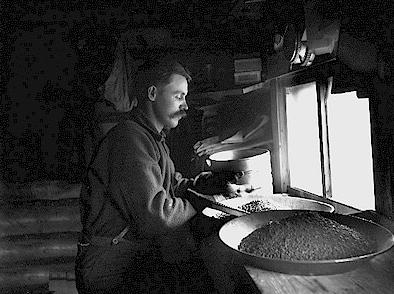
Gold miner at work, Klondike, Yukon, c1898
But the gold rush has been his ruin. Of Dawson he says, “No spot on the map in so short a space has hustled more souls to hell.” He has spent thousands on women, drink and gambling, ending up for a while in the “bughouse.” Now he lies dying on his bunk, and when he’s dead, we learn, his body will be eaten by his sled dogs.

Similarly, a fallen woman laments her lot in life in “The Harpy.” It matters not, she says, whether you are married or offering your body for hire. Either way you must serve the will of men. In “The Low Down White,” a man with half a lung waits for the return of his Siwash woman, who has been out trading sex for money. She’ll bring back three bottles, one for her and two for him.

Friday, May 17, 2013

Jack London, A Daughter of the Snows (1902)


Here’s one for the white supremacy bookshelf. Hard to find a book with more crack-brained ideas
about race than this first novel by Jack London. Set in northern Canada during the gold rush on the Klondike, it’s also a mixed bag of yarns about miners and adventurers on the north frontier.

The daughter of the title is Frona Welse a spirited and fiercely independent young woman whose main grievance is that she wasn’t born male. Being a woman she has to settle for living vicariously through the lives of adventurous men. There’s also the nuisance of amorous advances by men who don’t live up to her ideals.

Plot. The novel begins as Frona steps off the boat at Dyea, Alaska, where she grew up at a trading post. A young woman of 20, she has been away for ten years, getting an education in the States. Now returned, she is hardly changed from the free-spirited motherless child who was once friends with the men who trapped and prospected in the Canadian interior.

Chilkoot Pass, 1898
With the gold rush in full swing, she crosses the Chilkoot Pass with thousands of others and heads for Dawson City, in the Yukon. There her father, Jacob Welse, seems to own and run every enterprise in the territory.

As autumn darkens into sub-arctic winter, there are new arrivals, including Corliss, a tenderfoot mining engineer and Gregory St. Vincent, a journalist and world traveler. There’s a lot of talk and little action, however, until the last chapters when miners and prospectors head up river to wait for the spring thaw.

As the river ice is breaking up, Frona and the others discover a man in some distress on the other side of the raging torrent. She and two of the men paddle a canoe across to attempt a rescue. Braving the surging waters and dodging ice floes, they bring him back. Almost home free, they are caught in the path of a massive ice jam that breaks loose, flinging them ashore and crushing one of them to death.

On the heels of that narrow escape, Frona discovers a miners court in session. They have been called together to hear evidence against St. Vincent, who has been falsely accused of a double murder. Acting as his attorney, she argues persuasively for acquittal, but the jury is set on seeing him hang.

Stricken by guilt, he finally admits to watching the killing of the victims without lifting a finger to prevent either death. When the killer, an avenging Indian, materializes at the last moment to confirm St. Vincent’s story, he is saved from execution.

Corliss and Frona
Romance. Frona is a hero worshiper and would only be happy with a man like her larger-than-life father. St. Vincent first clicks with her because he has been an intrepid adventurer who has explored remote regions of the world, finding “life and strife” almost everywhere. She takes to him for his “healthful, optimistic spirit.” Expecting love to come to her in a “great white flash,” she mistakes a display of the aurora borealis for a sign and agrees to marry him.

But St. Vincent wins her utter contempt when he admits to doing nothing to prevent the murders. Having accepted food and lodging from the victims, he was bound by the code of the North to help defend them.

Meanwhile, Corliss slowly shows that he’s equal to the North. He demonstrates his grit on the ice-strewn and turbulent river by bravely risking his life to go to the aid of a complete stranger. Frona has turned him down once, saying she only wants him as a friend. We aren’t told at the end, but maybe he has a chance to win her heart again.

Friday, May 3, 2013

Arthur Stringer, The Prairie Wife (1915)


This is a novel that invites being read in different ways. For a while, I thought it was going to be a
satire, along the lines of Sinclair Lewis. Then it looked like it was going to turn into a melodrama about an unhappy marriage. After that it threatened to become a tragedy. But then nothing really adverse happened to anybody, and all ended quite happily.

The material is familiar, being about a young married couple making a life as wheat farmers on the Great Plains of Canada, somewhere between Winnipeg and Edmonton. In other western novels from the period, marriages founder as young wives fall victim to the malaise that comes with isolation and grueling work. The extremes of weather conditions take their toll, disease and accident claim lives, crops fail. Reality teaches harsh lessons if dreams themselves are not dashed completely. In this novel, we get a different kind of story.

Plot. Young Chaddie McKail arrives with her new husband, Duncan, on a 1,700-acre patch of western Canada that is little more than a dot in a sea of grass. They have a tiny cabin and a few out buildings, with a team of horses, farm implements, and a carriage to get to and from a distant settlement, Buckhorn. A hired hand, a Swede named Olie, helps out with the farm work.

The narrative extends from autumn of one year to autumn of the next. And as the story is Chaddie’s, it is mostly an account of frontier domesticity. The marriage passes from a honeymoon stage into a series of unexpected upsets and eventually settles into a bond between equals.

Duncan has planted his entire acreage into wheat, taking the risk of losing it all to prairie fire or violent weather. Both threaten, but the wheat escapes serious damage. Duncan, meanwhile, has been making trips that take him away for days and weeks at a time. We don’t learn until the end that he’s been scheming to have a railroad line built across his property, which will make him a rich man.

Romance. With a pair of newlyweds as central characters, we get a story that begins where most early western romances end. In novels where the heroine is a new bride, as in Emma Ghent Curtis’ The Fate of a Fool (1888), the couple has typically married in haste and the husband turns out to be a loser.

You expect that here, especially as the two have just married after a whirlwind shipboard romance, and she admits that she has become a wife before actually falling in love. But she has confidence in Duncan as a “gentleman” who is a civil engineer and has big plans to get rich quick. She enjoys calling him her “lord and master” and typically (and annoyingly) refers to him as “Dinky-Dunk.”

She has a swooning adoration of the man, whom you can tell between the lines is a bit stiff. Her playfulness sometimes shocks his Scots temperament. “I’m a wild woman,” she tells him. “You’ll never tame me.” He replies soberly that he won’t, but life will. She says she can’t let that happen and confesses that her high-spirited independence keeps her from feeling afraid out here on the lone prairie.

An English aristocrat named Percy Benson buys a nearby spread and becomes the McKails’ closest neighbor. A kindred spirit, he becomes Chaddie’s loyally platonic friend. Not in the best of health, he has come west for the arid climate.

When Chaddie becomes pregnant, Duncan hires a strapping young Finnish immigrant, Olga, who does both housework and field work. Built like a man and undaunted by physical labor, she’s a fortunate find since the war in Europe has depleted the labor market in western Canada.

The real romance, finally, is the tender sentiment that Percy begins to feel for Olga. Before long she is returning his interest, and by novel’s end the two are getting married. By then, Chaddie, who was deliriously in love with Duncan in January, has given birth to a boy in September.