Tuesday, November 19, 2013

Rio Lobo (1970)


Even star power and a first-class director can’t always overcome a confusing script, and this western is a good example. John Wayne has top billing in this Howard Hawks film about a former Union Army colonel who revenges a wartime traitor and rids a Texas town of a corrupt sheriff. The twist is that he relies on the help of two Confederate officers he met during the War.

Plot. The movie tries to tell two—maybe three—different stories with mostly the same characters. It starts out as a war movie with a long, half-hour sequence involving a complicated train robbery and a chase after the thieves in which Wayne is captured by rebels. This turns out to be a set up for his meeting the two Confederates (Jorge Rivero, Christopher Mitchum).

Suddenly the War is over and we’re in Texas. There a girl (Jennifer O’Neill) has ridden 200 miles from a town called Rio Lobo to report the killing of a medicine show peddler she has befriended. Reenter Rivero, in time for a gunfight that erupts with some deputies who have followed O’Neill to arrest her. Soon Wayne, Rivero, and O’Neill set off for Rio Lobo to bring the peddler’s killers to justice. Already there’s romance brewing between Rivero and O’Neill.

The corrupt sheriff (Mike Henry) and his gang are in the pay of a villainous land grabber (Victor French). His MO is to have a rancher’s family member arrested for a hanging offense and then dropping charges in exchange for the deed to the ranch. Reenter Mitchum who gets beaten up and jailed for allegedly stealing horses.

Rivero, Wayne, and O'Neill
Wayne and Rivero are joined by Mitchum’s father (Jack Elam) to capture French, who is surrounded by a small army of armed guards. In a daring nighttime raid they overcome the guards and Wayne nabs French, who turns out to be the traitor who tipped off the Confederates about the train we saw robbed in the first reel.

Taking over the town jail and freeing Mitchum, Wayne sends Rivero for the cavalry, but Rivero is taken captive by Henry’s men. This situation results in a prisoner exchange that ends unhappily for the sheriff and his gang. Henry himself is gunned down by a girl whose face he has disfigured during an interrogation.

Four stars. A synopsis of the film makes it sound fairly coherent, but watching its nearly 2 hours is another matter. It rambles on in way that seems like it’s not sure where it’s going. Screenwriter Leigh Brackett also has writing credits for two other Hawks-Wayne collaborations, Rio Bravo (1959) and El Dorado (1966). As the plot of this film threatens to resolve into a jailhouse siege, you are reminded of those two far superior westerns, which are much more tightly focused and constructed.

Monday, November 18, 2013

Race in early frontier fiction


Huck and Jim, 1884
For readers sampling early frontier fiction, one of the obvious differences between now and then is how unembarrassed writers were in their treatment of race. We know the arguments about the use of the n-word in Huckleberry Finn (1884), and that novel turns out to be a useful benchmark in the subject of race as it appears in the writings of others.

In Twain’s novel, the slave Jim is actually a full-fledged character, and Twain ascribes to him dignity as a member of the human race. You can’t really say that about most of the nonwhite characters in the novels of other mainstream writers. On the occasions when they appear in popular fiction, African-Americans, Native Americans, Asians, and Mexicans are typically peripheral characters portrayed in caricature. They may not even have names.

White supremacy is simply assumed in most novels, and there are degrees of whiteness. To call a man “white” carried the meaning of “decent,” “honest,” “generous,” and “honorable.” The word also meant “respectable” and “civilized.” Obviously, not all white men were. The connotation survives today in phrases like “that’s white of you.”

Occasionally one finds white supremacy actually voiced as a doctrine. Jack London’s A Daughter of the Snows (1902) applauds the survival of the fittest and sermonizes about the superiority of the white race. Rarely are notions of this caliber openly questioned or challenged by other writers, but the few examples that exist are worth noting.

Native Americans, 1900
Native Americans. In her novel Ramona (1884), Helen Hunt Jackson attempted to write an Uncle Tom’s Cabin to draw attention to the plight of Indian tribes in Southern California. Simple and trusting folk, her Indians are powerless against the unscrupulous land grabbers who are swarming into California. Confused like children in a suddenly alien and hostile world, they are ennobled by Jackson, who makes them patiently accepting of their fate.

The title character, Ramona, is the orphan daughter of a white father and Indian mother. Falling tragically in love with her is a young Indian, Alessandro, a gentle soul who has learned to speak Spanish and can also read and write.

Seeking sympathy and understanding for Indians, Frederic Remington takes a different tack in John Ermine of the Yellowstone (1902). The hero of this novel is a white man raised by Indians who attempts to reenter the white world as an Army scout. As he falls in love with an officer’s daughter, he is caught in a collision of cultures, and his story ends tragically, as well.

Sunday, November 17, 2013

One-sentence journal, Nov. 5–16


Oak Glen, 11/13/13
For a long time, I’ve been noticing how impersonal this blog has become over the months and years. There is something in me reluctant to post personal news, photos, birthdays observed, holiday greetings, and so on. The closest I’ve come lately to articulating an opinion about anything but western fiction and movies was a carefully worded “rant” on misuse of the term “political correctness.”

Reading and enjoying blogger Chris LaTray’s weekly one-sentence journal got me thinking I should do something to break out of the self-imposed silence a bit. So after more than a one-week trial, I’m posting a one-sentence journal installment of my own. Now that I’ve started, we’ll see how it goes.


11/5, Tuesday. A sliver of moon hangs over San Jacinto in the evening sky, the air so clear you can also see the dark side of the moon, while the Valley below becomes a carpet of lights.

11/6, Wednesday. The day starts at 5:20, dawn light silhouetting the ridge of hills against the northeastern sky as I step outside the garage door, the cool air stirring the branches of the palo verdes.

11/7, Thursday. Making final changes to draft 5 of the book with an old tape of Pat Metheny and Spyro Gyra on the stereo.

11/8, Friday. Awake at 4:45 a.m. with the dogs next door yapping and my dog wanting out to scold them until they run back indoors, and I’m standing there in the patio—Orion sailing serenely overhead.

11/9, Saturday. These days have been that brief perfect season in the desert when neither air conditioning nor the furnace is needed to keep the indoor temperature just right, and you can leave the doors and windows open all day.

11/10, Sunday. More than three years ago it began to dawn on me that blogging was turning into a book, and this morning, as the sun was coming up, a draft of the MS for that book finally went to an editor who wants to read it.

11/11, Monday. Veterans Day: after the usual search, I find our big flag neatly folded in the top drawer of the buffet—where it’s supposed to be—and hang it on the side of the house facing the street.

11/12, Tuesday. As usual, I awake with a song running through my head, this morning’s selection “You’re Nobody Till Somebody Loves You,” and I’m wondering, “Now what’s that about?”

11/13, Wednesday. A golden autumn day at the vintage apple orchards in Oak Glen, walking the footpaths in the fallen leaves and dodging around excited groups of well-behaved school children.

11/14, Thursday. Enough of political chicanery, school shootings, and typhoons; I’m giving myself a vacation from the nightly news shows.

11/15, Friday. Each evening as the sun sets, Venus is a super-bright spot of light, high over San Jacinto in the southwestern sky.

11/16, Saturday. Time (disturbingly) flies—all these posts seem like yesterday.


Photo credit: (c) Ron Scheer

Coming up: Race in early frontier fiction


Saturday, November 16, 2013

Glossary of frontier fiction: D
(dinger - dray)


Below is a list of mostly forgotten terms, people, and the occasional song, drawn from a reading of frontier fiction, 1880–1915. Each week a new list, progressing through the alphabet, “from A to Izzard.”


dinger = something outstanding of its kind (cf. humdinger). “It would shore make a dinger of a hide-out.” W. C. Tuttle, Thicker Than Water.

Dinkey engine, steam shovel, c1914
dinkey = a small locomotive. “Cut our best cable two years ago and twice they’ve run the dinkey off the track into the slough.” Vingie Roe, The Heart of Night Wind.

dip = a candle made by repeatedly dipping a wick into tallow. “By the time ‘a dip’ had been constructed the full weight of the disaster had fallen upon the defeated and despairing woman.” Dell Munger, The Wind Before the Dawn.

dirk = a short dagger of a kind formerly carried by Scottish Highlanders. “They go loaded down with six-shooters and dirk knives.” John C. Bell, The Pilgrim and the Pioneer.

dished = shaped like a dish or a pan, concave. “Under its lee lay an abandoned gravel wagon with dished wheels.” Frank Norris, McTeague.

divvy = a share, portion. “I’m onto a lay now that promises to pan big. If it does, I’ll divvy square.” Frank Lewis Nason, To the End of the Trail.

do for = to injure, beat up, murder. “I thought sure Retief was going to do for you when I heard about it.” Ridgwell Cullum, The Story of the Foss River Ranch.

do up = beat up. “Everybody he knew he either loved or hated, and was ready, according to his feeling, either to do anything for, or to “do up” on a moment’s notice.” Florence Finch Kelly, With Hoops of Steel.

dobe / ’dobe = a derisive term for the Mexican silver dollar (from Spanish, adobe). “Uncle Sam’s strongbox yielded up over a thousand dobes.” Andy Adams, Cattle Brands.

dodger = a small handbill or circular. “The editor issued an ‘Extra’ of dodger-like appearance, and it is doubtful if he would have used larger type to announce an anticipated visit of the President.” Caroline Lockhart, The Lady Doc.

dog = a short, heavy piece of steel, bent and pointed at one end to form a hook and with an eye or ring at the other, used for many purposes in logging. “A sharp, heavy logging ‘dog,’ had lost grip of a moving log under the strain of hauling, and flicking round had ripped a great wound down Fitz’s leg.” Martin Allerdale Grainger, Woodsmen of the West.

Four-wheeled dog cart
dog-cart = A one-horse carriage, usually two-wheeled and high, with two transverse seats set back to back. “As they thus talked and loitered, Ben Davison came driving by in his dog-cart, with Clem Arkwright.” John H. Whitson, Justin Wingate, Ranchman.

Dog Soldiers = a militaristic band of Cheyenne Indians who resisted western expansion into Kansas, Nebraska, Colorado, and Wyoming. “He bade them each mount behind an Indian,—his body guard, or staff, called the ‘Dog soldiers,’ because they worshipped dogs, having crowded about to protect their chief.” Cy Warman, Frontier Stories.

dog tent = a small tent shaped like a kennel. “He led a nomadic existence, moved continually from one piece of work to another, his temporary habitations ranging from modern hotels to dog tents and shacks.” A. M. Chisholm, Desert Conquest.

dogger = a worker performing a menial task. “No wonder nature kicks you out with all manner of illness. You are mere doggers of the machinery.” Honoré Willsie Morrow, The Heart of the Desert.

Dominecker = a black-and-white feathered chicken, considered cowardly because it will run from a fight. “A game-cock like you can do up a dozen yellow-legged Domineckers.” Mollie Davis, The Wire-Cutters.

Thursday, November 14, 2013

Leonardo Padura Fuentes, Adiós Hemingway


This crime fiction novella is a bit of a departure for BITS, but a recent article in NY Times Magazine about its Cuban author got me really curious. Padura Fuentes, a life-long resident of Cuba, has gained an international reputation while steering a middle course between officially approved publication and unofficial.

His police detective, Mario Conde, is a man hardened by his experience on the mean streets of Havana. He has been witness to the aftermath of revolución in Castro’s Cuba, faltering now with the end of Soviet support. Not proud of himself as a cop, he has sunk deeply into disillusionment. What keeps him going is drinking with old friends and a desire to be a writer. In fact, writing—and living in poverty—seems the only honorable use of his energy and intelligence.

Plot. The former Lt. Conde is lured from retirement when the remains of a shooting victim turn up on the grounds of Ernest Hemingway’s residence, Finca Vigía. The place is preserved now as a museum honoring the man who once kept a home in Cuba. Hemingway may even have been living there when the killing took place. The plot thickens as an FBI agent’s badge is found in the grave.

Hemingway at home in Finca Vigía, Havana
Solving a 40-year-old crime is more than a challenge. Conde begins with a boyhood memory of having seen Hemingway shortly before he left Cuba to return to the U.S. To reconstruct the famous writer's last days in Havana, Conde tracks down the few still living who knew him. His sleuthing also takes him to a library and involves snooping through the author’s old papers.

In a parallel storyline, Padura Fuentes cuts from Conde to Papa Hemingway himself on a night in 1958. He is prowling the grounds around his home with a dog and a Tommy gun. It is a place redolent with memories for the aging writer, including a nude swim in the pool with Ava Gardner.

The unraveling of the mystery comes as the two storylines finally converge. Eventually Conde’s hunch-work and skill at interrogation reveals some well-hidden secrets, though they leave him just short of being able to reconstruct the scene of the murder. For that, Padura Fuentes turns back to the fatal night in 1958, and we see how all the floating pieces of the puzzle fit perfectly into a single image. Nicely done.

Tuesday, November 12, 2013

Breakheart Pass (1975)


This western originated in a 1974 novel by Scots adventure and suspense writer Alistair MacLean (The Guns of Navarone). Set in 1870s Nevada, it takes place entirely on a train as it climbs the snow-covered slopes of the Rocky Mountains. The film might well have been called “Hell on Wheels,” as many on board do not make it to their destination alive. Charles Bronson, at the height of his career in tough-guy roles, has top billing, among a supporting cast of notables.

Plot. A medical relief train is on its way to a fort high in the mountains that has been reportedly stricken by an outbreak of diphtheria. Aboard the train are the governor of the territory (Richard Crenna), his girlfriend (Jill Ireland), a military officer (Ed Lauter), and a U.S. marshal (Ben Johnson), who is transporting a prisoner (Bronson). Two cars of the train are filled with cavalry.

We learn early on that a gang of thugs has overtaken command of the fort and is awaiting arrival of the train. The train itself is plagued with mysterious deaths and disappearances. The fireman falls from a high trestle and, climbing down to have a look at the body, Bronson determines that the fall was no accident. Then the cars carrying the troops derail and plunge over a cliff.

Whatever nefarious scheme is afoot becomes clearer as Bronson discovers that the medical supplies are in fact rifles and dynamite. And we gather that they are intended for a band of Indians waiting ahead at the Breakheart Pass of the film’s title. Several of the passengers and crew are acting strangely. Even the train’s cook seems to be in on the conspiracy.

The identities of the villains aboard the train and of Bronson himself are eventually revealed in the final scenes. Indians, the gang of thugs, and finally mounted cavalry converge on the stalled train, as bullets fly and dynamite explodes. In the final shot, Bronson stands with the locomotive, the snow-covered ground around him littered with bodies.

Mystery train. The film has the feel of an Agatha Christie mystery. The set up is much like one of her stories of murder in a country house, where all the suspects are under the same roof. There’s also her Murder on the Orient Express (1934), adapted to film in 1974. A difference is that Bronson’s character is part of the mystery. For a long time we don’t know who he is, and right to the end of the film we don’t know for sure what he’s up to.

Monday, November 11, 2013

The Old West illustrated


First Lt. Blueberry novel, 1965
Christoph Roos over at his excellent blog is an authority on book illustration, comics, graphic novels, and so on, with a special interest in the Old West. His self-named blog is subtitled “Phantastische Bilder Zwischen Traum und Wirklichkeit” [Fantastic Pictures Between Dream and Reality]. Roos is a German-speaking artist and blogger, who lives in Switzerland.

Readers here may be surprised to discover the breadth and depth of work by European graphic artists devoted to Old West themes. In recent posts, Roos has featured Czech artist Zdenek Burian (1905-1981) who illustrated editions of western novels by the Irish-American writer Thomas Mayne Reid (1818-1883) and the German writer Karl May (1842-1912).

Zdenek Burian, Scalphunters, 1937

Zdenek Burian, Northern Star, 1936

Zdenek Burian, Friend of the Solar Gun, 1935

For a more recent example, a hugely popular western series was a French-Belgian production, “Lieutenant Blueberry,” which began in the 1960s and still has a following in Europe today (see Fort Navajo cover above). Roos has a page devoted to its artist, Jean Giraud. (For more information on this series, there is an extensive entry in English at Wikipedia.)

Artist: Jean Giraud

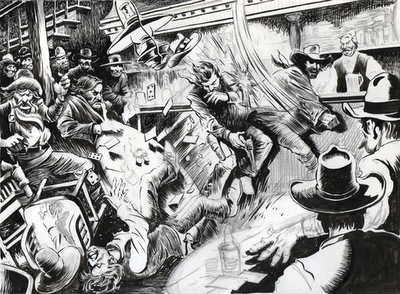
Roos is an illustrator himself and has posted samples of his own western comic sketches. Like other illustrators working in Europe, his style demonstrates the high drama in the way the Old West is imagined, in both the action and the landscape.

Sketch by Christoph Roos

Roos also discusses photo images from western movies, like his recent tribute to Robert Duvall with stills from several of his films. The best way to sample his blog (even if you don’t know German) is to scroll through posts using the label “western” [or click here]. At the end of the page, click on “Ältere posts” to get more pages.

Image credits:

Coming up: Charles Bronson, Breakheart Pass (1975)