Showing posts with label john wayne. Show all posts

Monday, December 8, 2014

The Sons of Katie Elder (1965)

A frequent complaint about westerns is that there are few strong roles for women. Katie Elder, the title character of this John Wayne film would be an exception, except for the fact that she is dead. Her four sons, as the film begins, are gathering for her funeral. As they talk about her, we learn that she overcame all manner of adversities and obstacles and remained proud of her offspring, despite the fact that they have done little to deserve her high regard.

Wayne, the eldest, has a reputation as a gunslinger. One brother (Dean Martin), is a gambler and wanted for murder. The other two (Earl Holliman, Michael Anderson, Jr.) have yet to make a mark in the world, though Anderson refuses to get the college education his mother wanted for him and intends instead to follow in Wayne’s adventuring footsteps.

Tuesday, January 14, 2014

The Train Robbers (1973)


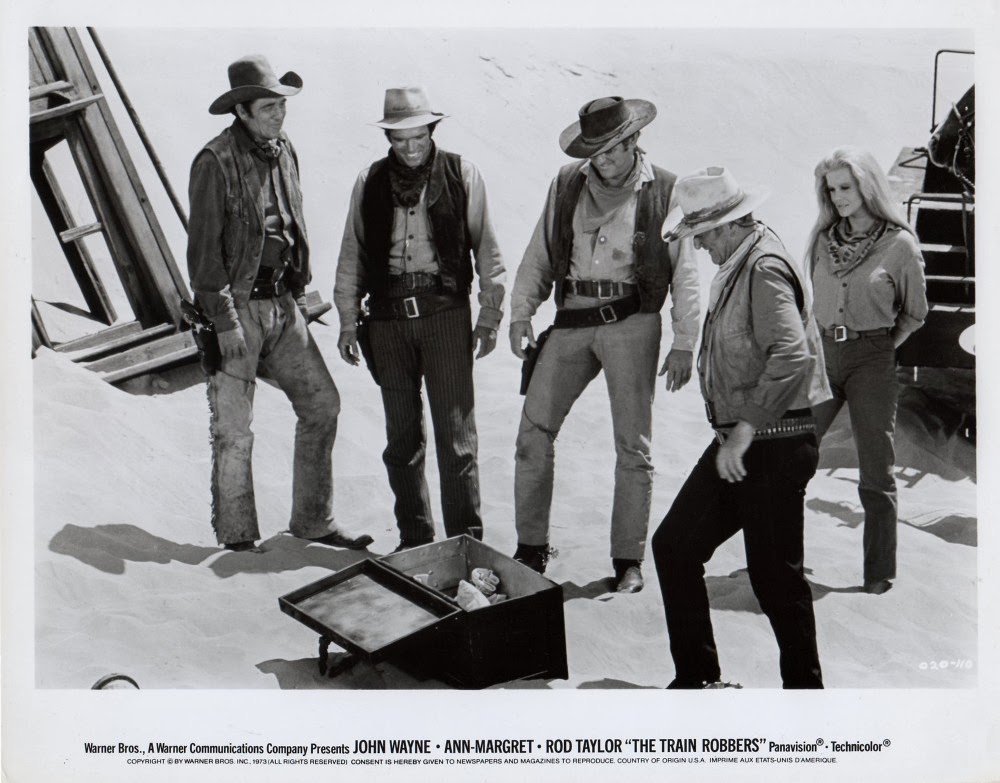
This John Wayne western should be better than it is. Individual parts of it are notable, but put together, it’s a 90-minute lead-up to a surprise ending. Wayne plays himself in the role his fans love—gruff and no-nonsense but with that disarming grin. 

The all-star cast includes Ben Johnson and Rod Taylor, both at their relaxed best. The hyphenated Ann-Margret provides the required female component. Ricardo Montalban, like someone looking for Fantasy Island, watches from afar and puffs on long cigars.

Plot. This is a Burt Kennedy film, directed from his own script. So the elements are familiar—a long trek across hostile terrain with several men and a woman. This time around, it's an assembled gang of former partners in crime accompanying the woman, who enlists them to retrieve a half million in stolen gold. It is stashed in the desert in an abandoned train locomotive.

Johnson, Guest, Taylor, Wayne, Ann-Margret
Wayne and his gang agree to help her find the gold so she can return it and supposedly clear the family name of a deceased husband, while Wayne and his men collect the reward. An immediate problem as they ride off together is that they are being followed by a troop of riders eager to separate them from the gold once it’s found.

Tuesday, November 19, 2013

Rio Lobo (1970)


Even star power and a first-class director can’t always overcome a confusing script, and this western is a good example. John Wayne has top billing in this Howard Hawks film about a former Union Army colonel who revenges a wartime traitor and rids a Texas town of a corrupt sheriff. The twist is that he relies on the help of two Confederate officers he met during the War.

Plot. The movie tries to tell two—maybe three—different stories with mostly the same characters. It starts out as a war movie with a long, half-hour sequence involving a complicated train robbery and a chase after the thieves in which Wayne is captured by rebels. This turns out to be a set up for his meeting the two Confederates (Jorge Rivero, Christopher Mitchum).

Suddenly the War is over and we’re in Texas. There a girl (Jennifer O’Neill) has ridden 200 miles from a town called Rio Lobo to report the killing of a medicine show peddler she has befriended. Reenter Rivero, in time for a gunfight that erupts with some deputies who have followed O’Neill to arrest her. Soon Wayne, Rivero, and O’Neill set off for Rio Lobo to bring the peddler’s killers to justice. Already there’s romance brewing between Rivero and O’Neill.

The corrupt sheriff (Mike Henry) and his gang are in the pay of a villainous land grabber (Victor French). His MO is to have a rancher’s family member arrested for a hanging offense and then dropping charges in exchange for the deed to the ranch. Reenter Mitchum who gets beaten up and jailed for allegedly stealing horses.

Rivero, Wayne, and O'Neill
Wayne and Rivero are joined by Mitchum’s father (Jack Elam) to capture French, who is surrounded by a small army of armed guards. In a daring nighttime raid they overcome the guards and Wayne nabs French, who turns out to be the traitor who tipped off the Confederates about the train we saw robbed in the first reel.

Taking over the town jail and freeing Mitchum, Wayne sends Rivero for the cavalry, but Rivero is taken captive by Henry’s men. This situation results in a prisoner exchange that ends unhappily for the sheriff and his gang. Henry himself is gunned down by a girl whose face he has disfigured during an interrogation.

Four stars. A synopsis of the film makes it sound fairly coherent, but watching its nearly 2 hours is another matter. It rambles on in way that seems like it’s not sure where it’s going. Screenwriter Leigh Brackett also has writing credits for two other Hawks-Wayne collaborations, Rio Bravo (1959) and El Dorado (1966). As the plot of this film threatens to resolve into a jailhouse siege, you are reminded of those two far superior westerns, which are much more tightly focused and constructed.

Tuesday, May 21, 2013

The Spoilers (1942)


This 1940s gold-rush western is jaw dropping. For one thing, it has John Wayne in black face swapping “colored” jokes with African American actress Marietta Canty. What was probably meant to be cheeky and rib-tickling in 1942 looks just plain racially insensitive today.  For another, the movie has Randolph Scott as a slick crook. And it’s no fun watching him use his patently pleasant and winning persona to trick honest folks into trusting him.

Another thing. Veteran actor Harry Carey is more or less wasted in a small two-dimensional role. And while that makes three strikes, The Spoilers isn’t quite out. It has the saving grace of Marlene Dietrich as a sultry and spectacularly dressed saloon owner. Her scenes with both Wayne and Scott are steamy with flirtatious bantering and sexual innuendo.

Plot. Another point in the film’s favor is its plot. Based on a bestselling Rex Beach novel of the same name, published in 1906, The Spoilers tells a ripping story of claim jumping in the Alaska gold fields. John Wayne and Harry Carey are mine owning partners whose claim to their mine is being challenged in court.

Randolph Scott, John Wayne, Marlene Dietrich
A crooked judge (Samuel S. Hinds) promises to clear up the cooked-up dispute and puts the mine and all its assets into receivership. He’s in cahoots with the local gold commissioner (Scott), who takes a safe full of gold from the mine’s offices as soon as they can lay hands on it.

Wayne is first trusting that the case will be settled fairly, while Carey trusts no one, and the two men part company for a while. When it’s clear they are being had by a bunch of “spoilers,” they engineer a bank robbery and, after dynamiting the front door, make off with their safe.

But during the robbery, the town marshal is accidentally shot dead by another man, and Wayne is blamed for the killing and thrown in jail to face murder charges. Scott arranges with the jailer to allow Wayne to escape, intending to have him shot dead as he attempts to ride off. But Dietrich foils that plan and gets Wayne safely out of jail herself.

To take back their mine, Wayne and Carey drive a train locomotive through the barricades set up around the perimeter and shoot it out with the armed men on guard. That leaves only a matter to settle with Scott, and the two men have a knock-down-drag-out fistfight that demolishes most of the saloon. When it’s done, Scott lies battered in the street, and Wayne comes around in the arms of Dietrich, bloody but smiling.

John Wayne, Marlene Dietrich
Romance. At the film's start, Dietrich and Wayne have been an item of long standing, but there’s trouble between them as he arrives in town on a ship from Seattle. On board, he’s befriended the judge’s daughter (Margaret Lindsay), unaware that she knows of the plot against him. Dietrich suspects him of being untrue, and the scenes between the two are less than sanguine.

Wayne plays tough with her, hoping she’ll relent, but he’s disappointed her once too often. She tosses him out of her apartment, a comfortably furnished retreat upstairs from the saloon. One of her employees, a gambler by the name of Bronco (Richard Barthelmess) has romantic hopes for her himself, but she keeps putting him off.

Enter Scott, who sets his eye on her, too. She strings him along for reasons of her own. As an investor in Wayne and Carey’s mine, she has an interest in keeping the mine in their hands. While Wayne is in jail, she pays a call on Lindsay, the other woman. By this time, father and daughter know the jig is up and are packing their bags to get out of town.

Why are you running away, Dietrich wants to know. A woman sticks by the man she loves. And that’s exactly what Dietrich does, breaking Wayne out of jail. Having learned of Scott’s scheming, she pretends to grant him some privileges. Thinking Wayne is dead, he is quick to take advantage.

Tuesday, November 27, 2012

El Dorado (1967)


This Howard Hawks western bears a strong resemblance to his previous western, Rio Bravo (1959). The elements are much the same, as if Hawks wanted to have another go at them. John Wayne appears again, this time as a hired gun. Particular about who hires him, he turns down a dirty job in the opening scenes offered by a land-greedy rancher (Ed Asner). Wayne ends up working instead with a sheriff (Robert Mitchum) to help a family keep their ranch out of Asner’s hands.

Plot. The family in question are the Macdonalds, with several grown sons and a feisty daughter (Michelle Carey). One of the boys takes a shot at Wayne and ends up dead. When Wayne brings his body to the ranch, Carey doesn’t believe his account of the incident and ambushes him. With a bullet now lodged near his spine, he is stricken at times by paralyzing pain that affects his shooting arm.

John Wayne
Drifting among the saguaros of the Southwest, he reluctantly picks up a trail buddy (James Caan), who has just killed his fourth man. Slow with a gun but quick with a knife, it seems he’s been avenging the death of an old friend, one man at a time. He adopts Wayne as a mentor.

When Wayne meets another gunman of his own professional caliber (Christopher George), he learns that the man has been hired by Asner to do the job he turned down. Wayne learns from George that while the sheriff, Mitchum, has a reputation as good with a gun, he is no longer a threat. He has been sidelined by two months of heavy drinking.

Wayne and Caan show up to give Mitchum a hand, and they wait for George and his gang. But Mitchum is in bad shape. He has hit bottom but doesn’t yet know it. The depth of his condition finally comes home to him when he is laughed at by the men in the saloon while buying another bottle of whiskey.

Robert Mitchum
As soon as the gang arrives there is trouble, and Wayne and Caan get to work getting rid of them, knocking off several in the first round. Mitchum gradually gets sober but, in an exchange of gunfire, gets shot in the leg. When Asner is taken prisoner, Wayne and the others are holed up in the jail and under siege.

All is resolved finally with a shootout at the saloon. Asner bites the dust along with George and other members of the gang we’ve come to know. Wayne takes some buckshot in his leg, and as Caan leaves to follow up on a rough meeting with Carey in the straw of a stable, Wayne and Mitchum hobble down main street, each of them on a crutch.

Tone. This is a loosely meandering film that sets up a good guys vs. bad guys conflict in the opening scenes and saves the final confrontation until almost two hours later. During that time there are several characters to get to know and some lengthy conversations.

James Caan, John Wayne
The tone of the film fluctuates between melancholy and lightly humorous, with a stretch or two of outright farce. When Macdonald says he doesn’t blame Wayne for his son’s death, Wayne turns to go, saying sadly to himself that it is not much consolation.

Meanwhile, there are several running jokes, one of them involving the riverboat gambler’s hat that Caan wears. As Mitchum slowly sobers up, he can’t remember who Caan is and keeps asking, “Who is he?” In another comic scene, Mitchum takes a much-needed bath, while everyone who visits brings him a bar of soap.

Mitchum’s alcoholism is also played for a while for laughs. When Wayne finds him passed out in a jail cell and dumps a bucket of water on him, Mitchum comes out with fists flying. Later, almost creeping away from the saloon with another bottle, he cradles it to his belly with both arms. In only a few minutes of screen time, we’ve gone from the Three Stooges to Lost Weekend.

Tuesday, July 31, 2012

The Horse Soldiers, 1959

John Ford gave western fans a version of the Civil War in this film starring John Wayne and William Holden. At two hours, it’s an entertaining film without being over-ambitious. And without exactly doing justice to the subject, it manages to tell its story in a way that does not discredit either the Union or the Confederacy.

You realize watching it that there have been few movies about the Civil War since Gone with the Wind (1939). While the U.S. Army fighting Indians was for a long time standard fare on the screen, seeing those same soldiers shooting at other white Americans is something else again.

Ford chose wisely when he picked the novel The Horse Soldiers by Harold Sinclair (1907-1966). The book was based on Grierson’s Raid in 1863, during which 17,000 Union troops traveled from Tennessee across Mississippi to Union-held Baton Rouge doing damage to Confederate infrastructure.

Plot. There are three engagements in the film, one as a trainful of armed men attempts to defend the town of Newton’s Station. A charge down the main street into withering gunfire leaves many casualties. A makeshift hospital is organized to tend to the wounded, with the help of a local doctor. Meanwhile, the Union soldiers’ destruction of the town’s rail line is sobering in its thoroughness.

Willian Holden and Constance Towers
Following that, the boys of a military academy attempt a courageous though foolhardy attack on the Union troops. It’s a relief when the soldiers react in disbelief and then make a quick retreat before any lives are lost. Finally, at the end of the film, an outnumbered contingent of Confederate soldiers attempts gamely to prevent the Union troops from crossing a bridge.

Most of the conflict in the film, however, is between the colonel (John Wayne) and an Army surgeon (William Holden). They are at cross-purposes from the first scene in which they meet. Wayne was a civil engineer for the railroad before the war; Holden was a graduate of West Point. Just about everything separates them, from class to temperament.

Amplifying the conflict is Constance Towers as a Southern belle, who happens to overhear Wayne’s plans to strike across enemy territory to Baton Rouge. To keep her from telling anyone what she knows, Wayne is forced to take her and her maid along. Her presence is a constant source of irritation to him.

Before all is said and done, she begins to have a change of heart about him. She seems sorry to see him go as she and Holden stay behind with the wounded, to be overtaken by the Confederate troops who are on their trail. Glad to be finally rid of her, Wayne makes a courteous but not unhurried exit. There’s no kissing.

Tuesday, April 24, 2012

Rio Grande (1950)

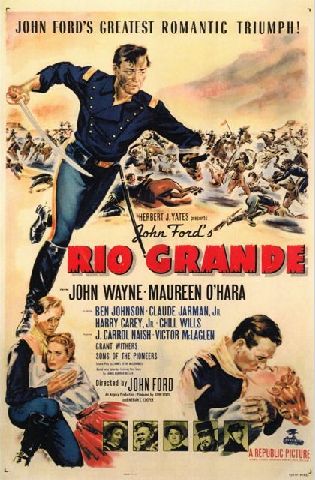
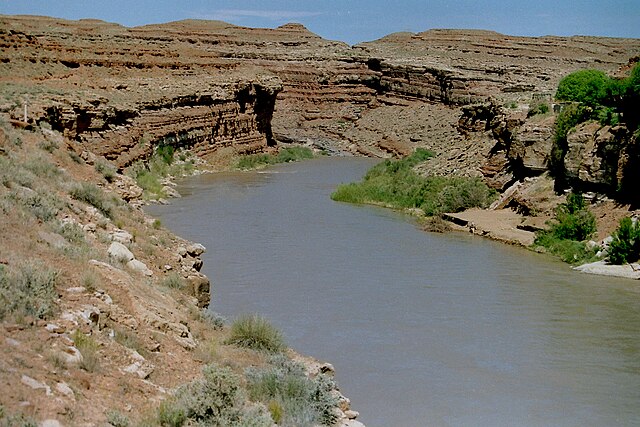
The story goes that Herb Yates at Republic Pictures agreed to make John Ford’s The Quiet Man only if he’d make another western first. So Ford went with a script from a James Warner Bellah story to Moab, Utah, and shot this classic western with John Wayne and Maureen O’Hara. Both would go on to star in The Quiet Man (1952).

It’s not hard to see this film as a warm-up to the success of Ford’s sentimental journey to Ireland in the later film. Here Wayne is a colonel and commanding officer of a cavalry post in Apache territory. O’Hara is his stunningly beautiful wife, a Southern belle (with no Southern accent, but enough Rebel attitude).

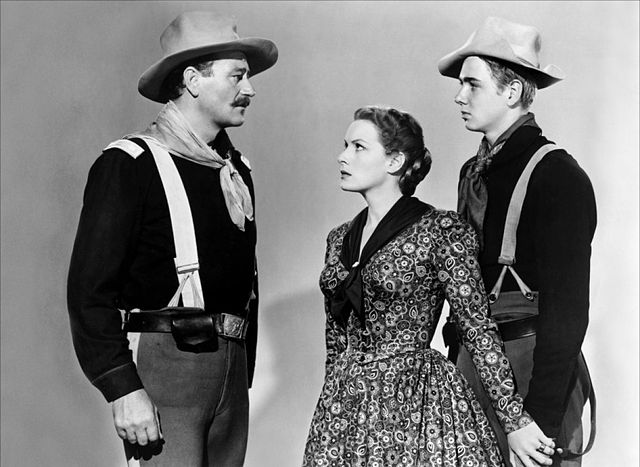
Plot. The two of have been separated 15 years, long enough for their son (Claude Jarmin, Jr.) to grow up and enlist in the Army, after failing a course or two at West Point. As chance would have it, he shows up at Wayne’s outpost, a raw but very proud recruit. His mother (O’Hara) arrives soon after, intending to pay for the boy’s release from his enlistment.

For quite a while, it’s a standoff between three stubborn people. But Jarmin holds the deciding vote, since he has no intention to leave the Army and wants to prove himself a man. If not to his father, at least to himself. He soon makes friends with two others fresh from boot camp, Harry Carey, Jr., and Ben Johnson. Meanwhile, O’Hara stays at the post, all the time hoping that Wayne will unbend enough to admit there’s a place for her in his heart besides the cavalry. Turns out there is, and the movie becomes, in an understated way, about two estranged people falling in love again. 

Wayne, O'Hara, and Jarmin
There’s action aplenty as the Apaches go on the warpath. They are able to avoid capture by crossing the Rio Grande into Mexico. When a wagon train of officers’ wives and children are ambushed and the children stolen, Wayne and his company follow them and, in a shootout with the Apaches, retrieve the children.

Playing key roles in the action are the three young recruits, Johnson, Carey, and Jarmin. Johnson’s role is complicated by the fact that he’s avoiding arrest for manslaughter in Texas. In the end, Wayne has been sidelined by an arrow to the chest, and O’Hara has resumed her place by his side. The three young soldiers get commendations for valor, having proved not only their courage but their manhood.

A Ford classic. Compared to a similar Ford western, Fort Apache (1948), this film is more scaled down in its aspirations. The setting is grand and photographed in dramatic black and white, but the story is more focused on the family at the center of it. Besides Johnson and Carey, there are several other characters in memorable roles, Victor McLaglen as a blustering sergeant, Chill Wills as the company doctor, and J. Carrol Naish as the general.

The Ford touches are all over the place, with moments of humor balanced against hard-driving action and scenes that tug at the heart. For the latter, there are the hopeful looks on the faces of the officers’ wives lined up to watch the soldiers return from fighting. The strains of “I’ll Take You Home Again, Kathleen” underscore several scenes.

Colorado River, near Moab, Utah; the "Rio Grande" of the film
There’s a gritty edge at times, as well. Bodies of dead Indians lie in a row on the ground after a battle, as a scout identifies each by the tribe they come from. We see cavalrymen shot from their horses. In a spectacular stunt, one is shot and falls under the galloping horses pulling the wagon he is driving. Actual Native Americans were cast in the roles of the Apaches.

John Wayne. This film is interesting for showing Wayne in a way that is not his usual larger than life western hero. Here, he seems very much someone given a difficult job and struggling manfully to just get it done and honorably, despite the odds. There are times when his face seems contorted with painful emotions: worry, regret, loneliness, the need to do his duty. Having his son under his command is an added burden.

Physically, Wayne also looks worn down by his responsibilities. His face sweaty and grimy from trail dust, his performance reflects a vulnerability we’re not used to seeing. In one scene he rushes half-dressed into the night, awakened from sleep by an Indian attack. Shirtless and shouting orders, he seems a man caught off-guard in the confusion.

Colorado River, near Moab, Utah
Finally, there is the surprise of his near-fatal injury in the final rescue of the children. He asks his son to pull the arrow from his chest, bravely wincing and not groaning and fainting as you or I would. But he arrives back at the fort, pulled on a travois rather than mounted, not beaten but bloodied for sure.

Wrapping up. I put this movie with the best of John Ford’s westerns. A project he apparently would not have done without the studio’s insistence, Ford directed this film with a great deal of care for the details. The performances are enjoyable; Wayne and O’Hara have plenty of chemistry; and the cinematography is often breathtaking. It’s a film that cries out to be seen on the big screen.

Rio Grande is currently available at netflix and amazon. For more of Tuesday’s Overlooked Movies jump on over to Todd Mason’s blog, Sweet Freedom.

Photo credits: Wikimedia Commons

Coming up: Mary MacLane, The Story of Mary MacLane (1902)

Tuesday, July 26, 2011

Rio Bravo (1959)


I probably saw this film in 1959, the year I graduated from high school, but I don’t have a memory of it. And I’ve put off seeing it now because I wasn’t sure I’d like either Dean Martin or Ricky Nelson. Turns out, they are both good, and Wayne is easily the best I’ve ever seen him.

Cast. Could be that the director was Howard Hawks, who  directed the classic western, Red River, also with John Wayne. He gets a relaxed performance from Wayne that has him doing what he always does best, reflecting a wry sense of humor. But if you grew up with Dean Martin opposite Jerry Lewis and then with his own variety show on TV, you think of him as belonging in a high-class Italian suit, holding a highball and a cigarette. A cowboy hat? No.

But the big surprise was the credible job he does as a former deputy on the comeback from two years of finding oblivion at the bottom of a bottle. Ricky Nelson is surprisingly stiff, given the fact that he grew up in front of cameras. But Hawks gets it to work for him, by not giving him much to do or say. The movie gets a little self-conscious when it has singers Martin and Nelson sing a duet, but with the help of Walter Brennan, it recovers itself again.

Brennan is at his comic best in the film, almost a self parody. He gets plenty of lines and though he almost never leaves the jail, where he’s keeping an eye on a prisoner, he has enough action as well. Angie Dickenson is given more than the usual two-dimensional part as the token female in the cast. The scenes of teasing flirtation between her and Wayne are plausible and seem to suit both of them. 

Plot. The plot is pretty simple for a film that runs 2 hours and 20 minutes. In a wordless opening scene, Claude Aikens shoots a man in a saloon and is arrested by Sheriff Wayne. With a town full of Aikens’ friends and a wealthy rancher for a brother, an attempt to spring him from jail is highly likely.

Wayne has only himself, game-legged deputy Brennan, and the still drying-out deputy Martin to prevent that from happening. And it’s a 6-day wait until a U.S. marshal arrives to take away the prisoner. Ricky Nelson, as the “Colorado Kid,” joins them. And the four men manage to hang onto the prisoner while being greatly outnumbered.

Shot in widescreen and color, the film includes a big cast of characters. A regular actor in Wayne’s company, Pedro Gonzalez-Gonzalez plays the town hotel owner. With his thick Mexican accent and his diminutive size, he is a warmly comic presence in the film. Ward Bond also appears in a role that is surprising for its brevity.

Jules Furthman and Leigh Brackett were the film's screenwriters. Furthman had a long writing career in Hollywood (1915-1959). Rio Bravo was his last film. Said to take place in west Texas, it was shot in Old Tucson, Arizona, and in Warner Brothers Studios, Burbank.

There’s an extensive list of interesting trivia related to the film at imdb.com. The most revealing is that the film was intended as a response to Gary Cooper’s High Noon, which Wayne is supposed to have considered “un-American.”

Rio Bravo is currently available at amazon and streamable at both netflix and amazon. Tuesday's Overlooked Movies is the bright idea of Todd Mason over at Sweet Freedom.

Source: imdb.com

Photo credits: Wikimedia Commons

Coming up: Charles King, Dunraven Ranch (1890)

Tuesday, July 19, 2011

3 Godfathers (1948)

The way this film was transformed in its journey from the printed page to the screen has director John Ford written all over it. Peter B. Kyne’s novel (reviewed here earlier) was published in 1913. Ford directed the first film adaptation of the novel in 1916, with Harry Carey. When Carey died in 1947, Ford decided to remake the story in Technicolor and dedicate the film to his memory.

Other film and TV versions have appeared under different titles over the years, before and since. Seems likely it has to be there somewhere in the background of the Tom Selleck comedy 3 Men and a Baby (1987).

Plot. The Three Godfathers was already a kind of Christmas story in Kyne’s hands. Not exactly the three wise men, the central characters are on the run following a failed bank job. But crossing the desert, they come upon a pregnant woman in the final hours before giving birth.

The new mother dies, after leaving her infant son to the care of the three men, who promise to be his godfathers and to bring him up right. With a dwindling supply of water, they start on a trek to a mining camp called New Jerusalem (New Bethlehem being maybe too obvious). Only one of them eventually arrives with the baby. It is Christmas, and so ends Kyne's novel.

John Ford, 1946
Ford’s version. The biggest change in the plot was to make John Wayne’s character the sole survivor of the three. In Kyne’s telling of the story, the youngest of them makes the final leg of the journey alone. Instead, the film makes this character (Harry Carey, Jr.) the first fatality. During the bank robbery that starts the film, he sustains a gunshot wound that’s eventually the cause of his demise.

Another change was to make one of the men Mexican (Pedro Armendáriz). He lapses into Spanish at times, which gets Wayne telling him to stop speaking “Mex” in front of the baby.

Ford’s impulse to show characters as part of a larger community seems behind the decision to expand the cast with the addition of a subplot. Ward Bond as the town sheriff leads a large posse of men into the desert in pursuit of the robbers. Finally apprehended and then brought to trial in the town saloon, Wayne’s character demands to retain custody of the baby.

Found guilty of armed robbery, he’s given the lightest sentence by the judge, who’s been moved by the obvious character of a man who won’t renege on a promise to a dying woman. On the train that will take him to Yuma prison, Wayne waves his hat at the crowd assembled to see him off, one among them a pretty girl who clearly looks forward to his return.

Wednesday, July 21, 2010

Fort Apache (1948)

I put off watching this John Ford classic until after I’d seen Broken Arrow (1950), which is on a similar subject, relations between the U.S. government and the Apaches.

The two films have several things in common. Both portray Cochise and his tribe with some historical honesty. Both films were received well by critics when they were new. Both have become somewhat dated, though John Ford fans may dispute that. Both stories get into trouble at the end.

First off, I liked Fort Apache much more than I thought I would. As Captain York, John Wayne has the kind of role I enjoy seeing him in – a man who mixes humor, strength, and good sense. He’s a man’s man. More avuncular than paternal. He’s the moral center of the movie who knows the Apache and doesn’t want a fragile peace to be undone.

Henry Fonda’s Col. Thursday is the perfect opposite. He’s first of all a bitter man, angry that after his Civil War service he was demoted and sent to this god-forsaken outpost on the Arizona frontier. He’s also a heavy-handed commanding officer, a martinet who expects unquestioned obedience to all his orders. It doesn’t matter that many of them are wrong-headed.

What makes Thursday not just overbearing but despicable is his use of authority to further his career ambitions. He will stop at nothing, even when it means certain death for himself and his men in a “last stand” reminiscent of Custer.

Tuesday, June 1, 2010

The Man Who Shot Liberty Valance (1962)

Frontier myth likes to show wagon trains full of pioneers heading west across the plains and mountains, but not the ones coming back the other way, and there were plenty who found that the West wasn’t what they expected. Some – who knows how many – weren’t cut out for it in the first place. Dorothy Johnson’s story “The Man Who Shot Liberty Valance” (1949) tells of the multiple ironies wrapped up in that simple fact.

In her story, an all around top cowboy, perfectly at home on the range, saves the life of a lawyer newly arrived from the East, who wants to practice law in a land where law is chiefly administered at the point of a gun. Despite his admirable intentions, there is hardly a good thing you can say about the lawyer. Full of self-pity, he lacks nearly every quality you might attribute to an honorable man, let alone a hero.

In attempting to bring the outlaw Liberty Valance to justice, he is drawn into a shootout that the more experienced gunfighter is sure to win. Surprisingly, the reverse happens, and years later the young lawyer rises to prominence as a politician on his reputation as “the man who shot Liberty Valance.” Meanwhile, the cowboy becomes a has-been, having outlived his time. He also loses his girl to the lawyer.

Wednesday, May 26, 2010

Happy Birthday, Duke!

I figure John Wayne's birthday is as good a day as any to get in the saddle here on blogger. I come to my interest in westerns from many years of reading about the historical west and cowboys in particular. Years ago, I discovered real-life cowboys of the 1880s were not regarded as icons of national character but rather as public nuisances on their trips into town from the open range. Then I wondered how they got to be the heroic figures we're familiar with from the movies. And that started a lot of reading, reading, reading.

Eventually, my interest expanded to cowboy songs, cowboy poetry, rodeos, comics, western movies, radio and TV. And I have an idea now of how myth and history overlap in these different genres - also how prolific was the output of cowboy-related material in popular culture. I'm just now discovering pulp westerns, thanks to Laurie Powers' book about her pulp writer grandfather, Paul S. Powers. Sagebrush Trail (1933) is one of John Wayne's many B-westerns made in the 1930s. Great example of how pulp westerns and B-westerns came together. And it's one of my favorite John Wayne movies. It also stars Lane Chandler and the incredible Yakima Canutt, who was a champion rodeo rider and stuntman for Wayne's early movies.

Anyway, that's how I got here today. I just acquired a stack of westerns from amazon that I intend to view in the coming weeks, with the intention of leaving my comments here and inviting those of any cowboy fans who happen to find this blog