Sunday, March 16, 2014

Push back

Cards
Here are more excerpts from the journal I have been keeping since returning from the hospital after brain surgery.

To be completely honest, this is not just a bad cold I’ve got. It has at its disposal the wherewithal to dispose of me. Treatment is a process of push back against the inevitable. I’m OK with that. The focus and clarity it gives to each waking moment are what you can wait a lifetime for anyway, so acceptance is joined by an unusual degree of gratitude.

2/26/14. Yesterday was a hard one. Time got away from us in the a.m. and we were 20 minutes late for the first radiation session. Then there was a long wait for my chemo meds at the pharmacy, where I discovered that the credit card I intended to use had expired, the credit union, once I reached them, unable to explain how new cards sent to my correct address had been returned undelivered. Then, with some blind stroke of luck the charge for well over $1000 worth of drugs came to less than $20.

Rock garden by front door
Witness to the growing stress on my wife, whom I’ve unreasonably expected to be my “minder” since leaving the hospital, I resolve to do more of my own minding, starting with management of all the meds I’m supposed to be taking now, and I painstakingly create a schedule, studying the pill bottle labels. Before long, I’m feeling a wave of fatigue, which I take to be a side effect of the radiation. Mostly I’m aware of the chemo capsules themselves, Temodar, scheduled for bedtime and the expectation of possible nausea and vomiting. I admit to being daunted after days of insisting that I’m not.

The day has been the crossing of a threshold. Washing down the Temodar with a glass of water before turning out the light for the night, I become a cancer patient for real. Treatment is no longer an abstraction. It has invaded me.

Saturday, March 15, 2014

Glossary of frontier fiction: M
(macer – mikonaree )


Below is a list of mostly forgotten terms, people, and the occasional song, drawn from a reading of frontier fiction, 1880–1915. Each week a new list, progressing through the alphabet, “from A to Izzard.”


macer = swindler, thief, villain. “Gamblers, miners, suckers, marks, / Spieler, macers, bunco sharks.” William De Vere, Jim Marshall’s New Pianner.

Flatboat
Mackinaw boat = a flat-bottomed boat used by fur traders on the Great Lakes and the Missouri River. “Unfortunately, the last steamboat had left Fort Union for the South, making it necessary that the trip be made in a mackinaw boat.” John Neihardt, The Lonesome Trail.

madroño = evergreen shrub or tree of the Pacific coast of North America with glossy leathery leaves and orange-red edible berries. “The ranchero was mounted on a lithe bay mare, which swiftly climbed the lazy rises of intervening hills dotted thick with oak, buckeye and madroño.” Charles Duff Stuart, Casa Grande.

Maggie Tulliver, 1910
Maggie Tulliver = the impoverished but idealistic young heroine of George Eliot’s novel, The Mill on the Floss. “A Maggie Tulliver in her own family, Luther was the one compensating feature of her life.” Dell Munger, The Wind Before the Dawn.

mahala = a slang word for an Indian woman in 1800's California, from a mispronunciation of the Spanish word  “mujer.” “Here are no wives, unless you have a fancy yourself for turning mahala, as seems likely.” Mary Austin, Isidro. [Thanks to www.native-languages.org] 

“Maiden’s Prayer, The” = a composition for piano by Tekla Badarzewska, first published in 1856. “It was announced to the audience very loudly that this piece was called The Maiden’s Prayer.” Grace and Alice MacGowan, Aunt Huldah.


main stem = the main course of a river or stream; the trunk of a tree. “They have lots of land, but are running shy on money, an’ the main stem of the family is getting purty well thinned out.” Robert Alexander Wason, Happy Hawkins.

make a mash = to seduce someone. “‘He’s makin’ a mash,’ said Ling laconically, as he jerked his thumb toward the open door of the living-room.” Caroline Lockhart, Me—Smith.

Thursday, March 13, 2014

Margaret Laurence, The Stone Angel (1964)


Reading this novel about a 95-year-old woman from a prairie town in Manitoba, I kept thinking of how seldom frontier fiction tells the stories of frontier women. The genre has so long relegated them to the sidelines of action-adventure stories about men, it seems not even odd to find them mostly missing from the panoramic narrative of the West.

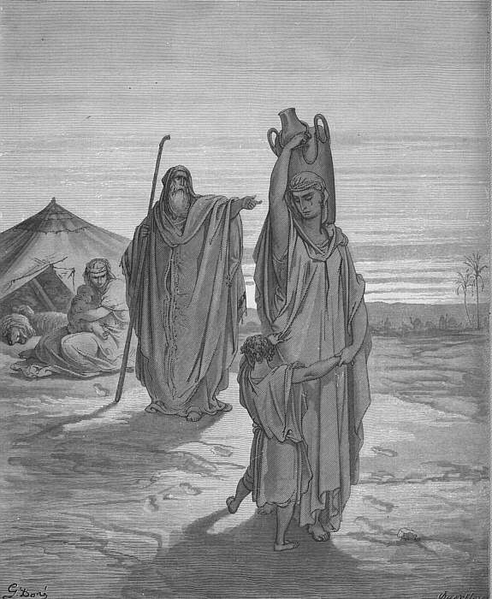
Hagar Currie in Margaret Laurence’s novel shows what it might have been like to enrich that picture with stories reflecting lives actually lived by women on the frontier. Named for the slave of Abraham and the mother of his son Ishmael in Genesis, Hagar has all the grit and survival instincts of her biblical counterpart. She is as much a feature of the western landscape as any adventuring man who has fetched up there.

Abraham sending away Hagar
Plot. The novel is more a character study than a story with beginning, middle, and end. It has all those, actually, but not in chronological order. As memories of the past crowd into Hagar’s awareness of the present, we are able to piece together the circumstances and the sequence of events that have shaped her as the person she has become.

These are dominated by the men in her life: her father and brothers, her husband, her two sons. Her mother, dead in childbirth, is an unknown, commemorated in the novel as a sightless stone angel in a cemetery overlooking the town of Manawaka, where Hagar’s father is a merchant and storekeeper.

Against his wishes, Hagar marries a widowed homesteader, Bram (cf. Abraham) Shipley, and gives birth to two sons, one of whom, John, she much prefers to the other. Aching for independence, she leaves Bram, taking John with her westward to a housekeeping job for a wealthy man in Vancouver.

Monday, March 10, 2014

The Painted Desert (1931)


This early sound western is something of a novelty. Shot on location in scenic locations in Arizona, it shows a visual sensibility from the Silent Era, while featuring the onscreen talents of two actors we don’t associate with each other today—William “Bill” Boyd before fame found him as Hopalong Cassidy, and Clark Gable, before fame found him, period.

Plot. Boyd is the grown foster son of a cattleman (William Farnum), and yearns to see Farnum reconciled with a former partner (J. Farrell MacDonald), both of whom found him as a toddler in the desert. In a complicated plot, Boyd discovers tungsten ore on MacDonald’s land and tries unsuccessfully to get the two men to partner again in what promises to be a lucrative mining project. But a couple of decades of ill will have kept the two men enemies. Boyd then approaches MacDonald with a mining deal of his own, and soon they are in business together.

Boyd also has eyes on MacDonald’s pretty rifle-toting daughter (Helen Twelvetrees). This does not go down well with a new employee (Clark Gable), a ranch hand who hires on in the middle of escalated hostilities between the two former partners over access to water. He sabotages the mining operation and interferes with time-sensitive delivery of ore in repayment of bank loans.

Sunday, March 9, 2014

No doubt


Rain-washed morning sky
Here are some more excerpts from the journal I have been keeping since returning from the hospital after brain surgery. Last week, I started calling my journal “Dodging Bullets,” which is what this all feels like some days. I said that next week would no doubt be different again. So, “No doubt” it is.

2/14/14. And life goes on. There’s no stopping it. I wake at dawn and take coffee outside with my roller-walker to sit on a fat rock near the front walk and watch the eastern sky, traced with vapor trails, listen to the neighborhood doves coo-cooing, my neighbor’s flag flapping softly in a light breeze from somewhere. I’m noticing the flowering plants in the yard, trimmed back and ready for the spring’s burst of growth. I’m thankful for Manuel, our “tree whisperer,” who has taken such expert charge of all things growing around the house now that I am scarcely able.

Saturday, March 8, 2014

Glossary of frontier fiction: L
(light-o’-love – lyed corn)


Below is a list of mostly forgotten terms, people, and the occasional song, drawn from a reading of frontier fiction, 1880–1915. Each week a new list, progressing through the alphabet, “from A to Izzard.”


light-o’-love = a woman inconstant in love. “‘His palace,’ came the arresting, accusing, stern tones of Campbell, ‘the palace that he built for his light-o’love.’” Nancy Mann Waddell Woodrow, The New Missioner.

lighter = a barge or other unpowered boat used to transfer cargo to and from ships in harbor. “A lighter grounded on Alki Point; he has been helping to float her.” Ada Woodruff Anderson, The Heart of the Red Firs.

lightning artist = an artist-entertainer who draws subjects very quickly. “A lightning artist appeared, drawing caricatures and portraits with incredible swiftness.” Frank Norris, McTeague.

lights and liver = stuffings; literally, lungs and liver. “O’ course ’t ain’t calc’lated t’ sweeten a feller’s temper none t’ have his dog handled, his worst outlaw rid, ’n’ t’ have th’ hull lites ’n’ liver o’ his conceit ’bout bein’ th’ best gun shot on th’ desert kicked plumb outen him at one kick.” Edgar Beecher Bronson, Reminiscences of a Ranchman.

limit = a tract or allotment granted for the cutting of timber. “Kent’s tender for the choice Wind River limits was accepted, somewhat to his surprise and to Crooks’s profane amazement.” A. M. Chisholm, The Boss of Wind River.

line out = to leave, depart. “I has only time to make camp, saddle up, an’ line out of thar, to keep from bein’ burned before my time.” Alfred Henry Lewis, Wolfville.

line out / line up = to scold, discipline, punish. “What do you mean by usin’ such langwidge? I’ll line you out for this.” Robert Alexander Wason, Happy Hawkins.

liquidate = to drink. “We passed into the bar and liquidated.” Frederick Niven, Hands Up!

lisle thread = a strong, tightly twisted cotton thread, named after the town in France where it was first manufactured. “From lisle-thread stockings; from round, tight garters; from brilliant brass belts; Kind Devil, deliver me.” Mary MacLane, The Story of Mary MacLane.

listeners = ears. “His listeners ’peared t’ be workin’ all right, fo’ sometimes he’d loosen up t’ th’ extent o’ a ‘yes’ o’ ‘nop,’ but that was all.” Edgar Beecher Bronson, Reminiscences of a Ranchman.

“Little Annie Rooney” = music hall song from 1890, by Michael Nolan; popular also in the US. “He rattled ‘Playmates’ off, and then he switched to ‘Annie Rooney.’” William De Vere, Jim Marshall’s New Pianner.


Sheet music, 1853
“Little More Cider, A” = a popular 19th-century song, published in 1853. “In the early days of the march they sang with spirit, to the tune of ‘A Little More Cider,’ the hymn of the hand-cart written by one of their number.” Harry Leon Wilson, The Lions of the Lord.

Little White Bird, The = a novel by Scottish author and dramatist J. M. Barrie (1860-1937), published in 1902. “Helen was sitting beside him in an easy chair, and he watched the play of her face in the lamplight as she read from ‘The Little White Bird’.” William MacLeod Raine, Wyoming.

J. M. Barrie, 1901
Little Willie = a genre of macabre short verse, usually involving children, originated by English writer Harry Graham (1874-1936). “Used to follow him down to the midnight train at St. Joe, gist to hear him speak ‘Little Willie’ to the ticket agent.” Cy Warman, Frontier Stories.

lo-the-poor-Indian = a reference to 18th century English poet Alexander Pope’s Essay on Man: “Lo! The poor Indian, whose untutored mind sees God in the clouds, or hears him in the wind.” “Denver, I’ll take care of these beauties while y’u step into the pantry with Mrs. Lo-the-poor-Indian and put up a lunch.” William MacLeod Raine, Wyoming.

loafer = a subspecies of the wolf, also known as the buffalo wolf and Great Plains wolf.  “The night silence was rent by the hunting cry of the loafer.” George Pattullo, The Untamed.

lobelia = an herbal remedy for respiratory conditions such as asthma, bronchitis, pneumonia, and cough; also called Indian tobacco. “If I’m sick and have to depend on myself, all right. I’ll dose up with lobelia or gamboge.” Harry Leon Wilson, The Lions of the Lord.

Thursday, March 6, 2014

Eleanor Gates, The Biography of a Prairie Girl (1902)

Eleanor Gates

This autobiographical novel begins with one of the finest pieces of writing I’ve found in more than 100 books of early frontier fiction. Eleanor Gates begins her story with the birth of her central character on a remote Dakota homestead during a raging blizzard. The family waits with growing dread the return of the newborn girl’s father, who has ventured into the storm for help.

The man’s remains are not found until the spring thaw, only a short distance from the family’s cabin. Told from the distance of a few childhood years, the girl thinks of her birth as the time she was brought by the stork—which chose the same day to take away her father. The raw realities of frontier life are thus embedded early on in a story of growing up on the prairie.

Plot. The novel is a rarity for its time, as it takes for its subject the emergence of a character’s consciousness during 15 years of childhood. Each chapter is a separate episode during those years, and each illustrates how the conditions of life on the prairie give form and shape to the girl’s personality and identity.

Heroine is actually not the right word for her, as she does nothing that requires heroism. Yes, she shows spunk, independence, curiosity, and a reckless daring at times, but what we are witness to is her gradual absorption of what’s to be learned from life’s limitations and contingencies.

Map of Dakota and nearby territories, 1864
Sometimes they are harsh, as when drought nearly destroys her family’s livelihood and prairie fire wipes out the little that is left of it. Sometimes they are trivial, as when an uncooperative chicken refuses to sit a nest of eggs and then refuses to lay altogether. 

In a comic turn, a visiting botanist discovers a petroglyph he believes is evidence of an earlier form of human life on the plains. We learn instead that what he’s found are the little girl’s initials inscribed on a rock face by a favorite playmate, the son of an officer from a nearby fort. More menacing is her night’s stay in an outlaw-infested hotel, where she and an older brother, with cash from the sale of a small herd of cattle, come perilously close to being victims of foul play.