Showing posts with label richard wheeler. Show all posts

Thursday, August 28, 2014

Richard Wheeler, Flint’s Honor

This is the third in Richard Wheeler’s series about frontier newspaper editor, Sam Flint. We catch him this time arriving in a silver mining settlement in Colorado. He’s been drawn there by a cruel editorial in the town newspaper, The Silver City Democrat, which smugly reported the suicide of a prostitute as a victory for the town’s morally righteous and a blow at the corruptive influence of vice.

Flint discovers that real estate is at a premium in town, and he has to settle for rental space in the very apartment where the prostitute took her life, harassed by the sheriff and his thug deputies, and unable to pay the heavy taxes levied by the town on those deemed undesirable.

Plot. Setting up shop as a rival newspaper, The Sentinel, Flint learns that his competitor, Digby Westminster, has the town sewed up, with a monopoly on the news and the advertising revenue. He manages a virtual cartel of local merchants, permitting them to avoid competitive pricing of their goods and services. Local law enforcement is also all too friendly with Westminster, and judge and prosecutor use their influence to keep Flint uninformed of any shady mishandling of public trust.

Thursday, May 1, 2014

Richard Wheeler, Flint’s Truth (1998)


Number two in Richard Wheeler’s series of novels about frontier newspaper editor Sam Flint, this is an unusually dark tale for the author. There are moments of harsh realism in the first one, Flint’s Gift, but Wheeler creates a mining community in his second novel so merciless that readers can be tempted to lose faith in the West of honest men and deeds they turn to the western story to reaffirm.

Plot. It’s the summer of 1870, and itinerant editor Flint picks a New Mexico gold mining town, Oro Blanco, to set up shop. He quickly meets the man who will become his nemesis, the town marshal, Crawford. The marshal is not just the law. He is a brutal bully who uses his authority to physically dominate and punish anyone who crosses him.

He actually shows little respect for or understanding of law or what it has to do with law enforcement. He simply makes threats, cracks heads, and throws people in jail he doesn’t like. He is soon at loggerheads with Flint, who just wants to print the news.

Printing press, 1835
What Flint learns after arriving in town is that Mason Weed, superintendent of the Golconda Mining Company, has a lot to hide. Lawyers in the hire of the company are attempting to invalidate a land grant that would give full right of ownership of the land the town rests on to the Mexicans who have lived there for generations. It would also give them 25% interest in the output of the mines.

Weed, a polished man driven by insatiable greed, will do anything to prevent that. Flint quickly becomes a thorn in his side. But rather than condone Crawford’s high-handed use of force to put Flint out of business, Weed brings in a rival newspaper to print trash about him and his efforts to thwart Crawford and to bridge the distance between Mexican and Anglo residents of the town.

Caught in the middle is a 12-year-old girl, Libby, whose widowed mother is dying of consumption in a state of utter poverty and destitution. Libby is befriended first by Flint and then by a seven-foot Cornish miner, Mountain Jack Treat, who refuses to be intimidated by Crawford and his deputy thugs. Flint gives her a job at the newspaper, sending her to a street corner to sell copies of his weekly. Treat organizes a boycott of the mayor’s saloon and opens his own bar, patronized by loyal fellow miners.

Thursday, March 20, 2014

Richard S. Wheeler, Flint’s Gift (1997)


“Profiles in Courage” would have been a good title for this novel of life in a frontier settlement in Arizona Territory. The title character, Sam Flint, is a young newspaper editor who sets up his press in little Payday, agreeing to boost the town in the interests of its growth, in return for complete freedom to print all the news he finds fit to print.

Plot. His editorial encomiums to Payday’s edenic virtues soon bring settlers and new residents. And with them comes a pack of unexpected trouble. A cattleman, Clayton Buell, long used to free use of open range for his stock brutally resists the attempts of families to homestead on public land he deems his own.

Worse yet, a black-clad business entrepreneur, Odie Racine, throws up a saloon called the Golden Calf that draws in an unwelcome element for drink, gambling, prostitution, and related forms of crime and vice. To tighten her grip on the town, she introduces a protection racket, extorting the town’s business owners, under threat of being pulverized by a couple of her brass knuckled thugs. Soon, as the sheriff and judge yield to pressure, duly constituted authority, law and order have been undermined and compromised.

Mogollon Range, Arizona
As Odie and her goons monitor the content of Flint’s newspaper each week, he falls prey to her as well. Meanwhile, he has the ire of Clayton Buell to deal with. The rancher follows through on a threat to horsewhip him should Flint print a word about his unlawful tactics preventing homesteaders from settling on his range.

Tension and suspense build in the novel as Flint plots to save himself, the newspaper, and the town. One by one, others join him in resistance, each finding the courage to put their lives on the line.

Storytelling style. Wheeler is adept at this kind of storytelling. We get an ensemble of characters, with shifting points of view and one of them, the editor Flint, at the center. As they comprise a community, we learn what drives and motivates each of them, as well as their secrets and regrets. There grows in the reader a sense of loyalty to them, the kind that made of Gunsmoke an irresistible weekly formula on TV.

Monday, January 6, 2014

Richard S. Wheeler, The Richest Hill on Earth


Review and interview

This is a novel for every reader who wanted Deadwood to go on indefinitely. In The Richest Hill on Earth, Montana writer Richard Wheeler turns his particular storytelling skills to an account of the copper mining town, Butte, at the turn of the last century. Here there are familiar names: William Andrews Clark and the other copper kings as they dig fabulous fortunes from a mountain slope near the Continental Divide. And there are the many who do the digging, as well as those scratching out a living above ground.

Besides the widow of an Irish miner and a woman with second sight, Wheeler’s novel follows an ambitious newspaperman and an enterprising mortician. There are also glancing appearances by a cop on the beat, a miner dying of consumption, a union boss, a woman on the hunt for a wealthy husband, and the residents of the red light district. Meanwhile, the bustling and rapidly growing town is a blighted, noisy, toxic environment, the often-wintry air laden with arsenic.

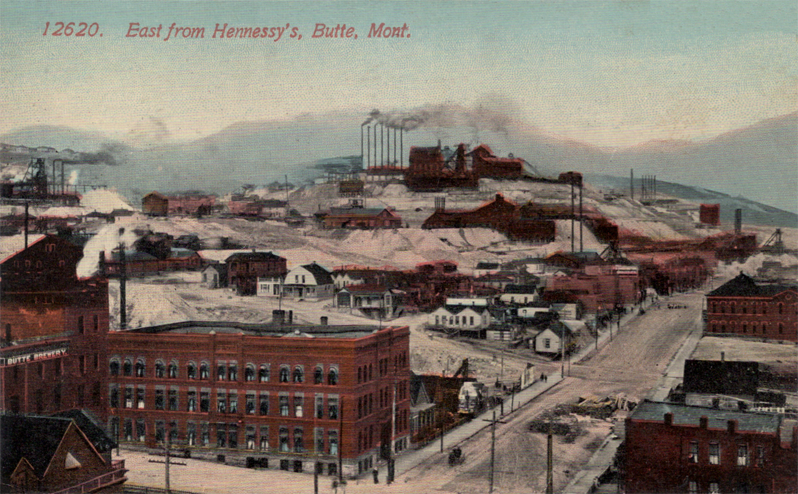
Butte, Montana, c1910
Plot. The stories of the novel’s several characters interweave. What lies at the center of them is a portrayal of monumental avarice that feeds the appetites of a few and leaves a host of others hungry. There are a lot of ways to take an attitude toward such extreme social disparity. You can imagine what a writer like Emile Zola or Victor Hugo would do with the material. And you would end up with Les Misérables. A Dickens might give us a Bleak House.

Wheeler finds a more ironic tone. One irony is that he does not villainize the three capitalists who compete for control of this “richest hill on earth.” They are no more evil than nearly anyone else around them, just vastly cunning in their deployment of their resources, and largely unaffected by the consequences for others. Pitting three of them against each other—Clark, Marcus Daly, and Augustus Heinze, Wheeler encourages a fascination in this gladiatorial contest among titans.

Thursday, September 19, 2013

Richard Wheeler, Sierra (1996)


Above all, this is a love story. You may not think so, considering how much of the novel is devoted to the gaining of wealth. But in the end, the effort to get rich turns out to be a dubious enterprise. The four young characters at the heart of the story learn that the love of another is more precious than gold.

Set in the years 1847-1851, during the time of the California gold rush, the novel has the scale and ambition of Larry McMurtry’s Lonesome Dove. It uses a sliver of American history, portrayed vividly and in depth, to deal with down-to-earth human themes. And it’s easily an equal of McMurtry’s novel—often superior to it.

Plot. You get two main plots for the price of one in Sierra, and they only briefly touch each other. One is a love-at-first-sight story of the daughter of a Californio ranchero and a young volunteer just discharged from the Army at the end of the Mexican-American War. The other tells of a newly married Iowa farmer who crosses the continent to look for gold in California, leaving behind his pregnant wife.

The volunteer, Stephen Jarvis, and his novia, Rita Concepción, are star-crossed lovers. Neither speaks the other’s language, and her family is dead set against him. Hoping to put together enough money to marry, Jarvis takes a job at Sutter’s Fort in the Sacramento valley. By chance, he is on a crew building a sawmill for Sutter when gold is discovered in the streambed of the millrace.

49er panning for gold
In a year’s time, he has acquired a fortune worthy of the girl he has given his heart to, but her family has married her off to a man from a rancho family much like their own. Heartbroken, Jarvis goes into business as a supplier of goods and materials for the wave of gold-hunters descending on California. With a natural head for business, he becomes wealthy many times over.

The Iowa farmer, Ulysses McQueen, has a much different story. Little more than a boy on an adventure, he has a grueling experience from almost the moment he leaves home. Death from disease, accident, and misfortune wait at every step of the way, and he arrives in California too late to make an easy fortune. Meanwhile, he puts off writing his wife back on the farm until she wonders whether he has died. She finally sets off to find him.

That takes you midway into this richly detailed novel. And Wheeler builds considerable suspense as obstacles mount up, preventing the happy reunion of both couples. Meanwhile, we meet a host of characters who inhabit the novel’s teeming social fabric.

Story and history. One achievement, among many, is the way the novel illuminates and enlivens a moment in time already fixed in place by national myth. Wheeler immerses the reader in a tumultuous period of history, at the time of a convulsive leap ahead in economic, political, and social change. His characters are being swept along by forces far beyond their understanding, chief among them their own desire to get rich quick.

Not only are characters unaware of their place in history. They know so little of their own present. The novel reminds us of the length of the news cycle before the advent of electronic communications. Mail delivery is sporadic, and they must wait months for letters to travel between East and West. Characters rely heavily on word of mouth, which may or may not be reliable.

Thursday, August 29, 2013

Richard S. Wheeler, Badlands (1992)


The western lends itself well to a particular kind of story—the small group of travelers crossing a forbidding terrain. Far from civilization, they are at the mercy of hostile elements, human and nonhuman. Richard Wheeler’s novel offers an interesting twist on that formula as he sends an expedition of scientists into the badlands of Nebraska Territory in the summer of 1859.

Among the small troop are men and women of honorable or questionable character, and circumstances bring out the best and worst in them. One or more of them rise to a kind of heroism in the face of adversity, others sink into depravity, and two will fall in love. It’s the world in microcosm.

Plot. Wheeler’s scientists include three paleontologists in search of fossils. A fourth is an ethnologist studying the native populations of the plains. Briefly outlined, the novel tells of how their fieldwork arouses the distrust of nearby Sioux, while the greed and disrespect of one of the party put all their lives in jeopardy.

The danger in which they find themselves grows only gradually. The reaction of the Indians, though unpredictable and potentially menacing, remains for a long time reserved and patient. Though intruders, the whites are granted the courtesy afforded to guests, and they are also subjects of immense curiosity.

Badlands National Park, South Dakota
When the ethnologist desecrates a burial site, the Indians give them all a polite warning and are pacified after negotiating a measure of restitution. Refusing to be warned, however, the ethnologist continues in his pillage of sacred Sioux artifacts and when discovered raises doubt that any of them will return to civilization alive.

Characters.  The story is chiefly in the characters themselves. Heading up the expedition is Cyrus Wood, an aging Harvard professor of paleontology. His grant from the Smithsonian has given him a last chance to win the fame that has long eluded him. Another paleontologist is a physician from North Carolina, an irritating man aptly named Roderick Crabtree. Tending to his daily needs is his black slave, Gracie.

The ethnologist, Archimedes Van Vliet, is greedy for fame, the selfless pursuit of pure science be hanged. He is also overly dependent on alcohol, which abets his reckless disregard for consequences.

All three men are nettled by the presence among them of an English woman, Candace Huxtable. An amateur fossil hunter, she has made of herself an unwelcome tag-along, coming all the way from Cambridge at her own expense to carry on the work of her departed father. With her, to ensure propriety for a woman traveling alone, is her hired chaperone, Mrs. Rumley.

Monday, August 19, 2013

Richard S. Wheeler, Eclipse: A Novel of Lewis and Clark


Review and interview

Fallibility. After reading from Richard Wheeler’s lengthy list of historical western novels, I’m thinking fallibility is a special interest of this award-winning author. And it’s a difficult subject in a field of fiction that traditionally wants to pay tribute to the men who opened the West. In this story of Lewis and Clark, however, we are given a portrayal of exceptional men, who are also only human.

Eclipse, published in 2002, tackles the story of the suicide of Meriwether Lewis, only a few short years after the triumphant return of his expedition to the Pacific with Will Clark. As Wheeler notes in a Postscript, his death had long been a mystery, some historians advancing evidence of foul play. As a close associate of Jefferson and the political camp opposed to Aaron Burr, he would have had his enemies.

But opinion has shifted to a belief that at the time of his death, Lewis was in fact dying of syphilis, contracted while consorting with an Indian woman. Wheeler’s novel begins with the return of the Corps of Discovery and follows Lewis as the disease eventually ravages his body and mind. The novel’s considerable achievement is that it makes of this unlikely material a wholehearted and compelling tragedy.

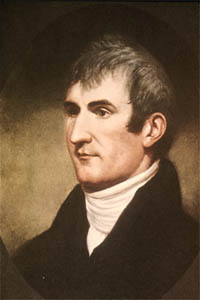
Meriwether Lewis, c1807
I know, that’s an odd use of the word “wholehearted.” But while one learns the doleful details of what was an essentially untreatable disease, we are witness to the destruction of a spirited and gifted man. A widely admired public figure, he was a born leader full of promise as a worthy public servant. His death marked a great loss to the republic.

In Wheeler’s hands, it is also a personal tragedy. What destroys him as much as the disease is the abject shame of being the host of a venereal infection. Lewis sees his hopes and dreams torn from him, leaving him unfit for marriage and unable even to confide in his closest friends. He is an exile, a prisoner suffering solitary confinement. One is reminded of the stigma and the moral panic unleashed with the first victims of the AIDS virus.

Plot. After their return to the States, Lewis and Clark are given administrative duties over upper Louisiana. Both are based in the former French colonial city of St. Louis. Lewis is appointed governor, and Clark is superintendent of Indian Affairs. Both have immediate and pressing responsibilities. Chief among them is the winning of allegiance from the many Indian tribes even as the British, Spaniards, and others contend for control of the vast tract of land.

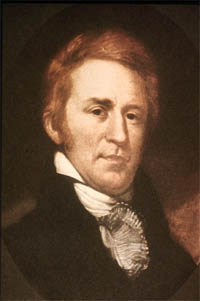
William Clark, 1810
Clark arrives first, newly married to the 15-year-old daughter of a prominent Virginia family. Before taking up his post, Lewis is lionized by the great and powerful, from politicians to scientists. He is received by Jefferson, who warms his heart and soul with fatherly praise.

Meanwhile, he sets himself unsuccessfully to winning a wife, someone not only arrestingly lovely, but serious as he. But the few who qualify find him strangely off putting. He exhibits a social awkwardness that may be related to his anxieties over his unsettled health. He attributes his symptoms to “ague,” while believing himself cured of “the pox.”

Arriving in St. Louis, he is greeted by his second in command, a secretary named Bates, who wants Lewis to be no more than a figurehead. A man with aspirations of his own, Bates has intentions for the government of the territory that are in direct opposition to Lewis’s. In time, his open hostility to Lewis produces a state of siege between the two men. It’s a situation that mystifies Clark, who remembers how Lewis was unreservedly loved by the men of the Corps.

Then there is the matter of the expedition’s journals, which Lewis has promised Jefferson and the scientific community to rush into print. His job is to edit the daily notes taken by Clark and himself, a formidable task given the three years of the journey. But despite Jefferson’s continued urging, he finds himself strangely unable to even start the task.

The levee, St. Louis, 1857
Character. And with this detail we begin to sense some of the weaker links in his character. Wheeler portrays Lewis as a perfectionist. While he’s able to turn over the work of preparing drawings and maps to experts, he wants the text of the journals to reflect his own expertise. And in so doing he seems to create the conditions for a first-class case of writer’s block.

As a man of achievement, he is also not without ego. He has been encouraged by others to regard himself as having potential for high office, even one day being asked to run for president.  At one point, he considers a potential wife as being worthy of joining him some day in the White House. And he dresses for success, spending his scant earnings as a government employee on fancy duds.

More devastating for him financially are his impulsive investments in real estate and other ventures.  When the fur trade suddenly goes into recession and a stingy War Department stops paying for expenses he has incurred as an agent of the government, he acquires a mountain of debts. To his credit, he determines to honor them to the last dollar, but financial ruin becomes the mirror reflection of the ruin of his mind and body.

Clark comes across as more sensible and even-tempered, his judgment more measured. He is lucky in marriage and more grounded professionally. His respect for Lewis as colleague and friend never falters. When he slowly learns the truth of the man’s condition, including his dependence on alcohol and opiates, he remains loyal and supportive.

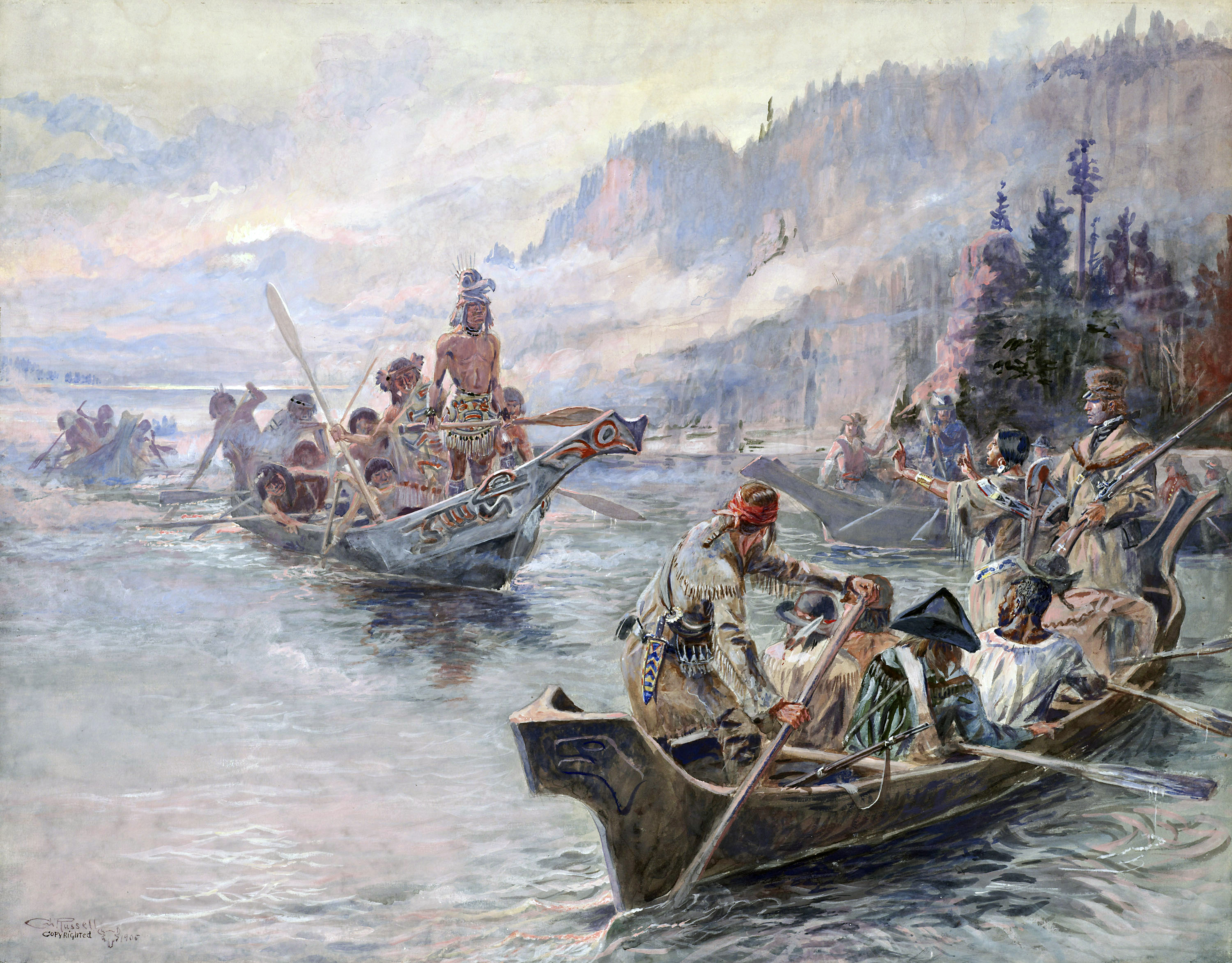
Lewis and Clark on the Lower Columbia, 1905
Yet there is a side to Clark’s character that will put a chill through modern readers. He is a slave owner, and his coldly resolute relationship with his man York is clearly from another era.  Though York traveled with the Corps to the West, performing tasks equal to the others, Clark treats him as property. We even learn his market value on the auction block in New Orleans, $1,500.

While York believes he has proved himself a man, worthy of his freedom, Clark regards him as no more than a child. Now that he’s married and has increasing responsibilities, Clark needs him more than ever, and he refuses him conjugal visits with his wife on the home plantation. It becomes a battle of wills that parallels the plotline between Lewis and Bates.

Structure and style. Wheeler’s special narrative gift is the ability to immerse us in a story about fallible men and to make it hard to put down. One of his choices is to tell the story in the first person, alternating between the points of view of both men. Thus, for Lewis, we swing between his emotional highs and lows as he struggles between fear and denial.

Also effective is how the men narrate the story, as if reporting what has just happened, so that events unfold for us only a beat or two after their occurrence. That has a subtle effect, producing an uncommon sense of immediacy.

Missouri River near Omaha Indian Agency, 1869
We also get plunged into an 18th century mindset as when Clark expresses his frustrations with his wife’s and York’s requests of him. “A man has to resist women and slaves and come to his own judgments,” he says, “or he’s not a man.” While his wife reluctantly yields to his wishes without objection, he threatens to give York “a taste of the whip” to make him more obedient.

Wrapping up. There is so much more packed into this novel, it’s hard to stop writing about it. Let it be said that it’s an absorbing account of a troubled chapter in the lives of two men who are remembered as national heroes. It’s a reminder of how historical fact defies myth, while demonstrating that behind the myth are living, breathing human beings with much to praise in them despite their faults.

Eclipse is currently available at amazon and Barnes&Noble and for kindle and the nook.

Interview 
Richard S. Wheeler
Richard Wheeler has generously agreed to spend some time here at BITS to talk about writing and the writing of his novel Eclipse. Here are his comments on the imaginative task of telling the story of Lewis and Clark and bringing the two men to life on the page.


Richard, talk about how the idea for Eclipse suggested itself to you.
In the 90s, a doctor who lectured on the medicine of the Lewis and Clark expedition told me he had read that Lewis had contracted syphilis, and it affected Lewis the rest of his brief life. The doctor couldn’t remember where he had seen it. I sensed a novel, and began a feverish hunt for the source, and after some serious looking over several months, I found it.

An epidemiologist named Reimert T. Ravenholt had examined the journals and concluded that Lewis had contracted syphilis when the corps was staying with the Shoshones. Syphilis is a New World disease, and Europeans were more vulnerable to it than native people. (Columbus took it back to Europe, where it eventually killed a third of the people. It was called the pox.)

Did the story come to you all at once or was that a more complex part of the process?
I was fascinated by the swift decline of Lewis, and the steady ascent of Clark after they got back. I envisioned a novel that would be nothing more than the dramatizing of all that. The expedition itself had been covered exhaustively in fiction and nonfiction, and more was being prepared for the bicentennial by gifted historians, but it seemed likely that a novel about the aftermath would have legs, and it did. I was helped by the enormous literature. There was so much I finally tapered off the research; I was writing a novel, not a new history.

Did anything about the story or characters surprise you as you were writing?
When an historical novelist is very lucky, he is overwhelmed with a sense of getting it right. That’s how this evolved. As I wrote, I was occasionally filled with that euphoric sense of capturing the period. Getting it down more or less as it happened. This was especially true when I thought I had caught an attitude or prejudice that lay deep within the character.

What parts of the novel gave you the most pleasure to write?
Medicine of the period became a fascinating subtext, crucial to the telling of the story. I immersed myself in it, got help from doctors, learned as much as I could about diagnosis, remedies, and also attitudes and nonscientific beliefs. (Such as the idea that malaria rose from the “miasma” found in swamps.) Medicine governed my novel. I learned what remedies got the expedition through three years of wilderness travel. Native American medicine played a crucial role, too.

Thursday, February 7, 2013

Richard Wheeler, The Buffalo Commons


Written in the late 1990s, Richard Wheeler’s novel is set in what was then (and still is) the near future. A Ted Turner style billionaire, Laslo Horoney, has been buying up ranchland in Eastern Montana, Wyoming, and South Dakota to create a grassland wilderness preserve. He plans to stock it with bison and other species of wildlife for whom this vast region of prairie was once home.

Sounds like a great idea, except for a ranching family, the Nicholses, who decide not to sell out to him. Ranching is tough, but they don’t want to give up their livelihood or the property that has been the family home for generations. “Pain and struggle make the deepest, toughest roots of all,” Cameron Nichols tells Horoney. The novel is a long account of the conflict and eventual friendship that develop between them.

Plot.  That conflict is no simple one of black vs. white, or one man against another. It quickly mushrooms into a battle among forces that are way beyond the control of either of them.

Ranchland, eastern Montana
An immediate complication is the illegal importing of wolves from Canada, which are set free on the Nichols ranch by an environmental activist. Designated an endangered species, they trigger the interest of the US Field and Wildlife Service, and the Nicholses soon find themselves embroiled in a host of government regulations. Failing to fully comply, they are at risk of having their ranch seized.

Meanwhile, Horoney discovers he’s up against nearly every interested federal agency eager to take possession of his grassland project for themselves. In league with them are the state authorities, who hope to milk him for millions in property taxes. Thus the use and misuse of power, at the expense of the individual, is a prevailing theme throughout the book.

The scope of this 380-page novel is as big as Montana. Besides the Nichols holdings in the southeast quadrant of the state, the geographical leaps take us back and forth along the I-90/94 corridor, from Miles City to Bozeman and north to Helena.  I also counted more than 35 characters who get themselves involved in one way or another, right up to the President of the United States.

Wheat, eastern Montana
Issues. Richard Wheeler is best known for his historical fiction. This novel is a departure, using a mode of speculative fiction to address a lot of current issues. But they’re issues that have a long history, particularly the rights of the individual vs. government. The villains in the novel are clearly those who do not respect those rights. Reading this book, a person can get a good idea of what animates voters for whom “big government” is a chief complaint.

Western fiction from 100 years ago often casts government and judicial systems as corrupted by moneyed monopolists. In Wheeler’s novel, government bureaucrats are in league with scientists providing research that supports policies biased by favored ideologies. The results are much the same.

Character. Among the handful of admirable characters in the novel is Sanford Kouric, a USFWS “wolf biologist.” He loses his job when he fails to give his full support to one of the agency’s rulings affecting the Nichols ranch. But like the others who refuse to knuckle under to the bureaucracy, he is not daunted.

Friday, November 2, 2012

Richard S. Wheeler, Yancey’s Jackpot


Review and interview

This novel won a Spur Award in 2005, and if the title doesn’t ring a bell, it went at that time under the name Vengeance Valley, which Wheeler has said was not his first choice. There’s little in the way of vengeance in this mining camp story and a great deal more about a lot of other kinds of human motives. There’s also no valley. Republishing the novel as an e-book, Wheeler had the opportunity to restore his original title and seized it—one might say with a vengeance.

Plot. There’s a lot to like about this story of greed for gold. The most compelling character is arguably the villain, Alfred Noble, a man without an ounce of nobility. On a technicality of the law, he is able to claim the gold strike of the novel’s title character, Will “Hard Luck” Yancey. Now kingpin of a mining syndicate, with capital from investors back East, Noble has taken over the entire town, lock stock and barrel.

Mining camp, Nevada, 1871
The only chunk of property he can’t claim as his own is a spring-fed patch deeded to a handful of nuns, who operate a small hospital. The hospital is run by a stalwart nun, Sister Carmela. Given the hazards of working in Noble’s mines, the beds there are usually full.

Broke and feeling more than a little lonely, Yancey has managed to hang onto his self-respect. While he has plenty of cause to take vengeance on Noble, who is now filthy rich, he remains philosophical. Despite what he has witnessed of the ruthlessness of the West, he is determined to remain an honorable man.

Fortunes, it turns out, are about to be reversed in chapter one as Yancey discovers a seam of gold running directly under the hospital. When he learns of it, Noble uses every trick in the book to oust the sisters from their property. Eventually, he simply seizes possession and throws them out, patients and all.

The one thing more precious than gold in the camp is water, and the sisters’ spring has been the only source of it for the whole camp. As Noble dynamites his way under the hospital, he disturbs the underground water flow, and without warning he finds himself and his enterprise confronting problems he never expected.

Miners, San Juan County, Colorado, 1875
Character. Wheeler draws a likeable and admirable character in Yancey, and for romantic interest, there is Adelaide Kearny, proprietor of a saloon. A young widow, she has become stranded in the West, barely making ends meet. Yancey’s tender affection for her deepens the yearning for companionship that haunts him.

Yancey’s strength as a character doesn’t materialize in action, as one expects in a standard western. He uses his intelligence and knowledge of geology and mineralogy to outsmart Noble. But he is powerless against the man’s relentless efforts to take advantage. With the town constable and the town banker in his pocket, he can run Yancey out of town if he wants. And he does.

The tougher nut for Noble to crack is Sister Carmela, who will not be cowed by him. She refuses to do his bidding or yield to his threats. He has to take the hospital from her by force. Her fearless faith in her calling and her physical stamina keep her going. She’s a memorable presence among the several threads of the story.

Two other characters deserve mention. Though both of them are physically disabled, they command readers’ respect for being tireless supporters of the sisters. There’s Rufus Borden, a doctor whose work is sometimes interrupted by grand mal seizures. And there’s Slow Eddie, whose head injury in a mining accident has affected his ability to converse freely.

Mining camp, Arizona, 1909
Themes. The matter of disability, in fact, is an underlying theme in the entire novel. How does a person resist despair when dealt an irreversible blow? When a miner is brought to the hospital having lost the use of his arm in an accident, Borden sees him at a decision point:

The mines mangled men and spit them out, and now Manx was another. But Doc had seen men make new lives out of what was left of them. And he had seen others who didn’t try, or want to try, and who sunk into bitterness.

Many of the central characters face insurmountable odds, seeming to lose everything but their own will to carry on. Call it grit or character or faith or moral fiber, they don’t give up. And among them all is a degree of selflessness that still puts the needs of others before their own.

In this regard, Noble is the foil to them all. Facing his ruin when the wheel of fortune suddenly turns, he remains his own worst self. Cold and heartless, though always with a smile, he tries to preserve his wealth at novel’s end with actions that are nakedly chilling.

Read in the company of mining camp stories from the turn of the last century, this novel shows some interesting ways that the genre has evolved. The harsh working conditions for miners are far more prominent, and there’s less respect for the get-rich-quick ethic we find in those earlier stories. Noble, like Hearst in the HBO series Deadwood, is a greedy and unscrupulous s.o.b.

Most curious to me was the realization that I’d not come across nuns before in reading early western fiction. Sister Carmela is true to type, as the hard-nosed bride of Christ we know from movies and TV, but religious folk in early westerns are typically Protestant. The nun as a stock character in popular fiction seems to have emerged sometime since Owen Wister.

Mining camp, Arizona, 1909
Wrapping up. Wheeler shows again with this novel that he is adept at telling stories that grip the imagination while using a western setting to explore ideas and values. The characters that come to life on these pages are genuine, and the portrayal of the West is a corrective to romantic notions that want to see it idealized.

It’s also an interesting take on violence that doesn’t feature gun duels and shootouts. The damage that Noble does to the people of the town, his total betrayal of public trust, his crassly callous disregard for the welfare of others wound and kill as thoroughly as any firearms.

And in the final pages, the vengeance taken on him is self-inflicted, though he does not yet know it. He walks away, free and clear of the financial disaster he sees coming. But he will eat his heart out when he discovers how he has been outwitted and outmaneuvered by Yancey. And that’s vengeance enough.

Yancey’s Jackpot and many of Richard Wheeler’s books are currently available at amazon, Barnes&Noble, and for kindle and the nook. You can visit his website here.

Richard S. Wheeler
Interview
Richard Wheeler has generously agreed to spend some time here at BITS to talk about writing and the writing of Yancey’s Jackpot. I’m pleased to turn the rest of this page over to him.

Richard, how did the idea for this novel suggest itself to you?
In researching Virginia City, Montana, I discovered that nuns, the Sisters of Charity of Leavenworth, operated a small hospital for miners, and had similar hospitals in several mining towns, thus filling a need.

Few mining towns offered any significant medical help to miners. It dawned on me that there might be a great story if the sisters’ hospital happened to be sitting on a bonanza lode. Thus the story was born.

Was the published version similar to how you first conceived it or somewhat different?
Pinnacle published it as it was written, except for the title. At that time, the publisher was hoping to bolster western sales by employing titles the evoked classic 1940s and 50s stories. Vengeance Valley had been used several times and had that classical western quality about it.

Unfortunately, it badly missed the mark, so much so that some reviewers were caustic about it. The company graciously reverted the title to me, enabling me to publish it under my original title.

Talk a bit about editing and revising this novel. After completing a first draft, did it go through any key changes?
When I finish a draft, I try to view the story as a new reader might, and look for things that could confuse or bore a reader. So my revisions are aimed at clarity and movement. I want to state things in ways that avoid confusion.

Elmer Kelton’s prose is more transparent than any other writer I’m familiar with, and I always hoped to reach his level of lucidity. In his case, it goes back to his pulp fiction days.

My other quest, when revising, is for plausibility. I just hate it when a reader says whoa! Just the other day I caught myself writing about bull oxen. If that had gone to print, I’d be drummed out of the company of western writers.

Virginia City, Nevada, c1876
Were you thinking of any previous mining-camp novels or stories while writing this one?
I suppose Ernest Haycox’s Alder Gulch was the portal to frontier mining. That was deepened by Mark Twain’s mining yarns, and Bret Harte’s great gold rush stories. But actually, it was a lot of nonfiction books, mostly histories of mining towns, that filled me with the belief that these were stories begging to be told.

I have a wide shelf devoted to mining nonfiction, including many technical books. There’s an amazing bookstore in Virginia City, Nevada, that loaded me up with fabulous books. A memoir, Deep Enough, by Frank Crampton, handed me one of my most powerful storylines in Goldfield.

Was there anything about this story that surprised you in the writing of it?
Yes, its resolution, or ending. I did not know how the story would end. But the ending leapt to mind one day as I pondered Yancey’s shrewd grasp of geology. He finds the magical, almost mystical, key to success and redemption, one that is deeply satisfying and just.

After more than a half-dozen years since its first publication, would you write this novel any differently today?
I would recast Yancey now. I wanted to portray a man whose gift was professional knowledge, in this case, of mineralogy and geology; a man who came west without any skill with firearms, a man very like the farmers and accountants and surveyors who flooded into dangerous country more or less unarmed, and in any case, hesitant to use arms. I think now I would have given Yancey a little more gravelly and rough personality.

Bodie, California, 1972
The word “jackpot” has numerous meanings. What was your thinking in choosing it for the novel’s title?
The good earth offers us many jackpots. In mining towns, these are often precious metals, but many western fortunes involved other things, such as grass or water or common minerals or rights of way or beef. There is another sort of jackpot, too. Yancey gets his girl. I like to think of jackpots as big payoffs to thoughtful ventures.

What sort of research went into the writing of this novel?
In addition to my large collection of mining histories, which I have devoured and bookmarked, I explored numerous ghost towns (mostly vanished now) and got a sense of how these amazing places sprang up in sheer wilderness and became bustling cities overnight. There is also wonderful stuff in the Montana Historical Society archives and library. I believe close to half of my seventy-some novels involve frontier mining.

Wednesday, August 22, 2012

Richard S. Wheeler, Masterson

The West sucked up men and women from the East for the few decades that it was the frontier, and of those we remember today, most never returned. Some settled somewhere, often California; some kept drifting; a lot simply died there before they got old. Few went back East to productively live on into the Twentieth Century. William Barclay “Bat” Masterson was one of those.

Richard Wheeler finds him in this novel in the year 1919, in what would turn out to be one of Bat’s few remaining years. Plagued with diabetes, he’s hard at work as a newspaperman in New York, where his chief concern is the imminent arrival of Prohibition.

The Old West has long been folded into the pages of history, and of all the men Bat knew back then, only Wyatt Earp seems still to survive. If the Old West exists anywhere at all, it’s on the miles of celluloid pouring forth from Hollywood.

Bat Masterson, in later years
Plot. Wheeler’s novel is structured as a personal journey as the aging Bat packs up with his common-law wife Emma to revisit the West he once knew. It’s not exactly a sentimental journey. Bat is a New Yorker. He hangs out at the Metropole drinking with the likes of Damon Runyon.

The journey west starts as a quest for the truth about his life, since legends seem to have taken over the facts. Legend would cast him as a gunslinger and heroic lawman, with how many men killed? Twenty? Thirty?

In fact, he knows of only one, for sure. And that was defending the life and honor of one of his countless sweethearts. Another man died resisting arrest, but Bat’s may not have been the bullet that killed him. There was some Indian fighting, too, which may have produced some casualties, but the rest is legend, and Bat seems to be the only one willing to accept the fact.

Traveling by Pullman to Dodge, then westward to Colorado, and eventually to California, Bat finds that any embarrassing memory of the bad old days has been obliterated. The brothels, of course, are gone, but even the saloons and variety halls have been torn down. A highlight for him and Emma is meeting William S. Hart, who gives them walk-on parts in a western he is shooting. A visit with Wyatt Earp proves to be unrewarding, as the grumbling old man seems stuck under the thumb of his wife, Josie.

Wednesday, May 2, 2012

Richard S. Wheeler, Collected Short Stories

Review and interview
I don’t know if this analogy holds up, but in this collection of stories there’s a near perfect example of what it is to read a Richard Wheeler story. Narrated by an undertaker, “Dead Weight” introduces us to a coffin maker, who makes a coffin that’s a work of art.

Constructed of three kinds of ebony wood, it is watertight and airtight, and so cunningly put together you cannot find the seams. Inside, it is comfortably appointed. Outside are silver handles, enough for ten men to carry it to a final resting place, where it will last until Judgment Day, if not longer.

The craft in Wheeler’s storytelling is like that.

Where the analogy breaks down is the “dead weight” of the title. These stories have a feather lightness. They make storytelling look easy, and in that way they show the craft of a skillful artisan at work.

A nifty trick, and I don’t know how he does it, is to have historical figures walk blithely in and out of his stories set in the Old West, as if they are unknowns. Wyatt Earp appears briefly in two of them, “Dead Weight” and “Hearts.” The latter is about a Pinkerton agent posing as a lady faro dealer. Yet Wyatt’s presence has no more weight than a fictional character, and a marginal one at that. There’s no aura about him of the legend he would become.

This is a fine irony. And the pleasure in many of the stories is in the bemused way they observe human behavior as it’s found among westerners—and all these stories, whether set in the past or not, take place in the West. In “A Commercial Proposition,” the irony is straightforward. A woman single-handedly stops a pox-bearing river steamer from docking at Fort Benton, while the men of the town cower in disarray and confusion.

Photo by Wing-Chi Poon
“The Great Filibuster of 1975” comically portrays some DIY international land grabbing along the Arizona-Mexico border. In “The Last Days of Dominic Prince,” an old-school rancher, living at a time when hippies roamed free, goes public with news that he’s shot and killed a wildcat. With his Old West assumption that humans are still the endangered species, he gets into serious hot water.

It’s hard to pick a favorite of the bunch, but up near the top for me is “The Tinhorn’s Lady,” about a young immigrant doctor who has fallen in love with the Wild West. As anyone who writes fiction knows, endings are hard, but Wheeler makes them look effortless with the final words of this one:

He had intended to sow a few wild oats for a few years and then sail for Le Havre, having had his fill of American wildness. But this morning he knew he wouldn’t. He would never have his fill of this reckless people and this new land.

Another gift is the ability to write of sentiment without sliding uncomfortably into sentimentality. Wheeler masters this, too, though I couldn’t tell you how he does it.

In “The Business of Dying,” two young men in the gold fields of California spend a last evening together as one of them, very sick, confronts his own imminent death. The tenderness between them may seem idealized, but you understand reading this story how premature death from accident and disease haunted the lives of far more westerners than death by violence.

This is a fine collection. All but one of the stories have appeared previously, in publications from 1997 to 2009. The one new story, “Looking for Love at a Romance Writers Convention” puts its western novelist in the company of a gathering of romance writers. Given his dubious reasons for being there, the outcome is again perfectly ironic. Collected Short Stories is currently available as an ebook for kindle and the nook.

Richard S. Wheeler
Interview
Richard Wheeler has generously agreed to an interview about Collected Short Stories and his writing. It's a pleasure to have him here at BITS, and I'm happily turning the rest of this page over to him.

At the Montana Festival of Books last fall, James Burke quoted William Faulkner as saying, “If I had not written my books, someone else would have.” As a writer, do you share that opinion? I typically invert that idea, thinking to myself that everyone has already done one of these, but maybe I can find a way to do it again. This is especially true of standard western fare, such as a story about Custer or Earp or Billy the Kid.

As characters came to life for you in writing these stories, do you recall any of them surprising you? They constantly surprise me. I don't plot my stories. I begin with a roughly-conceived character and put him or her into a dilemma, and see what happens. They head in surprising directions. Dilemma defines the character: it is only when I've got the person in a mess that I see who I'm writing about.

The exception here is when I'm using myself. In the three modern stories, I am actually the narrator. I did go to a romance writers convention looking for romance. I did rent a Sonora desert home from a rancher who roped and killed a mountain lion and ended up being assailed by legions of environmentalists. I did participate in a land grab on the border.

Do you have any rules of your own for incorporating historical figures in your stories? I don't have any rules other than to stay as close as possible to the generally perceived nature of that character.

Talk about “The Business of Dying.” How do you write a story with so much sentiment without slipping into sentimentality? That was my first short story, and I wanted to write something realistic about death on the frontier, omnipresent and stalking anyone of any age. From my readings, I knew that few people regretted heading into the unknown west. They treated it as a gamble, and one easily lost. Dysentery and cholera swept through mining camps and settlements, so it was something all those people lived with daily, and thought about, and planned for. In the mid-nineteenth century, people were much closer to death, and maybe that reality is what keeps the story matter-of-fact.

Some of your stories’ narrators are at the center of the story, some are peripheral observers, and some are unidentified. How do you go about deciding who narrates a story? The narrator of the story supplies its view, or its voice. Sometimes there doesn't need to be any narrator. The story is simply a journalistic account of events and people. But most stories benefit when events are seen through the eyes of someone who has opinions about what is happening. That's mostly an unconscious choice I make.
 
Do you think of or “hear” any kind of music to go along with any of your stories? On rare occasions a film theme might strike me, even when the music bears no relationship to what I'm writing. Themes from Rio Bravo or High Noon might thread my mind, but so too can something like Gone With the Wind or The High and Mighty. These have to do with emotion, feeling, love, rather than the story I'm writing. She Wore a Yellow Ribbon can start me writing a love scene.

You have won several awards for your writing. Has that affected your writing in any way? They've made me more reckless. I'll put things into stories that I'd once have self-censored for fear of being rejected by publishers.

Montana must be home to more writers per capita than any other western state. How would you account for that? The cynical answer is that it is a cheap place to live and live well. Actually, there are several reasons: The university at Missoula has had a fine writing program for generations. In the seventies a lot of hip writers, such as Tom McGuane, Jim Harrison and William Hjortsberg, landed in Livingston, along with film people, creating a writing community. 

But some came because they draw inspiration from the grand landscape. The state welcomes its writers and celebrates them, and honors them with awards and recognition. There was also some history: this was the home of A. B. Guthrie, Jr., Norman Fox, Dorothy Johnson, and a host of others.

What do you learn from your readers? Readers know a great deal more about many subjects than I do, and I often call upon them for expert advice. I also get a sense of what works in storytelling and what doesn't, and whether I've depicted something lucidly or have confused my readers. They are also a reality check. I might want to write about something that proves to be of no interest at all to readers I talk to.

How would you hope to influence other western writers? I've grown weary of the gunfight western, with high body counts, and callousness about death, and like to remind western writers that the field is much broader, with numerous powerful themes.

What can readers expect from you next? I've completed a novel called Easy Street, that pursues an early western theme now out of favor: sending a youth into the West to make a man of him. I freelanced it and am hoping for a sale.

Thanks, Richard. I appreciate the time you've spent with us today. Readers can find dozens of Mr. Wheeler's books at amazon and B&N, and for kindle and the nook. Among his most recent is a historical novel, The Richest Hill on Earth, about the legendary mining town, Butte, Montana.

Photo credit: Wikimedia Commons

Coming up: Grace and Alice MacGowan, Aunt Huldah (1904)