Showing posts with label rodeo. Show all posts

Tuesday, October 16, 2012

The Lusty Men, 1952


There may be lusty men in the title of this rodeo western, but they’re no match for Susan Hayward, who more than weighs in for her own gender. She was a stormy presence in her roles on screen, both beautiful and independent. Here she coolly manages the attentions of two men, Robert Mitchum and Arthur Kennedy.

Hard to say how this script would have fared in other hands, but direction is by Nicholas Ray, who brings a psychological depth of character to his films. In company with his other notable films from the period—beginning with the noir romance They Live By Night (1949) and on through Rebel Without a Cause (1955)—this film has more in common with them than the typical western.

Plot. All the same, though set in the modern-day West, it starts out with western elements enough. Mitchum is a drifting rodeo cowboy, a past champion, who gets off the road after 18 years riding rough stock. Returning to his old home ranch, he finds it occupied by an old-timer ready to sell it for the right price to a young couple, Kennedy and Hayward.

Rodeo cowboys, Cottonwood Falls, Kansas, 1974
Kennedy gets Mitchum hired on at a nearby ranch, where he is foreman. Before long, Mitchum’s talk of rodeoing gets Kennedy eager to give it a try. With his winnings, he tells Hayward, they’ll be able to pay the asking price for the ranch a whole lot faster.

With coaching from Mitchum, Kennedy follows the circuit, and Hayward goes along for the ride. Soon the winnings begin to add up, and Kennedy is swept along by a rising wave of self-confidence. When he’s won enough to buy the ranch, he’s become addicted to the excitement and the glory. Ranch life no longer interests him.

Hayward’s patience with both men eventually runs out. When Mitchum puts the moves on her, she turns him down. It takes a fatal accident in the arena for Kennedy to see that giving his best years to the rodeo is not such a good idea after all.

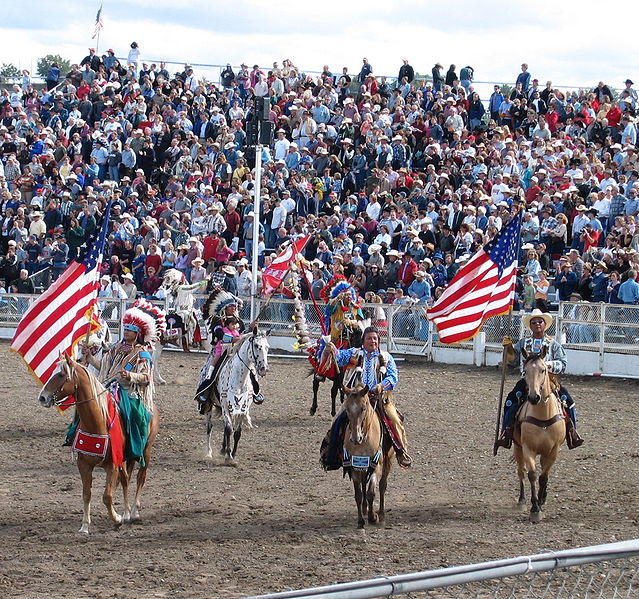
Rodeo parade, Cottonwood Falls, Kansas, 1974
Noir. Shot in deep-focus black and white, with documentary-style footage of rodeo events, crowds, and parades, the film has a noir feel. Increasingly, scenes take place at night, and Ray lets the shadows reinforce the darkness that gathers around his characters.

Rodeo has its seamy side, and the film doesn’t sugarcoat that either. The “lusty” men who populate the background of the film are often seen drinking and gambling. Arthur Hunnicutt plays a washed-out rodeo cowboy full of rodeo stories and sporting the scars of a career that must have broken every bone in his body at least once. He gimps around, broke, relying on handouts from the men who remember his good old days.

Saturday, September 17, 2011

Western writer inspiration no. 3

Here is this week's omnibus of #westernwriter inspirations posted each day at twitter. If you are on twitter, you can follow me @rdscheer.

Montana cowboys, 1904

Smoke of a .45, Charles Russell, 1908

Steer wrestler

Montana cowboy herding cattle, c1910

Straw

Working cowboys near Benjamin, Texas (CC) Pschemp

Come and get it!


Image credits: Wikimedia Commons 

Coming up: Old West glossary no. 20

Saturday, September 3, 2011

Western writer inspiration, no. 1

I've been posting pics from the Net on twitter and calling them "western writer inspiration" for fellow writers about the West. As an experiment here today, I'm posting pics from the last week for folks not in twitterdom:

Men in vests. Texas cowboys, c1900

Pulp cover cowboy

Cowboy in a hurry, Frederic Remington

You gotta have a hat.

Beef

High country

Pie Town Rodeo, 1940

And if you want to follow me on twitter, I'm @rdscheer.

Picture credits:
proprofs.com
cowboysong.com
psu.edu
pinenutlivestocksupply.com
grouchygrizzlymt.com
wikimedia commons

Coming up: Buffalo Bill (1944)


Thursday, March 31, 2011

FFB: Bob St. John, On Down the Road

Written and published in 1977, this is a great book about rodeo, with something like 250 photographs of rodeo cowboys in action, many of them in color. But it's not just a picture book. The author Bob St. John is a sports writer, and he covers the subject with the kind of depth you expect from good sports writing. 

His specialty is getting up-close and personal with the greats and near-greats of the sport. Thirty-some years ago, that meant men like Larry Mahan, Donnie Gay, Jim Shoulders, and Leo Camarillo.

He travels with them from rodeo to rodeo, sitting up with them in motel rooms late at night, listening to their stories, and capturing their personalities in the way they talk, tell jokes, even sing songs.

It’s a time capsule of a period when traditional rodeo was getting more like show business, but it was still not far from its roots. St. John pays plenty of attention to the events and the action in the arena, including the work of the rodeo clowns. There’s also a great deal more about what goes on behind the scenes, as he portrays the lives and personal histories of the men and women who "go on down the road."

This book is out of print. Used copies can be found at amazon.

Coming up: Francis Lynde, The Taming of Red Butte Western (1910)

Friday, March 18, 2011

Josh Peter, Fried Twinkies, Buckle Bunnies and Bull Riders

Rodeo Week concludes at BITS with this book about pro bull riders and the multimillion-dollar business that has sprung up around them. Professional bullriding has morphed from what used to be a feature rodeo event into a cross between NASCAR and the WWF.

Sports writer Josh Peter follows the 2004 PBR tour that crisscrosses the U.S. and ends with the finals in Las Vegas, drumming up excitement and suspense as he goes. He brings to life the widely divergent personalities of the riders. These range from seasoned champion and family-man Adriano Moraes and the stereotypical drinking, cussing Justin McBride, to the withdrawn, almost spookily religious Mike Lee.

Among them are a diversity of others, including rookies, old-timers hoping for a comeback, and competitors from countries as far away as Australia and Brazil. We learn that one out of 15 rides results in injuries requiring treatment, and Peter devotes a fair share of pages to the sports medicine room.

Adventurous foodie tries a Fried Twinkie
Meanwhile, we follow the drama of big business as differences between the men who run this show create a number of behind-the-scenes conflicts. There are firings and the threat of a boycott by riders who feel they are being under-appreciated by their employers. 

Peter's revelation of corporate and investor maneuvers will enlighten fans familiar only with the glitz and glamour of the sport and the men who are its stars. The book also describes the stock growers and investors who raise, train, buy, and sell bulls. 

There's even a side trip to Brazil, where we visit the ranch Moraes has bought with his winnings. Fans will enjoy the DVD documentary, Rank, which is a compelling record of the 2004 season finals, focusing on Moraes, McBride, and Lee.

Fried Twinkies, etc. is available at amazon and AbeBooks.

Photo credit: Wikimedia Commons

Coming up:  Mark Thompson, American Character

Thursday, March 17, 2011

Baxter Black, Hey, Cowboy, Wanna Get Lucky?

Rodeo Week continues at BITS with this “forgotten” comic novel. It’s humor in a jugular vein (as it used to be said of Mad Magazine), as well as a whole lot more. If you have an interest in rodeo cowboys and their life on the road between those hoped-for 8 seconds of adrenalin in the arena, this book is primarily about that. Exaggerated, you bet, but compared to the yarns told by real rodeo cowboys, not too far fetched.

First published in 1994, cowboy poet Baxter Black’s story of two cowboy pals tells of their summer on the rodeo circuit. They travel all over the western states, with hopes of winning enough money to make it to the national finals.

Their adventures partake of that particular brand of American humor that lies between guts-and-glory and the human comedy. For rodeo cowboys there is a fine line between fearlessness and foolishness. Few sports make failure not only ignominious but dangerous (being thrown and getting not only a faceful of dirt but broken bones as well).

Besides an enjoyable tale of going on down the road, Black's book is also a story about friendship. His two cowobys are different enough to play off each other's strengths and weaknesses, but they're no odd couple. Their devotion to each other, their companionship on the road, their late night talks attempting to make sense of the world they inhabit – not to mention their encounters with porcupines and "wild women" – all of it is an entertaining celebration of being best pals.

Hey, Cowboy, Wanna Get Lucky? is available at amazon and AbeBooks.

Coming up: Josh Peter, Fried Twinkies, Buckle Bunnies and Bull Riders

Wednesday, March 16, 2011

Ty Phillips, Blacktop Cowboys

Rodeo Week continues at BITS as author Ty Phillips follows a handful of champion steer wrestlers on a year's round of rodeos. In his book he focuses mostly on 23-year-old Luke Branquinho from Los Alamos, California. Branquinho, in 2004, went to the National Finals and finished first, with over $193,000 in overall earnings.

And that is the book in a nutshell. Readers follow along as Luke, his brother Casey, best friend Travis Cadwell, and a colleague Marc Jensen crisscross the West to compete at dozens of rodeos.

The steer wrestling itself and the competition get almost as much attention as the long-distance rig driving, poker playing, carousing, beer drinking, junk food eating, gambling, pot smoking, cell-phone talking, and the idle conversations, story telling, boredom, practical joking, raillery, tomfoolery, and high jinks that fill the time between rodeos and rides.

Luke Branquinho, National Rodeo Finals, 2004
The book is an honest effort to recreate the experience of being on the road with this fraternity of men in their twenties and thirties. Living out dreams of rodeo glory, they pit skill against luck in the arena. Meanwhile they struggle with disappointments and deal with physical ailments that range from colossal hangovers to serious injuries. Theirs is also a story of  building friendships that qualify as a rough-and-ready kind of male bonding.

You won't find much padding – no history of steer wrestling, no side-trips and detours into related subjects, and very little character study or analysis of the sport itself. It's pretty much play-by-play – whether behind the scenes or out in front of the crowd.

The book ends in a 40-page account of the ten-day Finals in Las Vegas. It's a quick read, with a 16-page section of great action photos and thumbnail portraits of the cowboys featured in the book. All told, it fills in those long gaps between those rides into the arena to throw oneself bodily at a four-legged moving target.

Blacktop Cowboys is available at amazon and Abebooks.

Photo credit: Wikimedia Commons

Coming up: Baxter Black, Hey, Cowboy, Wanna Get Lucky?

Tuesday, March 15, 2011

Cyra McFadden, Rain or Shine

Rodeo Week at BITS continues with a daughter’s memoir of her father, the larger-than-life rodeo luminary, Cy Taillon. With his golden voice and gentlemanly manner, he invented the persona of the rodeo announcer. And he won the devotion of rodeo cowboys and fans from San Francisco's Cow Palace to Madison Square Garden from the 1940s to the 1970s.

Not surprisingly, what this story reveals casts the man in a somewhat different light. Before fame finds him, he’s the hard drinking, gambling, womanizing ne'er-do-well who married the author's singer-dancer mother after a one-day courtship. Following the rodeo circuit out of a home base in Montana, they fought and loved each other passionately, a Scott and Zelda of the Western plains, and then broke up.

Following a spectacular crash at an air show in Great Falls in 1946, at which Cy used the microphone to calm the startled crowd, he became the hero he was destined to become. Assuming a life of propriety with a new devoted wife and two new sons, he was finally launched in the career rodeo people remember him for. Meanwhile, his first wife languished in a miserable second marriage, and his daughter grew up, loving her absent father deeply while stubbornly unwilling to come to terms with the man he had become.

Thanks to the University of Nebraska Press for reprinting this great memoir. It offers a fascinating window into the world of the rodeo circuit, at least as it once was. For rodeo-going readers, it does much to explain the evolution of the role and persona of the rodeo announcer and the elevation of rodeo cowboying into a kind of gallantry.

It's also an entertaining story told by an author with a gift for both sentiment and satire. With her eye for the absurd detail, she can unerringly find the irony in an often rueful story. The many family photos are also an excellent addition to the book.

Rain or Shine is available at amazon and AbeBooks.

Coming up: Ty Phillips, Blacktop Cowboys

Monday, March 14, 2011

W. K. Stratton, Chasing the Rodeo

Rodeo Week at BITS gets underway today with an introduction to the history, the personalities, and the meaning of this sport as it's evolved over the past century. Stratton, a journalist based in Austin, Texas, with roots in Oklahoma, comes by his "kicker" credentials fairly enough. His mother was a cowgirl in her own right and his father a rodeo cowboy who went on down the road and never came back.

Stratton's book is a personal journey, a search for an understanding of the romance of rodeo. For him, it’s the appeal of risk-taking and the call of the wild in the soul. It’s the love of a past that can be recaptured for a moment in a beautifully executed ride on a bucking horse or bull.

And his book does much to reclaim the essentials of a pastoral ritual that has been compromised by commercialism, corporate sponsorships, and marketing that positions it as an extreme sport.

Stratton covers some familiar ground for anyone familiar with rodeo history, but many stories deserve retelling. For example, that of George Fletcher at the 1911 Pendleton Roundup; the first bulldogger, Bill Pickett; and the death of champion bull rider Lane Frost. 

Grand Final Review, Pendleton Roundup, 1911. Click here to see larger pic.

Then there is an account of the first rodeo "cowgirl," Lucille Mulhall, and of Indian cowboy Will Sampson, who played Chief Bromden in One Flew Over the Cuckoo's Nest (1975). In Prescott, AZ, he has occasion to recall at length the rodeo film Junior Bonner (1972), already reviewed here.

There is a wide array of other personalities who find their way into Stratton's book: Justin McBride, Will Rogers, Tom Mix, Willie Nelson, Jack Kerouac, Ben Johnson, Theodore Roosevelt, Buffalo Bill Cody, and evangelist Susie Luchsinger.

He gets closest to the sport itself in conversations with all-around champion Jesse Bail and bullriding champion Freckles Brown. The first chapter account of Brown's famous ride on Tornado at the National Finals in 1967 just takes your breath away.

Finally there is the search for the story of Stratton's absent cowboy father, which rounds out the book with more than a little poignance. I loved this book and recommend it to anyone curious about rodeo, the fascination it holds for both fans and participants, and its place in American popular culture.

Chasing the Rodeo is available at amazon and AbeBooks.

Picture credit: Wikimedia Commons

Coming up: Cyra McFadden, Rain or Shine

Saturday, March 12, 2011

Rodeo Week, Junior Bonner (1972)

It’s Rodeo Week starting Monday at BITS – reviews of five great books about rodeo. Today I’m giving y’all a heads up with a review of not a book, but one of the best movies ever made about rodeo.

I’m calling it best, maybe, because it starred two of my favorite actors, Steve McQueen and Robert Preston. True to the spirit of rodeo, it’s also a comedy. Surprisingly, it was directed by Sam Peckinpah, who was hardly known for his light touch.

Junior Bonner was one of those movies that fell "under the influence" of the early 1970s. It came in that aimless trough between Easy Rider (1969) and Jaws (1975), when Hollywood was willing to let filmmakers try about anything to hang onto a youthful audience. It was a period also more than a little challenged by the post-Vietnam years of national bafflement.

The movie grabs for this mood from the opening credits, with kinetic split-screen images showing in slow motion a disastrous ride on a bull. These are intercut with shots of McQueen driving a mud-spattered and beat up white Cadillac convertible, towing a horse trailer. Altogether it’s the picture of a man down on his luck.

Pendleton Roundup, 2004. Photo by Bobjgalingo.
Then we get a vision of an American West exhausted and resold as suburban housing developments of so-called rancheros (never mind that "ranchero" in Spanish means rancher). The marketing involves busloads of prospective buyers shepherded by young women in cowboy hats and hot pants.

McQueen's rodeo cowboy, Junior Bonner, returns to the home place outside Prescott, Arizona, to find heavy equipment operators fiercely tearing up the earth and anything that gets in their way. He stands there in his Lee jeans, western shirt and straw cowboy hat, surveying a land laid waste. Like the mood of the country at the time, the scene portrays a promising future that has seriously run aground somewhere.

But after this downbeat start, the movie becomes a kind of romantic comedy. We meet Bonner Senior (Robert Preston) rising from his hospital bed with a dream of prospecting in Australia. He’s also making a last attempt to win back his wife of many years, played nicely by Ida Lupino.

Calf roper, Pendleton Roundup, 2004. Photo by Bobjgalingo.
There is plenty of farce, including Preston and McQueen riding a horse through backyards and getting hung up on a clothesline, a comical barroom brawl, and a punch that sends a man through a front porch window. The rodeo itself is a rapid montage of graceless falls from rough stock played against turkey-in-the-straw music.

Meanwhile, Junior, as an aging, stove-up bull rider, is the calm at the center of this storm. Preston clowns, Lupino frowns, Joe Don Baker fumes, and Ben Johnson grins and cracks jokes. There’s even a girl with an eye on Junior. But he is untouched by it all.

McQueen does what he does best, reflecting a quiet cowboy reserve. Though the West is no more, Junior continues to represent a long line of western heroes holding true to the cowboy code of generosity, individualism, and toughing it out when the going gets rough. Before all is said and done, he gets the girl, but not for long, because true to form, he has to get on down the road.

Picture credits: Wikimedia Commons

Coming up: W. K. Stratton, Chasing the Rodeo

Wednesday, July 14, 2010

Rodeo movies

I’m probably missing some, but there have been darn few movies about rodeo. Taking them one at a time, I’ll share what I can about the ones I’ve seen.

J. W. Coop (1971)
This film was written and directed by Cliff Robertson, who also plays the title character, a rough stock rider just released from serving nine years in prison. Coop has not only missed a big chunk of what might have been a prize-winning career in rodeo. He missed the 1960s, too. Walking confidently from prison in a fresh pair of Lee jeans and a black Stetson, he finds himself in a different America than the one he left.

He’s not long on the road before a peace-and-love hippie girl befriends him, introducing him to soy nuts and talk about the environment. (He’s already been stopped by a patrolman for the gross polluting old Hudson he’s driving). Hitching rides with truckers, he gets an ear full of right-wing politics and devotion to big-ticket consumer products.

Worse yet, rodeo itself has changed. Riders now “specialize” in their events, and the high-flyers literally fly their private planes between rodeos, to take in two and three a day. It’s become a big-money business. Coop gives it a shot anyway, never daunted by the odds, and we follow him on the circuit all over the Southwest.

The film was shot at actual small and regional rodeos, winding up at the National Finals in Oklahoma City. (This was before the move to Las Vegas.) Robertson got real rodeo cowboys to play themselves in the film, including Larry Mahan, who was then a World All-Around Rodeo Champion. Also Myrtis Dightman who was a Champion Afro-American Bull Rider (see above).

The rapid, telephoto montages of cowboys riding and being thrown, with a spirited music track, make rodeo seem all non-stop excitement. In reality, there are often long waits between rides, which are themselves hard to see well from the grandstand. You find yourself restlessly drifting toward the beer tent.

The movie is very much a product of its time, with Vietnam-era social comment that we also get in Easy Rider (1969), Zabriskie Point (1970), and M.A.S.H. (1970). Robertson is enjoyable as the easy-going, indomitable, small-town Texas rodeo cowboy going for the brass ring – all the way until the last reel, where reality finally catches up with him.