Monday, April 16, 2012

Old West glossary, no. 29

Here’s another set of terms garnered from early western novels. Definitions were discovered in various online dictionaries, as well as searches in Cassell’s Dictionary of Slang, Dictionary of the American West, The New Encyclopedia of the American West, The Cowboy Dictionary, The Cowboy Encyclopedia, The Barnhart Dictionary of Etymology, The Oxford Dictionary of Idioms, and The Shorter Oxford English Dictionary.

These are from Frank Lewis Nason’s To the End of the Trail about gold fever in Colorado; and Elizabeth Higgins’ Out of the West, about a man exiled by his father to a small town in Nebraska. Once again, I struck out on a few. If anyone has a definition for “put bread around one’s pie,” “tight leg and pull up,” “reversed pencil,” “pull gosling, pull grass,” “stamped china,” or “dancehall roller,” leave a comment below.

back-firing = running someone out of the country. “‘They ain’t only one thing’ll stop him.’ Tough Nut looked cunningly suggestive…‘Say, back-firin’. Savey?’” Frank Lewis Nason, To the End of the Trail.

base burner = furnace or stove in which the fuel is contained in a hopper or chamber and is fed to the fire as the lower layer is consumed. “I am going to buy a base-burner for the parlor, and have a drum put in its pipe in the room above, and we won’t have to sleep off the kitchen.” Elizabeth Higgins, Out of the West.

Bertha M. Clay = a writer of love stories and romances for English working-class audiences and Street & Smith’s readers in America. “On a cherry-stained writing-desk lay a novel by Bertha M. Clay.” Elizabeth Higgins, Out of the West.

Bloomingdale = a private hospital for the care of the mentally ill founded by New York Hospital, located in Morningside Heights and built c1820. “If I spoke all the truth I know and acted upon it, my friends would have me now in Bloomingdale.” Elizabeth Higgins, Out of the West.

blow = inform, confess. “‘Did the Big Swede blow on me?’ he asked excitedly.” Frank Lewis Nason, To the End of the Trail.

bobtail = worthless, a term from poker. “She ain’t goin’ bobtail. That’s straight.” Frank Lewis Nason, To the End of the Trail.

box coat = a coat designed to hang loosely from the shoulders. “The breeze carried a chill, and he drew about her the folds of his box-coat.” Elizabeth Higgins, Out of the West.

cab = baby carriage. “She took the baby out in his cab to give him the sun and air.” Elizabeth Higgins, Out of the West.

Saturday, April 14, 2012

Saturday music: I See Hawks in LA


Friend and colleague Rob Waller is lead singer in his alt-country, LA-based group I See Hawks in LA. They've got a new acoustic album "New Kind of Lonely" which I'm discovering is great road music. Here's their website.

Western writer inspiration, no. 32

Here is this week's omnibus of #westernwriter inspirations posted each day at twitter, where you can follow me @rdscheer if your attention is not already overloaded. As usual, click the pic to enlarge.
 
John Marsh House, Contra Costa County, California, c1870
Ely district, Nevada, 1871
Governors of Zuni, New Mexico, photo by John K. Hillers (1843-1925)
The Gem Theater, Deadwood, c1878
Huntsville, Texas, corner of Twelfth Street and University Avenue, 1870s
Quarrying granite for the Mormon Temple, Utah Territory, 1872
Overland stage road between Ogden and Helena, Wyoming, 1871

Picture credits: Wikimedia Commons
 
Coming up: James Stewart, Maureen O'Hara, The Rare Breed (1966)

Friday, April 13, 2012

Photo-finish Friday: out and about


Chance found me recently on Grand Avenue near 17th Street in LA, and I came upon this tribute to Thelonious Monk. It's a little worse for wear but doesn't lack the original spirit. A quick search online, and I was able to turn up the photo it was based on. Click here.

Photo-finish Friday is the bright idea of Leah Utas over at The Goat's Lunch Pail.

Coming up: James Stewart, Maureen O'Hara, The Rare Breed (1966)

Thursday, April 12, 2012

Jon Billman, When We Were Wolves

First published in 1999, this entertaining collection of short stories is set in the rural West and mostly in Wyoming. It is a comic world where men are men and, consequently, the women have a monopoly on intelligence. These guys hunt, they fish, they drink beer, and remain faithful to an adolescent disregard for law and order, taking delight in irritating their conventional, god-fearing neighbors and giving themselves to amusements like Little Bighorn reenactments.

My favorite is the title story about an ice hocky team from the state pen, who love the fierce brutality of the sport more than scoring. Close seconds are a series of stories about two buddies in Hams Fork (a fictional stand-in for the author's home, Kemmerer), Wyoming. One is a vaguely disgruntled history teacher and the other a painter, who decorates the town water tower one night and, immobilized by a ruptured disk while playing golf, has a close encounter with hypothermia.

Most of the women involved with the men in these well-written stories make only brief appearances, because they're either long-suffering or in possession of the good sense to move on. When We Were Wolves is available at amazon and AbeBooks and for kindle and the nook.  Friday's Forgotten Books is the bright idea of Patti Abbott over at pattinase.

Coming up:  James Stewart, Maureen O'Hara, The Rare Breed (1966)

Wednesday, April 11, 2012

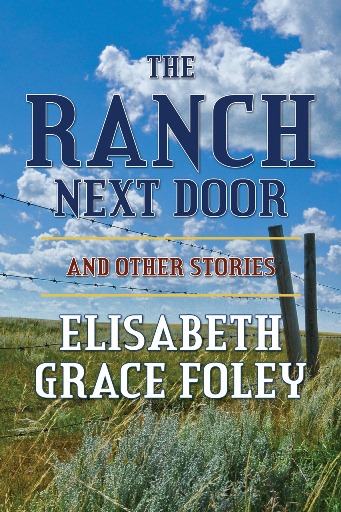
Elisabeth Grace Foley, The Ranch Next Door


Review and interview
The cover of this collection of stories by Elisabeth Grace Foley nicely captures its mood. After an excursion into the dark frontier world of a writer like Nik Morton, whose Bullets for a Ballot was reviewed here recently, readers would find themselves in a far sunnier West. Yes, there’s barbwire running through it, but it’s a “kinder, gentler” West, where a conflict is as likely to be solved at the point of an umbrella as the point of a gun.

Foley has a firm, intelligent grasp on the storytelling style she brings to her subject matter. The tone and mastery of language is consistent throughout. After a couple stories, you just know you’re in competent hands.

And it’s not diminishing them to say they hark back to the world of TV westerns like Gunsmoke and Bonanza. Relationships between friends and family members matter, and while violence lurks like a shadow in the corners, it’s often driven back or defused without serious bloodshed.

Often, I should say, but not always. Just as a sunny day in Dodge may be overtaken by storm clouds, there’s a good chance in Foley’s stories for events to take an unwelcome turn. Likewise, what may seem threatening can be revealed as its opposite. Such is the case in “Angel Unawares,” when a young rancher has a nasty fall from his horse while searching for lost cows in the herd of an unfriendly neighbor. Or when a doctor helps deliver a baby for the woman in the title of “The Outlaw’s Wife.”

While a handsome, good-natured young cowboy often figures in these stories, Foley’s gift for characterization is especially engaging in her portrayals of sheriffs. As one example, there’s Sheriff Coughlan in “Disturbing the Peace,” who’s a well-respected public servant. But he learns, like Willy Loman, that while he’s liked, he’s not well liked.

Sheriff Graham in “Delayed Deposit” is a bit out of shape and likely to turn red in the face with little provocation. Outside the town bank during an attempted robbery and trying unsuccessfully to handle a hostage situation on the inside, he’s lucky to have the help of his quick-thinking deputy.

That last story, by the way, is my favorite. It builds considerable tension as the stakes mount for everybody, hostages and gunmen, and the clock ticks away precious minutes. Foley shows her ability to take familiar western material and western characters, and make something fresh and engaging with them. Just as the writers of Gunsmoke did for 20 years, and rarely disappointed us.  

The Ranch Next Door is currently available at amazon. You can follow Elisabeth Grace Foley's blog, The Second Sentence, here.

Elisabeth has generously agreed to an interview here at BITS, and I’m turning the rest of this page over to her.

Interview
 
What makes these stories "western" for you besides the fact that they are set in the West?
Probably the fact that they take place on a frontier-partly-settled, still-changing, where daily life was different in many respects from life in the long-civilized East, and the kind of life I've always known myself. I think it may even be that intriguing difference from my own life that has attracted me to the Western in some ways.

What do you think of as the essential elements of the traditional western story?
Horses, perhaps? Well, seriously...if you mean "essential" as in "necessary" I don't think it's carved in stone. There's a lot of different ways to tell a story. But the common denominator of most Western stories seems to be the aspect of frontier life that I mentioned before.

How much is the actual history of the American West part of your interest in the genre?
It's definitely a significant part. I've always been fascinated with history. Studying Western history is a little odd at times, because of the way the "Western myth" has complicated things. Set up opposite those who embrace and exaggerate all the clichés of the genre, there seems to be a school of thought that likes to say, "Nothing happened the way it does in books and movies."

I was more exposed to that point of view early in life, through textbooks and children's history books, so my more recent reading has been a revelation of sorts, in finding out that some elements of the West were surprisingly like the movies (or even more interesting).

Your stories are mostly about male characters and told from their point of view. Is there a reason for that?
It wasn't really a conscious choice I made-it just happened that way. I tell each story from the perspective of whichever character seems most natural, and so far they've all been male. I'd like to write a story with a good female point of view sometime, but so far none of the ideas that have come into my head have lent themselves to that.

Where in the West do you imagine your stories taking place and in what time period?
Most of them are intended to be set in the 1880s/90s to turn-of-the-century period. I stuck to fictional towns, since none of the stories are centered around actual historical events or places, but I did have an idea in my head about what part of the country they were supposed to be set in. "Delayed Deposit" I think of as being in the northern plains region, like Montana or the Dakotas, and probably "The Ranch Next Door" too. "The Outlaw's Wife" hints at a Texas setting, and most of the others I imagined somewhere in the middle West.

Talk a bit about the creative decisions that went into the cover for the book.
I wanted something to evoke "The Ranch Next Door," since it provided the title for the book-the setting of springtime on the plains, and the barbed wire representing the conflict of the story. I picked out the photo, and cover artist J. Simmons did the design. I originally had envisioned a different type of font for the titles, but during the design process everyone I showed the early attempts to was immediately enthusiastic about his font choice-and after a little tweaking of the colors I realized they were entirely right. I'm very happy with the way it turned out.

If one of your stories was made into a movie, who would you like to see in the lead roles?
I don't know. At this point I'm the kind of author who'd be scared to death at the idea of someone adapting my work for the screen.

I believe you've been reading older popular novels from 100 or so years ago. What do you learn from them?
It gives you a glimpse into the time the books were written that you don't really get even from good historical fiction-the way people talked and thought, small details about everyday life. I don't necessarily use things that I read directly in my own stories, but I think it does give me a better feeling for the time period. Besides which, I've discovered some fine writers, too, and I'm always learning more about writing from what I read-from observing what works (and what doesn't) and why.

What have you learned from your readers?
The most encouraging thing has been learning that there is an audience for my work-that people actually liked what I wrote! For a first-time author that's a great relief. And I've had a first-hand glimpse of how individual tastes differ, from how people have different favorites among the stories (even though there are a couple that seem more popular than others).

How would you hope to be an influence for other western writers?
I'd like to be able to demonstrate that it's still possible to write a solid Western that is suitable for a wide audience. I believe you can write an interesting story without excessive violence or profanity, without making it seem "sanitized" or childish, and I think there is an audience of readers who would welcome that kind of story, as they did years ago.

What can readers look for from you next?
I'm not entirely certain yet. I have one or two projects nearly finished; one is a short historical mystery, another is a comedy. At some point I would definitely like to put together another volume of short stories-I'm always working on one or two, and sooner or later they'll add up into a collection.

Thanks, Elisabeth, for taking the time to join us at BITS today. Anything you would like to add that we didn't cover?
No, I don't think so. Thank you for having me!

Coming up: Elizabeth Higgins, Out of the West (1902)

Tuesday, April 10, 2012

The Sea of Grass (1947)

This Tracy-Hepburn domestic melodrama is set in the West and has some of the scale of George Stevens’ 1957 epic, Giant. But despite its dynamite cast, the film lacks what it needs most—wide screen and color.

Stock footage near the beginning of wind blowing in tall grasses and dramatic long shots of riders passing along the foot of a sheer cliff face promise some visual wonders. But with key exteriors obviously built on a sound stage and with the frequent use of process shots, you get the feeling that Tracy and Hepburn hardly left the comforts of home.

Plot. The film is based on Conrad Richter’s 1937 novel of the same name. Set on the open ranges of New Mexico, it tells a familiar story of a cattleman (Tracy) fighting an influx of homesteaders. Wearing his big, tan LBJ Stetson, he looks the part. But stiff and stern through most of the film, he rarely expresses the warmth that normally makes him a pleasure to watch on screen.

Tracy as Jim Brewton in The Sea of Grass
Hepburn, at the age of 40, is a bit spinsterish already to be playing an impulsive young woman who comes from St. Louis to the frontier to marry a man she hardly knows. When her sympathy is torn between her husband and the settlers he hates, the marriage begins to founder. Bored and left alone much of the time, she has a dalliance with a persistent suitor (Melvyn Douglas).

This is where the 1940s-style melodrama moves in on the plot. A second child is born, and close attention to the dialogue reveals that Douglas is the father. Hepburn eventually returns East for good, leaving the children with Tracy. The boy grows up to be the stereotypical rich man’s son (Robert Walker), misbehaving and counting on his father and the family lawyer to get him out of any trouble.

An exchange of gunfire over a card game turns him into a man wanted for murder. And by film’s end, Walker is dead himself. Tracy and Hepburn’s daughter (Phyllis Thaxter), long estranged from her mother, reunites her parents and after two hours we get to the last fadeout.

Cimarron National Grasslands, Kansas
Is it a western? Well, yeah. It has the familiar elements, including a large contingent of cowboys, herds of cattle, horses, guns, a ranch, a saloon, a frontier town.

What it does lack is a real western villain. Tracy’s cattleman may give the usual argument that the cattlemen tamed the frontier and for that reason deserve privileges that the homesteaders do not. But he’s right about something else. Turning the grasslands into farmland would be an ecological disaster. Recent memories of the Dust Bowl would have met with agreement from 1940s viewers. So he’s not the usual cattle-baron villain.

Douglas might qualify, as the man who lures Hepburn into adultery (and, oh, how gingerly that subject is portrayed). But he’s not a cad or a bounder either. To the end, he keeps trying to persuade Hepburn to marry him and provide a proper home for their son.

But maybe before all that, it’s a Tracy-Hepburn film, the fourth one they’d made together. Not quite a genre, but certainly a franchise, the combination of the two would become truly memorable in the romantic comedies that followed: Adam’s Rib (1949), Pat and Mike (1952), and Desk Set (1957).

1937 edition
Wrapping up. Deserving mention are the supporting actors, Harry Carey as a town doctor and Tracy’s longtime friend. Lifting the film from the melodramatic doldrums is the wonderful performance of Edgar Buchanan as Tracy’s cook. First gruff and ill tempered, he becomes an endearing presence in the ranch house, devoted to his employers and their children.

At two hours, the film has the feel of being inflated from Richter's modestly short novel. Director Elia Kazan is said to have been embarrassed by it. And to be honest, it hardly seems the work of the same man who directed films like A Streetcar Named Desire (1951) and On the Waterfront (1954).

Kazan’s reputation in Hollywood has been troubled by his naming names to the HUAC. And it’s an interesting irony that the screenwriter for The Sea of Grass, Marguerite Roberts, was blacklisted during the 1950s for refusing to do the same thing. Roberts, it should be added, returned to Hollywood in the 1960s and is probably best remembered for her screen adaptation of Charles Portis’ novel, True Grit.

The Sea of Grass is currently available at amazon and netflix. Tuesday’s Forgotten Films is the much-appreciated enterprise of Todd Mason over at Sweet Freedom.

Photo credits: Wikimedia Commons

Coming up: Elisabeth Grace Foley, The Ranch Next Door