Showing posts with label wyoming. Show all posts

Thursday, July 10, 2014

Caroline Lockhart, The Lady Doc (1912)

Femme fatale = a dangerously attractive woman (Oxford English Dictionary).

The “lady doc” of Caroline Lockhart’s novel is by no means attractive but she is definitely dangerous. Practicing medicine on the frontier with her only certification from a diploma mill, she is untrained and lacks any ideals usually associated with her chosen profession. She sees it only as a source of income. The lives, health, and welfare of her patients are of little concern to her.

Plot. We first meet Emma Harpe as she is being run out of a Nebraska town after the death of a patient, for which she faces a malpractice suit. Sometime later, she steps off the train in a Wyoming settlement called Crowheart.  Always looking for personal gain, she teams up with a land developer, Andy P. Symes, who is looking for gullible investors in a massive, ill-conceived irrigation project.

Emma Harpe
She persuades him to grant her the contract for providing medical services to his many employees and workmen. Meanwhile, she befriends his wife Augusta (“Gus”) and makes a nuisance of herself by interfering in their marriage and home life.

With her bluff manner and dressing in masculine clothes, Emma wins the hearts and minds of the local residents, who trust her to practice the medical skills she claims to possess. But she soon makes enemies of two men. One, an Italian frontiersman, whose public singing earns him a nickname, “the Dago Duke.” The other is his friend Ogden Van Lennop, from a wealthy family back East.

Tuesday, April 29, 2014

Jubal (1956)


Cover, Criterion Collection
Someone has already called this western a cowboy soap opera, so I won’t take credit for that label, though it fits. Glenn Ford is fine in this handsome Cinemascope production shot against the Teton landscape of Jackson Hole, Wyoming. (Ford was pretty much fine in anything.) 

Playing the title role of Jubal Troop, he’s a cowboy down on his luck who seems unable to escape being drawn into even worse luck. Though we know little to nothing of his back-story, a history of mischance and bad breaks is etched in his expression in scene after scene.

Plot. Found afoot and freezing by a ranchman (Ernest Borgnine), Ford is offered a job as a cowhand and is quickly promoted to foreman for his work ethic and dependability. Borgnine seems to be the first person who has ever liked and trusted him, and a strong bond builds between them.

This development rubs another of the hands (Rod Steiger) the wrong way, who takes an Iago-like dislike to Ford from the start and makes no secret of it. Even more problematic is Borgnine’s unhappy wife (Valerie French), who quickly makes seductive moves on Ford, further angering Steiger, who’s been having an adulterous affair with her already.

Glenn Ford as Jubal
Though one senses a hesitancy in him, Ford resists her advances out of loyalty to Borgnine, who suspects nothing. Ford seems not to lack a sense of decency, but lonely cowboy that he is, you wonder whether he might act differently under other circumstances.

Long story short, Steiger finally turns Borgnine against Ford, and in the misunderstanding and confusion that follow, Borgnine is killed. Matters are not resolved until a posse pursues Ford and finds him at yet another death scene, where the truth of Steiger’s villainy is finally revealed.

Monday, May 27, 2013

John D. Nesbitt, Dark Prairie


Review and interview

To paraphrase Winston Churchill, this western is a mystery wrapped in an enigma. The enigma in this case is a man who rides in to a small Wyoming ranch, the Little Six, and gets a job as a cowpuncher. The puzzle for everyone, including the reader, is what he’s really up to.

Like Shane in many respects, he goes by a single name, Dunbar, and he offers no other information about himself. He pokes around a dam-building project that will bring irrigation to the rangeland. And when he doesn’t disappear for days on his own, he hangs out in a nearby town. There he might be found in the saloon or on the front porch of a woman whose husband, Tut Whipple, is in charge of the dam project.

We witness all this through the eyes and ears of a young cowhand, Grey Wharton, who narrates the story. Is Dunbar a range detective? Some kind of troublemaker? Or just a drifter? The other cowboys at the ranch get to resenting him, and Grey is unhappy to find him in the company of Ruth, Whipple’s wife. Seems the motherless Grey is more than a little sweet on her himself.

Powder River Pass, Wyoming
Plot. The plot thickens as Dunbar becomes certain that the ranch owner’s cattle are being rustled and butchered to feed the crews working on the new dam. There’s also reason to believe he might be looking for a cave where robbers once stashed the take from a robbery.

Whipple surrounds himself with tough guys who try to intimidate Dunbar into minding his own business. But Dunbar is a powerful fighter and needs only a couple good punches to handily dismiss anyone who wants to get in his way. Matters take a nasty turn when one of the Little Six cowboys is provoked into drawing his gun and gets shot dead.

The town fathers are yet another matter. They are unconvinced by Dunbar’s claims of cattle rustling, and they close ranks when he says a town marshal would provide some much-needed law enforcement. They have much to gain by the success of the dam project and balk at interference by an outsider.

Little Laramie River, 1905
Character. As it turns out, Dunbar is a man on a mission. Like Shane he is a frontier knight errant, come to bring justice where, by design or neglect, injustice has been permitted to prevail. He has a code of conduct that is revealed in one of the several thoughtful talks he has with the young Grey.

Unlike the black-and-white code of the West, his is what might be called situational ethics. Actively defend what is right, he advises. But don’t take on more than you can handle. One on one, a man might stop a wrongdoer and hold him to account. But it’s no good going after the Big Guys, like the railroads. They’ll just crush you.

Meanwhile, do your work, the work you believe in. Be honest, be fair, even when the world is full of dishonesty and unfairness. In dealing with others, steer a middle course between the Ten Commandments and the Golden Rule. In other words, temper law with mercy.

Oregon Trail, Wyoming, 1870
Romance. The novel ends with a flash-forward, and we know that Grey grows up and 20 years later has followed in his dead father’s footsteps, becoming a lawyer. Happily married, he has weathered the trials and tribulations of young love and courtship.

But during the course of the novel, he is still sorting through a young adult’s hormonal urges that make sense only in retrospect. The pretty Mexican girl who serves him meals at one of the saloons in town draws him like a magnet. And then there is the married woman, Ruth, who mothers him without fully realizing the claim his heart has made on her.

Wrapping up. Nesbitt writes so familiarly about these characters on the high plains of Wyoming, you feel transported back to their time and their world. The dialogue he writes has the easy naturalness of everyday speech. And that dialogue sparks with life when people are suspicious of each other or yielding to a rising surge of anger.

He also reproduces the rhythms of talk likely to be heard among the “fraternity of men who had the common interests of cattle, horses, work, and weather.” We listen in as the Little Six men discuss the changes being wrought on the plains by speculators and reclamation projects. And we hear from them how progress means the loss of a way of life.

Dark Prairie will soon be available at amazon and Barnes&Noble. For more about John Nesbitt, visit his website.

John D. Nesbitt
Interview

John Nesbitt has generously agreed to spend some time here at BITS to talk about writing and the writing of Dark Prairie. So I'm turning the rest of this page over to him.

John, we last talked here in July 2012. How has the last year been for you as a writer?
It has been a good year, especially after being on the street, as I have called it, as a result of the collapse of Dorchester Publishing. I had been with them for thirteen years and had achieved some good continuity with them in addition to winning some awards, and then they imploded.

My last two novels with them did not go very far, and I had the rights to two manuscripts returned to me. It took me a while to find another publisher, and I am glad to have done so with Dark Prairie. Five Star is a very good company, with good professional attention to all aspects from editing to cover design to marketing and promotion.

Also during the last year I have had a collection of poetry published with Western Trail Blazer, a publisher of e-books with corresponding print format. WTB has done several of my works ranging from short story to novella to book reprint, and this poetry collection, my first, is a very special little thing for me. For those interested, it is entitled Thorns on the Rose.

Talk about how the idea for this novel suggested itself to you.
As often happens, I had a few different ideas converge. One idea was that I wanted to have an almost-mythical main character who works for the noble purpose of justice but who is not perfect. That's where I got Dunbar. Because he would be somewhat mysterious, I needed to present him through the eyes of a narrator.

That's where I got Grey Wharton. I wanted to have Dunbar deal with a problem that, as I noted to myself, threatened the social body. Several years ago, a crime like the one that Dunbar investigates took place not far from where I live.

Like many people, I was very disturbed by what happened (it seems so flat when I write about it in this way, but I would feel like even more of a traitor if I were more specific), and it gave me the emotional base to write a story in which I wanted to see justice served. So that's where I got Annie Mora.

Is the published version of the novel closely similar to your first draft, or was the revision process extensive?
The revision process was, I would say, moderate. The version I submit to the publisher is usually the third draft, and then it goes through editing. In the editing of this novel, there were no big changes such as adding or taking out pages at a time.

Friday, March 15, 2013

Cyrus Townsend Brady, The West Wind: A Story of Red Men and White in Old Wyoming (1912)


This novel is a high-pitched adventure about fighting Indians on the frontier, with the kidnapping of a white woman by a “half breed” as its starting point. Amy Benham, the West Wind of the title, is so called because she is a spirited and independent product of Wyoming’s wide-open spaces.

Saving her from a fate worse than death are two men, Army captain Joseph Kennard and the Irish foreman of her father’s ranch, Pat Sullivan. Both are head over heels in love with her. It is Wyoming in the 1870s, and her rescue is played out in the midst of an uprising of the Sioux and Cheyenne.

Plot. The kidnapping occurs in the opening chapter as Amy’s father is shot dead by Jules Girot, the “half breed,” who wants her for his “squaw.” He rides off with her as his prisoner, promising despite her protests that she will learn to love him.

At nearby Fort McCullough, cavalry troops are being marshaled to round up the Indians, who are reported to be on the warpath. When news arrives of the kidnapping, Colonel Wainwright, the commanding officer, permits Kennard and his men to follow Girot’s tracks. Sullivan goes with them.

They soon discover that he has made a perilous journey along river rapids and has been joined by a band of Indians. The trail leads into a canyon where they surprise the Indians and take a number of lives while the rest flee. But there is no trace of Amy Benham, only a pair of her slippers.

Amy and Mah-Wissah make an escape
Shifting point of view, the narrative reveals that Amy has escaped captivity with the help of an Indian woman, Mah-Wissa. The two women have found a hiding place in a remote and isolated canyon. There they wait to be rescued.

Rejoining Col. Wainwright’s troops, Kennard and Sullivan accompany the regiment until it finally meets a massive force of Indian warriors. Though outnumbered, five to one, the soldiers hold their own, while Kennard’s company is sent on a flanking mission, which leads them to an Indian encampment.

Sullivan is convinced that Amy is being held there and continues onward, while Kennard and his troops turn back under orders from the Colonel, who fears an ambush. Come darkness, Sullivan sneaks into the camp but finds neither Amy nor Girot, whom he’s determined to kill. Waking the camp, Sullivan rides off on a pony, with Indians in hot pursuit.

By chance, he discovers the two women in a cave, where they are besieged by the Indians, who are in turn driven off by Kennard’s search party. Girot is taken and killed, and Sullivan dies with Amy at his side. But before Kennard can return Amy to safety, they must endure yet another days-long battle with the Indians.

Romance. The wrinkle in this story is the presence of two men seeking the hand of the same woman. Normally one would clearly be the better man. He would be more handsome, appropriately aged, and good-hearted. But Brady makes the two men equals in all these regards.

The one difference is that Kennard is socially superior, being a commissioned officer in the Army, while Sullivan is somewhat the lesser man. More than a foreman, he’s in line to become a partner in the Benham’s ranching operation, but Kennard holds the trump card. He can make Amy an officer’s wife.

For the sake of the narrative, Sullivan is a hero better off dead and buried. As long as he’s kept alive, he remains a loose end for the plot. Brady hopes that his demise, attended by the woman he’s given his life for, will compensate for that loss with another kind of romance—the romance of a noble death.

Friday, February 15, 2013

William MacLeod Raine, Wyoming (1908)


In this first novel by one of the western’s most published writers, mistaken identities bring together a schoolmarm from the East with a sheep man believed to be an outlaw. While menace endangers its central characters on the plains of Wyoming, love overtakes the hearts of not one but two young couples.

Plot. Helen Messiter comes West from Michigan as the new owner of the Lazy D cattle ranch. She makes a spectacular entrance, arriving in an automobile just as the Lazy D cowboys, guns blazing, have cornered a fugitive in the sagebrush. She decides to even the odds and drives at full speed between them to carry out a daring rescue.

After ducking bullets, she and the man trade bantering comments as they disappear together in a cloud of dust. She is full of high spirits, and he is playfully gallant. A later generation would call it a cute meet.

Helen and Ned under fire
She learns, alas, that his name is Ned Bannister and has a reputation as a villainous outlaw, who has robbed banks and trains and killed men. Helen can’t square such heinous deeds with the well-mannered gentleman whose capture she has prevented. Puzzled, she shelves her initial attraction to him and goes about the business of running her ranch.

But the astute reader begins to gather that the real villain is yet another man, who also goes by the name of Ned Bannister. This “bad” Ned kidnaps Helen and takes her to his Robbers Roost. There she finds herself the prisoner of a man whose mercurial moods shift between gentlemanly refinement and vicious savageness.

Rescued and returned to the Lazy D, she learns that the two Neds are cousins. The “good” Ned has spent his life trying unsuccessfully to persuade “bad” Ned to mend his ways. The long unhappy history of the two cousins comes to an end as Bad Ned gets belligerent with one of his men, who draws on him and they kill each other. Good riddance.

But the excitement is not yet over. As Good Ned returns to the Lazy D, where Helen is supervising the autumn roundup, he finds her about to be trampled in a cattle stampede. In a reverse of the novel’s opening, he rescues her, lifting her onto his horse as he rides by. In the final pages, they declare their love and intention to marry.

Helen and the two Neds
Character. Both Ned Bannisters come from good Virginia stock, their grandfather a Confederate officer during the Civil War. But each grandson has inherited the temperament of his father, one self-disciplined and moral, the other a ne’er-do-well.

Bad Ned’s presence in Wyoming puts Good Ned’s character to the test. As he continues to cover up for his outlaw cousin, in hopes of reforming him, he allows people to believe that he’s guilty of Bad Ned’s crimes.

Villainy. A college education has not altered the dispositions of either cousin. Good Ned was a student athlete who gained both fame and physical dexterity on the football field. Bad Ned has developed a taste for the arts and can sing operatic arias in a way that stuns hearers into ecstasies. Like Good Ned, he’s also expert in rodeo events. He has the skill and the daring that make him a crowd-pleasing champion in the arena.

But, as Helen surmises, he’s an example of “good blood gone wrong.” Good Ned believes that his cousin was “handicapped” in his fight against the “depraved instincts and tastes” he inherited from his father. This genetic weakness in him prevented the building of good character.

Ned's horse falls at the rodeo
Romance. For a novel about dealing with a menacing villain, it is dominated by scenes related to romance and its discontents. After that cute meet, obstacles in the path of true love multiply and keep the characters separated or continually at odds with each other.

The chief obstacle for a long while is Helen’s belief that Good Ned is really an outlaw, and the Puritan in her keeps her love for him unspoken. Instead, there are many scenes of playful and ironic bantering as she makes a pretense of being offended by his advances. Or she grows more bitter and angry as she willfully misunderstands him. The course of true romance is similarly rocky for Helen's foreman, Mac, and her housemaid, Nora.

The scenes between Helen and Bad Ned are a dark burlesque by comparison, as Bad Ned lays on the charm and she attempts to keep him at bay with withering wit. When he’s on his best behavior, she is surprised that she rather enjoys his company. Despite his  “colossal egotism,” she is touched by his Byronic despair.

Friday, October 12, 2012

Wayne D. Dundee, The Guns of Vedauwoo

Review and interview

Here’s another Cash Laramie adventure from the pen of Wayne D. Dundee. I think of Dundee as the Max Brand of current western writers. He writes faster than I can read. He also has Brand’s sure grasp of how to make the western novel pop with excitement and sharply drawn characters. His villains are chillingly psychopathic.

For readers who like their western stories set in an Old West that is both mythic and historical, this novel fills the bill in that regard, too. It concerns an attempt to deliver rifles to Ghost Dance inspired Sioux, ready to wipe the North American continent clean of every alien intruder who has arrived since the Mayflower.

Plot. Cash is sent out from U.S. Marshal headquarters in Cheyenne to intercept a prison escapee by the name of Vilo Creed (an appropriate corruption of “vile” and “greed”). Creed is headed for Vedauwoo, an outcropping of rocky terrain on the Wyoming plateau. This area, familiar to Cash from his upbringing among Indians, is the apparent hiding place of a large shipment of Winchester rifles gone missing in the 1870s.

Vedauwoo, despite its isolated location, turns out to be a little crowded when Cash gets there. A gang of train robbers is hiding out nearby, and a small group of dudes from Denver have traveled out here so one of them can show off his rock-climbing skills.

Wayne D. Dundee
Cash, when he arrives, sets up camp, unaware of the presence of the others. Then he gets a visit from an aging medicine man, who’s had visions of disturbing events about to transpire at Vedauwoo. The villain Creed, meanwhile, is on his way, wreaking his own brand of havoc among peaceful citizens as he goes.

When all is said and done, the ranks of characters have been thinned considerably by fatalities, none from natural causes. One character, in fact, is never more than comatose from the start, following mortal injuries sustained during a train robbery. Cash himself takes a beating, surviving gunshot wounds by sheer will power.

Wrapping up. Fans will not be disappointed by this new addition to the Cash Laramie-Gideon Miles series. Dundee makes the novel a breathless page-turner. He deftly manages a large cast of characters, keeping them all sharply defined, and shifting point of view among them at a pace that never flags. His particular brand of graphic violence has its grim role to play as well.

Read the fine print, and you’ll discover that the handsome cover photo has been provided by western and crime fiction writer Richard Prosch. Dundee himself provides helpful historical notes at the end of the story. The Guns of Vedauwoo is currently available as an ebook for the kindle.

David Cranmer
Interview
David Cranmer, who as Edward Grainger created and edits the Cash Laramie and Gideon Miles series, has agreed to stop by BITS today for a chin wag. We’ve caught him in a wry mood, and thus I’m doubly happy to turn over the rest of this page to him.

As editor of the Cash and Miles series, talk about how this story suggested itself and took shape.
Wayne had told me he was “gathering the wool” for a story, and, when he’d finished, he presented to me the general direction he was heading. I’d let him know if something wasn’t working and might offer a few minor suggestions, but, honestly, Wayne gets this character of the outlaw marshal to a T and can just run with it on his own.

How different is the final version of the story from how it was first proposed?
A character that survives the ending, Wayne felt, was presented a bit harshly. He re-wrote it to present the character in a more sympathetic light. I appreciate Wayne’s detailed approach.

Climber at Vedauwoo
Was there anything about this story that surprised you in the writing of it?
Rock climbing in a Western! Good lord, that was a stroke of genius. He admits in the author’s note that he took a bit of dramatic license, but it was well worth it.

Do we see a side of Cash that we’ve never seen before?
Yes, in Cash’s dealing with Twisted Root, the medicine man of the tribe when Cash was a child, in the final scene high up in the Vedauwoo rocks. I like the fact that Wayne shows us Cash’s respect for his Native American roots.

How did you settle on the title for the novel?
That was all Wayne. Kinda like The Guns of Navarone only a little harder to say as a Twitter pal of mine informed me.

How did you settle on the cover?
I asked Richard Prosch if he had a photo of the Vedauwoo rocks because it’s hard to find stock images of the area. Then my wife Denise did the rest. We felt our BEAT to a PULP covers were starting to blend with all the darkness, so this was an attempt to lighten them up a bit. Does it work? Too much orange? You tell me.

Friday, September 14, 2012

Edgar Beecher Bronson, Reminiscences of a Ranchman, 1908

1910 edition
Edgar Beecher Bronson (1856-1917) was one of those larger than life writers and adventurers of the 19th and early 20th century. Born in Pennsylvania, he began as a youthful newspaper reporter for The New York Tribune. At nineteen, he was already a model of nerve and persistence. Covering the 1875 Henry Ward Beecher adultery trial in Brooklyn, he crossed the ice-covered East River on foot with his report when there was no boat to ferry him over.

Bronson was a member of that “strenuous” generation praised by Theodore Roosevelt. He anticipated TR’s interest in the West by giving up his reporter’s job and going west to cowboy and then take up ranching. This book is his memoir of that frontier adventure.

The new outfit
Cowboy to rancher. Through a connection with field geologist Clarence King, he found his way to a horse ranch in Wyoming where he endured several months as a tenderfoot among seasoned punchers. His accounts of rising to the challenge show him remarkable for his tenacity, eventually winning the respect of the other men and his employer.

Before long, he is in Texas, buying up cattle to drive north, with the intention of ranching on the plains. Still in his early twenties, he is out of his depth dealing with dishonest traders and trying to boss trail hands who resent his lack of experience and his Yankee origins.

Holding his herd in Wyoming, he is one of the first cattlemen to venture north of the North Platte River. He winters there with several of his men in a dugout near Fort Laramie. The structure is 18-feet square, with rawhide mattresses in the bed frames, a fireplace, a mountain lion skin on the floor, and tomato can cases nailed to the walls for shelves.

"Shet y'r yawp."
He has problems in Wyoming with rustlers, who take 70 or more of his cattle to Deadwood. In that wild mining camp, over 200 miles away, meat on the hoof is worth a small fortune. Catching a night coach, he is able to track down his cows and, after some hard bargaining, buy them back from a shady and threatening butcher.

By 1877, he has settled in the Nebraska panhandle, just south of Fort Robinson, hundreds of miles from any duly constituted authority. He is on his own, with 8-10 ranch hands, to keep cattle and horses on his range and out of the hands of rustlers and the Sioux.

Chief Dull Knife
Indians. With the Sioux resisting efforts to move them off their traditional lands, and Custer's recent encounter with them at the Little Big Horn, there is also the risk of retaliation. Bronson has several moments in tight spots with them when he’s fully aware that he may be breathing his last.

His understanding of the dilemma faced by the Indians makes him largely sympathetic with them. He admires their courage and ingenuity and gives a long account of Dull Knife’s breakout from Indian Territory. The tribe’s amazing trek northward defied multiple efforts of the U.S. government to intercept them. Fighting valiantly to the last in bitter winter cold, starved and scarcely clothed, they win Bronson’s unreserved respect.

Two chapters are devoted to what Bronson believes are the last Sundance ceremonies by Sioux tribes gathering at the agency near Fort Robinson. There in the spring of 1880 or 1881, he and several other whites observe days of rituals and dancing by an assembly of 10,000 Ogallala Sioux and 2,000 Brules.

Mutiny
Moving on. In 1882, at the age of 26, Bronson saw the writing on the wall. The range was getting overstocked, and homesteaders were arriving in droves. He’d had five good years and knew that staying on he chanced being wiped out by a killing winter. Against the wishes of his loyal cowhands, who were ready to take up their guns and drive the nesters out, he sells the ranch and returns east.

His last summer on the prairie finds him in Ogallala, Nebraska, at the height of its rip-roaring bad old days. There, with one hotel, 20 saloons, dancehalls, and gambling joints, all in a single row facing the railroad tracks, the town is surrounded by the herds of 12 or more trail outfits. He estimates that there are 20-30,000 cattle fresh from Texas.

The fierce, triple-digit heat gives way to a sudden storm front, which sends the temperature down 40-50 degrees F. After torrents of rain, the river floods, driving residents in the hotel to the second floor, raising fears that the whole town will be swept away. A tornado is sighted in the flashes of lightning, but it misses the town.

Wednesday, August 1, 2012

Jean Henry Mead, Escape

This novel might also have been called No Escape, for it tells the story of a young woman, Andy, taken hostage by some Hole in the Wall desperadoes on the run from the law. Her hair cut short and disguised in men’s clothes, she is mistaken for a boy by the gang. One of them discovers her identity, a boy named Billy, who is little older than she. He agrees to keep her secret and does his best to protect her.

Far from home, she is trapped among her captors and put to work as cook and domestic. Meanwhile, she develops an attachment to Billy. He’s a neophyte in the gang, with little criminal experience, and she wants to save him from the life of an outlaw. As the law is cracking down on rustlers and robbers with increasing ferocity, there seems little future in frontier crime anyway.

Characters. While Butch Cassidy figures only briefly in the story, Harry Longabaugh (the Sundance Kid) has a turn in a parallel plot involving a bank robbery in Belle Fourche, South Dakota. Longabaugh is not the congenial sort that Robert Redford made memorable in the movies. He’s a bit cranky and impatient. When the bank robbery is a fiasco, we find him to be little more than the above-average crook.

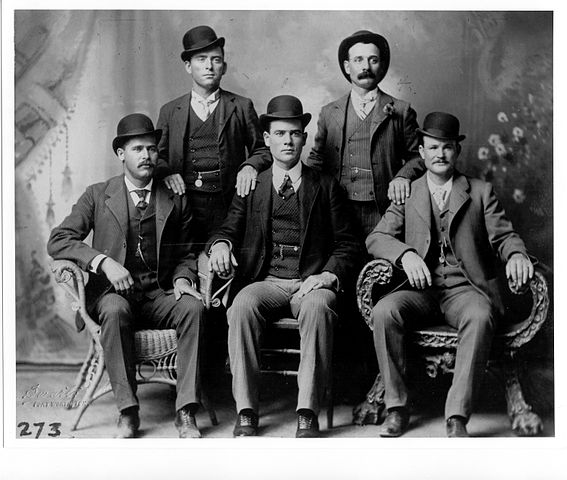
The Wild Bunch, Fort Worth, Texas c1900
Other characters of interest include Harve Logan, who attends Longabaugh on the ill-fated robbery attempt. The two get captured and jailed, then escape together, only to cross paths with two low-lifes with nefarious plans to join the Wild Bunch. We also get to know Tom O’Day, the man who bungles the robbery, chiefly because of a bad drinking problem.

Jim McCloud is another man bound for the Hole in the Wall when we first meet him. Freshly escaped from prison, he’s jumping trains, shedding his prison clothes and worried that his prison-shorn hair will give him away. Also memorable—for his stutter—is Jim’s friend, Dick Hale.

Plot. Much of the novel involves a winter trek across Wyoming by Billy and Andy as they deliver a change of horses for the Belle Fourche bank robbers. Having left the horses at an agreed place, the two then set off into bad weather on a return journey that takes many days and finally leaves them lost, on foot, and freezing from cold.

Along the way they encounter one difficulty after another. Meanwhile, Andy is torn by her growing affection for Billy and his resistance to her pleas for him to leave the gang. For him, the gang is his only family, and Butch is like a big brother to him. Failing to persuade Billy, Andy wants only to get back home, but obstacles continue to prevent that from happening.

Jean Henry Mead
Wrapping up. Mead has marshaled a good deal of history about members of the Hole in the Wall gang. The book closes with an account of the fate of many of them. I’d recommend readers to jump to that section first, because it provides an informative context for the story she has to tell.

Historical accounts, which focus on incidents and dates, don’t reflect the actual day-to-day experience of the men and women who lived outside the law. Of the Hole in the Wall gang and Butch Cassidy’s Wild Bunch, the novel captures the long months in hiding and the lack of diversions besides playing cards. Food was unvaried and bad. Illness and gunshot wounds had to be doctored with home remedies.

Traveling for days at a time across rough and hostile terrain in the worst of weather was a tedious, often life-threatening trial. Holed up in a cabin with the same handful of men week after week was no less wearying. Mead’s novel removes the romance and excitement from what we imagine as the outlaw life, and leaves us with what’s left, and it’s not exactly all thrills. I won’t think of the Wild Bunch again without recalling Mead’s portrayal of them.

Escape is currently available at amazon and Barnes&Noble and for the kindle.

Jean Henry Mead is a writer of historical fiction and mysteries, as well as an award-winning photojournalist and writer of children’s books. She is a frequent interviewer of western writers at her blog, Writers of the West. You can find out more about her at her website.

Image credits:
The Wild Bunch, Wikimedia Commons

Coming up: Lewis B. France, Pine Valley (1897)

Thursday, June 21, 2012

Cy Warman, Frontier Stories (1897)

Cy Warman
Before fame and fortune found Cy Warman, he had been a struggling writer in Colorado. After a short career working for the railroad, he was editor of the Creede, Colorado, newspaper, The Chronicle. There he knew both Bob Ford and Soapy Smith, and on a fateful June day in 1892, he was one of the first to rush through the door of Ford’s dancehall to find him shot dead.

Warman was a collector and teller of stories, some of them told in the manner of yarn swapping at a gentlemen’s club, some with the energetic flair of a news writer. How much is fiction and how much nonfiction is hard to say. He knows his audience’s fascination for the Old West when it was chiefly occupied by Indians, cowboys, outlaws, and the first railroad men.

Indians. There are 18 stories in this collection. Almost all of them involve white encounters with Indians—Utes, Paiutes, Sioux, Cheyenne, Pawnee, and Crow. The narrators of his stories are interested observers. Among them is one not altogether sure Indians are human, but respect is given, as to a species of armed, dangerous, and unpredictable bipeds.

Some Indians are friendly, some not. They steal what they can and behave in contradictory ways. The Hydes among them, we are told,  outnumber the Jekylls sixteen to one. An Indian boy may skin a live rabbit to see how long it lives. He's just as likely to share his food with a crippled dog. Bathing for the sake of cleanliness is unknown.

Creede Camp, Colorado, 1905
The Indians are also relentless in battle, whether with whites or other tribes. In “In the Hospital” the narrator hears a story of a railroad man working on a construction crew who goes missing. He is found at the bottom of a cliff, pressed against it as Indians above shower him with rocks and arrows, until one of them successfully puts an arrow through his heart.

In “Wantawanda,” a band of Cheyenne team up with a band of Sioux to massacre a small camp of Crow, their traditional enemies. Cunningly, the Cheyenne chief “persuades” a group of white trappers and adventurers to take up arms with them, though the Crow have long been allies of the whites.

The Crow are taken by surprise and fight valiantly until the only man standing is the chief, Little Gray Bull. Covered in wounds and blood, he is outraged and demands that they finish him off. The surviving Cheyenne and Sioux cower in awe, reluctant to take the life of such a brave man, until a “half-breed,” tired of waiting for breakfast, shoots him dead.

Pony Express riders, 1860
In one of the most engaging of the stories, "Little Cayuse," a trapper named Whip Saw buys a Pawnee boy from a Sioux in exchange for a knife. The two of them man a Pony Express station at White Horse, Wyoming, where they and the express riders are often under attack by the Sioux. Called Little Cayuse for his love of horses, the boy is taken captive again and lives with the Sioux in Nebraska Territory until he is able to escape.

Returning on foot to Wyoming, he is tracked by wolves who attack him as he is met by a Pony Express rider, who turns out to be his old friend Whip Saw. As another rider races off westward from White Horse, Whip Saw washes the boy's wounds with whiskey and quietly sheds his tears.

“Half-breeds.” The matter of mixed blood Indians comes up in several of the stories, and always the narrator characterizes them as worse than savage. The white blood in them makes them “ambitious,” while the red makes them vicious enough to “kill a man for a new saddle.”

In a story called “Half-Breeds,” the narrator tells of a family of mixed-blood brothers fathered by a Frenchman in British Columbia. After they and their gang kill a shepherd and the constable who tries to arrest them, a vigilante force of citizens and sympathetic Indians travels 50 miles to lay siege to them where they have holed up in a cabin. Surrendering, they are returned to the settlement for trial, where three are hanged, and three are put in prison because they are underage. A squaw with them is set free.

Cripple Creek, Colorado, 1906
In “Wantawanda,” the mixed-blood chief of a band of Crow Indians, Medicine Calf, turns out to be a “mulatto,” whose dark coloring and curly hair make him an object of curiosity among the whites. He surrounds himself with so-called “dog soldiers” who successfully protect a traveling company of whites from being slain by other Crow Indians.

Women. Warman’s West is almost bereft of females. A white woman, who keeps a boarding house in Cripple Creek, Colorado, shoots a suspicious man who turns out to be a deputy on duty during a miner’s strike. Nursed back to health by her, he falls in love. She makes a claim on a spot she likes, and the two invest his money in a dig for gold. They eventually find gold on the day the money runs out, in the last bucket of rock taken from the mine.

In “A Quiet Day in Creede,” a prostitute figures in the story only because she visits Bob Ford’s dancehall collecting for the burial of another woman just before he is shot. He signs her list of subscribers, and when he sees that Soapy Smith has pledged five dollars, he puts in five and “raises” Smith another five. She is described only as “sorry-looking.” A woman inside the entrance of the dancehall gets no description at all, except that she is a “silent partner” in the business.

Sheet music, 1893
Wrapping up. Cy Warman (1855-1914) must be the only western writer who made a living as a poet. His “Sweet Marie,” a love lyric to his wife, became a popular song in the 1890s after it was published in The New York Sun and set to music. Years later, at his death, he was remembered as “The Poet of the Rockies.”

Two collections of railroad stories preceded Frontier Stories, and he continued publishing stories about the railroad, Indians, and western life for the rest of his life. From 1893, he was a frequent contributor of poems, fiction, and articles to McClure’s and a few other slick magazines. In his later years, he settled in Ontario, his wife’s home.

Frontier Stories is currently available at google books and Internet Archive, and for the nook. For more of Friday's Forgotten Books, click over to Patti Abbot's blog.

Sources:
The Overland Monthly, vol. 37 (1901)
The Publisher’s Weekly, vol. 71 (1914)

Image credits:
Cy Warman photo, The Canadian Magazine, vol. 31 (1908)
Pony Express riders, Wikimedia Commons
All others, USGS Photographic Library

Coming up: Saturday music, Charley Pride

Thursday, June 7, 2012

Marie Manning, Judith of the Plains (1903)

Judith and Peter, an intimate moment
So this is #71 in a series of early westerns (1880-1915) I’ve reviewed here at BITS over the past two years. To a list that started out with mostly male writers, I’ve been finding and adding numerous more women writers. When the whole list is accounted for, they will make up about one-third of it.

The single illustration from Marie Manning’s Judith of the Plains (right) would suggest that it’s another romance, but she’s got a lot more on her mind than that. Depending on how you count, there are two main plots and parts of at least two others. They overlap somewhat, though each has its own emotional center.

Plots. Mary Carmichael is a young girl from the East who arrives in Wyoming to take a job as a governess for a sheep rancher in the Wind River Mountains. Her arrival after a long, uncomfortable cross-country train trip and a rough ride by coach across the prairie echoes the schoolmarm Molly’s arrival in Wister’s Medicine Bow, Wyoming.
Eventually arriving at her destination, she discovers that her employer, Mrs. Yellett, operates out of a camp and does without a ranch house, her family sleeping rough with only the starry sky for a roof. Her six children have never learned to read or write. What's more, Mary learns, they have no more interest in schooling than the sheep do that they help herd.

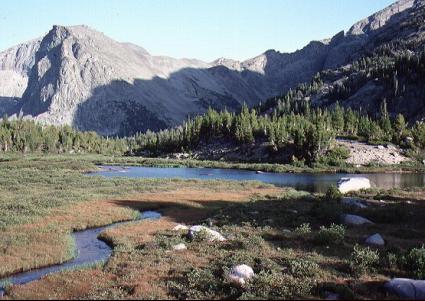
Wind River Range, Wyoming
In her first days in Wyoming, she meets the Judith of the title. Judith Rodney is a postmistress, delivering mail at a road ranch, where the local cowboys gladly gather to banter with her. She’s single and pretty, educated at a convent school. Her brother, Jim Rodney, is a rustler, who has already done time in the state pen at Rawlins. Both have an Indian grandfather, their grandmother a white woman raised as a Sioux.

Jim Rodney has good reason to carry a grudge against the local cattlemen. He had been a prospering sheep man, until he was brutally run off the range, his herd driven over a cliff to their deaths. His wife and children now live in poverty in an abandoned cabin deep in the criminal-infested hills.

Sworn to take revenge on a man named Simpson, who was responsible for the deed, Rodney sabotages a cattle roundup. He stampedes the herd while Simpson is riding night guard, and the man is killed. The foreman and some of his men then seek Rodney out and hang him.

Mixed blood Choctaw children, 1908
Romance. The likely beau for Judith is a transplanted Easterner, a cowboy named Peter Hamilton. Though he and Judith are friendly, he is distracted by a moth-to-the-flame obsession with a girl he once met while a student. Kitty Colbrooke is a published poet (and you don’t get many of those in westerns) with a literary following. And she’s also several years older than him.

When she shows up as a guest at a ranch within a day’s ride, he is off and running in hopes that marriage has become a more agreeable prospect to her than it was the last time he asked. It’s not, but his attentions do appeal to her vanity, and so he is stuck like a fly on a fly-strip, while Judith observes from afar, heartsick.

Peter cannot, in fact, claim much that is to his credit. He has tediously conventional notions about women and courtship. He also prefers the cream puffery of a fashion-conscious Eastern girl to the womanly beauty of feature and character to be found in Judith. An added obstacle for him is her family—there’s that Indian grandfather—and her ex-con, cattle-rustling brother.

Still, she is fond of him. When he finds her one night on a fearsome mountain trail, he hugs her to him protectively as they ride along together. Her heart melts. It isn’t until he sees the brave face she puts on to mask the grief at her brother’s hanging that he discovers the full depth of his love for her.

Sheep, Wind River Agency, Wyoming,
Character. Unlike many westerns of the period, Manning’s story has little to illustrate on the subject of character. Judith comes closer than any man in the novel to exhibiting admirable traits. She is strong and independent, courageous, brave. When we first meet her, we like her for her composure when she is teased by the cowboys who would happily be her suitors. As the story develops, she wins our respect as she attempts to protect her troubled brother. 

Although it’s a comic role, Mrs. Yellett would come in second for strength of character. She has the polish of a potato freshly unearthed, but she is formidable as a businesswoman, running a big, prospering sheep operation. She has no need for fashion or convention—or bathing. She lives by a homespun moral code that she quotes with aphorisms from a “Book of Hiram,” though we gather that like her children, she cannot read or write.
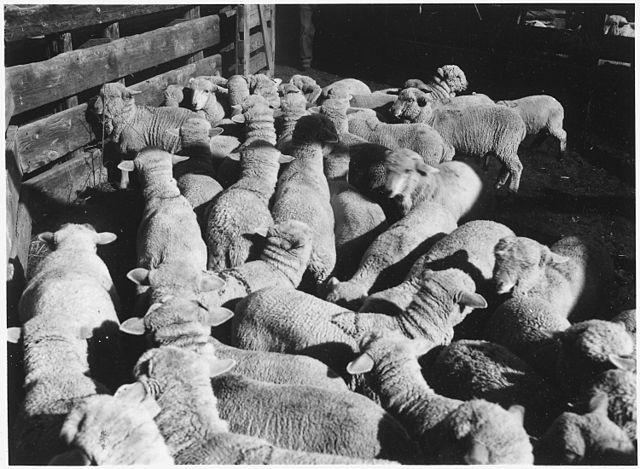
She does a man’s work, fearlessly driving a team of horses over perilous terrain, pulling a wagon precariously loaded with barrels of sheep dip. And she does not complain that her grumpy husband, now eighty, doesn’t lift a finger to help. At his age, he’s earned his rest, so far as she’s concerned.

Washington, D.C., c1900
Wrapping up. Turns out Marie Manning (1872-1945) was not to be remembered as a novelist, but as the Abigail Van Buren of her day. In 1898, while writing for the women’s pages of the New York Evening Journal, she originated the nation’s first personal advice column, “Dear Beatrice Fairfax.”

Born in Washington, D. C., she lived most of her life there. One earlier novel, set in England, preceded Judith of the Plains, and in the 1940s she published two more. During 1900-1920, she published numerous stories in Harper’s and other slick magazines.

Judith of the Plains is currently available at google books and Internet Archive, and for kindle and the nook. For more of Friday’s Forgotten Books, jump on over to Patti Abbott’sblog.


Photo credits: Wikimedia Commons

Coming up: Saturday music, Bob Wills