Tuesday, October 15, 2013

Good For Nothing (2011)


This gritty, sweaty western looks like it was shot somewhere on the endless arid plains under the great open sky of the American West. But think South—way South. Good For Nothing was filmed entirely and convincingly in New Zealand. Its story plays out over a vast, lonely landscape, where its characters are often shown as mere specks crossing vast, empty reaches. The panoramic views evoke the romance of the West at the same time they transport you back in time, in a way that many Hollywood westerns fail to achieve.

The visual and dramatic styles are sharply and precisely realistic. This is a West where men are surly and whiskery, seldom speak, and do not bathe. Long stretches of the film pass without a word of dialogue. Meanwhile, it tells a story in which western movie conventions abound—the lone rider, a smoky saloon, a woman in peril, a pursuit on horseback, gunplay and shootouts. The soundtrack reverberates with oversized western movie music.

The hero of the film (Cohen Holloway) would be a plausible stand-in for one of Clint Eastwood’s laconic heroes. Fast and lethal with a gun, he doesn’t crack a smile, and eyes everything with suspicious scrutiny.  He is the iconic paladin roaming the West alone. But as chance would have it, he currently has company. Along for the ride is an English girl (Inge Rademeyer) he has taken hostage after an explosive gunfight in a saloon.

And we soon learn that he has, alas, an unexpected flaw that provides the comic thread that runs through the film. That being his futile attempts to find a doctor who will cure a bad case of erectile dysfunction. What’s amazing is that this particular detail does not render him any less a man. It is a perplexing and desolate sorrow that accounts in part for his usually grim demeanor.

Monday, October 14, 2013

Johnny D. Boggs, East of the Border


Imagine the Three Stooges on tour in a play about themselves, and you’ll get a hint of this antic novel about Buffalo Bill Cody, Wild Bill Hickok, and Texas Jack Omohundro. It’s the 1873-74 theatrical season, and while the country’s economy dissolves into another panic, Cody’s troupe of actors turn away eager crowds everywhere east of the Mississippi.

They present two plays, Scouts of the Plains and Buffalo Bill! King of the Border Men. Best described as lunatic melodramas, they feature the killing of large numbers of Indians and dances performed by the Italian entertainer, Guiseppina Morlacchi.

Buffalo Bill Cody
Plot. Boggs’ novel follows Cody’s acting company as their tour has been documented in memoirs and newspapers of the time. Where there is a thread of plot, it concerns Buffalo Bill’s mostly unsuccessful attempts to manage the behavioral excesses of Wild Bill, who lives up to his name. Each undyingly loyal to the other as lifetime “pards,” they are rarely an easy match of temperaments.

Cody is the enterprising showman, missing the freedom of his youth as a scout, but married with kids. Hickok, the older of the two men, is sliding into an alcoholic haze, darkly given to brawling, whores, and other forms of mischief. Cody keeps him in the show long after everyone else has begged him to fire the man.

Meanwhile, Hickok would welcome release from the promise he’s made to stick with the tour for a year. The clownish fakery of the playacting gets riotous applause but galls the man who survived the perils of life on the border. The displays of Indian killing are cheap farce and demeaning. Making this point during a backstage dispute, he pulls off his costume to show the scars of a gash from an actual Indian’s lance.

Wild Bill Hickok, c1874
A subplot concerns the ongoing marital discord between Cody and his wife Louisa. He is true to her as the mother of his children—in his way. She distrusts him, often on the verge of volcanic fury, showing up during the tour to accuse him of consorting with one of his actresses. Hickok, playing a joke on his old friend, has tipped her off.

Cody is already overtaxed by the constant demands of managing his fractious company while busy meeting and greeting the public. Keeping Louisa happy nearly undoes him. In a desperate move, he gets her to come onstage during a performance. Instead of being pleased by the warm reception of the audience, she is deeply embarrassed and determines to go back to Nebraska, taking the kids.

But this crisis, too, passes. While real-life Cody and his wife seem never to have been reconciled, Boggs gives their part of the story a happy ending that is surely a stretch of his own imagination.

Saturday, October 12, 2013

Glossary of frontier fiction: C
(catchpenny – choker)


Below is a list of mostly forgotten terms, people, and the occasional song, drawn from a reading of frontier fiction, 1880-1915. Each week a new list, progressing through the alphabet, “from A to Izzard.”

catchpenny = made to sell readily at a low price, regardless of value or use. “With his catch-penny plausibility, his thin-spread good-fellowship, and his New York clothes, he mistook himself for a respectable man.” Owen Wister, Red Men and White.

Catkins
catkins = a usually dense, cylindrical, often drooping cluster of flowers found in willows, birches, and oaks. “Soft, wet and tender, with a faint green filming the sodden pasture field, and a rose-pink veil covering the maples, and blue-grey catkins tinting the dark alders, spring had come.” Charles G. D. Roberts, The Backwoodsmen.

catspaw = a person used as a tool by another. “Be sure that she is promised something she thinks worth her while, by Bob or by Moore, for her sudden interest in politics and—Charlie Blair. She is a good catspaw.” Alice Harriman, A Man of Two Countries.

cavayard = a group of saddle horses, remuda. “They’d go right out and make Amalon look like a whole cavayard of razor-hoofed buffaloes had raced back and forth over it.” Harry Leon Wilson, The Lions of the Lord.

cave canem = beware the dog. “From behind their barrier of thorns, every plant and shrub bristling a cave canem to the tactless marauders who should seek to prey upon them.” Frank Lewis Nason, To the End of the Trail.

Celestial = a Chinese person; derives from Celestial Empire, an ancient name for China. “And when the angry Celestial had gone he lay back in his chair, and laughed till he was weak.” A. M. Chisholm, Desert Conquest.

cellaret = a case for holding wine bottles and decanters, often built as part of a sideboard. “He crossed to the table and, springing the silver catch of a tiny door, cunningly empaneled in the wall, selected from the cellaret a long-necked, cut-glass decanter.” James Hendryx, The Promise.

chaffing = teasing, bantering (also chaffering). “I was prepared to hear a good deal of chaffing about getting lost.” Bertrand Sinclair, Raw Gold.

Chaos and Old Night = a scene of wreckage and confusion; reference to deities in John Milton’s Paradise Lost who reign over the realm of Anarchy that lies between Heaven and Hell. “[description of a trainwreck] Chaos and Old Night: a pile of scrap with a hole torn in the middle of it as if by an explosion, and a fire going.” Francis Lynde, The Taming of Red Butte Western.

chariots of fire = an emphatic expression; reference to usually airborne modes of transportation associated in the Old Testament with the divinity. “It looked like a put-up job, all right; an’ chariots of fire, but he was mad!” Robert Alexander Wason, Friar Tuck.

charivari = a  noisy mock serenade, typically performed by a group of people in celebration of a marriage (also spelled “shivaree”). “The next night about sixty of the white neighbors gave us a charivari and my wife was much pleased to know there was no color prejudice among them.” Oscar Micheaux, The Conquest.

Thursday, October 10, 2013

Arthur Henry Paterson, The Better Man (1890)


This novel may qualify as the first western, and it was written by an Englishman. The central characters of the novel are also English, and the author writes as someone who acquired a familiarity with the people and customs of the American West. He lived there for a time in the 1870s.

Plot.  Two school chums, who first met as schoolboys at Eton, meet again in a settlement called Toros in New Mexico. Frank Houghton has lived here as a cattle rancher for four years. He is joined by the younger Tom Eckersley, who has left his upper-class family to seek his fortune in America. Against the advice of Houghton, Tom befriends a shady character, Mark Galt. With the help of an unscrupulous judge, Galt and his gang run a town 50 miles away called Carita.

Confident in his ability to judge character, Tom signs a contract that commits him to a year of sheepherding for Galt. When Tom also agrees to persuade his father to invest £1,000 in their ranch, he does not sense that Galt is laying a trap for him. But eventually, he is so enraged by Galt’s duplicity he nearly kills the man.

Apprehended before he can flee to safety, he is thrown in jail and faces attempted murder charges. Frank gathers a small army of cowboys to ride all day and night to rescue Tom, who has been found guilty in a hurried trial and sentenced to be hanged. The rescuers meet little resistance, and the crooks are quickly overwhelmed and sent packing.

Tennyson's home, from book by A. Paterson
Romance. Midway through the novel, Tom’s family arrives in Toros to take him back to England. With his parents is his sister, Edith, whose presence disturbs the already taciturn Frank. He had once proposed marriage to her, and she declined his offer. She is now being courted by a military man, Major Crawford, who arrives in town as well.

Frank is not a happy soul, still suffering from a broken heart. Edith’s arrival revives his hopes, but she remains unaware of his feelings, and hardly knows her own. Belatedly discovering her love for Frank, she turns down Crawford’s proposal of marriage.

When a young telegraph operator observes the major’s abrupt departure from town, he sends word to Frank who returns from his ranch just as the family is about to leave for England. Frank and Edith are united once more, this time confessing their love, and he promises to wrap up his affairs within three months and return to England himself.

Character. Before we meet Frank Houghton, a crusty old stage driver describes him warmly as “a man!” By that he means a trailblazer, “one who cuts a notch in every tree he passes as he walks through life.” Frank has been transformed by his four years in the West. Already a big man at six-foot-three and a half, he has developed a massive chest, his skin has browned, and he has grown a thick beard.

Someone observes that the West has been hard on Frank. Edith tells him he has “a tired, grim look, as if you did not find life very much worth living.” She guesses that it must be lonely with no one to speak to but the men who work for him. He tells her he can bear it, because he’s a man and he has no choice. Meanwhile, he has won a place in the hearts and minds of the local residents. Through his courageous effort, he has helped rid the town of a ring of crooks and outlaws.

Tuesday, October 8, 2013

Cowboys in early frontier fiction


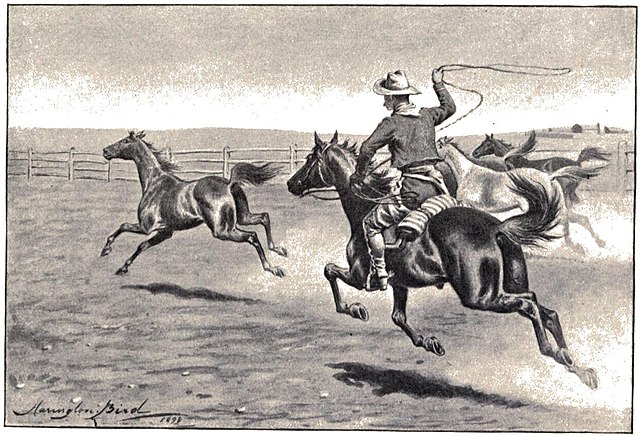
Cowboy, 1898
The cowboy western originated with the dime novels of the nineteenth century. These were exaggerated tales of adventure in the Wild West. But when did cowboys first appear in mainstream popular fiction?

Vaqueros. In early examples, set in California, they appear as vaqueros, and remind us that the actual horsemen who herded cattle in the frontier West were itinerant agricultural laborers. In Maria Amparo Ruiz de Burton’s The Squatter and the Don (1885), a californio ranch owner has vaqueros among his employees. They figure into the plot as a herd of cattle are driven through a winter storm in the mountains above San Diego. 

A foil to the central character of Gertrude Atherton’s Los Cerritos (1890), Carlos Castro is the chief vaquero at a neighboring ranch. He is a burly giant of a man, so full of energy he is like a volcano waiting to erupt. His comrades adore him for his “enormous vitality” and his “rude magnetism.” Though a horse thief, he is always acquitted of any crime. He is opposed to americanos moving onto California rangeland, picks a fight with and grievously wounds one of them, and sets fire to his ranch.

Ranch hands. English-speaking cowboys make an early appearance in Charles King’s Dunraven Ranch (1890). They are employed on a mysterious ranch located near a cavalry outpost in Texas. Eager to solve the mystery, a young lieutenant pays a call with several troopers, who are of Irish descent. The visit develops into a donnybrook between the cavalrymen and the ranch hands, who are English.

Three ranch hands are minor characters in Marah Ellis Ryan’s Told in the Hills (1890), set in western Montana. Jim the youngest is an innocent, who gets excited when the cavalry arrives to set up camp near the ranch. Another, Andrews, is occasionally sent to the nearest settlement for the mail, but tends to stay overlong and come home drunk.

Cowboys are a “wild combustible element” in Arthur Paterson’s A Better Man (1890). They gather in numbers in the saloon of a New Mexico frontier settlement. Some are given to drunkenness and insulting women. The novel’s central character, a rancher, assembles a small army of them to ride all day and night to rescue an innocent man, who has been found guilty in a hurried trial and sentenced to be hanged.

Cowboys. Owen Wister may have popularized the cowboy, but in his early western stories written for Harper’s and collected in Red Men and White (1896), they are dubious characters. Two crop up in “A Pilgrim on the Gila.” The story’s narrator learns that one of them is avoiding a woman who is two months shy of claiming him as a common-law husband. Later, the two cowboys are among a dozen road agents who hold up an army paymaster and make off with the strongbox.

The Great K&A Train Robbery
The cowboys in Paul Leicester Ford’s The Great K&A Train Robbery (1897) talk in stereotypical lingo. Asked if he is carrying a weapon, one responds, “Do I chaw terbaccy?” Threatening another man, one calls him a “stinkin’ coyote” and tells him to stay put “or I’ll blow yer so full of lead that yer couldn’t float in Salt Lake.”

Colorful, yes, also ungovernable and potentially dangerous. They are frequenters of saloons, eager to accept a wild rumor as fact, and quick to rush a suspected wrongdoer to justice. Believing the young hero of the novel to be a train robber, they try to lynch him from a telegraph pole.

Cowboys of a similar stripe appear in two of Cy Warman’s Frontier Stories (1897). Given to gunplay and playful troublemaking, they can easily find themselves on the wrong side of the law. In one of them, several cowboys play a trick on a band of Indian cattle thieves. Finding the cremated remains of one of them, they leave a handwritten curse in the man’s skull that frightens the thieves away.

Warman’s “A Cowboy’s Funeral” starts out with some hijinks of a half-dozen cowboys, who have ridden 200 miles to a town in Utah to mail a letter. They get drunk and start firing their pistols until a bystander is accidentally shot and killed. They make a hasty retreat into the desert, but when the sheriff gives chase, one of them is shot dead.

When the cowboys put enough distance between themselves and the law, they stop and make camp. There they pass the bottle before eventually putting the dead man into a grave. One cowboy leads them in a version of “The Streets of Laredo,” which the narrator describes as “plaintive and pleading—a sort of mixture of negro minstrel and the old time Methodist revival song.”

Monday, October 7, 2013

Thomas D. Clagett, The Pursuit of Murieta


This novel is a lot like a Budd Boetticher western. It has the structure of a movie plot, and much of the action takes place a good distance from civilization. A group of male characters deal with life and death issues like what to do with and what to believe about a man they have captured. And a woman riding with them has an agenda of her own.

Plot.  At the center of the story is real-life Mexican bandit Joaquin Murieta who harried the americanos flooding into California after it became a state. Something of a Robin Hood, he reputedly stole from the wealthy to distribute among the poor. He was a popular hero among the disenfranchised and a pain in the backside of law enforcement, which found itself plagued with not one but several “Joaquins” roaming the state.

The story begins with a scene of unprovoked yanqui violence against Murieta and his wife as they attempt to return to Mexico after an unfruitful sojourn in the California gold fields. Then it jumps ahead to 1853 during a few days in which Murieta is pursued by a contingent of rangers tasked by the governor with bringing him in. They finally run him down in the mountains above San Gabriel Mission.

Lt. Ambrose Quick, the young man in command, has trouble keeping order among his men and deciding whether to believe their captive when he claims to be Murieta. Addie Moody, a saloon girl who has joined them has revenge in mind. Her sister was raped and killed by a man she believes is Murieta.

Style and structure. Like a movie, the novel has a single central conflict, pitting two men against each other: Murieta and Lt. Quick. One of them is more admirable than the other, but neither of them is a villain. That honor goes to one of Quick’s men, Ned Needle, who is a hateful bigot, driven by sneering contempt for everyone.

As in a movie, the characters tend to be types whom we quickly recognize. Besides the bigot Needle, there’s a drunk, a self-important sheriff, his featherbrained daughter, and a mysterious Mexican woman. Addie Moody is the outspoken prostitute with more intelligence than any of the men. Besides Lt. Quick, only one of them actually breaks out of the pattern created for them and makes a choice that amounts to a change in their character.

Quick is interesting for starting out a man with aspirations far beyond his capacity to achieve. He wants to be mayor of Los Angeles, but has no qualifications for the job. He hopes that capturing Murieta will sweep him into office. Before the story is over, he makes some difficult decisions and some unwelcome discoveries that both lift and lower him in our estimation.

Many of the characters in the novel are based on actual historical figures. Ten or more of them walk from the pages of history. Maybe most surprising is to find “Judge” Roy Bean running a saloon in the little settlement of San Gabriel. Andres Pico, retired Mexican general runs horses on the verdant ranges of the San Fernando Valley.

Saturday, October 5, 2013

Glossary of frontier fiction: C
(cab - catch a tartar)


Below is a list of mostly forgotten terms, people, and the occasional song, drawn from a reading of frontier fiction, 1880-1915. Each week a new list, progressing through the alphabet, “from A to Izzard.”

cab = baby carriage. “She took the baby out in his cab to hive him the sun and air.” Elizabeth Higgins, Out of the West.

cabbage = to pilfer, take possession of by stealth. “‘I can see Briggs City eatin’ the shucks when it comes ’lection day,’ he says, ‘and that Goldstone man cabbagin’ the sheriff’s office.” Eleanor Gates, Alec Lloyd, Cowpuncher.

caboose = a cookhouse; oven or fireplace. “With tape-line and pegs McKenna laid out the ground plans of bunk-house, eating-camp, caboose, foreman’s quarters, and stables.” A. M. Chisholm, The Boss of Wind River.

calcium light = limelight; a lamp consisting of a flame directed at a cylinder of lime with a lens to concentrate the light; formerly used for stage lighting. “There will be no villain clothed with a little temporary power to shut the calcium light out of these putrid beds of corruption.” John C. Bell, The Pilgrim and the Pioneer.

calf’s head jelly = head cheese; a meat jelly made with flesh from the head of a calf or pig and often set in aspic. “It is a good thing, I tell you, ladies and gentlemen, a very fortunate thing, that I am so amiable, and Gabriel so good a fellow, or else I would have punched his head into calf’s head-jelly, twice a day, many times.” Maria Amparo Ruiz de Burton, The Squatter and the Don.

Calumets
call the turn = to predict accurately. “That either they or I can learn / A sinner how to call the turn.” William De Vere, Jim Marshall’s New Pianner.

calumet = a highly ornamented ceremonial pipe used by Native American tribes, a  peace pipe. “As the circling smoke rings rose from the sachem’s calumet, the gentle breeze bore them slowly to the southward.” G. Frank Lydston, Poker Jim, Gentleman.

calzones = breeches, pants. “It appears that he had only has dirty cotton calzones to be buried in, so his wife begged a worn white suit from Mr. Benson.” Herman Whitaker, Over the Border.

Camilla = from Roman legend, a woman warrior who fought on the side of Turnus against Aeneas. “But the sudden shadow of a coyote checked the scouring feet of this swift Camilla, and sent her back precipitately to the buggy.” Bret Harte, Frontier Stories.

camp robber = a jay of northern North America with black-capped head and no crest; noted for boldness in thievery. “A camp robber was screaming on a cedar bough above the prostrate figures.” Cy Warman, Frontier Stories.