Tuesday, December 24, 2013

Christmas wishes


This whole CD has been my companion during this Christmas season, cycling through random mode on my car stereo.

I wish you a holiday season that is mellow as Oscar Peterson's music. May the days bring all you hope for and a new year full of promise.

The Appaloosa (1966)


Marlon Brando, for some reason, has never seemed an easy fit in western movies for me. His face and his voice are so deeply grounded in On the Waterfront, Guys and Dolls and, later, The Godfather. He seems to have wandered far from home when he shows up on the frontier, as he does here.

Whether it is he or a double in the opening shots, riding across the vast western landscape, it looks like someone who has never been on a horse before. Muttering his lines as he stops by a church for a confession in an early scene, he seems to be trying on a character that is beneath his range as an actor.

Donning a huge brimmed sombrero and serape to recover an Appaloosa stolen from him by John Saxon in the first reel, he begins to bristle with menace. It’s almost like watching the Hulk pop out of Bruce Banner’s shirt. His steely determination is pitted against the grinning arrogance of Saxon and his pistoleros. While Saxon’s grin is malicious, Brando’s is blood curdling. For all that, he’s still not a character this side of villainy we expect to find in a western.

Marlon Brando
Plot. The plot of the film is simple, almost like a fable or folk tale. Diffident and soft-spoken, Brando returns from “the war” where he killed men and “sinned” with women. Saxon wants to buy his horse for a girlfriend (Annjanette Comer). When Brando refuses to sell, Saxon steals it and heads into Mexico. Brando follows and is taken prisoner by Saxon. In a suspenseful scene the two arm wrestle for the horse, the loser to be stung by a deadly scorpion.

Comer helps Brando flee with his horse, eager herself to escape the clutches of Saxon, who follows them into the mountains and attempts an ambush. Brando, exhibiting his skill with a rifle, puts an end to Saxon on the snowy mountain slopes and returns to the U.S. side of the border. A friendly Mexican family waits there to welcome him back.

Three stars. The widescreen cinematography of the title sequence is almost breathtaking. We see the desert Southwest and a small lone figure riding horseback across the terrain. Camera work in the rest of the film, however, gets to be awkwardly self-conscious. Almost invariably there is someone or something between the camera and the action, sometimes nearly filling the screen. At times the film seems more style than content.

Monday, December 23, 2013

One sentence journal, Dec. 15–21


Sandhills pasture in winter

Time marches on . . .


12/15, Sunday. Early Christmas gift: a warm watch cap from L.L. Bean that I will not take off until next spring.

12/16, Monday. Look up: in the desert sky swirls and slowly shifting shapes of high, thin clouds against stark blue, an edge of them briefly catching a flash of brilliant color from the ice crystals of a mid-day sun dog.

12/17, Tuesday. Full moon in a misty haze of early dawn clouds, shining between the slats of the kitchen window blinds as I wait for coffee, impatient for solstice and an end to these long dark nights.

12/18, Wednesday. Off at short notice to Nebraska, to join relatives for a family funeral, searching through closets before I go to find warm clothes and discovering a forgotten wool coat long zipped away in a garment bag that somehow escaped donations to Goodwill.

12/19, Thursday. Turns out there’s not a single normal sized car to be had at airport rentals in Grand Island thanks to pre-Christmas travel, and after a moment’s thought, I decide to take the remaining Ford Expedition, with its seats for nine passengers and a heater that this California driver forgot you have to wait for the engine to warm up before turning it on full blast.

12/20, Friday. It is 10 degrees in little Worms, Nebraska, where the gateway to the church cemetery says “Est. 1873” and I’m following a fresh footpath through last night’s dusting of snow to join a hundred or more gathered by a new grave, and a minister in white vestments, without a hat on his thinly-haired head, says last words, his voice resonating in the cold with Scripture readings promising life everlasting.

12/21, Saturday. I head out of town for a two-hour drive along highway 2 toward Broken Bow and the Sandhills, stopping every 20 minutes to take pictures of harvested fields, a frozen creek, and rolling grassland and discovering Ainsley (pop. 431), with two vacant storefronts side by side, built in 1916.


Image credits: Ron Scheer

Coming up: Marlon Brando, The Appaloosa (1966)

Saturday, December 21, 2013

Glossary of frontier fiction: F
(forcemeat – fuseloil)


Below is a list of mostly forgotten terms, people, and the occasional song, drawn from a reading of frontier fiction, 1880–1915. Each week a new list, progressing through the alphabet, “from A to Izzard.”


forcemeat = finely ground and highly spiced meat, fish, or poultry that is served alone or used in stuffing. “It was a very comfortable meal,—soup with force-meat balls, chicken, beef dressed with peppers, a dish of spiced pumpkin, another of fried beans, fine flour cakes, and light sour wine of the Mission’s own making.” Mary Austin, Isidro.

foretop = a lock of hair growing above or arranged on a person’s forehead, a forelock. “His foretop was long, and he wore it over one ear like a hoss’s when the wind is blowin’.” Henry Herbert Knibbs, Overland Red.

forfeits = a parlor game in which a judge requires the owner of a personal item to perform an act or stunt to retrieve it. “Every mother in the house knew what forfeits and post-office meant; some of them were watching the players at their peculiar merriment.” Elizabeth Higgins, Out of the West.

forninst = opposite to, facing; alongside. “Chilkat Jo, man, look what devil’s work is going on forninst ye! Can’t ye say the word to stop it?” Marguerite Merington, Scarlett of the Mounted.

forty drops = alcohol (40 drops equal ½ teaspoon); “Forty Drops,” a popular 1890s rag tune. “We’re all in the Red Light takin’ our forty drops, an’ Sam Enright brings up this yere Wilkins.” Alfred Henry Lewis, Wolfville.

forty rod = cheap, strong whiskey, said to be strong enough to kill at a distance of forty rods (11 miles), or to give the drinker strength to run full-speed at that distance, or to permit a drinker to walk no far than that distance. “An average twenty-wagon outfit, first and last, would bring him in somewheres about fifty dollars—and besides he had forty-rod at four bits a glass.” Stewart Edward White, Arizona Nights.

forty ways from the jack = in every way possible. “He’s the only man ever got me skinned forty ways from the Jack.” Marguerite Merington, Scarlett of the Mounted.

forty-five ninety = a round of ammunition introduced in 1877 by the Sharps Rifle Manufacturing Company. “‘Keep a constant eye on the grub.’ ‘And on the forty-five-nineties,’ Captain McGregor rumbled back as he passed out the door.” Jack London, A Daughter of the Snows.

Thursday, December 19, 2013

Ed Gorman, Blood Game (1989)


This hard-boiled "midwestern" is set in the summer of 1892 in some unnamed city big enough to turn out over 4,000 fans for a nasty boxing match. The focal character is Leo Guild, a 55-year-old bounty hunter convinced by a boxing promoter to help stage a fight between a white man and a black man. A bloodthirsty crowd is expected, believing they’ll be witness to a killing in the ring—and not the killing of the white fighter.

It’s an ugly set-up, and Guild has seen enough of the world to know it’s not much different from what passes for everyday human behavior anywhere. Stoddard, the promoter, is a tyrannical blowhard, loved only by a loyal son, Stephen, whom he abuses and scorns.

The white fighter, Victor Sovich, is equally hateful. Given to insane rages, he abuses women and boasts that he likes to kill people. One young fighter died during a bout after Sovich poisoned him to slow him down in the ring. His opponent in the upcoming match is a Franklin Rooney, a man past his prime whose only aim is to survive the fight. The longer he can stay upright, the more he gets paid. He only half understands that the crowd has gathered to see him die.

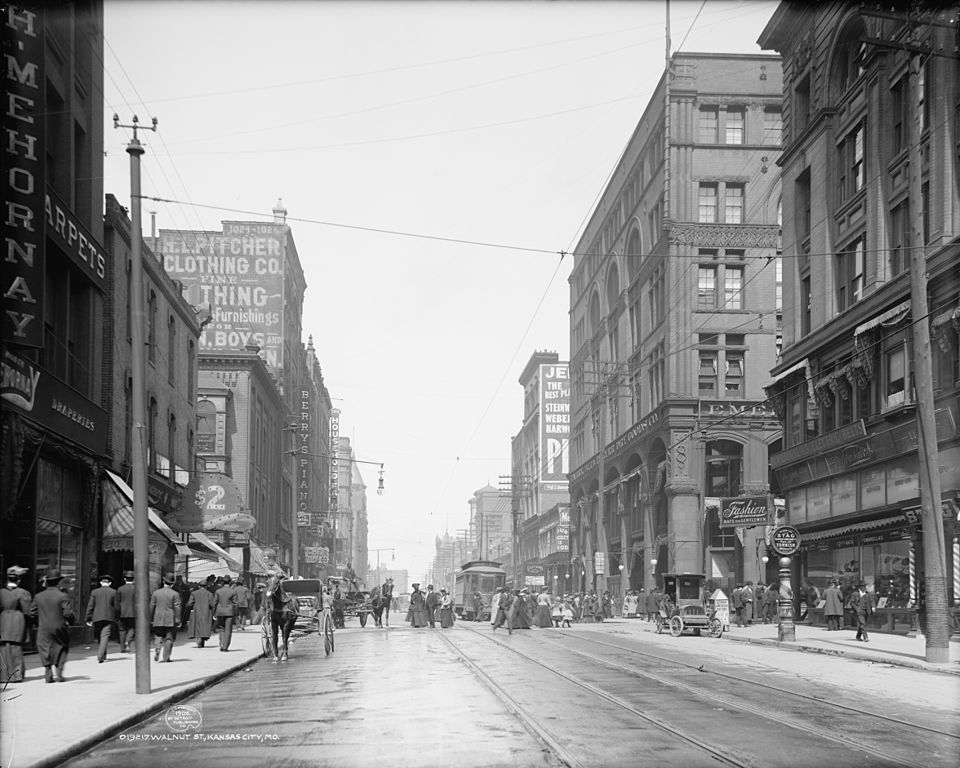
Kansas City, Missouri, 1906
Guild meets a pistol-packing mama, Clarise Watson, intent on avenging Sovich for the poisoning of her brother. Guild, unconcerned by their difference of color, maneuvers to keep her out of harm’s way. Also keeping her company with hotel breakfasts and after dark walks, he discovers her to be a consenting adult.

Stoddard hires Guild to guard the day’s take during the fight. He has promised Sovich to split it with him, but hires a thief to conveniently steal it. Sovich will get nothing, and Guild is intended for a bullet during the robbery. By mid-novel, death is in the cards for several characters, and however it plays, you know it will all end in tears. Which it literally does.

Tuesday, December 17, 2013

Dallas (1950)


I’ll start with the one good thing I can say about this muddled western—Gary Cooper. His face is often the only sign of life on the screen, while the clichés, crazy plot turns, and groaners pile up around him. 

Plot. The plot of this film is not so much contrived as simply a chopped salad of worn out story ideas from B-westerns. It’s a confusing mix of revenge, switched identities, a love triangle, a Confederate colonel who has never surrendered, the theft of a ranch, rustlers, a villain pretending to be an upstanding citizen, a sociopath killer, and lots of shooting and chases on horseback. 

With several characters pretending to be someone else or someone different, I was often unsure about who knew what about whom. I admit, it was late in the day and I was not at my sharpest, but it was all more than I could keep track of.

Cooper. I give the guy credit for holding his own in this one. As long as Cooper was on the screen, a scene seemed to be clear, even when it wasn’t. I finally just took to watching him, as you do when a situation is puzzling and you look for someone who acts like they know what’s going on.

Gary Cooper, Ruth Roman
An unexpected twist involved a black cat that we see Cooper absently petting for a while—something I don’t recall ever seeing in a western before. It seemed like a wonderful throw away detail, even as the cat appears on a windowsill next to Cooper during a gunfight. Then the script has him step on its tail to get a reaction out of the other man. A long build-up to a cheap trick. Argh.

A viewer might argue that the film is meant in part to be a comedy. It opens with a gun duel in the street between Wild Bill Hickok and Gary Cooper’s character. It’s an attention grabber if we know that Hickok died in Deadwood, playing cards. But Cooper is the star of the movie and can’t expire in the first reel either. Though shots ring out and Cooper drops to the ground, looking dead, it turns out to be a ruse. Not all that clever, but it gives you hopes for a movie that never quite lives up to that moment again.

Monday, December 16, 2013

Alfred Wallon, Showdown in Abilene


Review and interview

Originally published in 1981—in German—Showdown in Abilene was the first novella in Alfred Wallon’s Rio Concho series. Published now for the first time in English by Piccadilly Publishing, it’s in many ways a love letter to the American West.

Plot. With an abbreviated story that could well fit neatly into a one-hour TV western episode, Wallon introduces readers to a trail boss, Jay Durango, and his crew of cowboys. They have just arrived in Abilene, Kansas, after a summer-long cattle drive from Texas.

Encouraged to have a good time in town by the marshal, Bear River Tom Smith, but to stay out of trouble, the cowboys make an attempt to comply. But under the influence of too much alcohol, they cause a disturbance at the Opera House. Before long, they’re cooling off in jail.

More serious trouble is in store for Jay Durango. A pair of villains abduct him and hope to leave him dead in a shadowy corner of the red light district. Arson figures in to further plans for a bank robbery while a section of town burns. Bullets finally fly proving once again that crime rarely pays.

Railway, Abilene, Kansas, c1867
Pleasures of the text. There are many things to enjoy about the story and the storytelling. In Wallon’s hands a reader senses the pleasure of spinning a yarn from the familiar elements of the material. His characters are not only full of life. They are sketched in with hints of backstory that make you curious about them.

Durango, for instance, has what seem to be troubled memories of soldiering for the Confederacy. Returning to Texas, he’s in hopes of a new beginning. Billy Calhoun, the young son of the rancher he works for, was for two years abducted by Quanah Parker’s Comanches. He rankles at Durango’s attempts to supervise him. There’s even brief reference to a black cowboy, Bob Rennington.