Thursday, January 16, 2014

G. F. Unger, Last Chance Camp


G. F. (Girt Fritz) Unger was the Louis L’Amour of German western writers. Over more than half a century until his death in 2005, he wrote, by one count, 742 western novels, selling over 300 million copies. Born in 1921 in Breslau, he studied mechanical engineering and served on a U-Boat during WWII, until he was captured by the British.

After winning a prize for a radio play in 1949, he took up novel writing, producing sea adventures until trying his hand at westerns. Giving up a job as construction supervisor for Siemens, he became a full-time writer in 1951. Like his American counterparts, he published under various pen names. At the time of his death, he left a number of unpublished manuscripts, which have seen print posthumously. A number of his novels are currently being released (in German) by Bastei Entertainment as ebooks for the kindle.

Overcoming a lifelong aversion to German, I picked a title at random, Last Chance Camp, and have been reading a page a day with the help of a German-English dictionary. I can say that from what I have read so far, the book is a corker.

Plot. The hero, Jim Whittaker, shows up at a gold mining camp much like Deadwood. He is the sole survivor of an Indian attack on a cattle drive. He has lost everything, including his boots. Riding into camp, starving, no saddle, shirt torn, and barefoot (barfussig) he is approached by a cook offering him $100 for his horse (Pferd). Meat is in short supply.

Tuesday, January 14, 2014

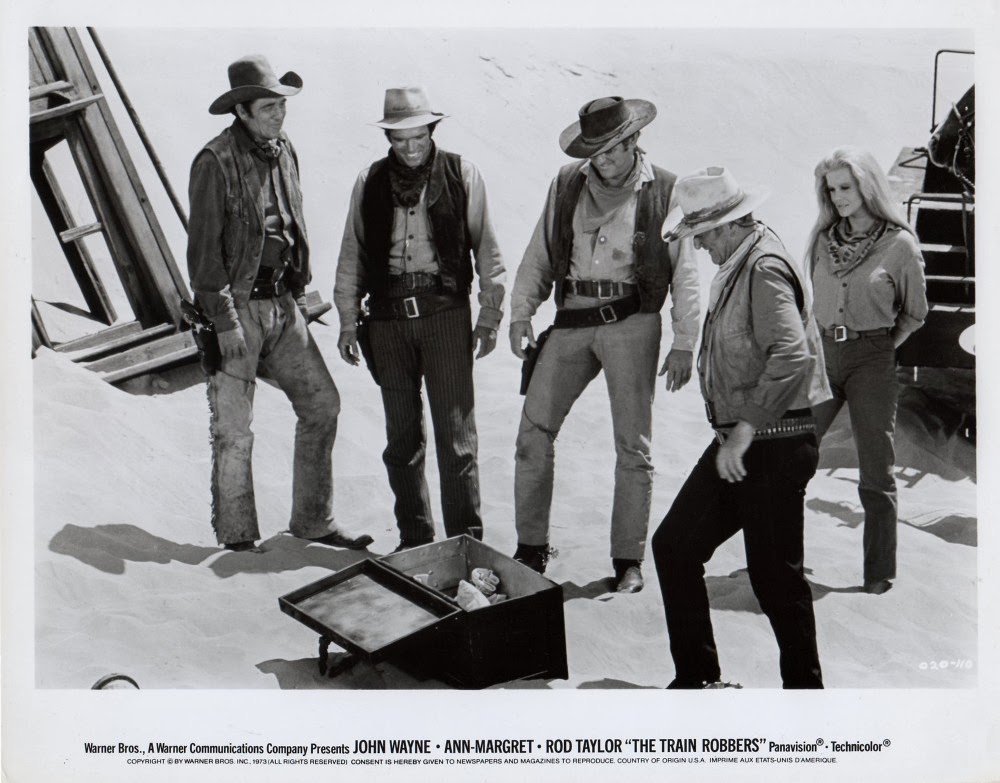
The Train Robbers (1973)


This John Wayne western should be better than it is. Individual parts of it are notable, but put together, it’s a 90-minute lead-up to a surprise ending. Wayne plays himself in the role his fans love—gruff and no-nonsense but with that disarming grin. 

The all-star cast includes Ben Johnson and Rod Taylor, both at their relaxed best. The hyphenated Ann-Margret provides the required female component. Ricardo Montalban, like someone looking for Fantasy Island, watches from afar and puffs on long cigars.

Plot. This is a Burt Kennedy film, directed from his own script. So the elements are familiar—a long trek across hostile terrain with several men and a woman. This time around, it's an assembled gang of former partners in crime accompanying the woman, who enlists them to retrieve a half million in stolen gold. It is stashed in the desert in an abandoned train locomotive.

Johnson, Guest, Taylor, Wayne, Ann-Margret
Wayne and his gang agree to help her find the gold so she can return it and supposedly clear the family name of a deceased husband, while Wayne and his men collect the reward. An immediate problem as they ride off together is that they are being followed by a troop of riders eager to separate them from the gold once it’s found.

Monday, January 13, 2014

Ben Bridges, Draw Down the Lightning


Review and interview

For starters, Ben Bridges is the pen name of writer David Whitehead. This year, 2014, marks his 30th as a published writer of western fiction. His first novel, The Silver Trail, featured a character named Carter O’Brien, and it was the start of a series that reached #14 with this one, Draw Down the Lightning. 

Originally published in 2007 by Robert Hale Ltd., it has now been revived as an ebook and can be read on your kindle. London-born and British enough to have worked for the BBC, Whitehead has an ear and a feel for the genre that are estimable.

Character. His Carter O’Brien is a likable protagonist pushing middle age, his lumpy ears showing signs of having lived a rough and bruising life. He throws a good punch and carries a .38 Colt Lightning, which he uses as needed to discourage villainy on the 1880s frontier.

Given to offering his services to others in trouble, he refers to himself, with amused self-deprecation, as “Old Dependable.” Helping others get out of jams seems to be what he does best. When a sheriff says to him, “A man has to do what he does best and do it as long as he’s able,” O’Brien concurs.

He doesn’t enjoy violence, and after putting a bullet through an assailant, he is likely to feel “quivery” inside. Physical pain doesn’t slow him down—at least not so much that it sidelines him for long. He gets a beating and kicking that leave him unconscious, but in no time he is on a horse and riding off after the villains, broken ribs and all.

Sunday, January 12, 2014

One sentence journal, Jan 5 – 11


Jerk Alert
Time marches on . . .


1/5, Sunday. So I sit up watching CBGB last night, and today I’ve got the Talking Heads singing “This ain’t no party, this ain’t no disco, this ain’t no fooling around” repeating in my head.

1/6, Monday. A walk around the neighborhood unleashes an unending chorus of dogs barking from yards and houses, each setting off the next like falling pins or block-long strings of firecrackers.

1/7, Tuesday. Thanks to whoever and wherever I was on January 1, 1988, when I mixed a cassette tape called “Uppers,” which I put in the player today and discovered it was clips from old comedy albums by Woody Allen, Bill Cosby, Groucho Marx, Lily Tomlin, and Steven Wright.

1/8, Wednesday. Gratitude Department: On a walk today in Palm Springs, making breezy laps around the Wellness Park, we are gratefully reminded of a similar outing a year ago using a walker and still deep in the oh-so-slow recovery process following spinal surgery.

1/9, Thursday. With my left arm half-numb and half-useless with a wrist brace, my usual clumsiness has increased by a factor of at least 10, and I am giving up thoughts for now of growing old gracefully.

1/10, Friday. Not given much to rants, I would sure as hell anyway like to see the recycling truck dump a full load in the front yards of the don’t-give-a-damn jerks who discard their old TVs and furniture in the desert.

1/11, Saturday. Finishing up draft 6 of the book on early frontier fiction I’ve been writing, after deciding a couple months ago (with the help of a candid reader) that draft 5 needed a major overhaul, and in a day or two it’s off to an editor.


Last week: Dec 29- Jan 4

Image credits: Ron Scheer

Coming up: Ben Bridges, Draw Down the Lightning

Saturday, January 11, 2014

Glossary of frontier fiction: H
(habit – hickory shirt)


Below is a list of mostly forgotten terms, people, and the occasional song, drawn from a reading of frontier fiction, 1880–1915. Each week a new list, progressing through the alphabet, “from A to Izzard.”


habit = a costume designed to be worn by a woman on horseback; riding-habit. “You’re not going to try to ride Ginger in a habit!” William Lacey Amy, The Blue Wolf.

Woman in riding habit
habitaw = a backwoods dweller, e.g. trapper, hunter (French, habitant). “Why, she’s hotter now ’n Billy Buell got last October when that loony haibtaw cook o’ ourn made up all our marmalade and currant jelly into pies.” Edgar Beecher Bronson, The Red-Blooded.

hackle = an instrument with steel pins used to comb out flax or hemp. “Upon either thigh he had countless scars, as though he had been whipped with a flax hackle.” Cy Warman, Frontier Stories.

hair brand = a brand made by burning the hair but not the hide. “You ponder on that and get it fixed proper in you—no hair-brand—but plumb well in.” Frederick Niven, Hands Up!

hair mattress = a beard. “Have you seen that there feller up ’t the casa? Him with the hair mattress on his face?” Adeline Knapp, The Well in the Desert.

Hair wreath, 1800s
hair wreath = decorative wreath made from the hair of dead and/or living people. “And I suppose there is a hair wreath and perhaps some worsted flowers in deep frames on the wall.” Mary Etta Stickney, Brown of Lost River.

hairpin = a fool, simpleton. “I’m my own boss, as I say, and I’m goin’ to stay my own boss if I have to live on crackers an’ wheat coffee to do it; that’s the kind of hair-pin I am.” Hamlin Garland, Main-Travelled Roads.

half-calf = leather book binding. “He waved a hand at the formidable rows of half-calf and circuit bindings in his bookcase.” A. M. Chisholm, Desert Conquest.

half-hitch = a knot made by passing the end of a rope around the rope and then through the loop thus made. “All the time Llano had been throwing half-hitches of his rope at the flying hoof.” Edgar Beecher Bronson, Reminiscences of a Ranchman.

Half hitch knot
half-seas over = drunk, intoxicated, inebriated. “Tryon came down a few minutes ago, considerably more than half-seas over, and said he was ready to take his engine and the first section of the east-bound midnight—which would have been his regular run.” Francis Lynde, The Taming of Red Butte Western.

halo = Chinook jargon for no, not. “Halo cuss word—no bad word—no. D-a-m, ‘dam’.” A. M. Chisholm, Desert Conquest.

Thursday, January 9, 2014

Elmore Leonard, Hombre (1961)


After the muddled The Bounty Hunters (1953), Elmore Leonard’s skill as a novelist took a quantum leap forward with this novel. Hombre is a tense western thriller that is also a fascinating study of an enigmatic character. That character is John Russell, the “hombre” of the title.

The story is set, like other Leonard novels, in southern Arizona. The year is 1884. A stagecoach is held up by road agents, and all the passengers are set afoot in the desert. The robbery doesn’t go quite as planned, and the passengers are able to retrieve a saddlebag full of money. They strike off across the desert, pursued at some distance by the thieves, who have taken a woman hostage.

Character. Russell is a young white man raised during his boyhood by Apaches. The narrator, one of the passengers, believes he is three-quarters white and one-quarter Mexican. There is about him a coolly calculating mentality that often puts him at odds with the other passengers. However, he has superior survival skills, and though he seems indifferent to them, the urge is strong to stick with him.

The premise of the plot is brilliant in its simplicity. Yet there is a complicity of cross-purposes among the handful of characters that allows several stories to be told at once. For starters, if they stay together, do they let Russell make all the decisions? Then does survival depend on confronting their pursuers or running and hiding?

Tuesday, January 7, 2014

Zen (2011)


Bit of a departure today, this is a review of the BBC series Zen, with Rufus Sewell as Italian police detective Aurelio Zen. The character is based on the novels of British crime fiction writer, Michael Dibdin. Unaware of the existence of this series, we came upon it at amazon, where it and countless other movies and TV shows are streamable free with amazon’s Prime service.

The series is set in modern-day Rome, where Sewell’s Zen is, one gathers, nearly the only resident not guilty of some crime, whether petty or capital. Merely by having a reputation for rectitude, he gets reluctantly involved by high placed government officials in cases of murder and kidnapping. And there’s always more at stake than simply solving the crime. Typically, he is being pressured to achieve results that are at complete cross purposes with each other, with his own life and career on the line no matter how things turn out.

Meanwhile, his personal life is nothing to brag about. He and his wife are separated and headed for divorce. Like the stereotypical Italian male, he lives with his mother. A leggy and stunning colleague (Caterina Marino), another casualty of marriage Italian style, has her eye on Zen. Almost diffident, he lets her make all the seductive moves.