Tuesday, January 21, 2014

Chino (1973)


Despite the raggedy and apparently pirated copy of this film currently showing on amazon, this movie shines through as a quiet gem. An Italian-French-Spanish production, shot in Spain, it is not your usual spaghetti western. Based on Lee Hoffman’s The Valdez Horses (reviewed here recently), it is faithful to the heartfelt spirit of that novel.

Characters. Cast as the title character, Chino Valdez, Charles Bronson delivers a persuasive and nuanced performance as a reclusive breeder and trainer of horses. His rough appearance, which can turn a scowl or a grimace into a chilling expression, suits the character of a gruff man who prefers the solitude of a lonely cabin on the open range.

When the youngster Jamie Wagner (played by 16-year-old Vincent Van Patten) shows up looking for work, Bronson at first seems to resent the intrusion. Eventually, a bond builds between them, and the boy becomes a trusted companion.
Charles Bronson, Jill Ireland
Romance. The half-sister of a business partner (Bronson’s real-life wife, Jill Ireland) is next to intrude. As she asks him to choose and train a horse for her, he ridicules her for intending to ride sidesaddle. Unaccustomed to western riding, she strikes him as a poor horsewoman, and he has a good laugh.

The tables turn when she finds him taking a bath and, refusing to look away, observes suggestively that he has not only the personality of a horse but the appearance of one. Before long he is courting her, and as they happen to witness Bronson’s stallion mounting a mare, they yield to nature’s urging as well. Very Euro.

Monday, January 20, 2014

Julia Robb, Del Norte


This dark western novella from Texas writer Julia Robb begins appropriately with the gravestone of a murdered man. The stone leans against an interior wall of a saloon, the Del Norte of the story’s title, owned and operated by a Mexican woman, Magdalena Chapas. We’re in a dusty garrison town in West Texas. The year is 1870.

Characters. Robb gives us an ensemble of characters, several men and women who have fetched up on this isolated outpost. The battlefield carnage of the Civil War is recent history for two of the men, who share a memory of deprivation and disgrace in a POW camp in far-off Elmira, New York. Thomas, a decorated Union officer, bears wounds to both body and spirit. Wade is a doctor, a consumptive, and unable to practice his profession because of injuries to his hands.

Sunday, January 19, 2014

One sentence journal, Jan 12 – 18

The Birds

Time marches on . . .


1/12, Sunday. Thanks to Lynda, who had the grit to spend an eternity on the phone to a technical support center somewhere on the globe, the new Roku is now set up, and switching it on is like arriving at the ticket counter of a multiplex and discovering that a thousand movies are playing.

1/13, Monday. So it turns out again that I’m a poor diagnoser of my own ailments, since a doctor at Urgent Care says what I have is not carpal tunnel, but something more like tennis elbow.

1/14, Tuesday. Pigeons flock to a house on the corner where a retired gentleman lives with a Basset Hound and throws out snacks for the birds, who hang out all day like they’re waiting to audition for a remake of a Hitchcock movie.

1/15, Wednesday. After waiting a week and a half and then spending another hour in the waiting room to see a specialist who takes all of two minutes to send me to another specialist, who can’t see me for another 2 weeks or more, I’m thinking, I’m going to get a lot of reading done before this is over.

1/16, Thursday. Good grief, I wake up in the middle of the night realizing that I have been dreaming of composing one-sentence journal entries, and I’m wondering, is this such a good idea?

1/17, Friday. A bump under my chair in the middle of an episode of “Justified” on the TV, the dog giving me a startled look, and I check usgs.gov later to discover a 3.0 seismic disturbance over in Yucca Valley.

1/18, Saturday. Koan for the week: Don’t search for the truth, simply stop having opinions, and I’m thinking if that were generally put into practice, 95% of what’s on the Internet would disappear.


Image credit: Ron Scheer

Coming up: Julia Robb, Del Norte

Saturday, January 18, 2014

Glossary of frontier fiction: H
(hide hair and horns – hurroar)


Below is a list of mostly forgotten terms, people, and the occasional song, drawn from a reading of frontier fiction, 1880–1915. Each week a new list, progressing through the alphabet, “from A to Izzard.”


hide hair and horns = completely. “You rec’lect what he said in them Civic League talks o’ his: said these politicians had stole the road, hide, hair an’ horns.” Francis Lynde, The Grafters.

Emma D.E.N. Southworth, c1860
Hidden Hand, The = a wildly popular novel set in antebellum South by best-selling author Emma D.E.N. Southworth (1819-1899), originally serialized in the New York Ledger from 1859 to 1883, with numerous stage productions. “I’ve seen ‘Uncle Tom’ and ‘The Hidden Hand,’ but ‘Ten Nights in a Bar-room’s’ finer than them.” Elizabeth Higgins, Out of the West.

high banker = a logger’s term for a pretentious person. “All the blasted high-bankers between this and the booms of hell can’t hang us up.” A. M. Chisholm, The Boss of Wind River.

High Tippy Bob Royal = a very important person; a show off. “He’s a regular High Tippy Bob Royal! That’s what I told Mart Young yesterday.” A. B. Ward, The Sage Brush Parson.

high wine = a distillate containing a high percentage of alcohol. “His poor stomach kept trying to crawl out of his body in its desperate strife to escape Wilmore’s decoction of high-wine.” Frederic Remington, John Ermine of the Yellowstone.

high-ball = a railway man’s hand signal to set a train in motion. “‘Nobody in sight,’ said the brakeman wearily. ‘Might as well high-ball, Charley.’” W. C. Tuttle, Thicker Than Water.

High-Five = an American trick-taking card game derived from Pitch, also known as Double Pedro or Cinch. “Beside the stove Scully’s son Johnnie was playing High-Five with an old farmer who had whiskers both gray and sandy.” Stephen Crane, “The Blue Hotel.”

highbinder = a thug, corrupt politician. “On his way through Chinatown he had noticed Stratton entering the house of a certain merchant and highbinder.” Ada Woodruff Anderson, The Heart of the Red Firs.

highstrikes = hysterics. “If you don’t get us out of this quick I’ll have high-strikes.” Gertrude Atherton, Perch of the Devil.

Thursday, January 16, 2014

G. F. Unger, Last Chance Camp


G. F. (Girt Fritz) Unger was the Louis L’Amour of German western writers. Over more than half a century until his death in 2005, he wrote, by one count, 742 western novels, selling over 300 million copies. Born in 1921 in Breslau, he studied mechanical engineering and served on a U-Boat during WWII, until he was captured by the British.

After winning a prize for a radio play in 1949, he took up novel writing, producing sea adventures until trying his hand at westerns. Giving up a job as construction supervisor for Siemens, he became a full-time writer in 1951. Like his American counterparts, he published under various pen names. At the time of his death, he left a number of unpublished manuscripts, which have seen print posthumously. A number of his novels are currently being released (in German) by Bastei Entertainment as ebooks for the kindle.

Overcoming a lifelong aversion to German, I picked a title at random, Last Chance Camp, and have been reading a page a day with the help of a German-English dictionary. I can say that from what I have read so far, the book is a corker.

Plot. The hero, Jim Whittaker, shows up at a gold mining camp much like Deadwood. He is the sole survivor of an Indian attack on a cattle drive. He has lost everything, including his boots. Riding into camp, starving, no saddle, shirt torn, and barefoot (barfussig) he is approached by a cook offering him $100 for his horse (Pferd). Meat is in short supply.

Tuesday, January 14, 2014

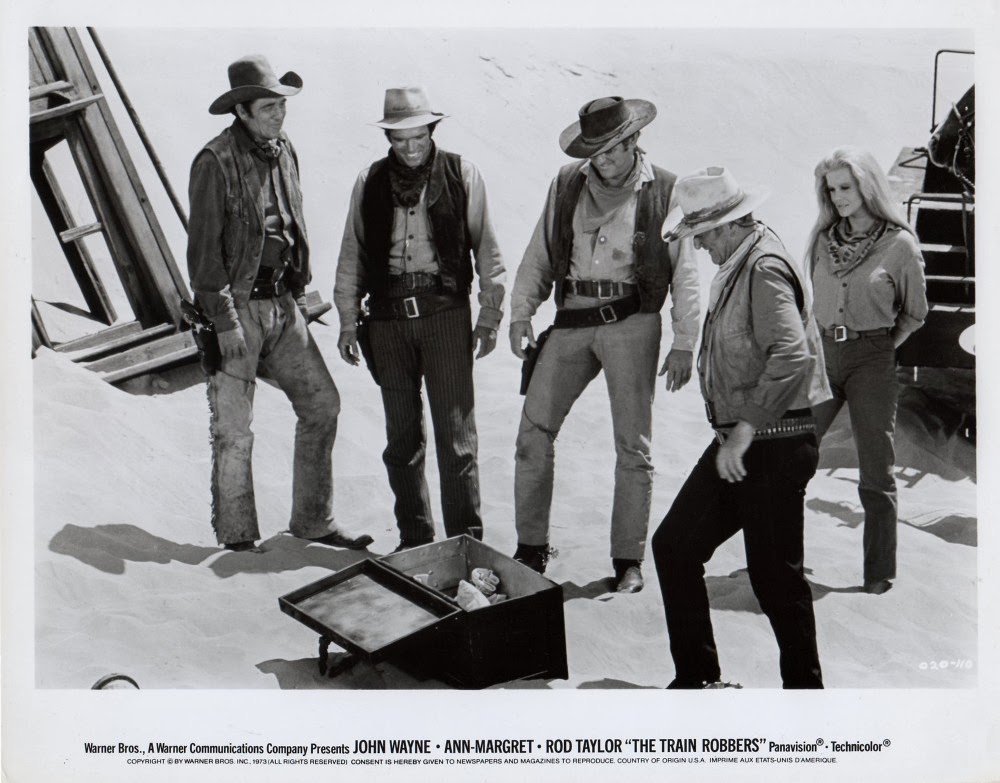
The Train Robbers (1973)


This John Wayne western should be better than it is. Individual parts of it are notable, but put together, it’s a 90-minute lead-up to a surprise ending. Wayne plays himself in the role his fans love—gruff and no-nonsense but with that disarming grin. 

The all-star cast includes Ben Johnson and Rod Taylor, both at their relaxed best. The hyphenated Ann-Margret provides the required female component. Ricardo Montalban, like someone looking for Fantasy Island, watches from afar and puffs on long cigars.

Plot. This is a Burt Kennedy film, directed from his own script. So the elements are familiar—a long trek across hostile terrain with several men and a woman. This time around, it's an assembled gang of former partners in crime accompanying the woman, who enlists them to retrieve a half million in stolen gold. It is stashed in the desert in an abandoned train locomotive.

Johnson, Guest, Taylor, Wayne, Ann-Margret
Wayne and his gang agree to help her find the gold so she can return it and supposedly clear the family name of a deceased husband, while Wayne and his men collect the reward. An immediate problem as they ride off together is that they are being followed by a troop of riders eager to separate them from the gold once it’s found.

Monday, January 13, 2014

Ben Bridges, Draw Down the Lightning


Review and interview

For starters, Ben Bridges is the pen name of writer David Whitehead. This year, 2014, marks his 30th as a published writer of western fiction. His first novel, The Silver Trail, featured a character named Carter O’Brien, and it was the start of a series that reached #14 with this one, Draw Down the Lightning. 

Originally published in 2007 by Robert Hale Ltd., it has now been revived as an ebook and can be read on your kindle. London-born and British enough to have worked for the BBC, Whitehead has an ear and a feel for the genre that are estimable.

Character. His Carter O’Brien is a likable protagonist pushing middle age, his lumpy ears showing signs of having lived a rough and bruising life. He throws a good punch and carries a .38 Colt Lightning, which he uses as needed to discourage villainy on the 1880s frontier.

Given to offering his services to others in trouble, he refers to himself, with amused self-deprecation, as “Old Dependable.” Helping others get out of jams seems to be what he does best. When a sheriff says to him, “A man has to do what he does best and do it as long as he’s able,” O’Brien concurs.

He doesn’t enjoy violence, and after putting a bullet through an assailant, he is likely to feel “quivery” inside. Physical pain doesn’t slow him down—at least not so much that it sidelines him for long. He gets a beating and kicking that leave him unconscious, but in no time he is on a horse and riding off after the villains, broken ribs and all.