Saturday, March 31, 2012

Western writer inspiration, no. 30

Time for another omnibus of the week's #westernwriter inspirations posted each day at twitter, where you can follow me if your attention isn't already overloaded @rdscheer. As usual, click a pic to enlarge it.

San Luis Obispo, California, 1876
Miners of the North Star and Mountaineer lodes, Colorado, 1875
Freight wagon and ox team, Topeka, Kansas, c1870
Black Canyon on the Colorado River, Nevada, 1871
A general view of the Laguna Pueblo, New Mexico, 1879
Hunting party, Indian Territory (Oklahoma), 1870s; photo by William S. Soule
Deadwood, from Frank Leslie's Illustrated Newspaper, September 8, 1877


Photo credits: Wikimedia Commons

Coming up: Jack Palance, The Lonely Man (1957)


Friday, March 30, 2012

Photo-finish Friday: desert sunset


Something for a change of pace from LA. I snapped this photo at sunset recently while returning from a walk in the desert near where I live in the Coachella Valley.

Photo-finish Friday is the bright idea of Leah Utas over at the Goat's Lunchpail.

Coming up: Jack Palance, The Lonely Man (1957)


Thursday, March 29, 2012

Paul Leicester Ford, The Great K&A Train Robbery (1897)

This is a breezy short novel for turn-of-the-century railroad fans. It makes it onto the BITS list of early westerns for taking place in Old Arizona and involving a bunch of lynch-happy cowboys. It also happens to be a romantic comedy.

Plot. Dick Gordon, our young narrator, is a superintendent on the K&A, a railroad line that runs from Kansas to Arizona. It connects two other lines, the Missouri Western and the Great Southern. These are each owned and operated by mighty railroad barons, and each of them has members on the K&A board of directors.

It is 1890. The Great Southern (no doubt a fictionalized version of Leland Stanford’s transportation empire in California) is attempting a coup at the next board meeting. Thus three registered letters en route to that meeting in a K&A mail car become key elements in the plot.

Traveling on the same train is Dick Gordon. He is four years out of a mechanical engineering program with not much to show for his Yale education but a memorable career on the football field. He’s accompanying a party that includes an executive officer of the Missouri Western by the name of Cullen, his Oxford-educated son, and two of his aristocratic school chums.

Dick Gordon roped by cowboys
Along for the ride is the delightful Madge, Cullen’s charming daughter, who instantly steals away the heart of our Dick. She is, alas, out of his league. Besides his lowly position on the company’s organizational flow chart, Dick has a rival in the form of her brother's college friend, Lord Ralles, who has taken a proprietary interest in her.

Briefly, and not to give too much away, the train is stopped and robbed in a remote stretch of Arizona desert, and the three letters in question are taken. More mysteriously, the train robbers have taken nothing else, and they’ve left no sign of their coming or going in the desert sands surrounding the stopped train.

There follows a series of incidents in which the stolen letters get Dick Gordon into a heap of trouble. Pursued at one point by the aforementioned lynch-happy cowboys, he is eventually rescued by the cavalry, who after some delay arrive to save the day.

Romance. It will come as no great surprise that Dick Gordon finally wins the hand of Madge. The social distance between them fails to prevent her from finding him a suitable mate. Grateful for Dick’s efforts to keep the K&A out of the hands of the Great Southern, Cullen even sees to it that the young man does good.

Ford fleshes out an otherwise slim plot with a full-blown account of his young hero’s romantic aspirations and frustrations. We are there for every turn of his often-agonized emotions and each and every detail of his moments either with Madge or thinking about her.

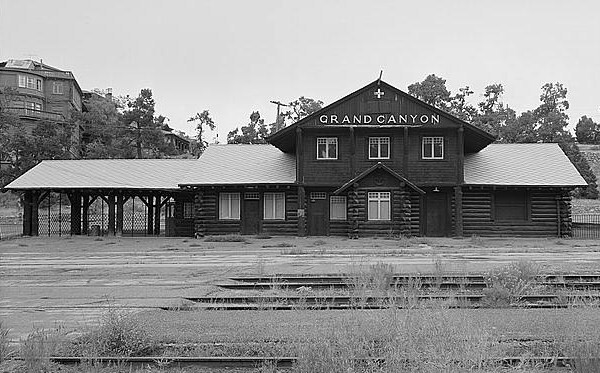
Grand Canyon train station
Cowboys. Ford’s cowboys have their own stereotypical lingo. Asked if he is carrying a weapon, one responds, “Do I chaw terbaccy?” Threatening another man, one calls him a “stinkin’ coyote” and tells him to stay put “or I’ll blow yer so full of lead that yer couldn’t float in Salt Lake.”

In a word, they are ungovernable. They are drinkers, eager to accept a wild rumor as fact, and quick to rush a suspected wrongdoer to justice. While in the saloons, they are entertained by a “medley of cracked pianos or accordions.” Then when they overhear Madge playing a guitar and singing on the platform of the Cullens’ special car, they gather around and, “not being over-careful in the terms with which they expressed their approval, finally by their riotous admiration drove us inside.”

The Sunset Express at Yuma, Arizona
Villainy. The chief villain of the novel is Theodore Camp of the Great Southern, who is fighting for control of the K&A line, using any underhanded means available to him. When Dick Gordon refuses to cooperate, Camp has him thrown in jail on trumped up charges. Then he tries threatening him and, when that doesn’t work, buying him off.

The unseen organization itself would be the true culprit in the story. The company has a reputation for using hard-knuckle, extra legal methods to crush competitors—buying judges and legislators who will make laws that favor its interests. A reader is reminded of Maria Amparo Ruiz de Burton’s The Squatter and the Don (1885), which paints a similar portrait of the western railroads.

The Great Train Robbery, 1903
Wrapping up. Paul Leicester Ford (1865-1902) was born in Brooklyn, New York, the great-grandson of Noah Webster. An invalid, he was prevented from attending school, and he was largely self-educated, having access to his father’s private library of an estimated 100,000 books.

While he was well known in his time for his bibliographical and historical research and publications, he also wrote novels. Only one of them, The Great K&A Train Robbery, takes place in the West. Its familiarity with railroading may originate in his father’s years as president of the New London, Willimantic, and Palmer Railroad. Ford’s life ended abruptly in the library of his four-story home in Manhattan when he was shot dead by a mentally deranged brother.

The Great K&A Train Robbery was made into a movie in 1926 starring Tom Mix and Tony the Horse. The novel is currently available online at google books and Internet Archive and for the nook. Friday’s Forgotten Books is the bright idea of Patti Abbott over at pattinase.

Source: The New York Times

Image credits:
Illustration from the novel
Wikimedia Commons

Coming up: Jack Palance, The Lonely Man (1957)

Wednesday, March 28, 2012

Nik Morton, Bullets for a Ballot

Review and interview
Edward Grainger’s Cash Laramie and Gideon Miles “fiction factory” has produced another hard-hitting western. This one from the fevered imagination of Nik Morton, whose extensive writing credits include several Black Horse westerns, crime fiction, and a veritable truckload of short stories. He’s also an illustrator.

Bullets for a Ballot finds Cash Laramie involved with a fierce mayoral election in a Wyoming town. The incumbent is running a negative campaign—so negative that he's hired killers to eliminate his opponent. The man's widow has then taken up her husband’s cause and against all odds is running for office herself.

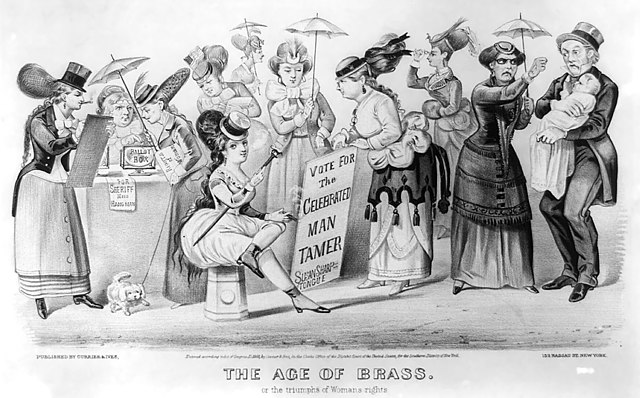
It’s 1885 in Wyoming Territory, where women have had the vote since 1869 and women’s suffrage is still decades away in the 38 states of the Union. Reasons vary for the early adoption of women’s suffrage in Wyoming. You can bet money that it served both political and business interests. Some no doubt saw it as a way to counter the votes of recently emancipated male African Americans. It may also have been a publicity stunt.

History, however, doesn’t factor into the brutal electoral contest in the backwater town of Bear Pines, a place so out of the way that Cash Laramie has never heard of it. It’s just one wealthy, powerful bad guy with a town in his pocket and wanting to keep it that way. He owns the sheriff, and anybody he doesn’t own he intimidates.

The Triumph of Women's Rights, Currier & Ives, 1869
As the novel’s chief villain, he has to share honors with his wife, a real nasty piece of work. She cheats on her husband, berates him to his face, and amuses herself with kidnapping and molesting minors. We gather that it’s her décolletage being featured on the book’s steamy cover.

As the violence escalates and the body count quickly goes into double digits, Gideon Miles joins Cash to help restore order. Not to be trifled with by two U.S. Marshals, she even lures them into an ambush. The woman is a walking argument for not only rescinding women’s suffrage but putting all of her gender under lock and key.

Nik Morton does a heck of a job weaving a high-stakes story around our favorite federal frontier law enforcers, Cash and Miles. While plenty of lead flies, both bad guys and good guys meet untimely ends. An invalid woman perishes when arsons put the torch to her house. A man suffocates in fresh cement while resisting arrest. I’ll leave it to thick-skinned readers to learn about the torture and unfortunate demise of another character, held captive in a root cellar.

Two bits for Wyoming
One unlucky survivor is tied down with a fire lighted between his legs to encourage a confession. He cooperates but doesn’t last long either, unceremoniously shot from his horse while riding off without benefit of trousers.

Which leaves only the topic of sex undiscussed in this review. On the frontier, we learn, there was time enough between deaths for sexual congress—some consensual, some not. A woman had best be armed in the event of liquored-up and otherwise unwelcome male visitors. If it’s a Cash Laramie novel, she might also find herself in the company of a male who’s downright irresistible. All of which transpires in the book’s opening pages.

Enough said about that. I’ll just add that for readers who like nonstop action of all kinds, Bullets for a Ballot does not disappoint. Nik Morton is a literary pit bull. He knows how to take a reader by the nape of the neck on page one and simply not let go.

Bullets for a Ballot is currently available at amazon for the kindle.

Nik Morton
Interview
Nik Morton has generously consented to an interview for BITS about the book and himself as a writer of westerns. So I’m turning the rest of this page over to him.

How was writing Bullets for a Ballot different from other westerns you’ve written?

It was deliberately darker. My last book Blind Justice at Wedlock has dark undertones as the plot is revealed, but Bullets went that extra distance in several respects.

What makes this novel “western” for you besides the fact that it is set in the West?

The characters of Cash and Miles David created are very much from the western myth, even if revisionist. I just had to step into Cash’s boots. The freedom to fight for a decent township against insuperable odds – that’s a classic western theme, I think. 

Would the story be much the same or very different if set in the modern-day West?

People and emotions are the same throughout history. The situations and interactions are often similar, too. Naturally, the environment they find themselves in, the opportunities or lack of same, affect their emotional responses.

I feel that a western gives me the opportunity to write a moral tale – more acceptable to readers of that genre. Modern times tend to be more amoral, as do the fictional characters. Cash wouldn’t have such freedom to mete out rough justice in the modern-day West; that’s some of the character’s appeal.

What was it like working with David Cranmer, the originator and editor of the Cash Laramie series?

I first encountered David’s Cash character when he sent me “Cash Laramie and the Masked Devil” for the anthology A Fistful of Legends. He’d also accepted a couple of my stories for his BTAP webzine. So I was familiar with his style. David’s a generous man, allowing other scribes to write about his own characters. When he asked me to write a Cash novel, I was both pleased and honoured.

He provided a Bible for Cash and Miles – which incidentally must be growing considerably. I did a quick study of Wyoming, Cash’s home ground and once I checked on the dates in the Bible, and assured myself they’d (just) fit to include the women’s vote, I had my theme. Then I wrote a rough story outline, which he okayed. David’s main emphasis was on making the story dark.

How did you settle on the title of the novel?

The subconscious kicked in, I guess. I like playing with words – many of my books’ chapter headings will attest to that, as will several short story titles. Maybe we take for granted the freedom to vote – when in the past it had to be fought for, against prejudice and vested interests. And of course there are plenty of countries even today where a free and relatively fair vote is non-existent.

How has your writing about the American West evolved over the years?

I’ve only been writing westerns for 5 years. From the outset, I relied on research, and that hasn’t changed, though perhaps I now tend to bring in historical events, where before I didn’t.

How much is the actual history of the American West part of your interest in the genre?

Reading non-fiction for research and just for interest inspires any number of stories. My research library will provide me with plenty of material for years to come. I certainly admire the remarkable characters who lived through that period.

Is your writing inspired at all by western movies?

I grew up on a diet of TV western series – favourites being Cheyenne, Have Gun Will Travel, Range Rider, Maverick and Wagon Train. I’m sure they influence my subconscious.

If Bullets for a Ballot were made into a movie, whom would you like to see in the lead roles?

Difficult. Maybe Will Smith as Miles. Cash - maybe Russell Crowe, as he did well in the 3:10 to Yuma remake, as did Christian Bale.

What do you learn from your readers?

Quite a few of my readers have previously never read a western before and I hope that, since they’ve enjoyed my books, I may have converted them to the genre. All feedback is welcome. It’s gratifying when several readers want to be reacquainted with some of my main characters; all those people, still in my head, in stasis, so to speak; maybe a sequel or two will get written one day.

How would you hope to be an influence for other western writers?

By constantly challenging myself and always improving. For example, in Blind Justice at Wedlock, I decided on the hero being blinded at the outset, so he has to experience his world through other senses. I’m also in the throes of writing a book entitled Write a western novel in 30 Days. The subtitle – with plenty of bullet points!

What can readers look for from you next?

Hale publishes Old Guns on 30 April. The tentative title for my next possible Black Horse Western is The Magnificent Mendozas. It’s about a Mexican circus visiting southern Colorado. I have two other westerns in the hazy planning stages. I’ve also started a Private Eye novel, a Victorian detective novel, a pirate novel and the third Tana Standish psychic thriller, though I haven’t decided which one to concentrate on yet.

Anything you would like to add that we didn't cover?

No matter how dramatic the storyline, I try to leave room for some humour. Life’s like that – even if noir, there’s humour in there. Like many an author, I’m drawn to writing about the Old West because it’s a place and time where a man or woman can make a difference. Where justice might not be right, where right might only come from making a moral stand.

Thank you for inviting me, Ron.

Thanks to you, Nik, and every success.

Image credits: Wikimedia Commons

Coming up: Paul Leicester Ford, The Great K&A Train Robbery (1897)

Tuesday, March 27, 2012

Tracker (2010)

I’m calling this a western even though it was shot and takes place in New Zealand. It has most of the elements of a good western—sweeping unpopulated landscapes, guns, horses, immigrants, soldiers, and natives. It’s 1903; the story is of searchers on the trail of a man wanted for murder; there’s plenty of action, and most of it happens outdoors.

Plot. British actor Ray Winstone plays a South African veteran of the Boer War, fetching up in New Zealand and looking to start a new life. An Afrikaner fighting the Brits, he’s lost everything, including wife and daughters.

After an incident involving the accidental death of a British soldier, he volunteers to track down a Maori (Temuera Morrison) believed to have done the killing. He accompanies a small contingent of mounted soldiers until parting company with them and striking off on his own into the heavily forested, rugged terrain.

Eventually, he catches up with the man, only to lose control of him, regain the upper hand, and lose him again. Captured once more, the Maori tells of witnessing the humiliating death by hanging of both his father and grandfather. He is intent on escaping that final indignity for himself.

Glenorchy, New Zealand (CC) Joe Taylor
The search party, with another tracker, catches up with them, and Winstone has begun to feel a bond with this man whose people have also been subdued by the British. In the final scenes he makes a desperate attempt to save him from the gallows.

The film joins a long series of movies about fugitives and pursuers. The Searchers is another that comes to mind, and director Ian Sharp comments in an interview that he had John Ford in mind as he shot this one. 

Wrapping up. Ray Winstone and Temuera Morrison are an excellent pairing. Known in this country for his roles in Once Were Warriors (1994) and Broken English (1996), Morrison is a strong, animated presence on the screen. Which is saying something given Ray Winstone’s thuggish bulk and dark silences.

Viewers craving constant action may find this film a little slow-going, but there is excitement to be had in both the concentrated matching of wits and the sudden surprises. A stunt involving an unexpected plunge from a cliff edge into a swollen river is heart-stopping.

Tracker is currently available at netflix and amazon. Tuesday’s Overlooked Movies is the ongoing and much-appreciated enterprise of Todd Mason over at Sweet Freedom.

Photo credit: Wikimedia Commons

Coming up: Nik Morton, Bullets for a Ballot

Monday, March 26, 2012

Jory Sherman, Shadows of Yesteryear

Review and interview

It was Troy Smith, I think, who recommended this recent collection of short stories by western writer Jory Sherman. Getting my hands on a copy, I found that its enthusiastic introduction was written by another favorite writer, Loren D. Estleman. I did not require a third opinion.

Jory Sherman has his own special touch with short fiction, as is evident in these eleven stories. The first thing you notice is the intensity of the storytelling voice. The situation in each of them is strongly felt, and it comes through in the language.

It was no surprise to learn on his website that he has also published poetry, for he typically uses poetic language to set a scene. By that I don’t just mean that the description is vividly detailed. The flow of his words captures and heightens the drama. You both see and feel.

Here’s a sentence from the first story, with line breaks as if it were a poem:

The stately stalks of yucca,
their blooms arranged
like yellow concho belts
hanging on store pegs,
stood like sentinels
and all about him,
off the road,
the cholla bristled
like exploded muffs of delicate lace,
so beautiful,
yet as lethal to the touch
as surgeons’ scalpels,
so sharp they’d slice through a child’s hand
if any dared to touch.

I could be wrong, but I don’t think you’ll find a sentence quite like that in Louis L’Amour. This one invites the reader to indulge the senses and then to feel a little chill as the “beautiful” and the “lethal” meet side by side.

Jory Sherman
That meeting between the beautiful and the deadly is a theme that runs through all of the stories in the book. Death haunts each of them. Somebody or something dies. And the action in all of them involves the gun as an instrument of death.

Another theme has to do with ideas about fate and destiny. A desperate man is saved from drowning in “Destiny’s Gun” but proves to be such a wife-beating scoundrel that he ends up being shot by the man who saved him. Did saving his life merely postpone an inevitable death?

Finally, another thread that runs through the book is the special regard in which its women characters are held. The men in the stories who have women to love really love them. The women are both strong and vulnerable, and their presence in a man’s life evokes powerful feelings.

A good example is Sherman’s “The Return of Talking Boy,” where Tom Horn tells of his growing affection for Hollie MacGuire. This is how he remembers her:

She smelled of the fragrance of earth and growing things. There were scratches on her arms from the brambles, white streaks on the suntanned skin. Her hair was tied back with a faded ribbon, but the loose strands kept moving over her face, as if caressing her.

When she smiles at him, something inside him melts. But Hollie is married to another man, and Tom’s days are numbered, so what might have been would never be. The emotions in the story ring bittersweet and true, and Sherman allows us to see that his male characters are both strong and vulnerable, too.

Interview

Jory Sherman has generously agreed to a short interview to accompany this review, and so I’m turning the rest of this blog page over to him.

The full title of your book is Shadows of Yesteryear: Western Short Stories. What makes these stories “western” for you besides the fact that they are set in the West?
They are set in times and places when the West was sparsely populated and there was all that grandness of mountains and prairie along with towns and settlements which were still struggling to become “civilized.”

The Alamo, Gleason's Pictorial Drawing Room Companion, 1854
Which, if any, of your stories in this collection could have been set in the modern-day West?
Most of them I suppose. The stories are about people and people adapt to their environment. There are still places in the West where life has not changed much despite the encroachment of civilization. And, in many cities today, there are still bank robbers and criminals of every sort, and there are places where men and women must stand their ground against government or corporate tyranny.

How did you settle on the title for the book?
I thought about the long shadows of afternoon and the evening of the West after its shining day was fading in memory.

Looks like your name at the bottom of the cover art. What were some of the choices that went into the cover design for the book?
I did paint the cover of Shadows of Yesteryear with the title of the book in mind. I chose the Alamo as a symbol of death and heroism and painted it with shadows to reflect both the title, and the story that is in the book. So, the cover and the title held a lot of meaning for me.

Using your own well-designed author’s website as an example, what advice do you have for writers wanting to make the most of their own site?
I have had a lot of problems with web designers and webmasters and my website is slowly undergoing changes under an experienced hand who is in the publishing business.

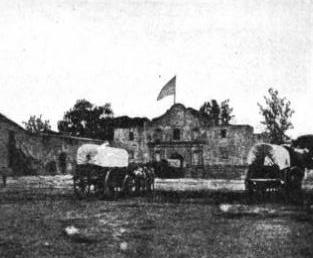
The Alamo, 1860s
I think there is a lot of trust involved in choosing both a web designer and a webmaster, so the beginning writer should either learn to design a website or hire someone who knows books and how to promote them online. I don’t have time to do any of these things, so must rely on others to set up and maintain my website. 

Can you say how this book came to be published by AWOC?
I met Dan Case, the publisher of AWOC at a writer’s conference and liked him. I was just venturing into the ebook market and thought he would be a fine publisher. He’s honest and marketing savvy and so far he has outstripped all my ebook publishers in sales and promotions.

What do you learn from your readers?
Not much. Some readers do not like my style of writing. Others do, but they do not know much about writing. Some readers write letters that praise a book, but just skate over the deeper meanings. Most readers comment on my imagery and tell me they feel as if they are in the scenes. They say they can smell the coffee and taste the blowing dust of the trail.

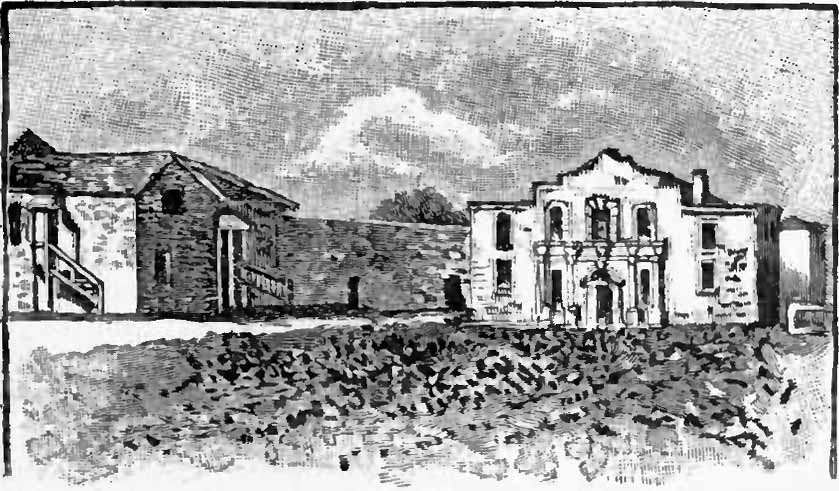
The Alamo, 1886
How would you hope to be an influence for other western writers?
I do not hope or wish to influence other western writers. Each is an individual with his or her own voice. I do hope to influence beginning writers, though, who are just dipping a tentative toe into the murky waters of writing and publishing.

Let me add that I am influenced by other writers, living and dead, which include A.B. Guthrie, Jr., Jack Schaefer, my great aunt, B.M. Bower, James Joyce, Vladimir Nabokov, Loren D. Estelman, Richard S. Wheeler, James Lee Burke, and many others. I could go on...

What can readers look for from you next?
I think my time as a western writer has passed. I have one more Sidewinder book coming out from Berkley, but the series is not being renewed because of poor sales. That book is Nest of Vipers. And, I have another Ralph Compton book in production at Signet, The Omaha Trail

Next month, The Baron Decision will be published by High Hill Press as both an ebook, a trade paperback and in hardcover. Some of my backlist books will be reborn as ebooks, including those titles I wrote for my Rivers West series at Bantam. I created the series and obtained the rights. I reverted those rights to those writers I hired for the series at Bantam. 

Anything you would like to add that we didn't cover?
No, I think you covered quite a bit of ground and asked good questions. I thank you for your fine and complimentary review of Shadows. I love the short story and am still learning how to write a good one.

Thanks, Jory. It’s been a privilege having you as a guest today at Buddies in the Saddle. Shadows of Yesteryear is currently available in paperback at amazon and Barnes&Noble, and for the kindle.

Image credits: Wikimedia Commons

Coming up: Paul Leicester Ford, The Great K & A Train Robbery (1897)

Saturday, March 24, 2012

Saturday music: Collin Raye


This country song has been around for a dozen years and I never tire of it.