Sunday, March 2, 2014

Dodging bullets


Room with a view, and flowers from a friend
Here are some more excerpts from the journal I have been keeping since returning from the hospital after brain surgery.  Last week, I was calling my journal "Big Baby," and for good reason. This week it changed to "Dodging Bullets," which describes more of what this all feels like some days. Next week will no doubt be different again.

2/18/14. Sleep comes in longer swaths, 3-hour stretches of it last night. The in-between times of almost maddening restlessness are shorter. Dreams are spin-offs from whatever we last watched from Netflix. I still wake at dawn, ready to start the day, eager to write and read more. Part of me watches amazed as words and sentences tumble together triggered by thought and feeling. I enjoyed writing before, but never with this intensity. 

There is maybe some trauma-induced illusion at work here, but the flow of words seems to come from some bedrock deeper within. I cling to that urge and marvel at the continuing ability to make and find meaning in language. So I am up this morning when I see it’s after 5 a.m., make coffee and toast, dress in sweats, and pull out this journal to write for a while as morning sun begins to show on clouds in the eastern sky outside my window.

Saturday, March 1, 2014

Glossary of frontier fiction: L
(La France rose – light a shuck )


Below is a list of mostly forgotten terms, people, and the occasional song, drawn from a reading of frontier fiction, 1880–1915. Each week a new list, progressing through the alphabet, “from A to Izzard.”

La France rose = a rose developed in 1867 by Jean-Baptiste Guillot (1803–1882); generally accepted to be the first hybrid tea rose. “Marie Hampton was attired in a beautiful evening gown of white silk, with a knot of La France roses at her corsage.” Willis George Emerson, Buell Hampton.

laboring oar = a position of hard work and chief responsibility. “I’ll bet they have to pull the laboring oar to get it.” S. Carleton Jones, Out of Drowning Valley.

lacking = a fool, a dunce. “It be a hard blow to me to know that my sons are lackings.” Marie Manning, Judith of the Plains.

ladino = said of a horse or cow in possession of crafty intelligence (from Spanish). “Pasquale had watched the band for an hour, and described the ladino stallion as a cinnamon-colored coyote, splendidly proportioned and unusually large for a mustang.” Andy Adams, A Texas Matchmaker.

ladrón = robber, thief (from Spanish, pl. ladrones). “All they could tell us was that there was plenty of ladrones and lots of horses.” Andy Adams, Cattle Brands.

Lady Baltimore cake = a white cake described in Owen Wister’s novel Lady Baltimore (1909) as “all soft and it’s in layers and it has nuts.” “The whites of sixteen aigs I put in this Lady Baltimore cake, and it’s light as a feather.” Caroline Lockhart, The Lady Doc.

Lady of Lyons, The = a popular romantic melodrama by English dramatist Edward Bulwer-Lytton (1903-1873); first performed in 1838. “Mrs. Tutts showed her public spirit by rehearsing Crowheart’s talented amateurs in an emergency performance of the ‘Lady of Lyons’ for the strangers’ evening entertainment.” Caroline Lockhart, The Lady Doc.

lag = to arrest. “I’ve kind of seen to the end of this racket. Maybe there’s trouble coming. Who’s to be lagged I can’t say.” Ridgwell Cullum, The Story of the Foss River Ranch.

lagging = a covering for something either as insulation or protection. “The shaft was inclined, four by eight, and timbered with lagging.” Gertrude Atherton, Perch of the Devil.

lala-kadinks = the high and mighty, style setters, culture vultures. “I ain’t a-layin’ no plans to have the lala-kadinks from the civilized parts o’ this country come out an’ round up my langwidge, same as they gather Injun specimens.” Robert Alexander Wason, Happy Hawkins.

Lalla = Persian princess, in a poetic romance, Lalla Rookh (1817), by Irish poet Thomas Moore. “He would do all right for the poet-prince—or was it a king? But  you—well, Rachel, you are not just one’s idea of a Lalla.” Marah Ellis Ryan, Told in the Hills.

lally/lolly cooler = someone or something successful or admirable. “An’ she was a shore lally-cooler all right! More prittys about th’ fixin’ up o’ that house than I’d allowed anything but a woman could pack.” Edgar Beecher Bronson, Reminiscences of a Ranchman.

Thursday, February 27, 2014

Dane Coolidge, The Texican (1911)


This early cowboy western is a rollicking political satire, the likes of which a reader would find difficult to duplicate in a western novel today. The Texican of the title is a freelance cattle rustler, Pecos Dalhart, who fetches up in Arizona, where he gets involved in a feud between two rival cattlemen, Ike Crittendon and John Upton.

Plot and character. Crittendon hires Pecos to alter the brands on any of Upton’s cattle he finds on the range. Meanwhile, the local sheriff, Boone Morgan, is alert to any signs of cattle theft, and when Crittendon falsely accuses Pecos of stealing a cow, he gets hauled in to the county jail, to await trial.

Pecos draws his pistol
Pecos, as Dane Coolidge describes him, was “born a Democrat and taught to love whiskey and hate Mexicans.” However, he has begun reading an anti-capitalist newspaper, The Voice of Reason, which has opened his eyes to the corrupt law enforcement system used by the rich to oppress the poor. Sheriff Morgan soon learns he has incarcerated an outspoken advocate of revolution.

Cracking heads, Pecos immediately overturns Morgan’s use of a prisoner-run kangaroo court for maintaining order in the jail. Joined by a friend and fellow revolutionary, Angevine “Babe” Thorne (jailed for drunk and disorderly), and winning the respect and protection of the Mexican prisoners, Pecos takes charge behind bars. He is soon getting preferred treatment from Hung Wo, provider of the jail’s meal service. 

Tuesday, February 25, 2014

The Hanging Tree (1959)


Based on a novel by Montana writer Dorothy M. Johnson, this western film is a dark study of mob violence. By unfolding the backstory preceding the attempt to lynch a man (Gary Cooper) in a Montana mining camp, it traces a tangled web of deceit, lust, self-righteousness, and avarice.

Plot and characters. At the center of it is Cooper, whose character is a mix of good will and a shadowy past. Though physically strong and a skilled doctor, he lives under an assumed name, Frail, as a reminder to himself that he is weak and vulnerable in ways that are otherwise hidden.

A loner, arriving with a packhorse in the Montana gold fields in 1873, he allows two people into his life, while keeping each of them at a safe emotional distance. One is a young thief (Ben Piazza), shot by pursuers and rescued by Cooper, who removes a bullet from his chest, then retains him as an unpaid bond servant.

Maria Schell, Gary Cooper
The other is the lovely Maria Schell, a Swiss emigrant to the West, whose father is killed in a stage holdup. She nearly dies of exposure in the mountain wilderness before being found, blinded and burned by the sun. Nursed back to health by Cooper and recovering her vision, she falls in love with him. He eventually sets Piazza free, and unknown to Schell, he grubstakes a mine she and Piazza invest in.

Sunday, February 23, 2014

My left hand


My new wheels

I have been keeping a journal since coming home from the hospital after brain surgery. I’m posting some of it today for any BITS readers curious about how I’m getting along.

Monday, 2/17/14. I’ve been wanting to write about my left hand and arm, which have been affected by this tumor. The numbness in them was the sign to me that I was developing some kind of neuro-problem. The neurosurgeons seemed disappointed when I told them afterward that I had not regained full use of them. Apparently, that had been on their wish list. Maybe mine, too, but I have been careful not to seem ungrateful that my left side has not deserted me completely. I still have use of my left leg and the ability to walk short distances without a roller-walker.

Bedside basics
But the numbness of my arm and hand are a mostly constant reminder that for a time, that part of my physical being is experiencing a kind of “brown out.” I wake in the morning with a heaviness that extends from my shoulder to my fingertips, and only thumb and index finger seem functional, though not with great reliability. I massage my left hand and wrist with my right, and something like feeling returns for a while.

Throughout the day, however, simple movements produce a frustrating comedy of unrealized expectations. Pulling on a tee shirt or sweatshirt is usually a challenge, the memory of how to do it colliding with the impediments. What was once an automatic function now requires my full attention, as I relearn the process, breaking it down into steps.

Saturday, February 22, 2014

Glossary of frontier fiction: K
(Kafir corn – kumtuks)


Below is a list of mostly forgotten terms, people, and the occasional song, drawn from a reading of frontier fiction, 1880–1915. Each week a new list, progressing through the alphabet, “from A to Izzard.”

Kafir corn = a Southern African variety of sorghum, cultivated in dry regions for its grain and as fodder, “Was it you, Doc, you benighted stray from the short-grass Kansas plains, where they can't raise Kafir corn?” Emerson Hough, Heart’s Desire.

kale = money. “Pass over the kale. Just slip out a five for your trouble.” James Hendryx, The Promise.

kalsomine = whitewash, applied to ceiling or walls. “It had five rooms, and all they needed was a coat of paint and kalsomine.” Emma Ghent Curtis, The Fate of a Fool.

katy = hat (also “kady,” “kadi”). “I take off my katy, and I apologise to you.” George W. Ogden, The Long Fight.

Katy bar the door = a warning to take precautions. “Ef yu crowds her too hard ’n’ gits her on th’ fight, it’s ‘Katy bar th’ door’ wi’ yu, ’n’ adios t’ her ’n’ her calf.” Edgar Beecher Bronson, Reminiscences of a Ranchman

katzenjammer = a hangover. “Woke up next day with a katzenjammer.” William De Vere, Jim Marshall’s New Pianner.

keeno = excellent, wonderful, first-rate. “‘Keeno!’ shouts back Ches, some exasperated.” Robert Alexander Wason, Happy Hawkins.

keep a weather eye open = to stay alert. “Surrounded as he was by other horses, he kept his weather eye open for a race.” Andy Adams, The Log of a Cowboy.

keep case/cases = to watch closely. “The rest of the guests got to noticin’ too, an’ when they’d finish they’d just stick around an’ keep cases.” Robert Alexander Wason, Happy Hawkins.

keep up the stroke = to labor without resting. “‘How do you manage to keep up the stroke?’ ‘Law bless you!’ she laughed easily, “I ben trained into it.’” Vingie Roe, The Heart of Night Wind.

Kelpie, T. Dow, 1895
kelpie = a supernatural creature of Scottish and Irish folklore, appearing as a horse luring riders into the water where they are drowned and eaten. “O’ course a man likes to try his chance on the chips once in a way, and to the kelpies o’ the drinkin’ places one must leave a few dollars.” Marah Ellis Ryan, Told in the Hills.

Kentucky breakfast = a three-pound steak, a bottle of whisky, and a setter dog. “What’s the dog for? Why, to eat the steak, of course.” Stewart Edward White, Arizona Nights.

Thursday, February 20, 2014

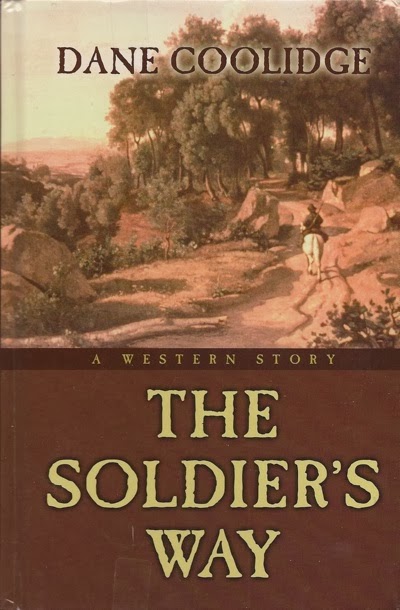
Dane Coolidge, The Soldier’s Way (1917)


This is a ripping yarn set among a band of American mercenaries and soldiers of fortune during the last years of the Mexican Revolution. It appeared first in 1917 as a four-part serial in The Popular Magazine. While prepared in a book-length version by Coolidge, it was not published as such until 2006 by Five Star.

Plot and character. The story is based on that of the so-called Gringo Battalion that fought in the army of revolutionary general Pancho Villa. Coolidge singles out two Americans from among them to illustrate the daring, the egoism, and adrenalin-fueled risk taking that drive the actions of such men.

One is the Irish-American Beanie Bogan, who with the rank of sergeant commands the respect of a small “legion” of American fighters, most of them deserters from the U.S. Army. The other is Bruce Whittle, a descendant of the Scots warrior hero, Robert the Bruce. While Bogan is all business, a skilled leader of fighting men and a veteran of combat, Whittle is a man seeking oblivion in death on the battlefield. The girl he passionately loves has married another man.

In spite of himself, Whittle has an instinct for survival that not only keeps him alive. His high-risk exploits earn him popular acclaim, while making him an outlaw at home. As a U.S. citizen he is deemed guilty of violating his homeland’s official policy of neutrality in the conflict.

Mexican rebel camp, c1911
Set on the international border along the Rio Grande, the story starts on the U.S. side in Del Norte, where Bogan recruits Whittle into the “foreign legion” fighting under Col. Gambolier, a French military consultant to revolutionary general Pepe Montaña. The underfed, poorly armed, and undisciplined army of revolutionaries is camped in the mountains above the garrison town of Fronteras, well defended by government troops. Military progress is at a stalemate.

In a strategy to isolate the town in advance of an attack, Bogan and Whittle accept a mission to dynamite a key bridge on the railway from the interior. Their job done, they find themselves betrayed by Montaña and Gambolier. This sets in motion a series of plot turns that has the Americans assembling their own assault on the town. The remaining chapters are an account of fierce street fighting, as they make their way by night and house by house to the central plaza to lay siege to the government strongholds.