Showing posts with label commentary. Show all posts

Saturday, September 13, 2014

James Wood, How Fiction Works

Some readers here will know James Wood as a book reviewer (he would say critic, I suppose), at The New Yorker. Published in 2008, this book suggests by its title that it’s a how-to manual for writers, but it’s better described as a what-to-notice for readers.

Wood covers a half dozen or so topics: narration, point of view, detail, character, and realism. In his preface, he states that his argument is that fiction is both “artifice and verisimilitude.” In other words, it draws on a store of conventions and fakery to create an illusion of reality.

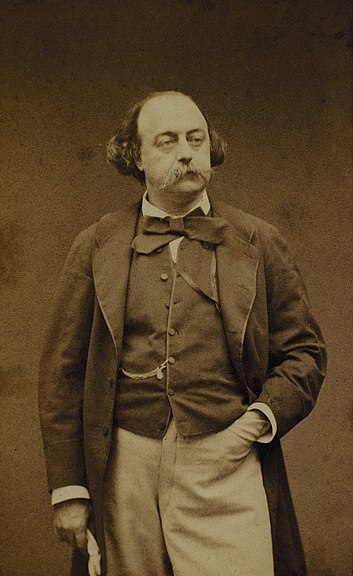
Detail. This assertion won’t come as a surprise to many readers or writers. What’s interesting about Wood’s argument are the examples he uses, starting with Flaubert, whom he credits with virtually inventing the modern novel, with its eye for concrete detail. Whether in literary or genre fiction, the prominence given to visual, audio, and other sensory images becomes suddenly obvious after Wood points it out. You see that it is part of the artifice.

Gustav Flaubert
Narration. More complex is the matter of narration. Wood argues that all narration is unreliable, and third-person more so than first-person. To demonstrate this last assertion, he takes apart a paragraph from Henry James’ What Maisie Knew. There he finds a supposedly unbiased and neutral narrator using a word betraying an attitude that Maisie would not herself possess.

It’s a surprising revelation when you realize how writers do this all the time, blurring the line between the storyteller and the character—sometimes for a clever sleight-of-hand effect, sometimes from lack of narrative precision.

Monday, June 16, 2014

Family musicale, c1870

Illustration from A Son of the Middle Border
I just read Hamlin Garland’s moving and wonderfully detailed memoir, A Son of the Middle Border (1917). It describes better than any book I’ve read the impact of western expansion on the lives of men and women who cast their fate to the wind on the frontier in the decades following the Civil War.

An acute observer of rural life, Garland lost faith in the lure of westward immigration, especially as he saw how it tore apart his family, scattering them across isolated distances, from Dakota to California. In the early chapters of the book, he recalls their gatherings in a small town in Wisconsin, before the promise of the West uprooted them.

Without TV, radio, and digital media, they bonded around music, passing the time singing songs and listening to a favorite uncle play his violin. Garland describes this world of his youth with affecting nostalgia, already long passed into mists of history by the time he was writing about it.

I’ll be reviewing this book here shortly, but until then, I’ve put together a sample musicale from those family gatherings to evoke the period and the sensibilities that enlivened the spirit of ordinary people and hard but simpler lives. Following quotes from the book, you’ll find song clips from youtube. Take a few moments to listen to even just parts of them and let yourself be transported to another time.

The only humorous songs which my uncles knew were negro ditties, like “Camp Town Racetrack” and “Jordan am a Hard Road to Trabbel” but in addition to the sad ballads I have quoted, they joined my mother in “The Pirate’s Serenade,” “Erin’s Green Shore,” Bird of the Wilderness,” and the memory of their mellow voices creates a golden dusk between me and that far-off cottage.

Camptown Races

Jordan Am a Hard Road to Travel

Sunday, June 8, 2014

BITS is four years old

Buddies in the Saddle began on May 26, 2010, with a birthday observance for John Wayne. It has grown since then to 1,051 posts with a total of 475,000 page views. As for content, not a lot has changed since my update a year ago. I’ve been reviewing western and frontier fiction and movies, usually 2 – 3 per week, with a weekend edition of glossaries of words and idioms drawn from early novels set in the West.

A year ago, I was also in the latter stages of writing a book on early frontier fiction published during 1880 – 1915. Since then, the first volume of that project, How the West Was Written, has been published by Beat to a Pulp Press, and volume 2 is now in the finishing stages. Together they cover the first novels and short story collections of over 100 writers (see side panel for more details).

Highlights of the past year at BITS also include interviews with the following writers (click through for any you missed or would like to read again):


Changes. My health, as most reading this know by now, has undergone a big change in the last few months, and I’m currently dealing with cancer. It has meant a necessary slowing down for me as a blogger. I’m having to admit that being a cancer patient is a full-time job, and I can’t keep up the pace of book and movie reviews without unwanted side effects.

Thursday, April 3, 2014

Video: Read the book

While waiting to get up to speed with Dragon Dictate, it came to me I might try converting this to a video blog for a while. So today is kind of a trial run.

When I was teaching Advanced Writing to university students, I had a Call to Action unit, in which they had to take what they'd learned from their research all term, find an issue in need of attention, and make a short call-to-action video. As I did all my assignments along with them, I did this one, too.

I'm reviving it here for followers at BITS, who might crack a smile at my amateur movie-making efforts. And while you may not agree completely with my argument, remember that we are not just lovers of westerns. We love books, too.


Image credits: Wikimedia Commons

Coming up: Glossary of frontier fiction

Thursday, October 31, 2013

Canada in early frontier fiction


There’s surely as much western frontier north of the 49th parallel as there is south, and Canada has had numerous writers setting their stories there. During the years 1880-1915, a dozen or more of them appeared to write from the mountains and timberland of BC, to the prairie, the border country straddling the international boundary with Montana, all the way to the frozen Yukon.

Ralph Connor
Ralph Connor was the pen name of Charles William Gordon (1860–1937), a Presbyterian minister of some prominence in Canada. The Sky Pilot (1899) was the novel that made him famous, selling over a million copies. It is set in a frontier community, Swan Creek, in the foothills of the Rockies, west of Calgary.

Its characters are early settlers, ranchers, and cowboys, and at the center of them is a church missionary, Arthur Wellington Moore, who has been dubbed “the sky pilot.” Connor served 40 years as a minister at a single parish in Winnipeg, Manitoba. In 1972 his Works, containing 43 titles, were published by the National Library of Canada.

Bertrand Sinclair (1881-1972) was born in Scotland and came to North America in 1889. He was a young cowpuncher living in Montana when he wrote Raw Gold (1908) set north of the border in the southern corners of what is now Alberta and Saskatchewan. 

The time is shortly after the arrival of the North-West Mounted Police, and the entire story takes place within one or two days’ riding of Fort Walsh in the Cypress Hills. We get the wide-open frontier of the 1870s with outlaws and lawmen, stolen money, and an innocent fugitive wrongly accused of a crime. After a brief marriage to western writer B. M. Bower, Sinclair settled in British Columbia, where he continued to write.

Tuesday, October 1, 2013

Revise, revise, revise: nitpicking


Working with my own personal copyeditor, I’ve just finished the third draft of the book I’m putting together on early frontier fiction. I would have said “the book I’m writing,” but it’s at the stage now where “putting together” is more like the task that revising feels like. Some assembly required.

I’m now looking at a list of terms I need to make sure are used consistently:

couple of – My copyeditor points out that it’s not just couple, as in a couple people.

barb wire – Other forms of this term are OK (barbed wire, barbwire); I just need to stick with one.

Cavalry / cavalry – Use one when I mean the U.S. Cavalry and the other when I’m just referring to a company of mounted soldiers.

nonwhite – It’s not non-white.

backstory – It’s not back story or back-story.

kind of – Delete when it’s a hedge phrase (e.g., kind of angry).

Populist / populist – Capitalize when it refers to the actual political party.

en dashes – Use these instead of hyphens in date ranges (e.g.,  1910 – 1915)

s’ / s’s – Either is right for possessive case of plurals; I prefer s’ and just need to check for consistency. What I’m still not sure about is whether the same rule applies to a singular word ending in s (e.g. the name Adams).

dance hall – Always two words, not dancehall.

half-dozen – Takes a hyphen.

East / West. A big headache so far has been deciding when to capitalize these two words. The manuals say to use capitals when you are referring to a region with its specific culture and customs. So the East and the West are easy, and a little less so is back East and back West. But things get murky when combined with other words. Is it came West or came west? And when is it Western or western? Westerner or westerner? I still don’t have a rule for these nailed down.

Wednesday, September 25, 2013

Political correctness


Recently I picked up a historical novel that came with a warning from the author. I was told that if I held to any form of political correctness I would be offended. And it made me wish again that the term “political correctness” were abolished. It has become so over-used it doesn’t mean anything anymore. It’s not even a bumper sticker.

People who use it should be required to say what they mean. For instance, “It’s a free country and a) I can say what I like, b) I can show my prejudices if it suits me, c) I don’t have to grant any respect to people different from me, and d) I don’t believe in being nicey-nice about it.” If that’s not what they mean, they need to say so and explain.

For help, I direct anyone with internet access to wikipedia to discover the history of “political correctness.” Currently it takes over 4,000 words there to describe where the term came from and the many different ways it has been used over the last century.

Some may be surprised to know that it began as an epithet used by Socialists to characterize Communists who rigidly adhered to “correct” interpretations of the Party line. Later in the 20th century the term got new life by critics of attempts to banish the language of prejudice from public discourse. The theory behind this effort was that language itself can be used to perpetuate unfair forms of discrimination. In a country founded on the belief that all are created equal, that seems a worthwhile goal.

As an example, substituting the word “disabled” for “crippled” helped draw awareness to unfair discrimination against men and women in wheelchairs. It reminded Americans that the 14th Amendment applies to all persons, not just those who can step onto curbs and climb stairs to get to a job or access public services. Here in the U.S. it helped lead to the Disabilities Act of 1990. Tell me that’s a bad thing.

But in any reform movement—and not at the same time for all people—enough change becomes too much. As other groups of Americans began calling attention to social and economic disadvantages, their efforts gave rise to the idea of multiculturalism. This is the belief that American culture is not a melting pot that dissolves away all differences. It’s more like a salad of different ingredients, each worth preserving and savoring.

Social programs and government policies based on this idea met a wave of resistance, and the term “politically correct” was reborn. This time, instead of coming from advocates of socialism, it came from the Right of the political spectrum. So when a writer warns me that he or she is being politically incorrect, I want to know what exactly they mean. There is a world of possibilities, not all of them easily justifiable.

In my own case, as I write about popular western fiction of a century ago, I am dealing with novels that consistently use racist talk. Rather than sidestepping it as an embarrassing feature of them, I’ve made a point of taking a good look at it. That language is a record of how Americans perceived and understood race and ethnicity back then. It reveals a lot about our cultural history and how we got where we are today.

So I’ve included it as I write about the subject: uses of “darkie,” “greaser,” “redskin,” and so on. Note the quotation marks around each. I want readers to know I’m quoting from the authors and their characters, so there’ll be no mistake about whose words they are. I do the same for “half-breed,” “breed,” “squaw,” and “squaw man.”

But for the sake of full disclosure, I need to add that I often use the word “Indian” instead of “Native American.” My reasons for that are simple. In everyday use most Indians seem to prefer the term “Indian,” and “Native American” is a term that has been bestowed on them by nonIndians. I use “Native American” sometimes when an honorific seems in order. But I don’t put either term in quote marks. For more on this, go to Troy Smith's discussion of Indian and tribal nomenclature.

For similar reasons I use both “black” and “African American.” I remain open to debate, but having lived my formative years when “Black Power” and “Black Pride” were used respectfully, I continue to assume that “black” is not insulting or discriminatory for most African Americans. For whites, I do just that, use the word with no quotes. I don’t raise a fuss about “Caucasian,” but it seems awkward and a misnomer. I’m not from the Caucasus, and I don’t think I know anybody who is.

As for other self-identified groups in our big country, I try to be respectful, not because it’s politically correct to do so but because it’s courteous. There is always room for differences of opinion, and using unbiased language leaves open the doors for discussion, argument, and debate.

Bias immediately closes them, as when someone refers to Second Amendment advocates as “gun nuts.” That kind of talk is not going to get anyone anywhere. It just ramps up the rhetoric to where everybody’s shouting and nobody’s listening. As I often want to say to some folks, “a little courtesy won’t kill you.”

Image credits: Wikimedia Commons

Coming up: John Reese, The Wild One

Monday, September 23, 2013

Books as touchstones


Recently, Elisabeth Grace Foley over at her blog, The Second Sentence, posted a list of books that changed her life—which got me thinking. Over the (many by now) years, a lot of books have become touchstones of one sort or another. Some have become so much part of the fabric of me that it’s hard to even recall them. But these are some that came to mind.

Lord Jim. This may seem a little laughable, but I was brought up in a strictly conservative religion that wasn’t funny at all. Eight years of parochial school had me separating right from wrong by a standard far too dogmatic. The mistake Jim makes in this Conrad novel is unforgivable, yet he wins and holds a reader’s sympathy. Hard to imagine that it produced a crisis of faith, but it was an early step for me in becoming more of a humanist.

Peyton Place. It’s not easy to talk about this today in a way that’s not embarrassing. When Grace Metalious’ racy bestseller came out in paperback, I was in high school. It had caused a storm, and I had to find out what all the talk was about. The novel’s relaxed attitude toward sex turned out to be pretty healthy for a kid who needed to lighten up about the subject.

Letters and Papers From Prison. This collection of writings by Dietrich Bonhoeffer had me riveted for a long time. Here was a theologian who stood up to Nazism on moral grounds and was imprisoned by the Gestapo, which executed him in the final hours of the War. The book is a record of doubt and belief that stands as a persuasive counter-argument to my own unbelief. You have to respect a book that does that.

Monday, September 9, 2013

How (not) to write a book review


I came across the following at goodreads and have borrowed it to say a few things about reviewing books:

This book has everything you need to make a historical novel suck. And not just moderate, forgivable sucking, but full-on golf ball through a garden hose suckage. Painstaking, ubiquitous research that adds nothing; language so stilted it topples off the page; unbelievable characters doing ludicrous things, but doing them -- importantly -- in period costume; overwrought British-accent narrative musings stretching to find some justifying meaning in the assinine [sic] shit-chimp plot. Also, a glowing cover blurb from Annie Proulx. What the fuck? My mind rejects it as true non-sense.

I grant a reader the right to be angered and repelled by a book. But this diatribe puts me in mind of a quote attributed to Kurt Vonnegut that writer Thomas Rizzo recently posted on Facebook:

“Any reviewer who expresses rage and loathing for a novel is preposterous. He or she is like a person who has put on full armor and attacked a hot fudge sundae.”

Vonnegut rarely said anything without irony, but I think his point here is that a full-scale assault on a novel quickly becomes overkill. And if you extend the analogy, he seems to be saying that a novel is no more than a defenseless confection anyway. What’s the big deal?

For me, the main purpose of a review is to give a reader enough information to predict whether a book will hold his or her interest. What else besides that do we expect from a book? The writer of the review above doesn’t do that. All I know is that he or she thinks the book sucks and then complains about it in a way that doesn’t help me as a reader at all.

Here are some points the reviewer might have considered:

Plot. Safe to say, most readers of fiction read for plot. It’s possible to sum up the plot of a novel in 10-25 words. It’s often enough to simply state the premise:

It’s 1876 and two aging Texas Rangers take a herd of cattle on a perilous trek across Indian Territory to points north.

Beyond that, a summary of the plot needs no more than what a reader requires to understand the rest of the discussion of the book. Meanwhile, most readers don’t like spoilers, so I try not to give away too much. Surprises should remain surprises.

A review can say that a novel ends happily without spoiling anything, if how it does that is left unexplained. A dramatic turn of plot can also reveal something of the content of a story without being over-specific. For example:

A life-and-death crisis develops as a confrontation with a band of hostile Indians leaves one man mortally wounded and another wandering alone and on foot across the trackless prairie.

It's tricky knowing where to draw the line, but I find reviews sometimes that are blow-by-blow synopses of a plot. The writers, I think, are confusing plot summary with something like a Reader's Digest condensed version of the novel. That's not the job of a review either.

Tuesday, September 3, 2013

Revise, revise, revise: readability


Readability is whatever makes something written easy to understand. Years in writing copy for public relations, technical publications, and marketing communications taught me that the most complex content can be made simple. By that I don’t mean dumbing it down.

As I’m going into a third draft of my book on early frontier fiction, the revision is focusing more and more on keeping the text smoothly readable. Having a sharp copyeditor, I am not the only judge of smooth readability, and her questions in the margins typically flag rough patches that I’ve missed.

But there are some general rules for readability I try to follow as I revise, and I’m sharing some here today. 

Short.  In a word, I tend to be verbose. My sentences can go on forever, and the words that come to mind are often multi-syllable ones. The cognitive sciences tell us that breaking information down into bite-size pieces helps readers. So I keep an eye on sentence length and try never to go beyond 30 words. In my version of Word, that means two lines of characters from margin to margin. No more.

Usually even an average sentence can be shortened by condensing:

Before: In an action sequence, Parrish can punch up the description in a style that would suit any reader of pulp fiction.

After: In an action sequence, Parrish has a punchy style that reads like pulp fiction.

Longer sentences are usually a pile up of clauses. Shortening them means splitting them into shorter ones.

Before: Brant, for starters, is hopelessly infatuated with Naida. He falls so quickly and so thoroughly in love, and while page after page is devoted to the growing and maddening intensity of his feelings, he becomes a caricature of youthful infatuation.

After: Hopelessly infatuated with Naida, Brant falls quickly and totally in love. Page after page is devoted to the growing and maddening intensity of his feelings. He becomes a caricature of youthful infatuation.

It also means substituting shorter words, like bad for malevolent, plans for intentions, learn for discover, and show for illustrate.

Verbs for nouns. English lets you turn a short verb into a long noun. Like oppose (the verb) and opposition (the noun). In my early-draft writing, sentences tend to formulate around those long nouns. Besides handicapping the sentence with a clumsy long word, it usually flattens any action by putting a form of to be in place of the verb.

The loss of his claim to the open range was the reason for his opposition to the new homestead settlements.

For a verb this sentence offers the word was, which does no more than act as an equals sign. Stuffed with nouns, the sentence just lies there, flat as a cheap rug.

I envy a writer who seems able to draw on an endless supply of precise verbs. In fiction, Loren D. Estleman is a good example. He can use them to make even a long sentence bristle:

Big Isaac Cody, whiskered like a border raider, with the build of a canal-boat puller and the eyes of a boy on his first visit to a Leavenworth whorehouse, rested a horned hand on his eight-year-old son’s shoulder and watched Kansas bleed. (This Old Bill).

He rests a hand on his son’s shoulder and watches Kansas bleed. 

Hedge words. For another form of wordiness, my early drafts rely too much on hedge words (kind of, rather, somewhat, really). Reluctant to make a flat statement, I retreat from it at the same time. Defensive writing I suppose you’d call it. Revising means sharpening sentences so that I can stand behind them without hedging.

Wednesday, August 28, 2013

Revise, revise, revise: cutting


Early installments of the book I’ve been writing date from three years ago, when frankly I didn’t know what I was doing. Revising that early material now, I find a lot that has to go because it doesn’t work or doesn’t fit anymore. So today’s post is about cutting.

False starts. I’m often unsure where to begin with a new subject, and a first draft may show more than one start. A chapter about the novel The Wire-Cutters by Mollie E. Davis originally began with this paragraph.

This novel ends with a young woman dropping an engagement ring over the side of a transatlantic liner. The ring was given to her by the brother of her new husband. The two men, without knowing they are brothers, have been arch enemies through most of the novel. Thus the story ends as it began, a young bride coming to believe that she has married the wrong man.

But this apparently didn’t go anywhere. The next paragraph took another tack. The first one, however, must have seemed too good to let go. It was still there. I wince now and cut it.

Tone.  My early work was heavily influenced by the tone I was taking in blog posts. Doing a bad imitation of other bloggers, my writing was full of mock conversations with the reader, self-important references to myself, forced analogies, and over-cleverness. The following manages to exhibit all four:

Confused yet? I’d call this a western novel duking it out with a very sentimental Southern melodrama. The result is a TKO. Giving the last scene to that unhappy bride finally tips the balance toward melodrama.

Dreadful. Notice the desperate attempt to link back to the bride in that “false start.” So this kind of stuff goes, too.

Condensing. I think it was Mark Twain who said it’s a terrible death to be talked to death. My writing tends to over-explain. If one example will do, I’m ready with several. If there’s some nuance that takes a paragraph to put into words, you’ll find me expecting a reader to wade through all that, too. Say something once and then say it again a couple of more times. Like I’ve just done in this paragraph.

Revising, I have to sort need-to-know information from what is just nice-to-know. Then start cutting back the nice-to-know. The result, with luck, is clear and succinct. Like this paragraph.

Summarizing a novel’s plot, for instance, means stripping it down to the basics and ignoring the wrinkles. What’s left is no more than what a reader needs in order to easily follow the rest of a discussion of the novel.

Digressions. I can digress like crazy. It comes with a habit of free-associating. There’s always some point of connection between the mainstream of a discussion and some side topic, but that side topic muscles in like it belongs there. In a looser format, you’d put that stuff in a sidebar, treating it as optional reading. More nice-to-know information.

In my case, digressions are a sign of poor organizing. As the first draft developed, I gradually settled on a series of topics I wanted to cover for each book I was discussing: plot, character, women, romance, villainy, race and ethnicity, East vs. West, storytelling style, and the writer's career. I can now compare the earliest first-draft chapters to that basic outline. What doesn’t fit into it is usually the digressions, and out they go.

Point first. I often need to write for a while before knowing what my point is. Finally it will show up at the end of a paragraph. Or I expect the reader to infer it without my having to put it into words.

To make it into draft #2, these paragraphs need an overhaul, with a clear statement of the point at the beginning. The rest of the paragraph, usually with some rewriting, then falls into place right after it.

Unsupported claims. Another first-draft habit is to state a point and then follow it with no clarification, no examples, no support, nothing. The rest of the paragraph is typically nice-to-know information about something else. Or a digression.

Writing of any kind is rhetoric, meaning you are making an argument. As a writer, you’re stating claims and making them persuasive by supporting them with evidence. Think of a lawyer summing up a case for the jury. The defendant is innocent because (a) she had no motive to kill her husband, (b) her fingerprints were not found the murder weapon, and (c) witnesses saw her somewhere else at the time of the crime.

So those unsupported claims I like to make have to be either developed or—better yet—cut.

To be continued.


Further reading:
Revise, revise, revise: audience

Photo credit: Wikimedia Commons

Coming up: Richard S. Wheeler, Badlands

Monday, August 26, 2013

Traditional western vs. Frontier Fiction


Putting together a survey of the first writers of novels set in the West, I have been puzzled by what to call what they wrote. The term “western” doesn’t quite do the job. In the mind of readers, that word has come to mean a story specifically about cowboys and/or lawmen and outlaws. But the early years of the genre (1880-1915) saw novels on many other subjects.

There were novels about prospecting and mining, the military, the logging industry, railroads, reclamation projects, homesteaders, politics, parsons, Indians and mixed bloods, Mormons, animals, the settlement of Old California, marriage and domestic relationships, and so on. To give them their own name, I’ve been calling them “early westerns.”

By doing that, I was hoping to help rehabilitate the term “western” itself, which bears the stigma for many readers of a worn-out and outdated genre of storytelling. I felt that by demonstrating the breadth of its origins, I might encourage both western readers and writers, some of whom who are already rediscovering its roots.

Traditional western. So I have quietly balked at the term “traditional western” because its usual focus on good men gunning for bad men is too narrow for what I was finding as I read. True, you can argue that a tradition got started with novels by Wister, Mulford, Seltzer, Raines, Coolidge, Grey, and a few others.

But those writers actually made up only a small percentage of turn-of-the-century western fiction. Seen in context, what people call the “traditional western” begins to look more like an off-shoot of a much broader variety of storytelling set in the West.

The male-dominated world of the “traditional western” also assumes that males have dominated the writing of western fiction from the beginning. That’s not in fact the case either. When Owen Wister began publishing his stories, the majority of western novelists had been women.

Their number included Mary Hallock Foote, Helen Hunt Jackson, Maria Amparo Ruiz de Burton, Emma Ghent Curtis, Patience Stapleton, Marah Ellis Ryan, and Gertrude Atherton. They had been writing western stories for almost 20 years before Wister published his cowboy western, Lin McLean, in 1897. It wasn’t until that novel that males of any number began writing in the genre.

Frontier fiction. A while ago, the term “frontier fiction” emerged as an apparent attempt by publishers to shake the western stigma for new fiction set in the West. John Nesbitt’s recent novel, Dark Prairie, is an example of the new breed, signaled in part by a shift away from the usual western cover art. The cover of Dark Prairie evokes a mood meant to draw in adult readers not looking for gunplay and lone horsemen in cowboy hats.

With this development, it has belatedly occurred to me as I write a book of my own on the subject that “early western” is not the right term for the novels I’m writing about. They are, and always were, “frontier fiction.” As stories about men and women in various walks of life, they have a particular character for being set on the barely civilized frontier. And, for a general rule, that’s about as specific as you can be about them.

So with something like relief, I’ve come to accept “frontier fiction” as a term that comes closer than “early western” to describe what I’m writing about. I figure it would also look good in a book title.


Photo credit: Wikimedia Commons

Coming up: Robert J. Conley, Zeke Proctor: Cherokee Outlaw

Tuesday, August 20, 2013

Revise, revise, revise: audience


Three years in the making, as they used to say in movie advertising—and still counting. At one point this summer, I passed unofficially from the first draft to the second draft stage of the book I’ve been working on. In fact, the first draft is not 100% done, call it 98%. There’s at least one more chapter to write and an introduction.

Now I’m dealing with several issues. One of them is no doubt similar to that of a novel writer, whose project has evolved since the initial conception. A few parts were written simply as blog posts, before there was even the idea of a book. Quite a few more date from when that idea was only coming into focus.

So revision has been producing its surprises. For one thing, I now see how I kept raising my own standards as I took what I was doing more seriously. Write-ups of research I did at the start are sometimes awkwardly organized, with off-topic digressions. Sometimes there’s a breeziness that is OK for blog writing but sounds amateurish now. For at least one chapter I’ve had to go back and redo all the research from scratch. There will no doubt be more.

Audience. I remember taking a while to figure out the readers I’m writing for. Early on, I knew that I wasn’t writing for academics or scholars. They’re welcome to read the book and may get something from it. But academic writing means that you are taking part in a discourse among experts in a particular field of research.

The discourse on my book’s subject—early frontier fiction—has been going on for a while, and to join that conversation, I’d have to find and read what scholars have already said about it. Fine for a graduate student working on a master’s thesis and with easy access to a university research library. But that made the project too much like work, and a whole lot less fun.

Since I’m an old-school literary historian by training, the current practice of theory-driven cultural studies isn’t so interesting to me either. I’ve heard papers read at conferences so dryly analytical and full of jargon an ordinary person walking in off the street would think they were hearing a foreign language. I’d be obliged to learn that language if I were to write to that audience. 

So I decided instead to write for what I think are readers of this blog. That is, book readers and writers who enjoy westerns and frontier fiction and who share my curiosity about the origins of the genre. That audience may include academic folks, but I wanted what I wrote to be clear and interesting for the person who was simply a fan of the genre.

That meant writing plain English, informally, with some humor if I could manage it. The idea was to both illuminate and entertain—not an easy task, and one that I’ve only been able to approximate at times. But clarifying that target audience was an essential part of the book’s evolution—and now the revision process.

Whether that audience is actually out there is a question that enters my mind as I do this. But as long as I’m clear that I’m not doing it for fame or fortune, the number of readers the book finds isn't my main concern right now.

To be continued. . .

Image credits: Wikimedia Commons

Coming up: Guy Vanderhaeghe, The Last Crossing